Genesis 38:19
And she arose, and went away, and laid by her vail from her, and put on the garments of her widowhood.
Translations
And she arose, and went away, and laid by her veil from her, and put on the garments of her widowhood.
King James Version, KJV Cambridge Paragraph Bible
And she arose, and went away, and laid by her vail from her, and put on the garments of her widowhood.
And she arose and went her way and laid by her vail from her, and put on the garments of her widowhood.
Revised Version, American Standard Version
And she arose, and went away, and put off her veil from her, and put on the garments of her widowhood.
and she riseth, and goeth, and turneth aside her vail from off her, and putteth on the garments of her widowhood.
And she arose and went away; and she laid by her veil from her, and put on the garments of her widowhood.
Then she arose and went her way, and put off her veil from her,—and put on the garments of her widowhood.
Berean Standard Bible, Majority Standard Bible
Then Tamar got up and departed. And she removed her veil and put on her widow’s garments again.
She arose, and went away, and put off her veil from her, and put on the garments of her widowhood.
Then she got up and went away and took off her veil and put on her widow's clothing.
Then she rose, and went and put her vaile from her and put on her widowes raiment.
Douay-Rheims (Challoner revision)
And she arose and went her way: and putting off the apparel which she had taken, put on the garments of her widowhood.
Pictures
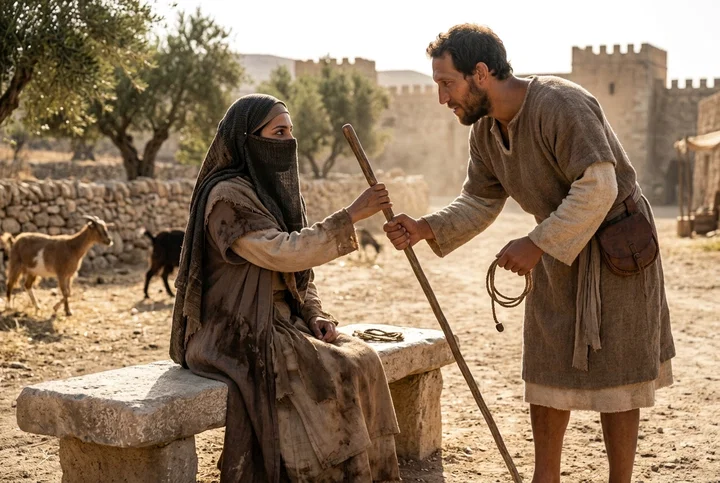
Cross-references
- Matthew 1:3
And Judas begat Phares and Zara of Thamar; and Phares begat Esrom; and Esrom begat Aram;
Names Tamar and Pharez among Jesus’ ancestors.
Commentary
Each commentary is drawn from primary sources: the writings of Ellen G. White and Adventist pioneers and periodicals. Each commentary is separate. Its own words are not a quotation; follow the references to read the source passages.
Pioneers and periodicals
6 sources
After meeting Judah, Tamar arose and went away, laying aside her veil and disguise and putting on her widow's garments again to keep Judah from recognizing her.ST Jan 21, 1889RH Jan 19, 1860RH Nov 4, 1858 Her change of apparel and conduct, walking in an unaccustomed path, hid her identity from man, but time, place, speech, or apparel cannot obscure or darken God's sight, for His eye is always over His people and He knows who are His.RH Nov 4, 1858 The verse belongs to the account of Judah's sin, a horrible deed recorded not to encourage lust or excuse sin but to expose sin so that it may be shunned.ST The verse belongs to Joseph's history, which shows that God guides people rightly even when the route is indirect.RH Jan 19, 1860
Tamar, who acted the part of a harlot with her father-in-law, is named by Matthew in Jesus' ancestry, and her son Pharez from that union is an ancestor of Christ according to the flesh, showing that His human ancestry included people marked by human weakness and sin.RH Oct 2, 1900ST Oct 21, 1889ST Jan 21, 1889 That sinful origin, together with a human ancestry through Jacob, David, Rahab, Solomon, and the wicked kings of Judah, would tend to concentrate in Christ all the weaknesses and sinful tendencies to which fallen human nature is subject.ST Oct 21, 1889 Christ therefore took flesh not of a sinless being but of deteriorated, sinful man, which was necessary so He could suffer death and sympathize with and succor tempted humanity.ST Oct 21, 1889 The inclusion of people with such troubled histories in Christ's genealogy offers hope to the fallen, even to those who have inherited strong sinful tendencies.RH Oct 2, 1900
Sources