Genesis 38:25
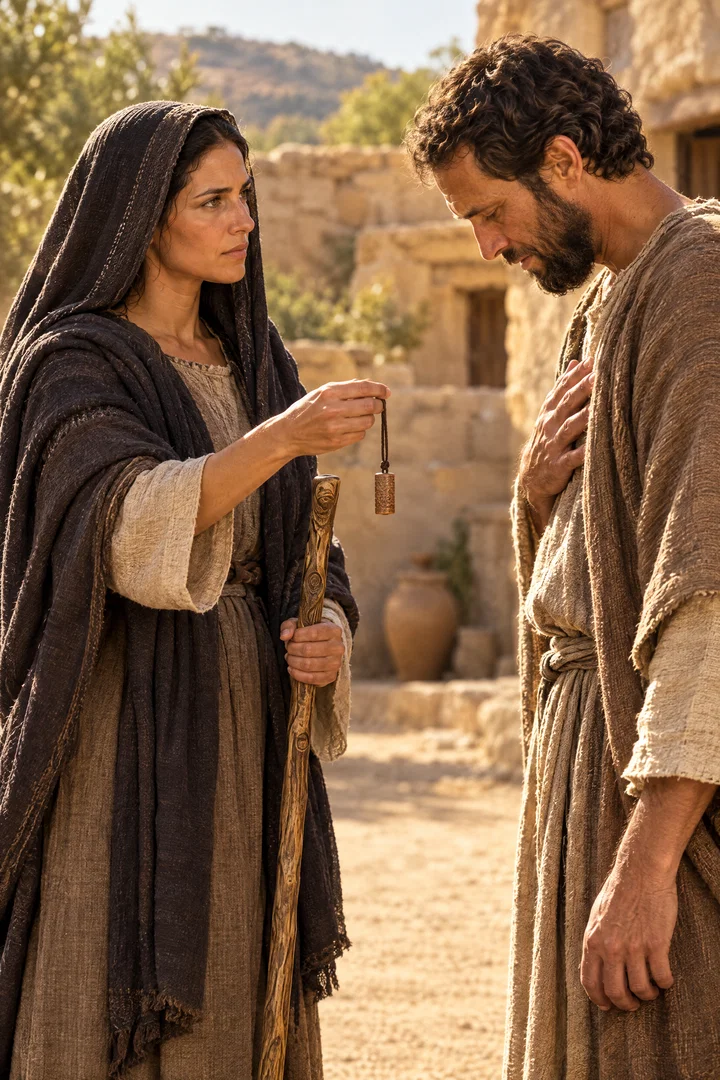
When she was brought forth, she sent to her father in law, saying, By the man, whose these are, am I with child: and she said, Discern, I pray thee, whose are these, the signet, and bracelets, and staff.
Translations
When she was brought forth, she sent to her father in law, saying, By the man, whose these are, am I with child: and she said, Discern, I pray you, whose are these, the signet, and bracelets, and staff.
King James Version, KJV Cambridge Paragraph Bible
When she was brought forth, she sent to her father in law, saying, By the man, whose these are, am I with child: and she said, Discern, I pray thee, whose are these, the signet, and bracelets, and staff.
When she was brought forth, she sent to her father-in-law, saying, By the man whose these are, am I with child: and she said, Discern, I pray thee, whose are these, the signet, and bracelets, and staff.
When she was brought forth, she sent to her father in law, saying, By the man, whose these are, am I with child: and she said, Discern, I pray thee, whose are these, the signet, and the cords, and the staff.
When she was brought forth, she sent to her father-in-law, saying, By the man, whose these are, am I with child: and she said, Discern, I pray thee, whose are these, the signet, and the cords, and the staff.
She is brought out, and she hath sent unto her husband's father, saying, 'To a man whose these [are], I [am] pregnant;' and she saith, 'Discern, I pray thee, whose [are] these — the seal, and the ribbons, and the staff.'
When she was brought forth, she sent to her father-in-law, saying, By the man to whom these [ belong] am I with child; and she said, Acknowledge, I pray thee, whose are this signet, and this lace, and this staff.
When, she, was about to be brought forth, then, she herself, sent unto her father-in-law saying, By the man to whom these belong, have I, conceived! And she said—Examine, I pray thee, to whom belong the signet-ring, and the guard, and the staff—these!
Berean Standard Bible, Majority Standard Bible
As she was being brought out, Tamar sent a message to her father-in-law: “ I am pregnant by the man to whom these items belong.” And she added, “ Please examine them. Whose seal and cord and staff are these?”
When she was brought out, she sent to her father-in-law, saying, “ I am with child by the man who owns these.” She also said, “ Please discern whose these are— the signet, and the cords, and the staff.”
And while she was being taken out, she sent word to her father-in-law, saying, The man whose property these things are, is the father of my child: say then, whose are this ring and this cord and this stick?
When she was brought foorth, she sent to her father in law, saying, By the man, vnto whom these things pertaine, am I with childe: and saide also, Looke, I pray thee, whose these are, the seale, and the cloke, and the staffe.
Douay-Rheims (Challoner revision)
But when she was led to execution, she sent to her father in law, saying: By the man, to whom these things belong, I am with child. See whose ring, and bracelet, and staff this is.
Pictures
Cross-references
- Matthew 1:3
And Judas begat Phares and Zara of Thamar; and Phares begat Esrom; and Esrom begat Aram;
Names Tamar and Perez in Jesus’ ancestry.
Commentary
Each commentary is drawn from primary sources: the writings of Ellen G. White and Adventist pioneers and periodicals. Each commentary is separate. Its own words are not a quotation; follow the references to read the source passages.
Pioneers and periodicals
9 sources
When she was brought forth, Tamar sent to her father-in-law Judah his signet, bracelets, and staff and asked him to discern whose they were, thereby identifying him as the man by whom she was with child.RH Oct 2, 1900ST Oct 21, 1889ST Jan 21, 1889ST Aug 21, 1884 She was able to do this because she had disquieted herself and walked in an unaccustomed path, so that Judah did not know her.RH Nov 4, 1858 The verse belongs to the account in which Judah treated adultery as a crime worthy of death, and when Tamar's trespass was exposed he acknowledged that his own sin was greater than hers.RH Aug 17, 1876 The verse belongs to the account of Judah's shameful sinful conduct.ST
The verse is part of the account of the sad consequences of Jacob's having more than one wife, which included partiality, jealousy, envy, low moral standards, and crime.ST The verse stands in Genesis 37-41, which record Joseph's early life, the envy of his brothers, his sale to the Ishmaelites as a slave, his sojourn in Egypt, and God's wondrously good dealings with him in it all. The verse is part of the history of Joseph's family, which illustrates that God can guide people through difficult and unexpected circumstances toward what he intends for them.RH Jan 19, 1860
The chapter records the birth of Perez, also called Pharez, an ancestor of Christ according to the flesh, born of harlotry, making Tamar herself one of Christ's ancestors.RH Oct 2, 1900ST Oct 21, 1889ST Jan 21, 1889 This puts gross sin in Christ's own human line, together with Jacob's selfish crafty deceitful disposition, David's passions, Rahab's unenlightened heathenism, and the weakness, idolatry, and sin of Solomon and the kings of Judah, tending to concentrate in Christ all the weaknesses and sinful tendencies to which fallen human nature is subject.ST Oct 21, 1889 Although his mother was pure and godly, his human nature was therefore more subject to infirmities of the flesh than if he had been born before the race had deteriorated physically and morally, and this was not accidental but necessary, for only sin causes death and only by taking sinful flesh could he suffer death, be tempted, sympathize, and succor the tempted.ST Oct 21, 1889 As part of the Bible's record of Christ's ancestors, including women whose lives were marked by shame, the verse presents hope for the fallen, even for those with inherited tendencies toward sin.RH Oct 2, 1900 The chapter records this shameful conduct not to excuse sin, but to expose it so that people may shun it and see the remedy in God's love, mercy, and power.ST The verse shows that time, place, speech, or apparel can obscure human sight and that ignorance and forgetfulness can estrange love and knowledge in the creature, while by contrast the Lord knows who are his and his eye is always over them, never obscured or darkened, discerning his own everywhere.RH Nov 4, 1858
Sources