Genesis 38:26
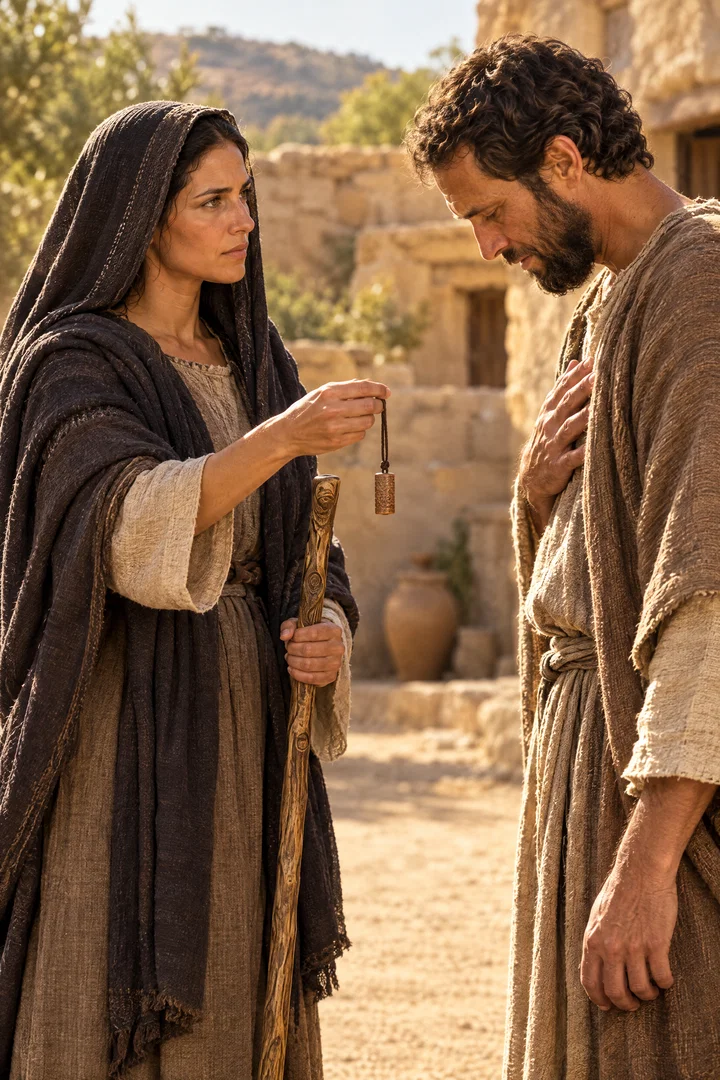
And Judah acknowledged them, and said, She hath been more righteous than I; because that I gave her not to Shelah my son. And he knew her again no more.
Translations
And Judah acknowledged them, and said, She has been more righteous than I; because that I gave her not to Shelah my son. And he knew her again no more.
King James Version, KJV Cambridge Paragraph Bible
And Judah acknowledged them, and said, She hath been more righteous than I; because that I gave her not to Shelah my son. And he knew her again no more.
And Judah acknowledged them, and said She hath been more righteous than I; because that I gave her not to Shelah my son: and he knew her again no more.
And Judah acknowledged them, and said, She is more righteous than I; forasmuch as I gave her not to Shelah my son. And he knew her again no more.
And Judah acknowledged them, and said, She is more righteous than I, forasmuch as I gave her not to Shelah my son. And he knew her again no more.
And Judah discerneth and saith, 'She hath been more righteous than I, because that I did not give her to Shelah my son;' and he hath not added to know her again.
And Judah acknowledged [ them], and said, She is more righteous than I, because I have not given her to Shelah my son. And he knew her again no more.
So Judah examined them and said—More righteous than I! forasmuch, as I had not given her to Shelah my son. And he knew her again no more.
Berean Standard Bible, Majority Standard Bible
Judah recognized the items and said, “ She is more righteous than I, since I did not give her to my son Shelah.” And he did not have relations with her again.
Judah acknowledged them, and said, “ She is more righteous than I, because I didn’t give her to Shelah, my son.”He knew her again no more.
Then Judah said openly that they were his, and said, She is more upright than I am, for I did not give her to Shelah my son. And he had no more connection with her.
Then Iudah knewe them, and said, She is more righteous then I: for she hath done it because I gaue her not to Shelah my sonne. So he lay with her no more.
Douay-Rheims (Challoner revision)
But he acknowledging the gifts, said: She is juster than I: because I did not give her to Sela, my son. However, he knew her no more.
Pictures
Cross-references
- Matthew 1:3
And Judas begat Phares and Zara of Thamar; and Phares begat Esrom; and Esrom begat Aram;
Names Tamar and Pharez among Jesus’ ancestors.
- Genesis 38:11
Then said Judah to Tamar his daughter in law, Remain a widow at thy father’s house, till Shelah my son be grown: for he said, Lest peradventure he die also, as his brethren did. And Tamar went and dwelt in her father’s house.
cited together as patriarchal recognition
- Genesis 38:8
And Judah said unto Onan, Go in unto thy brother’s wife, and marry her, and raise up seed to thy brother.
cited together as patriarchal recognition
- Deuteronomy 25:5-10
If brethren dwell together, and one of them die, and have no child, the wife of the dead shall not marry without unto a stranger: her husband’s brother shall go in unto her, and take her to him to wife, and perform the duty of an husband’s brother unto her.
later Mosaic form of same law
- Genesis 38:9
And Onan knew that the seed should not be his; and it came to pass, when he went in unto his brother’s wife, that he spilled it on the ground, lest that he should give seed to his brother.
cited together as patriarchal recognition
Commentary
Each commentary is drawn from primary sources: the writings of Ellen G. White and Adventist pioneers and periodicals. Each commentary is separate. Its own words are not a quotation; follow the references to read the source passages.
Pioneers and periodicals
9 sources
Judah admitted that Tamar was more righteous than he was because he had broken his promise to give her to his son Shelah, and he had no further sexual relations with her afterward.STRH Aug 17, 1876RH Oct 2, 1900ST Jan 21, 1889ST Dec 17, 1902 Before making that admission he had judged adultery to be worthy of death.RH Aug 17, 1876 He had failed to recognize Tamar because she had disguised herself and acted outside her usual manner, so that the time, place, speech, and clothing hid her identity from him.RH Nov 4, 1858
The verse stands in Genesis 37 to 41, which record Joseph's early life, the envy of his brothers, his sale to the Ishmaelites as a slave, his sojourn in Egypt, and God's good dealings with him in it all, leading to the famine, the reunion with his father's family in Genesis 42 to 45, and Judah's plea before Joseph for Benjamin in Genesis 44:18-34. Judah's withholding of Shelah was a failure of the levirate duty toward a widowed daughter-in-law, and the verse with its surrounding account is an incidental reference to a usage later included in the Mosaic code, showing that levirate marriage was already recognized in patriarchal times before Moses and proving that not all so-called Mosaic laws originated with Moses.ST Dec 17, 1902 The chapter to which the verse belongs exposes Judah's sin so that sin may be shunned rather than excused or used to indulge lust, while also revealing God's remedy through his love, mercy, and power.ST The sorry incidents of Genesis 38, including this verse, are not necessary to the narrative of Jacob and Joseph, which shows how God overrules human wrath, ambition, and jealousy for his praise and works out his providence for the true and faithful.ST Jan 16, 1912
The verse belongs to the account in which Pharez, an ancestor of Christ according to the flesh, was born to Tamar, who acted the part of a harlot with her father-in-law, and this lineage shows that Christ's human ancestry included moral weakness, degraded human nature, and human sin and weakness.ST Oct 21, 1889RH Oct 2, 1900ST Jan 21, 1889 Jacob's selfish, crafty, and deceitful disposition passed to his sons and concentrated human weakness in Christ, so Christ took flesh not from a sinless being but from sinful, fallen humanity with all its weaknesses, sinful tendencies, and increased subjection to infirmity of the flesh after the race had deteriorated physically and morally, in order that he could suffer death and be made like his brethren to redeem them.ST Oct 21, 1889 Tamar's place among Christ's ancestors shows that hope is offered even to the fallen and to those with inherited sinful tendencies.RH Oct 2, 1900 In contrast to Judah's ignorance and forgetfulness, which estrange love and knowledge in creatures, the Lord knows who are his, his eye is always over them, he is never subject to ignorance or forgetfulness, and his eye and ear cannot be darkened.RH Nov 4, 1858
Sources