Genesis 41:37
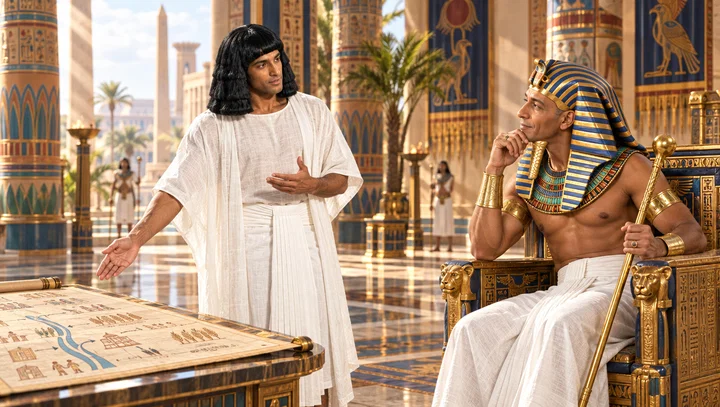
And the thing was good in the eyes of Pharaoh, and in the eyes of all his servants.
Translations
American King James Version, King James Version, KJV Cambridge Paragraph Bible, Webster Bible, Revised Version, American Standard Version
And the thing was good in the eyes of Pharaoh, and in the eyes of all his servants.
And the thing is good in the eyes of Pharaoh, and in the eyes of all his servants,
And the word was good in the eyes of Pharaoh, and in the eyes of all his bondmen.
And the thing was good in the eyes of Pharaoh,—and in the eyes of all his servants;
Berean Standard Bible, Majority Standard Bible
This proposal pleased Pharaoh and all his officials.
The thing was good in the eyes of Pharaoh, and in the eyes of all his servants.
And this seemed good to Pharaoh and to all his servants.
And the saying pleased Pharaoh and all his seruants.
Douay-Rheims (Challoner revision)
The counsel pleased Pharao and all his servants.
Pictures
Cross-references
- Genesis 41:1-7
And it came to pass at the end of two full years, that Pharaoh dreamed: and, behold, he stood by the river.
same Egyptian dream of Nile, cattle, grain
- Genesis 41:42
And Pharaoh took off his ring from his hand, and put it upon Joseph’s hand, and arrayed him in vestures of fine linen, and put a gold chain about his neck;
same collar of gold distinction
- Genesis 41:54-57
And the seven years of dearth began to come, according as Joseph had said: and the dearth was in all lands; but in all the land of Egypt there was bread.
Joseph’s stored grain supplied Egypt and other lands during the famine.
- Genesis 42:6
And Joseph was the governor over the land, and he it was that sold to all the people of the land: and Joseph’s brethren came, and bowed down themselves before him with their faces to the earth.
brothers bow before him
- Genesis 41:16
And Joseph answered Pharaoh, saying, It is not in me: God shall give Pharaoh an answer of peace.
Both mark Joseph’s rise from prison to palace.
Commentary
Each commentary is drawn from primary sources: the writings of Ellen G. White and Adventist pioneers and periodicals. Each commentary is separate. Its own words are not a quotation; follow the references to read the source passages.
Ellen G. White
2 sources
Genesis 41:37 belongs to the larger passage in Genesis 41:28-54 that sets out definite periods of seven years connected with Pharaoh.GC88 323.2GC 323.2–324.2 Those periods were seven years of plenty followed by seven years of famine.GC 323.2–324.2 What in that passage was once only a matter of prophecy was afterward fulfilled in accordance with the prediction.GC88 323.2GC 323.2–324.2
The verse thus shows that God foretells events limited to a given time and that predicted events often occur within that given time.GC88 323.2GC 323.2–324.2 It therefore proves that the chronological portions of the Bible are as sure as any other Scripture.GC 323.2–324.2 It therefore proves that the chronological periods extending to the second coming of Christ will occur at the appointed time.GC 323.2–324.2
Sources
Pioneers and periodicals
31 sources
The thing that pleased Pharaoh and all his servants was Joseph's wise plan to appoint overseers and store up a fifth of the harvest during seven plentiful years against seven years of famine.ST Nov 10, 1898ST Nov 10, 1898ST Mar 17, 1914ST Jul 29, 1875 Their approval embraced both his interpretation of the dreams and the counsel joined to it, and opened the way for his exaltation from prison to rule over Egypt.ST Jan 3, 1911ST Apr 9, 1894ST Oct 16, 1901RH Jun 10, 1902 In approving him Pharaoh recognized Joseph as a man in whom the Spirit of God was present.RH Oct 18, 1853 The counsel belonged to a true prophecy of plenty followed by famine, given beforehand and fulfilled in its time, by which God brought Jacob's family to Egypt and preserved Israel and multitudes in other lands from starvation.ST May 9, 1878RH Apr 18, 1854RH Jul 25, 1854RH Mar 31, 1868ST Jan 21, 1913 God thus showed He rules in the kingdoms of men and guides His people by a winding course, giving the dream to a heathen ruler while giving its explanation to His servant, and setting truth before kings that His purpose to preserve life might be fulfilled.ST Jan 3, 1911RH Jan 19, 1860RH Mar 14, 1865ST Jan 21, 1889ST Oct 12, 1904
Approval and Setting
The thing that was good was the detailed administrative counsel to look out a discreet and wise man and set him over Egypt, to appoint overseers, to take up the fifth part of the land in the seven plenteous years, and to gather and store corn in the cities against the seven years of famine.ST Nov 10, 1898 Pharaoh and all his servants approved that proposal to store food and grain during the years of plenty to prepare for the years of famine.ST Nov 10, 1898ST Mar 17, 1914ST Jul 29, 1875ST Apr 16, 1894ST That approval belongs to the account of the coming years of plenty and famine and of those seven years in Egypt, and it shows his counsel was accepted by Egypt's rulers.ST Mar 17, 1914ST Jul 29, 1875RH Aug 12, 1875
Their approval embraced both the interpretation of Pharaoh's dreams and the plan given with it.ST Apr 9, 1894ST Oct 16, 1901 It recognized the wisdom God had given as Joseph explained what God would do and advised how Egypt should prepare, and it opened the way for his exaltation.ST Apr 9, 1894ST Oct 16, 1901RH Jun 10, 1902 God had given the dream and brought Joseph before Pharaoh to help preserve Israel.ST Apr 9, 1894 The approval accompanied Pharaoh's recognition that Joseph was a man in whom the Spirit of God was present, showing that knowledge of God existed in Egypt.RH Oct 18, 1853
The wisdom that won this approval kept Joseph free from pollution and gave him foresight to store food beforehand so that famine was prevented.RH May 2, 1865 Pharaoh's approval stands within a true history, not fiction or sun myth, thoroughly Egyptian in form, dress, and even language.ST Dec 14, 1915 The dream of the Nile River, cattle, grain, and sacred seven is Egyptian, and so is the surrounding account: grape juice as a chief offering with the chief butler's duty to prepare it, beheading of the chief baker according to Egyptian custom, Joseph shaving himself before appearing before the ruler though shaving was abhorred by Semitic peoples, and the collar of gold as a mark of distinction among the Egyptians.ST Dec 14, 1915
Joseph reached this approval after being called from prison to the throne of Egypt.ST Jan 3, 1911 He reached that place after proving integrity and purity instilled by his father soon after reaching Egypt, after enduring two years in prison though innocent of crime, and after discipline that humbled pride bred by his father's favoritism.ST Jan 3, 1911 His exaltation brought about the fulfillment of his earlier dreams when his brothers came unknowingly and bowed humbly before him.ST Jan 3, 1911
Prophecy and Preservation
This verse belongs to the prophecy of seven years of great plenty to be followed by seven years of famine, with advance notice given before the events took place.RH Apr 18, 1854RH Jul 25, 1854 It stands as an example of a predicted event fulfilled within a stated period.RH Apr 18, 1854 The prediction in Genesis 41:28-54 was once only a matter of prophecy and was fulfilled in accordance with the prediction.RH Mar 31, 1868 This proves that predicted events often occur within a given time, and that the chronological periods of Scripture extending to the coming of the Saviour will likewise be fulfilled on time.RH Mar 31, 1868
The verse belongs to Joseph's prophecy in Egypt, showing that he was a prophet, one of more than one hundred and fifty mentioned in the Old Testament besides the sixteen from Isaiah to Malachi.RH Jun 23, 1903 God revealed to Joseph the coming famine that would bring Jacob and his family to Egypt.ST May 9, 1878 The Lord was in this preparing Joseph to preserve the holy Seed.ST Jan 21, 1913 Joseph's service in Egypt became the means of preserving Israel, his family, and people in other countries through the seven-year famine, with what Satan intended to use to destroy Israel overruled by God for their survival.RH Nov 28, 1912
God used the king's dream and Joseph's interpretation to raise Joseph from captivity to the throne of Egypt, to a position where he could help preserve his family and others from famine.ST Jan 3, 1911ST Jan 21, 1889ST Mar 11, 1913 This shows God's care working through events that seemed adverse.ST Mar 11, 1913 His exaltation brought about the fulfillment of his earlier dreams when his brothers came unknowingly and bowed humbly before him.ST Jan 3, 1911 The advance warning made it possible to save multitudes from starvation.ST Mar 23, 1882 Joseph's plan, approved by Pharaoh and his servants, helped Egypt store grain, prosper, and endure the famine, so that Egypt was saved from famine through his wise counsel and vigorous action.ST Mar 23, 1882ST Nov 14, 1906ST Feb 4, 1889
Their approval of his wisdom and plan led Pharaoh to value Joseph's service.ST Feb 12, 1880 Pharaoh later showed gratitude by providing for Joseph's family in Egypt.ST Feb 12, 1880
Guidance and Application
God is not confined to His own people and does not work exclusively with them, for He rules in the kingdoms of men and uses whomever His purposes require.RH Mar 14, 1865 He gives instruction to mankind even through heathen rulers, so that Pharaoh receives the dream while Joseph must give the explanation.RH Mar 14, 1865 God does nothing with which His people are not concerned or in some way directly connected, and the casting down and setting up of kingdoms opens a way for His people.RH Mar 14, 1865 He goes before His church like a pillar of cloud by day and of fire by night to pilot them through six thousand years in a world blighted by the curse and made perilous by sin.RH Mar 14, 1865
Joseph's history shows that God can lead a person by a winding course and still guide him to the purpose He intends.RH Jan 19, 1860 His being brought before the king of Egypt belongs to God's plan of missionary work to set the truth before those of great influence.ST Oct 12, 1904 If such persons accept it, their endorsement goes far toward making a favorable impression upon the lower classes.ST Oct 12, 1904 God will have His name and His truth brought to the attention of kings and others in authority, even forcing His children through oppression or chastisement to bear the message.ST Oct 12, 1904
Joseph in Egypt is what God would have His workers be in the world in its closing act, especially those in the medical missionary cause.RH Dec 20, 1906 To them God fulfills the new covenant promise to lead each worker individually.RH Dec 20, 1906
Sources