Genesis 41:38
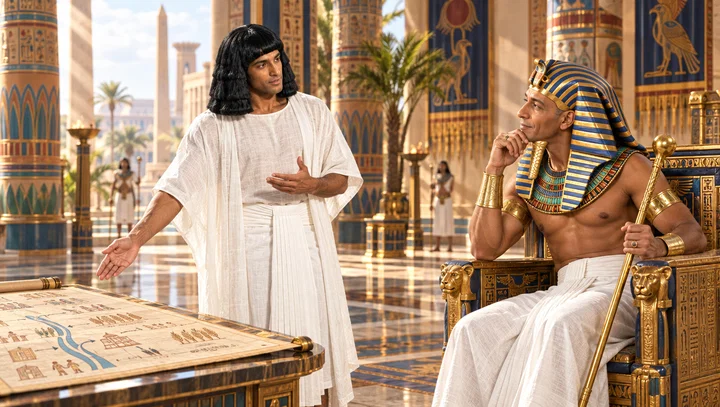
And Pharaoh said unto his servants, Can we find such a one as this is, a man in whom the Spirit of God is?
Translations
And Pharaoh said to his servants, Can we find such a one as this is, a man in whom the Spirit of God is?
And Pharaoh said unto his servants, Can we find such a one as this is, a man in whom the Spirit of God is?
And Pharaoh said unto his servants, Can we find such a one as this is, a man in whom the spirit of God is?
And Pharaoh said to his servants, Can we find such a man as this is, a man in whom the spirit of God is?
Revised Version, American Standard Version
And Pharaoh said unto his servants, Can we find such a one as this, a man in whom the spirit of God is?
and Pharaoh saith unto his servants, 'Do we find like this, a man in whom the spirit of God [is]?'
And Pharaoh said to his bondmen, Shall we find [ one] as this, a man in whom the Spirit of God is?
and Pharaoh said unto his servants,—Can we find such a one, a man in whom is the Spirit of God?
Berean Standard Bible, Majority Standard Bible
So Pharaoh asked them, “ Can we find anyone like this man, in whom the Spirit of God abides?”
Pharaoh said to his servants, “ Can we find such a one as this, a man in whom is the Spirit of God?”
Then Pharaoh said to his servants, Where may we get such a man as this, a man in whom is the spirit of God?
Then saide Pharaoh vnto his seruants, Can we finde such a man as this, in whom is the Spirit of God?
Douay-Rheims (Challoner revision)
And he said to them: Can we find such another man, that is full of the spirit of God?
Pictures
Cross-references 20 of 27
- Genesis 40:20-22
And it came to pass the third day, which was Pharaoh’s birthday, that he made a feast unto all his servants: and he lifted up the head of the chief butler and of the chief baker among his servants.
The butler and baker’s predicted outcomes occurred within the stated time.
- Genesis 39:2-3
And the LORD was with Joseph, and he was a prosperous man; and he was in the house of his master the Egyptian.
The Lord was with Joseph and caused his work to prosper.
- Genesis 41:16
And Joseph answered Pharaoh, saying, It is not in me: God shall give Pharaoh an answer of peace.
Joseph credits God, not himself, for interpreting Pharaoh’s dreams.
- Genesis 41:56
And the famine was over all the face of the earth: and Joseph opened all the storehouses, and sold unto the Egyptians; and the famine waxed sore in the land of Egypt.
Joseph’s Spirit-led administration provides grain during the famine.
- Genesis 37:5-11
And Joseph dreamed a dream, and he told it his brethren: and they hated him yet the more.
Joseph’s dreams foretell his brothers bowing to him when he is exalted.
- Daniel 5:11
There is a man in thy kingdom, in whom is the spirit of the holy gods; and in the days of thy father light and understanding and wisdom, like the wisdom of the gods, was found in him; whom the king Nebuchadnezzar thy father, the king, I say, thy father, made master of the magicians, astrologers, Chaldeans, and soothsayers;
Both recognize God’s Spirit in an interpreter.
- Daniel 4:8
But at the last Daniel came in before me, whose name was Belteshazzar, according to the name of my god, and in whom is the spirit of the holy gods: and before him I told the dream, saying,
Nebuchadnezzar recognized the same power in Daniel.
- Daniel 4:18
This dream I king Nebuchadnezzar have seen. Now thou, O Belteshazzar, declare the interpretation thereof, forasmuch as all the wise men of my kingdom are not able to make known unto me the interpretation: but thou art able; for the spirit of the holy gods is in thee.
Nebuchadnezzar recognized the same power in Daniel.
- Numbers 27:18
And the LORD said unto Moses, Take thee Joshua the son of Nun, a man in whom is the spirit, and lay thine hand upon him;
The same Spirit was in Joshua.
- Genesis 41:1-7
And it came to pass at the end of two full years, that Pharaoh dreamed: and, behold, he stood by the river.
Pharaoh’s dreams prompt his declaration about Joseph.
- Isaiah 63:10-11
But they rebelled, and vexed his holy Spirit: therefore he was turned to be their enemy, and he fought against them.
It speaks of God’s Spirit working among his people.
- Genesis 40:8
And they said unto him, We have dreamed a dream, and there is no interpreter of it. And Joseph said unto them, Do not interpretations belong to God? tell me them, I pray you.
Joseph credits God with the interpretation of the dream.
- Genesis 41:42
And Pharaoh took off his ring from his hand, and put it upon Joseph’s hand, and arrayed him in vestures of fine linen, and put a gold chain about his neck;
gold collar proves Egyptian honor
- Genesis 42:6
And Joseph was the governor over the land, and he it was that sold to all the people of the land: and Joseph’s brethren came, and bowed down themselves before him with their faces to the earth.
brothers bowing fulfills dreams after enthronement
- Genesis 41:14
Then Pharaoh sent and called Joseph, and they brought him hastily out of the dungeon: and he shaved himself, and changed his raiment, and came in unto Pharaoh.
shaving before Pharaoh proves Egyptian setting
- Genesis 45:5-7
Now therefore be not grieved, nor angry with yourselves, that ye sold me hither: for God did send me before you to preserve life.
Joseph says God sent him ahead to preserve life.
- Genesis 39:21-23
But the LORD was with Joseph, and shewed him mercy, and gave him favour in the sight of the keeper of the prison.
God remained with Joseph in prison and prospered what he did.
- Genesis 41:29-30
Behold, there come seven years of great plenty throughout all the land of Egypt:
Describes the coming years of plenty and famine in Egypt.
- 1 Peter 1:10-11
Of which salvation the prophets have enquired and searched diligently, who prophesied of the grace that should come unto you:
The Spirit dwelt in the holy prophets.
- Genesis 39:1
And Joseph was brought down to Egypt; and Potiphar, an officer of Pharaoh, captain of the guard, an Egyptian, bought him of the hands of the Ishmeelites, which had brought him down thither.
angels prepared reception through Potiphar's purchase
Commentary
Each commentary is drawn from primary sources: the writings of Ellen G. White and Adventist pioneers and periodicals. Each commentary is separate. Its own words are not a quotation; follow the references to read the source passages.
Ellen G. White
13 sources
Pharaoh asked his counselors where another could be found like Joseph to carry out the plan to store food in the plenteous years against the coming famine.PP 221.1–2 He recognized that the Spirit of God was in Joseph and God was with him, shown by his wisdom to point out the danger and the preparation needed and by his power to interpret the dreams.1SP 138.1SG3 151.3ST Jan 15, 1880PP 221.1–2 Though Joseph was a Hebrew and a slave, that was of little moment beside his evident wisdom and sound judgment.1SP 138.1ST Jan 15, 1880PP 221.1–2 That recognition raised him from prison to stand second only to the throne, set over Pharaoh's household and people to lead Egypt through plenty and famine.1SP 138.1SG3 151.35T 321.1–2 His elevation was no accident but the ordering of Providence, for living in close connection with God made him God's witness among an idolatrous nation, standing firm to principle without compromise and carrying his religion with him in prison and at court.5T 321.1–25T 124.1–28T 153.1–3Ms 18, 1897, par. 10ST Nov 7, 1895
Pharaoh's Recognition and Appointment
The question was put to servants and counselors, asking where another like Joseph could be found.PP 221.1–2 It came after troubled deliberation over whom to trust to carry out his plan to take up the fifth part during the seven plenteous years and store food in the cities against the seven years of grievous famine.PP 221.1–2
Pharaoh had learned through the chief butler of Joseph's wisdom and prudence and pre-eminent administrative ability in managing the prison, a report confirmed by further inquiry.PP 221.1–2 He found that Joseph alone in all the realm had wisdom to point out the threatened danger and the preparation necessary to meet it.PP 221.1–2 He was best qualified to execute the sound and shrewd policy he had proposed, and a divine power was evidently with him, surpassing all the king's officers of state.PP 221.1–2
The words mean that Pharaoh recognized Joseph as a man in whom the Spirit of God was present and that God was with him.1SP 138.1SG3 151.3 That recognition was drawn from his exceptional spirit and wisdom and his ability to interpret the dreams.SG3 151.3ST Jan 15, 1880 His living connection with God gave him influence and moral worth.ST Nov 7, 1895
That he was a Hebrew and a slave was of little moment against his evident wisdom and sound judgment.PP 221.1–2 He was not rejected for it.1SP 138.1ST Jan 15, 1880
The recognition led directly to bringing him from prison to share the throne of Egypt.5T 321.1–2PP 221.1–2 He was placed over Pharaoh's household and people, second only to the throne.SG3 151.3PP 221.1–2 In that place he was to lead Egypt through the coming years of plenty and famine.1SP 138.1SG3 151.3
Timed Prophecy Proves Reliable
The seven years shown in Pharaoh's dreams in Genesis 41:28-54 were made known beforehand, when they were only a matter of prophecy, and were then fulfilled in accordance with the prediction.GC 323.2–324.2GC88 323.2 Predicted events in Scripture often occur within a given time, with God foretelling that they will take place within that time and then fulfilling them accordingly.GC 323.2–324.2GC88 323.2 That exact fulfillment of the seven-year period proves that the chronological portions of the Bible are reliable.GC 323.2–324.2GC88 323.2
That same exactness proves that prophetic chronological periods are reliable and are fulfilled exactly as foretold.GC 323.2–324.2GC88 323.2 Because God thus appoints times and fulfills them, there is reason to regard periods extending to the second coming of Christ as appointed times revealed by God.GC 323.2–324.2
Faithful Character and Witness
Joseph's checkered life and sudden elevation from prison to share the throne were not accident but ordered of Providence, with God working for him, the eye of God upon him, and a divine hand leading him to raise up a youth of firm principle whom God could use.5T 321.1–2 After much affliction God chose him to bear a heavy burden in idolatrous Egypt and to make the knowledge of God shine there, and he remained faithful to that sacred trust.Ms 18, 1897, par. 10 His firmness of character, uprightness, excellent character, and wisdom that fitted him for usefulness and great responsibility came from God's presence and the Spirit of God working in him, and the goodness seen in him reflected a righteousness from Jesus Christ, not from himself.5T 321.1–2Lt 14, 1897, par. 6–8 That character was built by careful training in early years, consulting duty rather than inclination, purity of motive and simple trust in God under unjust accusation and imprisonment, cultivated talents, industrious habits, force of character, and quickly discerned and eagerly seized openings of Providence.5T 321.1–2
He was one of the few who could withstand temptation because he had an eye single to the glory of God and a lofty regard for God's will.5T 124.1–2 He was the same man in the prisoner's cell and when standing next to the throne, carrying his religion with him wherever he went and in whatever situation he was placed.5T 124.1–2 True religion in him had an all-pervading power that gave tone to everything he did, so he discharged well the duties belonging to the place where God had put him by keeping his heart fixed upon heavenly things, carrying sanctifying influence into all he did and said without needing to go out of the world to be a Christian.5T 124.1–2 The Spirit of God in him meant living in close connection with God as God's representative and witness placed by providence as a captive among a heathen nation to carry the knowledge of the true God.8T 153.1–3Ms 18, 1897, par. 10ST Nov 7, 1895 He stood firm to principle and loyal to faith with no compromise with the idolatrous nation around him, bearing as a special honor the name of a worshiper of the God who created the heavens and the earth.8T 153.1–3
Honoring God in all his ways, God honored him and was his wisdom, giving him knowledge and understanding, and his living connection with God gave him influence and moral worth.8T 153.1–3ST Nov 7, 1895 Like Daniel he was entrusted with important responsibilities and represented Christ through character that had saving influence on those around him before a heathen kingdom.ST Nov 7, 1895 His presence in Egypt as such a witness makes him the model of what every Seventh-day Adventist institution is to be to the world, a representative of God to carry the knowledge of the true God.8T 153.1–3HPMMW 6.2–3 His life displayed precious, fragrant and beautiful fruits of character from the Spirit's graces. Those qualities were absent from the Jews of Christ's day, whose outward show of piety concealed fruitlessness and lack of the Spirit's graces, making Israel a hindrance rather than a blessing to the world and causing its religion to mislead people toward ruin instead of salvation.
His example teaches that parents should educate children, and that children, youth, and young men under God's discipline and blessing can develop solidity of character and Christlike compassion and virtue even amid severe trials to share in the earnest work to be done in this age.5T 321.1–2Lt 14, 1897, par. 6–8
Sources
Pioneers and periodicals
52 sources
Pharaoh declared that no one as discreet and wise as Joseph could be found, a man in whom the Spirit of God was, after he interpreted the doubled dream of coming plenty and famine and counseled storing food, and on that ground set him over his house and all Egypt.ST Nov 10, 1898ST Oct 16, 1901ST Nov 10, 1898ST Aug 25, 1909 The dream made known beforehand seven years of plenty to be followed by seven years of famine, so that provision stored in the good years saved multitudes from starvation, including Jacob and his whole family.ST May 9, 1878RH Jul 25, 1854ST Mar 23, 1882 It shows the Spirit of God worked within people in the earlier dispensation just as in the present one, and that the wisdom He gave Joseph revealed the superiority of the God he worshiped over the gods of Egypt.ST Aug 14, 1893ST Oct 16, 1901RH Jun 10, 1902 God rules in the kingdoms of men and gave revelation to Pharaoh though a heathen king, yet kept His work joined to His people by requiring His captive servant to give the interpretation, thereby raising him from prison to ruler to preserve Israel and the holy Seed.ST Jan 21, 1913RH Mar 14, 1865RH Nov 28, 1912ST Jan 21, 1889 Joseph was honored because he honored God, giving heaven the credit for the interpretation, and his integrity and faith kept firm through slavery and unjust imprisonment make him a shining example of duty, courage, perseverance and loyalty and a pattern for God's workers to the close of the world.ST Dec 25, 1901ST Apr 9, 1894ST Oct 16, 1901ST Aug 15, 1916RH Dec 20, 1906
Setting and Background
Pharaoh was a title shared by successive kings of Egypt, and this is the king who commended Joseph and made him ruler over Egypt.RH Nov 12, 1861 The account is true history of Egyptian origin, not fiction or sun-deity myth.ST Dec 14, 1915 The dreams that bring Joseph before Pharaoh are thoroughly Egyptian in form and dress, with the Nile River, kine, grain, the sacred seven, and even Egyptian words.ST Dec 14, 1915
The surrounding details reflect Egyptian custom: grape juice as a chief offering prepared by the chief butler, beheading of the chief baker, Joseph shaving himself before appearing before the ruler though shaving was abhorred by Semitic peoples, and the collar of gold as a mark of Egyptian distinction.ST Dec 14, 1915 Joseph was exalted in Egypt after great affliction at being separated from his father, his bitterest sorrow being reflection on his father's grief.ST Mar 24, 1887 God did not leave him to go into Egypt alone, but angels prepared the way for his reception.ST Mar 24, 1887
Potiphar, an officer of Pharaoh and captain of the guard, bought him from the Ishmaelites, and the Lord was with Joseph and prospered him and gave him favor with his master.ST Mar 24, 1887 Potiphar entrusted all that he possessed to Joseph's care, knowing nothing of his own affairs except the bread he ate, because it was considered an abomination for a Hebrew to prepare food for an Egyptian.ST Mar 24, 1887 Hatred from his brothers over his father's favoritism led them to sell him as a slave into Egypt, where he developed the integrity and purity his father had instilled in him.ST Jan 3, 1911ST He then spent two years in prison though innocent of crime because he still needed discipline, after which God raised him to rule Egypt.ST Jan 3, 1911
There his brothers came before him and humbly bowed without knowing him, fulfilling the dreams that had aroused their envy and made them hate him.ST Jan 3, 1911ST The verse belongs to Joseph's rise from prison to palace in Egypt, where Joseph insists the interpretation is not in himself but in God.RH Jan 20, 1916 This was shortly before Jacob's sons came to buy corn from Joseph.RH Jan 20, 1916 Pharaoh sought the kind of man in whom the Spirit of God was present to oversee the storing of food during the seven years of plenty.ST Oct 16, 1901
Pharaoh's Declaration Explained
After Joseph interpreted the doubled dream of seven years of plenty and seven years of famine as what God was about to do and advised appointing a discreet and wise man to store food, the proposal was good in the eyes of Pharaoh and his servants.ST Nov 10, 1898 Pharaoh speaking to his servants then judged Joseph to be uniquely discreet and wise in character, declaring that none other like him could be found, a man in whom the Spirit of God is.ST Nov 10, 1898 That declaration led directly to setting Joseph over his house and all the land of Egypt.ST Nov 10, 1898 Pharaoh recognized the Spirit of God in Joseph and saw him as uniquely qualified to serve and govern because God had given him insight into coming events.ST Oct 16, 1901ST Apr 9, 1894 His faithfulness and the wisdom God gave him led Pharaoh to entrust him with authority over his household and all Egypt.ST Nov 10, 1898ST Aug 25, 1909ST Jan 16, 1912
Pharaoh regarded Joseph's divine wisdom and exceptional spirit and wisdom as evidence that God was with him.ST Jan 15, 1880RH Oct 18, 1853 That endowment made Joseph the most suitable person to lead Egypt's affairs despite being a Hebrew slave, his faithfulness and ability to interpret the dreams marking him out for rule.ST Jan 15, 1880 The recognition of God's Spirit in Joseph for his God-given wisdom is reason to recognize God's Spirit in instruction given through a humble instrument.PGGC 100.1 The recognition rested on God giving Joseph wisdom to interpret Pharaoh's dreams and to counsel about the coming years of plenty and famine.ST Oct 16, 1901 That Spirit-given gift revealed God's wisdom and power to Pharaoh and Egypt and led to Joseph's appointment over the land.ST Oct 16, 1901
The verse shows that God's Spirit worked within people in the earlier dispensation just as in the present one.ST Aug 14, 1893 Joseph was a prophet in Egypt, one of more than one hundred and fifty prophets in the Old Testament besides the sixteen from Isaiah to Malachi.RH Jun 23, 1903 That prophetic office meant he prophesied seven years of great plenty to be followed by seven years of famine.RH Jun 23, 1903
Prophecy and Deliverance
The dream made known seven years of plenty to be followed by seven years of famine, so that provisions could be stored during the plentiful years and many lives saved from starvation.ST Mar 23, 1882 God gave Joseph that coming time of plenty and famine as advance notice of events before they took place.RH Jul 25, 1854 That foreknowledge included the famine that brought Jacob and his whole family down into Egypt.ST May 9, 1878
Pharaoh's seven years are an example of an event predicted within a stated time and fulfilled exactly as foretold.RH Apr 18, 1854RH Mar 31, 1868 It stands with other past predictions fulfilled within their given time as proof that chronological prophecies belong in Scripture and deserve serious study.RH Apr 18, 1854 Those fulfilled periods give reason to trust the chronological periods of Scripture extending to the coming of the Saviour.RH Mar 31, 1868
The Lord was preparing Joseph to preserve the holy Seed.ST Jan 21, 1913 God used him to preserve Israel, his family and people in Egypt and other countries through the seven-year famine.RH Nov 28, 1912 God overruled the selling into slavery and used a king's dream and Joseph's interpretation to raise His captive servant to a place where he could help others in hardship.ST Jan 21, 1889ST Mar 11, 1913 In that exalted position he saved Jacob's household from famine and became an instrument of deliverance for his people.RH Nov 28, 1912ST Jan 21, 1889ST Mar 11, 1913
The raising from prison to ruler over all Egypt displays God's leading, protecting providence over His people in the making of Israel as a nation.ST Jun 11, 1894 Faithfulness comes before honor, for because Joseph honored God by doing his duty faithfully in jail in time of trial, God honored him with authority.ST Jun 11, 1894 His history shows that God may lead a person by a winding path yet guides him to the place God intends.RH Jan 19, 1860
Joseph's God-given wisdom enabled him to plan for the famine by storing grain during the years of plenty, and his administration helped Egypt prosper.ST Nov 14, 1906 His faithful service brought abundant food during the famine and enriched Egypt.ST Feb 12, 1880 Pharaoh credited God and Joseph for this provision, recognizing that Joseph's wisdom and ability to manage the kingdom, especially to prepare for famine, came from God.ST Feb 12, 1880ST Nov 14, 1906
God and the Nations
Joseph's interpretation of the dreams and the wisdom he displayed showed the superiority of the God he worshiped over the gods of Egypt, and through him Egypt and the nations that came there for grain were brought to know Israel's God.RH Jun 10, 1902 God rules in the kingdoms of men and uses whomever His purposes require, and He does not impart instruction through His people alone.RH Mar 14, 1865 He gave revelation in a dream to Pharaoh, a heathen king, yet He kept His work connected with His people by requiring Joseph, a man in whom the Spirit of God is, to come in and give the interpretation.RH Mar 14, 1865 Nothing God does is without concern to His people even when given through outsiders, and this casting down and setting up of kingdoms opens a way for them as God goes before His church like a pillar of cloud by day and of fire by night to pilot them through six thousand years in a world blighted by the curse and made perilous by sin.RH Mar 14, 1865
Joseph was one of the witnesses God sent again and again to idolatrous Egypt to declare the truth and make known the living God, proving that God had not abandoned Egypt though it was filled with the grossest idolatry. Through his witness Pharaoh welcomed the children of Jacob into the land. His coming before the king of Egypt is an example of God bringing His truth to the attention of rulers and other influential people.ST Oct 12, 1904 Joseph's God-given wisdom fitted him to manage the storehouses he had planned and filled and to distribute their provisions wisely, and this foreshadows Jesus, in whom all fullness dwells and from whom people receive an abundant, well-ordered supply of God's grace.RH Sep 2, 1902
When what is predicted comes to pass it proves that the Spirit of God taught it.PGGC 96.1 Pharaoh's confession that the Spirit of God was in Joseph because his interpretations proved true applies to the predictions about the Civil War, for all that was predicted came, proving that the Spirit of God taught those things, and this should be confessed with firmer faith than the queen of Babylon showed.PGGC 96.1 The gift of the Spirit made Joseph a wise ruler, bringing wise administration through years of overflowing harvests followed by years of devastating famine, including wise systems of agriculture.ST Aug 3, 1904 His wise counsel and vigorous action saved the Egyptians from perishing by famine, and his generous dealings with other peoples in their time of want won their goodwill, giving Egypt many years of peace and prosperity.ST Aug 3, 1904ST Feb 4, 1889 That peace and prosperity continued through the eighty years Joseph lived after becoming ruler, until a new dynasty rejected the principles he had established.ST Aug 3, 1904 The Egyptians thus owed their very existence under God to the Hebrews through him, leaving Egypt justly indebted to Israel alongside the wealth Israel later added by many years of uncompensated labor.ST Feb 4, 1889
Example and Application
Joseph's integrity and faith held firm through slavery and unjust imprisonment, and his faithful service while innocent and mistreated in prison opened the way to liberty and royal honor.ST Aug 15, 1916RH Jan 11, 1912 Pharaoh discerned God's Spirit in him and set him as ruler over Egypt, and after passing through those trials he was prepared to rule and to preserve life.ST Aug 15, 1916 That same character appeared in mercy toward the brothers who had wronged him, and his faithfulness in the king's court made him a witness to the living God throughout Egypt.ST Aug 15, 1916RH Jan 11, 1912
As slave and prisoner and afterward as prime minister he served with integrity, becoming a shining example of duty, faith, courage, perseverance, and loyalty.ST May 11, 1904 His wisdom and ability to interpret dreams came from the Spirit of God, and his rise from affliction to deliverance shows that God remained with him through trial and brought good out of his deepest sorrow.ST May 11, 1904ST Feb 18, 1913 He was honored by God because he honored God, giving the God of heaven the credit for wisdom to interpret the chief butler's dream and Pharaoh's dreams, and for that he received return honor.ST Dec 25, 1901ST Oct 16, 1901 Pharaoh judged that a man so endowed would be wiser and more discreet and more faithful in all duties than one depending only on his own wisdom, and that God's blessing would attend his plans and deeds.ST Apr 9, 1894ST Oct 16, 1901 God is all wise, and a man endowed with His Spirit is wiser than if he had all the wisdom of the world, so giving God the honor due His name brings profit.ST Apr 9, 1894ST Oct 16, 1901
He was a just man whose glory is from within, not borrowed but given by God in himself as a radiation, so that wherever he is put he shines and cannot but shine.RH Jul 24, 1856RH Mar 27, 1856 Even when imprisoned he shone out upon all Egypt, cloudless as the sky where rain never falls.RH Jul 24, 1856RH Mar 27, 1856 The Spirit in him was as wisdom that saved him from pollution and gave him forecast to prevent famine.RH May 2, 1865 His living connection with God made him a representative of God before a heathen kingdom and gave him influence and moral worth, so that like Daniel he was entrusted with important responsibilities and represented Christ through character that had saving influence on those around him.ST Nov 7, 1895 His life displayed precious, fragrant and beautiful fruits of character that were absent from the Jews of Christ's day, whose outward show of piety concealed lack of the Spirit's graces and whose failure to bear good fruit made Israel a hindrance rather than a blessing, misleading people toward ruin instead of salvation.
Guided and saved by God in his youth, he shows that divine providence preserves the young who fear and trust God, with angels guarding them in trouble.RH Nov 24, 1874 This gives youth and little children reason to want the God of Israel for a friend and to seek Him early, with the promise that those who seek Him early shall find Him.RH Nov 24, 1874 In Egypt he stands as an example of what God would have His workers be in the closing act of the world, a man in whom the Spirit of God is and who is led individually by God in fulfillment of the new covenant promise, a pattern for medical missionary workers to follow in holding the light higher in their own work.RH Dec 20, 1906
Sources