Genesis 8:21
And the LORD smelled a sweet savour; and the LORD said in his heart, I will not again curse the ground any more for man’s sake; for the imagination of man’s heart is evil from his youth; neither will I again smite any more every thing living, as I have done.
Translations
And the LORD smelled a sweet smell; and the LORD said in his heart, I will not again curse the ground any more for man’s sake; for the imagination of man’s heart is evil from his youth; neither will I again smite any more every thing living, as I have done.
And the LORD smelled a sweet savour; and the LORD said in his heart, I will not again curse the ground any more for man’s sake; for the imagination of man’s heart is evil from his youth; neither will I again smite any more every thing living, as I have done.
And the Lord smelled a sweet savour; and the Lord said in his heart, I will not again curse the ground any more for man’s sake; for the imagination of man’s heart is evil from his youth; neither will I again smite any more every thing living, as I have done.
And the LORD smelled a sweet savor; and the LORD said in his heart, I will not again curse the ground any more for man's sake; for the imagination of man's heart is evil from his youth: neither will I again smite any more every living animal as I have done.
And the LORD smelled the sweet savour; and the LORD said in his heart, I will not again curse the ground any more for man’s sake, for that the imagination of man’s heart is evil from his youth; neither will I again smite any more every thing living, as I have done.
And Jehovah smelled the sweet savor; and Jehovah said in his heart, I will not again curse the ground any more for man’s sake, for that the imagination of man’s heart is evil from his youth; neither will I again smite any more everything living, as I have done.
and Jehovah smelleth the sweet fragrance, and Jehovah saith unto His heart, 'I continue not to disesteem any more the ground because of man, though the imagination of the heart of man [is] evil from his youth; and I continue not to smite any more all living, as I have done;
And Jehovah smelled the sweet odour. And Jehovah said in his heart, I will no more henceforth curse the ground on account of Man, for the thought of Man's heart is evil from his youth; and I will no more smite every living thing, as I have done.
And Yahweh smelled a satisfying odour, so Yahweh said to himself. I will not, again, curse any more the ground for man’s sake, although the device of the heart of man, be wicked from his youth,—neither will I again, any more smite every living thing, as I have done.
Berean Standard Bible, Majority Standard Bible
When the LORD smelled the pleasing aroma, He said in His heart, “ Never again will I curse the ground because of man, even though every inclination of his heart is evil from his youth. And never again will I destroy all living creatures as I have done.
The LORD smelled the pleasant aroma. The LORD said in his heart, “ I will not again curse the ground any more for man’s sake because the imagination of man’s heart is evil from his youth. I will never again strike every living thing, as I have done.
And when the sweet smell came up to the Lord, he said in his heart, I will not again put a curse on the earth because of man, for the thoughts of man's heart are evil from his earliest days; never again will I send destruction on all living things as I have done.
And the Lord smellled a sauour of rest, and the Lord said in his heart, I will hencefoorth curse the ground no more for mans cause: for the imagination of mans heart is euill, euen from his youth: neither will I smite any more all things liuing, as I haue done.
Douay-Rheims (Challoner revision)
And the Lord smelled a sweet savour, and said: I will no more curse the earth for the sake of man: for the imagination and thought of man’s heart are prone to evil from his youth: therefore I will no more destroy every living soul as I have done.
Pictures
Cross-references 20 of 27
- Genesis 6:5
And GOD saw that the wickedness of man was great in the earth, and that every imagination of the thoughts of his heart was only evil continually.
Both describe humanity’s evil thoughts, the wickedness that brought the Flood.
- Genesis 9:11-17
And I will establish my covenant with you; neither shall all flesh be cut off any more by the waters of a flood; neither shall there any more be a flood to destroy the earth.
Continues the flood account with God’s promise afterward.
- Genesis 6:13
And God said unto Noah, The end of all flesh is come before me; for the earth is filled with violence through them; and, behold, I will destroy them with the earth.
God announces destruction of the corrupt world by the flood.
- Ephesians 5:2
And walk in love, as Christ also hath loved us, and hath given himself for us an offering and a sacrifice to God for a sweetsmelling savour.
Christ’s self-offering is a sweet-smelling savor to God.
- Genesis 7:21-23
And all flesh died that moved upon the earth, both of fowl, and of cattle, and of beast, and of every creeping thing that creepeth upon the earth, and every man:
The flood’s destruction precedes God’s promise not to destroy every living thing again.
- Genesis 3:17
And unto Adam he said, Because thou hast hearkened unto the voice of thy wife, and hast eaten of the tree, of which I commanded thee, saying, Thou shalt not eat of it: cursed is the ground for thy sake; in sorrow shalt thou eat of it all the days of thy life;
The ground’s curse began at the fall, and God later promised not to curse it again.
- Revelation 22:3
And there shall be no more curse: but the throne of God and of the Lamb shall be in it; and his servants shall serve him:
The curse is removed in the restored earth.
- Matthew 24:37-39
But as the days of Noe were, so shall also the coming of the Son of man be.
Christ compares His coming to Noah’s days and the flood.
- Genesis 9:15
And I will remember my covenant, which is between me and you and every living creature of all flesh; and the waters shall no more become a flood to destroy all flesh.
God pledges not to destroy the world by flood again.
- Philippians 4:18
But I have all, and abound: I am full, having received of Epaphroditus the things which were sent from you, an odour of a sweet smell, a sacrifice acceptable, wellpleasing to God.
Both describe an offering as a sweet savor to God.
- Genesis 9:13
I do set my bow in the cloud, and it shall be for a token of a covenant between me and the earth.
bow as memorial of covenant
- Genesis 7:11-12
In the six hundredth year of Noah’s life, in the second month, the seventeenth day of the month, the same day were all the fountains of the great deep broken up, and the windows of heaven were opened.
Forty-day rain brought judgment that destroyed life.
- Genesis 7:23
And every living substance was destroyed which was upon the face of the ground, both man, and cattle, and the creeping things, and the fowl of the heaven; and they were destroyed from the earth: and Noah only remained alive, and they that were with him in the ark.
The flood destroyed those who would not heed the warning.
- Genesis 9:1
And God blessed Noah and his sons, and said unto them, Be fruitful, and multiply, and replenish the earth.
acceptance followed by blessing Noah
- Ecclesiastes 9:3
This is an evil among all things that are done under the sun, that there is one event unto all: yea, also the heart of the sons of men is full of evil, and madness is in their heart while they live, and after that they go to the dead.
Describes the human heart as full of evil.
- Ecclesiastes 7:20
For there is not a just man upon earth, that doeth good, and sinneth not.
Also says no one does good without sin.
- 1 Peter 3:20
Which sometime were disobedient, when once the longsuffering of God waited in the days of Noah, while the ark was a preparing, wherein few, that is, eight souls were saved by water.
both describe eight souls saved through Flood judgment
- Genesis 7:4
For yet seven days, and I will cause it to rain upon the earth forty days and forty nights; and every living substance that I have made will I destroy from off the face of the earth.
The Flood account reflects Noah’s seven-day divisions.
- Genesis 9:4
But flesh with the life thereof, which is the blood thereof, shall ye not eat.
blood restriction on new meat permission
- Psalms 104:9
Thou hast set a bound that they may not pass over; that they turn not again to cover the earth.
God sets a boundary so the waters do not cover the earth again.
Commentary
Each commentary is drawn from primary sources: the writings of Ellen G. White and Adventist pioneers and periodicals. Each commentary is separate. Its own words are not a quotation; follow the references to read the source passages.
Ellen G. White
7 sources
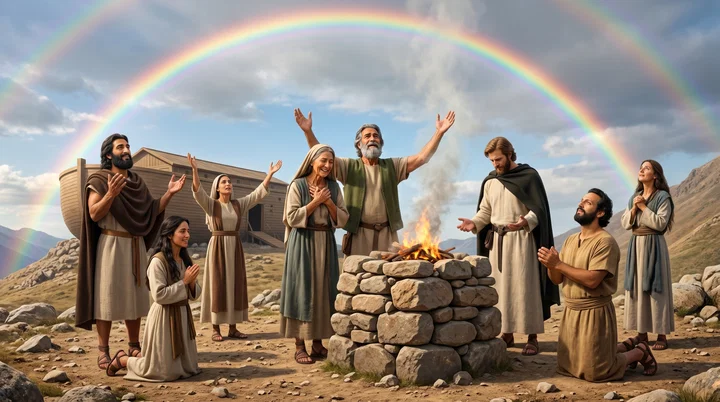
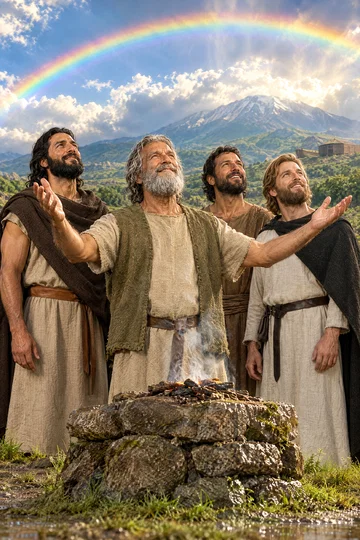
After leaving the ark, Noah's first act was to build an altar and offer burnt offerings from every kind of clean beast and clean fowl.PP 105.41SP 76.2 God's smelling a sweet savour means He accepted that offering with pleasure, as it rose before Him and was received by Him.PP 105.4SG3 73.11SP 76.2 The offering expressed gratitude for deliverance and preservation through the Flood and faith in Christ as the great sacrifice.PP 105.4SG3 73.11SP 76.2
In response God blessed Noah and his family, and through them all who would ever live on the earth, promising never again to curse the ground for man's sake nor to smite every living thing as He had done.PP 105.41SP 76.2 He keeps that promise by sustaining human life, sending rain and sunshine by miracle-working power to make cultivated seed grow from blade to ear to full grain for bread, providing the materials for the loaf and daily feeding thousands and ten times ten thousand out of mercy and compassion even though the imagination of the heart is evil from youth.ST Aug 12, 1897 The chapter is inspired Scripture and factual history of Noah and the Flood.ST Sep 8, 1881 It demonstrates the fulfillment of God's warning that those who refused to obey His commandments perished while the obedient found shelter in the ark, showing that human perversity brings divine judgment, and its account of human nature in Noah's day applies to the present age when people are uninfluenced by the Spirit and the same kind of sins are increasing.ST Sep 8, 18815T 601.1FE 504.1–3
The verse teaches all succeeding generations to put God first before providing for themselves, making grateful thanks and humble worship the first response to every display of mercy and love, giving cheerfully to the Lord and His cause even from a small stock preserved at great cost in acknowledgment that all belongs to Him.PP 105.4SG3 73.11SP 76.2 People dishonor God by forgetting the Giver, glorifying human instrumentalities and natural causes, perverting His natural provisions into unnatural stimulants for perverted appetite that becloud the intellect and wear out the body, and by selfishness and indulgence bringing excess and want and polluting the earth by sin as did the inhabitants of the Noachic world.ST Aug 12, 1897
Sources
Pioneers and periodicals
62 sources
Coming out of the ark after the waters dried, Noah built an altar and offered burnt offerings of every clean beast and fowl, and the Lord accepted the offering as a sweet savour that pleased Him.ST Aug 4, 1898RH Jan 27, 1910ST Oct 25, 1905RH Oct 8, 1903RH May 22, 1866 In His heart He then promised never again to curse the ground any more for man's sake nor to smite every living thing as He had done, but while the earth remains to continue seedtime and harvest and to set the bow in the cloud as memorial of His covenant not to cut off all flesh again by a flood.ST Aug 4, 1898ST Aug 4, 1898RH May 22, 1866 He made this promise even though the imagination of man's heart is evil from his youth, for the Flood did not wash evil from the earth or change the human heart, which remains sinful by nature and in need of subjection to Christ.RH May 1, 1866RH Dec 20, 1906ST Nov 18, 1886RH Jul 9, 1872ST Jul 17, 1901 Noah's costly offering expressed gratitude for deliverance and faith in Christ the great sacrifice, whose purity the clean victims pointed to and whose self-offering is the atonement for the sins of the world.ST Mar 6, 1879ST Jan 22, 1880RH Oct 31, 1854ST Jan 22, 1880 The flood judgment was a type of the final destruction of the wicked by fire, and the ark a type of Christ, with the condition of the people before the Flood typical of conditions when Christ shall come to judgment.ST Sep 25, 1901ST Dec 11, 1928ST Dec 11, 1928
Flood Setting Described
Genesis 8:21 belongs to the account of the Deluge, whose cause was the corruption of sinful humanity in persistent transgression of God's law.ST Dec 20, 1910ST Sep 25, 1901 Noah was saved in the ark by the obedience of faith in the word of God when judgment came upon the world.ST Sep 25, 1901 God's saving of Noah is a type of Christ's salvation, the flood judgment a type of the final destruction of the wicked, the ark a type of Christ, and the condition of the people before the Flood typical of conditions when Christ shall come to judgment.ST Sep 25, 1901 The covenant bow in the surrounding account is a lesson of God's covenant with the human race.ST Dec 20, 1910
The verse belongs to the events immediately after the Flood and to the account of the Deluge and what followed it.ST Aug 9, 1905RH May 22, 1866RH Jan 23, 1855 After forty days of rain covered the hills and mountains and destroyed every living substance, the waters subsided at the appointed time.RH May 22, 1866ST Oct 7, 1880 The ark rested on Mount Ararat, the earth again displayed beauty and glory though it had lost its former magnificence, and dry land appeared.RH May 22, 1866ST Oct 7, 1880 Noah and all with him left the ark, built an altar and offered sacrifice, and God made a covenant with the human race, promising not to curse the ground or destroy every living thing by another flood even though human hearts remain inclined to evil from youth.RH May 22, 1866RH Jan 23, 1855
Only Noah's family was saved at the Deluge, so all of Cain's posterity perished in the Flood.ST Apr 1, 1913RH Nov 5, 1861ST Feb 15, 1883 This proves the mark put on Cain did not continue afterward as a racial mark, since no descendants of Cain survived.ST Apr 1, 1913 All the various nations on earth sprang instead from Noah's three sons, with Ham and his son Canaan fathering the dark tribes of Africa.ST Apr 1, 1913 The present race of men is not the first, for the former wicked and profligate generation was all destroyed by water, and one prudent and pious man was left for a second generation, preserved in a great ark entered with his wife and children and receiving creatures in pairs dwelling together in peace by divine power as long as the water prevailed.RH Nov 5, 1861ST Feb 15, 1883 Human wickedness had become so widespread that only eight people who feared God remained, and the Flood was a judgment that preserved the possibility of true piety on earth.ST Feb 15, 1883ST May 7, 1894 Though saving only eight souls looked like Satan's triumph and the defeat of God's plan to people the earth, the faithful were saved, faith laid hold of the promise, and the earth came forth to begin another age so the great work of salvation went on.ST May 7, 1894
Genesis 8:21 marks the opening of a new age after the Deluge and connects the Flood with the beginning of post-Flood history.ST Jan 18, 1905ST May 7, 1894ST Sep 28, 1904 The ancient American and Old World civilizations were connected near that definite event and their later dispersion followed from it.ST Jan 18, 1905 The Deluge was preceded by the most terrible convulsion of record, showing that great changes in God's dealings are preceded and accompanied by grand, striking and awful phenomena in nature.ST Sep 28, 1904 Noah was needed by the people before the Flood to warn them, just as Lot was needed by Sodom and Jonah was needed by Nineveh, and prophecies of events appalling in nature and eternal in consequence are needed much more now to show the way beyond the perils of earth to the eternal home of the blessed.RH Jun 8, 1911
Offering Pleasing Accepted
Coming forth from the ark after the waters had dried and the ark had rested on Mount Ararat, Noah built a dedicated altar for worship and offered burnt offerings of every clean beast and clean fowl, one of every kind saved from the Flood.RH Jan 27, 1910ST Aug 4, 1898RH May 22, 1866 This is the earliest intimation of a set-apart altar for worship, and in return God promised to care for the needs of all Noah's descendants.RH Jan 27, 1910RH May 22, 1866 The offering was made from gratitude to God and faith in Christ after leaving the ark, and the Lord accepted it.ST Aug 4, 1898ST Aug 4, 1898 That he offered every kind, and that he offered clean beasts and fowl, raises why every kind and why clean.ST Aug 4, 1898
Clean and unclean animals were already distinguished by God's instruction before the Levitical law, with seven pairs of clean and one pair of unclean preserved in the ark.RH Aug 17, 1876 The distinction rested on the nature of the animals themselves and was not created by a later ceremonial rule. The Lord's acceptance of Noah's burnt offering after the Flood is evidence that the sacrificial law was known before it was formally recorded at Sinai.RH Aug 17, 1876
Noah's burnt offering expressed gratitude for deliverance, for preservation through the Flood, and for past blessings, not by words of thanks alone but by tangible offering.ST Jan 22, 1880ST Jan 22, 1880ST Jan 22, 1880 Having few useful animals and needing them to rebuild his stock, he nevertheless burned one-seventh of the clean animals and birds in a costly act showing reverence for God.ST Jan 22, 1880 Its smoke rising was felt by him as God's approval in his heart. Such tangible gratitude illustrates thank-offerings made in response to God's deliverance and blessings.ST Jan 22, 1880
The Lord smelled a sweet savour, which means He accepted the offering and was pleased with it.ST Aug 4, 1898ST Oct 25, 1905 The Hebrew roo-agh is used in the sense of smell, for the burning on the altar puts a sweet smell in God's nostrils that pleases Him forever.ST Mar 14, 1878ST Feb 19, 1902 The declaration of the divine promise follows Noah's abundant offering and points to the sacrifice as a sign of the complete redemption God would bring to humanity and the natural world.ST Oct 25, 1905
Noah's sacrifice expressed faith in Christ, the great sacrifice, and gratitude for preservation, and God accepted it as a sweet savor and blessed him and his family.ST Mar 6, 1879RH Oct 31, 1854 The selection of clean beasts points to the purity of the sacrificial victim they represented, ultimately Christ, whose self-offering is a sweet-smelling savor and an atonement for the sins of the world.RH Oct 31, 1854 Received as a pleasing act of gratitude for preserving mercy, his willingness to offer valuable animals despite scanty supply makes his sacrifice an example of the spirit of sacrifice, gratitude, and giving expected of the righteous ever after.RH Nov 15, 1870 Such offerings are not exclusively Jewish or limited to Israel but express a continuing duty, for God values willing sacrifice for His cause and has not changed.RH Nov 15, 1870
Promise Earth Spared
In His heart the Lord then promised never again to curse the ground any more for man's sake and never again to smite every living thing as He had done, even though the imagination of man's heart is evil from his youth.ST Aug 4, 1898ST Aug 4, 1898RH Jan 23, 1855 While the earth remains, seedtime and harvest, cold and heat, summer and winter, day and night shall not cease, and all flesh shall not again be cut off by the waters of a flood to destroy the earth.RH May 22, 1866 The bow with its brilliant hues is placed in the clouds as a memorial of God's everlasting covenant not to destroy the earth again by a flood.RH May 22, 1866
At the Flood the curse upon the earth fell still more heavily than before, cursing the ground again after the curse to bring forth thorns and thistles for Adam's sin and the curse for Cain's crime, as part of the undoing of the creation pronounced very good.RH Jul 9, 1872ST Mar 19, 1912 God resolved to add no further curse to the ground on account of people, holding the first curse placed after the fall sufficient.RH Jul 9, 1872RH Feb 17, 1852ST Mar 19, 1912 That original curse bringing mortality, decay, and corruption remains until the earth is consumed and the curse removed, and the Sabbath's blessing placed before the curse likewise remains to Paradise restored.RH Feb 17, 1852 The promise limits but does not yet remove the curse, for the world remains under the curse and groans under transgression until Christ, made a curse Himself, lifts it and brings the time when there is no more curse, which is included in all that redemption reaches to restore.ST Mar 19, 1912
The sweet savour means God cleansed the face of the earth after the Flood from the sickening scene of dead bodies of men, beasts and fowls, torn vegetation, mighty trees, and all decaying matter that would have poisoned the atmosphere and brought disease and death.RH Jul 9, 1872 By the Lord's rebuke with a strong wind that assuaged the waters and caused dry land to appear, driving waters up by mountains and down by valleys and blowing sand, loose trees, and decayed bodies into heaps and covering them with dirt and sand, He formed hills and mountains.RH Jul 9, 1872 Buried decayed trees of firmer texture became petrified and formed coal deposits, thus providing fuel and other wants for villages, cities, and labor-saving machines in these last days when wood is rapidly consumed.RH Jul 9, 1872
God's promise not to curse the ground or destroy every living thing again applies to the earth during probationary time and does not prevent the earth from later becoming desolate during the thousand years when no people live on it.ST Apr 11, 1911 It promises that God will not again destroy every living thing as in the Flood but does not rule out a future literal destruction of the wicked by fire.ST Apr 11, 1911RH Mar 29, 1870
God decided not to add to the curse because up to the Flood the curse had fallen on the earth each time and not on man himself, yet man did not stop sinning.RH Jul 9, 1872RH Jul 9, 1872 With men living to great age averaging over nine hundred years on plant food of herbs and fruits most conducive to longevity, a still heavier curse would keep the aging earth, which grows old like a garment and yields little, from bringing forth enough for sustenance.RH Jul 9, 1872 Then men must run to and fro to find support and would suffer for food except for the inventive faculty God gave for labor-saving farm implements in the last days.RH Jul 9, 1872 Therefore He did not leave man to perish but brought His work closer to man by permitting a change of diet in which every moving living thing would be meat, with flesh with its blood still forbidden.RH Jul 9, 1872 In return He promised to care for the needs of all Noah's descendants, keeping His promise to sustain life by sending rain and sunshine through miracle-working power to make cultivated seed grow first the blade, then the ear, then the corn in the ear, providing the loaf and daily feeding thousands out of mercy even though man's heart is evil.ST Aug 12, 1897RH Jan 27, 1910
Heart Evil Youth
The verse declares that the imagination of the human heart is evil from youth, which proves that all people are sinful by nature with a natural character bent toward evil.RH May 1, 1866RH Dec 20, 1906ST May 19, 1898 Evil thinking begins in childhood and comes out in a person's actions.RH Dec 20, 1906 Those who reject God and make their own gods cannot give those gods a character better than their own evil one, so whatever they deify can be no better than evil.ST May 19, 1898
The Flood did not wash evil imagination from the earth or change the human heart, for the evil bent survived the Flood and remains in need of sanctification.ST Nov 18, 1886ST Jul 17, 1901 By the grace of God it can be brought into subjection and obedience to the will of Christ.ST Nov 18, 1886 The declaration is prophetic, since God's promise never again to destroy every living thing was not made because people would be better in the future than in the past.ST Jul 17, 1901 Even when the curse upon the earth fell still more heavily at the Flood, so heavily that God resolved to add no further curse to the ground on account of people, human thinking remained evil from childhood and the heavier curse had not turned people to God.RH Jul 9, 1872
Children are self-willed and inclined to evil from their cradles, greedy without shame and ready to lie as soon as they discover the use of language.ST Jun 11, 1894 This condition is the same today as in the days of the patriarchs and is not removed by advanced civilization, so affectionate firmness and even wholesome chastisement remain necessary.ST Jun 11, 1894 Evil grows naturally while goodness requires constant care and cultivation.RH May 18, 1869 A good mother does not shut her eyes to impudence, insubordination, selfishness, lying and dishonesty or excuse them, but accepts the child as imperfect and trains it with never-ceasing love and care for its highest duties.ST Jun 11, 1894 Such training guides and restrains children while nurturing their hearts rather than crushing their warmth.ST Jun 11, 1894RH May 18, 1869
Left to themselves, human beings tend downward rather than steadily improving even when they know a better way, and without divine life they deteriorate.ST Feb 3, 1887 The account of human nature in Noah's day applies to the present age when people are uninfluenced by the Spirit of God.ST Sep 8, 1881 Civilization in itself has no moral power to lessen evil propensities but only sharpens intelligence, and where righteousness is lacking it is only a cloak covering moral deformity, a mask hiding a monster.ST Jul 1, 1903 It is unable to preserve the righteousness of a good man or change the heart of a bad man.ST Jul 1, 1903 The only cure for the evil natural heart is reception of the Gospel of Jesus Christ.ST Jul 1, 1903
History Confirmed Worldwide
The verse was breathed out by the Creator of the universe and was not copied from Babylonian accounts.ST Dec 7, 1915 No person now living watched Moses write, and monuments cannot by their nature settle whether he copied, so the evidence must be read, weighed and judged.ST Dec 7, 1915 It stands among the purest, least extravagant and nearest to the original form of the primeval traditions common to all civilized nations of antiquity, pointing to a time when the human race shared a common home and a common faith carried by early wandering races in different dress.ST Dec 7, 1915 Its historical accuracy is confirmed in remarkable manner by the literature and traditions of ancient Babylon, Egypt, India, China, Persia, Japan, Siam, Greece, Rome, Mexico, Nicaragua, Brazil, Cuba, Borneo, the Scandinavians, the Tartars, the North American Indians and the South Sea Islanders, and by a voice out of the tombs of thirty centuries.ST Dec 7, 1915 That confirmation demolishes the criticism that this part of Genesis is impossible and pure imagination, and it revives the credit and authority of the Bible.ST Dec 7, 1915
The verse belongs to the Bible's record of the Deluge in Genesis 6 to 8, whose story is preserved in traditions among tribes and nations all over the world.ST Dec 29, 1909 It is part of a real, universal, historical event and a straightforward and sensible history of a flood that rose and subsided quickly, reckoned among the great events in Genesis' history of beginnings and God's dealings with humanity.ST Dec 29, 1909STST Jun 19, 1907 Christ's references to the Flood as a real event and His comparison of His coming to the days of Noah affirm its reality.ST Nov 18, 1880ST Mar 9, 1888 It cannot be rejected without rejecting the whole book of Genesis and undermining the trustworthiness of Scripture.ST Nov 18, 1880 Its historical setting stands against the claim that civilization appears older than four or five thousand years, against objections to the Mosaic record of deluge and ark, and against critics who dismiss it as pious legend or myth.ST Nov 18, 1880STST Mar 9, 1888ST Nov 18, 1880ST Jun 19, 1907
The Lord's smelling of the sweet savor and resolving never again to curse the ground or destroy every living thing as He had done is preserved in distorted form in the Babylonian flood account, where the gods smelled the sacrifice and swarmed around it like flies. The Deluge story was also preserved in Babylonian literature and was known in Western Asia long before the time of Moses. The Bible's testimony is far clearer and more consistent than the very fragmentary, incomplete and uncertain Babylonian records and legends, and is not to be set aside for them.ST Mar 10, 1909 Babylonian legends claiming 432,000 years before the Deluge with only ten kings ruling are utterly preposterous, and boastful claims for the great antiquity of man argued from tablets, uniform accumulation of debris over buried objects, and advanced culture and refinement are not conclusive.ST Mar 10, 1909
The Deluge was a real historical catastrophe that throws light on conditions in the earth, including great rocky mountain ranges, buried forests, beds of coal, stores of oil, internal fires, earthquakes and volcanoes, a terrible upheaval that buried ancient forests, birds, animals and men.ST Sep 9, 1930 It is indicated by the Bible record, by widespread traditions among primitive and educated nations and early peoples of the world, and by archaeological discoveries and scientific observations that corroborate and substantiate the narrative as trustworthy history.ST Jan 25, 1905ST Sep 9, 1930ST Oct 21, 1930 The facts of science support that account against evolution and long geological periods, and its historical reality supports a literal creation at the beginning.RH Aug 20, 1914ST Oct 7, 1930 The early chapters of Genesis really took place in the history of the human race as history infallibly inspired and rigidly accurate in all details, not myth to be disbelieved because science or ordinary education rejects it.ST Nov 13, 1893
Prophecy Doctrine Life
The judgment of the waters upon a world ruined by persistent transgression of law, from which Noah was saved by obedient faith in the word, was a type of the final destruction of the wicked, and the ark itself was a type of Christ.ST Sep 25, 1901 Noah through the events of the Flood prefigures the coming Seed in birth and death and resurrection, and his coming forth from the waters is a new birth.ST Dec 11, 1928ST Dec 11, 1928 The state of men before the Flood is typical of the state when Christ shall come to judgment.ST Sep 25, 1901 The Flood did not make the heart better, for its evil imagination from youth remained and the declaration was prophetic, and the promise never again to smite every living thing was not given because the future would be better than the past; the Flood stood as object lesson and type of the final destruction by fire that shall utterly destroy the wicked and purify the earth to make it a fit dwelling for righteousness.ST Jul 17, 1901
God carried the earth through that judgment into another age.ST May 7, 1894 The wicked were destroyed for iniquity and only eight souls were saved, which looked like triumph for evil and defeat of the plan to fill the earth.ST May 7, 1894 The faithful were preserved, faith laid hold of the promise, and the earth came out of seeming defeat to begin another age, so that the great work of salvation went on.ST May 7, 1894
The first curse laid on the ground after the fall was held sufficient, so the ground would not be cursed again for man's sake nor every living thing smitten again, even though the imagination of the heart is evil from youth. God accepted the offering as a sweet savor and blessed Noah and his family, for the sacrifice expressed faith in Christ the great sacrifice and gratitude for preservation.ST Mar 6, 1879 Noah's costly offering of gratitude and faith drew the divine approval as the smile of Heaven, and stands as an example of sacrifice showing that willing sacrifice for the cause is valued and that God has not changed.RH Nov 15, 1870 The lesson is that every sign of mercy and love should be met with grateful thanks and humble worship.ST Mar 6, 1879 This sparing mercy is one of the many blessings to be counted, giving consolation to all who have hope of eternal life and foretelling that some shall escape the final destruction.
God keeps His word to sustain life, sending rain and sunshine by miracle-working power to bring the cultivated seed from blade to ear to full corn in the ear, furnishing material for the loaf and daily feeding thousands and ten times ten thousand out of mercy though the heart is evil.ST Aug 12, 1897 Men dishonor Him by forgetting the Giver and glorifying human instrumentalities and natural causes.ST Aug 12, 1897 They pervert His natural provisions into unnatural stimulants for perverted appetite, beclouding the intellect and wearing out the body, and by selfishness and indulgence bring excess and want and pollute the earth by sin as did the inhabitants of the Noachic world.ST Aug 12, 1897
Sources