Genesis 3:17
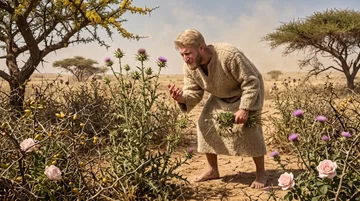
And unto Adam he said, Because thou hast hearkened unto the voice of thy wife, and hast eaten of the tree, of which I commanded thee, saying, Thou shalt not eat of it: cursed is the ground for thy sake; in sorrow shalt thou eat of it all the days of thy life;
Translations
And to Adam he said, Because you have listened to the voice of your wife, and have eaten of the tree, of which I commanded you, saying, You shall not eat of it: cursed is the ground for your sake; in sorrow shall you eat of it all the days of your life;
King James Version, KJV Cambridge Paragraph Bible
And unto Adam he said, Because thou hast hearkened unto the voice of thy wife, and hast eaten of the tree, of which I commanded thee, saying, Thou shalt not eat of it: cursed is the ground for thy sake; in sorrow shalt thou eat of it all the days of thy life;
And to Adam he said, Because thou hast hearkened to the voice of thy wife, and hast eaten of the tree of which I commanded thee, saying, Thou shalt not eat of it: cursed is the ground for thy sake; in sorrow shalt thou eat of it all the days of thy life;
Revised Version, American Standard Version
And unto Adam he said, Because thou hast hearkened unto the voice of thy wife, and hast eaten of the tree, of which I commanded thee, saying, Thou shalt not eat of it: cursed is the ground for thy sake; in toil shalt thou eat of it all the days of thy life;
And to the man He said, 'Because thou hast hearkened to the voice of thy wife, and dost eat of the tree concerning which I have charged thee, saying, Thou dost not eat of it, cursed [is] the ground on thine account; in sorrow thou dost eat of it all days of thy life,
And to Adam he said, Because thou hast hearkened to the voice of thy wife, and eaten of the tree of which I commanded thee saying, Thou shalt not eat of it: cursed be the ground on thy account; with toil shalt thou eat [ of] it all the days of thy life;
And, to the man, he said, Because thou didst hearken to the voice of thy wife, and so didst eat of the tree as to which I commanded thee, saying, Thou shalt not eat of it, Accursed be the ground for thy sake, In pain, shalt thou eat of it, all the days of thy life;
Berean Standard Bible, Majority Standard Bible
And to Adam He said:
“ Because you have listened to the voice of your wife
and have eaten from the tree
of which I commanded you not to eat,
cursed is the ground because of you;
through toil you will eat of it
all the days of your life.To Adam he said,
“ Because you have listened to your wife’s voice,
and have eaten from the tree,
about which I commanded you, saying, ‘ You shall not eat of it,’
the ground is cursed for your sake.
You will eat from it with much labor all the days of your life.And to Adam he said, Because you gave ear to the voice of your wife and took of the fruit of the tree which I said you were not to take, the earth is cursed on your account; in pain you will get your food from it all your life.
Also to Adam he said, Because thou hast obeyed the voyce of thy wife, and hast eaten of the tree, (whereof I commanded thee, saying, Thou shalt not eate of it) cursed is the earth for thy sake: in sorowe shalt thou eate of it all the dayes of thy life.
Douay-Rheims (Challoner revision)
And to Adam he said: Because thou hast hearkened to the voice of thy wife, and hast eaten of the tree, whereof I commanded thee that thou shouldst not eat, cursed is the earth in thy work; with labour and toil shalt thou eat thereof all the days of thy life.
Pictures



Cross-references 20 of 48
- Romans 5:12
Wherefore, as by one man sin entered into the world, and death by sin; and so death passed upon all men, for that all have sinned:
Connects Adam’s sin with sin and death entering the world.
- Genesis 2:17
But of the tree of the knowledge of good and evil, thou shalt not eat of it: for in the day that thou eatest thereof thou shalt surely die.
states the prohibition and death penalty Adam violated
- Romans 8:22
For we know that the whole creation groaneth and travaileth in pain together until now.
Creation groans under the curse and suffering caused by humanity’s fall.
- Genesis 2:15
And the LORD God took the man, and put him into the garden of Eden to dress it and to keep it.
Adam tended the garden before disobedience; the curse made his labor difficult.
- Genesis 3:22-24
And the LORD God said, Behold, the man is become as one of us, to know good and evil: and now, lest he put forth his hand, and take also of the tree of life, and eat, and live for ever:
Adam and Eve are driven from Eden after their sin, barred from the tree of life.
- Revelation 22:3
And there shall be no more curse: but the throne of God and of the Lamb shall be in it; and his servants shall serve him:
The curse on the earth is removed.
- Genesis 3:6
And when the woman saw that the tree was good for food, and that it was pleasant to the eyes, and a tree to be desired to make one wise, she took of the fruit thereof, and did eat, and gave also unto her husband with her; and he did eat.
Adam and Eve eat the forbidden fruit, bringing about the fall.
- Genesis 4:11-12
And now art thou cursed from the earth, which hath opened her mouth to receive thy brother’s blood from thy hand;
Cain’s murder brings a further curse, and the ground no longer yields its strength.
- Revelation 21:4
And God shall wipe away all tears from their eyes; and there shall be no more death, neither sorrow, nor crying, neither shall there be any more pain: for the former things are passed away.
Sorrow and pain brought by sin end, and death is no more.
- Galatians 3:13
Christ hath redeemed us from the curse of the law, being made a curse for us: for it is written, Cursed is every one that hangeth on a tree:
Christ bears Eden’s curse to redeem humanity from it.
- Romans 8:20-21
For the creature was made subject to vanity, not willingly, but by reason of him who hath subjected the same in hope,
Creation was subjected to vanity because of humanity’s sin, but will be freed from corruption.
- 1 Corinthians 15:21-22
For since by man came death, by man came also the resurrection of the dead.
Death entered through Adam, while resurrection and life come through Christ.
- Isaiah 24:6
Therefore hath the curse devoured the earth, and they that dwell therein are desolate: therefore the inhabitants of the earth are burned, and few men left.
Human transgression brings a curse upon the earth.
- Genesis 1:26-28
And God said, Let us make man in our image, after our likeness: and let them have dominion over the fish of the sea, and over the fowl of the air, and over the cattle, and over all the earth, and over every creeping thing that creepeth upon the earth.
Humanity’s entrusted dominion is contrasted with its loss through Adam’s disobedience.
- Genesis 3:4-5
And the serpent said unto the woman, Ye shall not surely die:
The serpent’s false promise of godlike knowledge led to disobedience and death.
- 1 Corinthians 15:45
And so it is written, The first man Adam was made a living soul; the last Adam was made a quickening spirit.
The first Adam’s disobedience brought the curse; Christ, the last Adam, brings restoration.
- Genesis 5:5
And all the days that Adam lived were nine hundred and thirty years: and he died.
Adam’s death records the sentence’s fulfillment after 930 years.
- Genesis 2:9
And out of the ground made the LORD God to grow every tree that is pleasant to the sight, and good for food; the tree of life also in the midst of the garden, and the tree of knowledge of good and evil.
God’s pleasant trees in Eden contrast with the ground cursed after Adam’s sin.
- Genesis 3:23
Therefore the LORD God sent him forth from the garden of Eden, to till the ground from whence he was taken.
Adam is sent from Eden to till the ground under the sentence.
- Genesis 1:31
And God saw every thing that he had made, and, behold, it was very good. And the evening and the morning were the sixth day.
Creation was declared very good before sin brought the ground’s curse.
Commentary part 1 of 3
Each commentary is drawn from primary sources: the writings of Ellen G. White and Adventist pioneers and periodicals. Each commentary is separate. Its own words are not a quotation; follow the references to read the source passages.
Ellen G. White
182 sources
Because Adam listened to his wife and ate from the tree God had directly commanded him not to eat, God cursed the ground for his sake so that in sorrow he would eat from it all the days of his life.1SP 42.3ED 25.4–26.1PP 59.2 Eve was deceived by Satan through the serpent, but Adam was not deceived, and from love and fear of separation he deliberately shared her transgression with no valid excuse, for the fruit had no harmful quality in itself but was only a test of loyalty.Ms 97, 1901, par. 3–8CTBH 42.1–3PP 53.5SG4 120.2 The sentence brought thorns and thistles, eating the herb of the field and bread in the sweat of the face until return to dust, with expulsion from Eden lest fallen man eat of the tree of life and become an immortal sinner.1SP 42.3PP 59.2ST May 29, 1901 Labor itself was not the curse, for pleasant tilling was Eden's blessing, but sorrowful toil against stubborn soil was added, yet even in judgment it was appointed in love to check indulgence, develop character, and lift man from ruin.SC 9.2CTBH 172.2Ms 8b, 1894 [Copy 2], par. 12–14ST Nov 12, 1885RP 24.2–4 With the curse God gave before Adam heard of toil the promise of a coming Saviour, and Christ entered the cursed ground where Adam fell and by obedient victory when hungry redeemed Adam's failure by appetite, opening the way to regain Eden and the tree of life through His blood.4T 293.2–3ST Apr 8, 1875ST Jan 22, 1880LC1 118.2
Fall and Divine Sentence
Because Adam listened to his wife's voice and ate from the tree God had directly commanded him not to eat, God cursed the ground for his sake so that in sorrow he would eat of it all the days of his life.1SP 42.3ED 25.4–26.1PP 59.2Ms 97, 1901, par. 3–8 The sentence placed him under hardship outside Eden, under unfavorable conditions in seeking to regain what was lost, with thorns and thistles, eating the herb or plants of the field, and obtaining bread by the sweat of the face until return to the ground.1SP 42.3ED 25.4–26.1PP 59.2ST May 29, 1901Ms 31, 1901, par. 4–8 Through that hardship Adam and Eve would become acquainted with evil all their lives, whereas God had freely given them good and withheld evil.1SP 42.3 Adam was held guilty and his disobedience left him without excuse, and the judgment stands as a lesson that God's word must be treated as sacred and His requirements implicitly obeyed.Ms 97, 1901, par. 3–8ST May 29, 1901
Adam had no excuse, for all his wants were generously supplied and only one tree was forbidden as a clear prohibition and test of obedience.Ms 97, 1901, par. 3–89MR 232.2–3SG4 120.3–121.2 The fruit itself had no peculiar harmful quality and was not injurious in itself, but was used merely as the test of loyalty to God's requirements and law.9MR 232.2–3 God had given the fruit of the trees as the food man's wants required, with no life of any creature to be taken and no death in Eden, when disobedience brought the first of three dreadful curses upon the earth and its posterity.SG4 120.3–121.2
Eve was beguiled and deceived by Satan working unperceived through the serpent as his medium, but Adam was not deceived.CTBH 42.1–3PP 53.5SG4 120.2LC1 192.2SG1 21.1 Adam and Eve had labored together daily and angels had cautioned Eve not to separate from her husband because she would be in less danger with him, yet absorbed in her pleasing task she unconsciously wandered from his side, felt apprehension of danger when alone yet dismissed her fears deciding she had sufficient wisdom and strength to discern evil and withstand it.PP 53.5 She gazed with mingled curiosity and admiration on the very beautiful fruit of the forbidden tree while questioning why God had withheld it, and lingered wonderingly instead of fleeing when Satan, through the serpent then one of the wisest and most beautiful creatures with wings and dazzling brightness like burnished gold, addressed her thoughts about God's command with subtle praise of her loveliness in a musical voice.PP 53.5 Surrounded by fruit of every variety freely given to make her happy, she desired the forbidden fruit above all the rest in intemperance, was led by the serpent to disbelieve God's warning of death, ate and imagined a pleasurable exaltation, and bore the fruit to her husband believing Satan's lie that eating would give higher perceptions of good and evil and make them like angels.CTBH 42.1–3SG4 120.2Ms 120, 1899, par. 8 Adam listened to Eve's recital until his constancy and integrity wavered and doubt arose whether God meant exactly what He said, and being sad, troubled, afraid, astonished and tempted because his wife had sinned, with strong love and a struggle in his mind, he felt sure Eve must now die and they must be separated.LC1 192.2SG1 21.1 In utter discouragement and fear of separation and sorrow he resolved to share her fate, seized the fruit and quickly ate it, permitting himself to be seduced by her experience standing against Jehovah's positive command in rash, presumptuous, deliberate and inexcusable transgression.CTBH 42.1–3LC1 192.2SG1 21.1 Satan had first tempted Eve to distrust God, question His wisdom and seek to penetrate His plans, expecting she would not fall alone, and he exulted when Adam fell, just as he had fallen in heaven and caused others to fall with him.SG1 21.1
Adam's attempt to blame Eve, saying she gave him of the tree and he ate, had no influence to save him from the result of disobedience.ST May 29, 1901Lt 91, 1900, par. 11–12 The opened eyes promised by disobedience brought only sight of shame and ruin, realization that the garments of heavenly light that had protected them were gone, knowledge that nakedness is the fruit of transgression, and hiding from God in expectation of His condemnation.Lt 91, 1900, par. 11–12
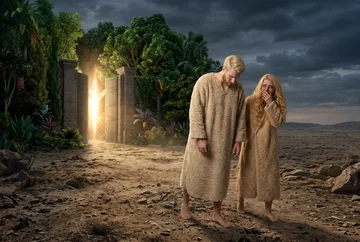
The full sentence brings thorns and thistles, eating the herb of the field, and eating bread in the sweat of the face till return to the ground, for out of it he was taken, dust to dust.1SP 42.3PP 59.2Ms 31, 1901, par. 4–8 By breaking God's command he became a sinner, forfeited his right to Eden, was driven and expelled from the garden, and was left ever after with ground bringing forth briers and thorns and exposed to Satan's temptations as long as he lived, finally to pass through death back to dust.EW 103.2RH Feb 24, 1874 Cherubim and a flaming sword were set with an angel to guard the way to the tree of life, so that the disloyal, disobedient pair might not gain access to it and fallen man could not approach and eat its fruit which perpetuates immortality and thus become an immortal sinner by immortalizing transgression.ST May 29, 1901EW 103.2 Yet God did not leave Adam without a ray of hope, though all nature must feel the effects of sin.Ms 31, 1901, par. 4–8
Though the act appeared small, its bitter experience and awful consequences reached far beyond appearance, for it opened the floodgates of woe and of evil and suffering upon the world and the whole human family.Ms 97, 1901, par. 3–8Ms 31, 1901, par. 4–8Ms 139, 1903, par. 22–25Lt 35a, 1877, par. 3–6Lt 14, 1885, par. 1–3 Man thereby followed his own way in harmony with Satan's temptation and in opposition to God's known will in a vain attempt to elevate and bless himself, gaining an experimental knowledge of disobedience and of good and evil, losing fidelity and loyalty to God.Ms 139, 1903, par. 22–25 The severity of the punishment proves God does not overlook violation of one command and His mercy does not excuse the sinner or lessen guilt while sin is continued.Lt 35a, 1877, par. 3–6 Mercy covers guilt only after sin is repented of and forsaken, while justice and mercy go hand in hand.Lt 35a, 1877, par. 3–6 The debt of transgression required God to give His Son from heaven to die to save the fallen race and make it possible through Christ's merits and blood to keep God's law, and that valuable sacrifice exalts the law and evidences its sacred character.Lt 35a, 1877, par. 3–6 Through Christ's sacrifice alone fallen man has been granted another trial, and the example and result should lead every soul to avoid and abhor sin as hateful, feeling that it is better to suffer loss of all things than to depart from the least of God's commandments.Lt 14, 1885, par. 1–3ST May 26, 1898 The same experiment is made today whenever men refuse full confidence in a thus saith the Lord and follow human inventions, policy and tradition, regarding deviation from His holy and just and good law as of little account, as when Satan leads men to disbelieve God's declarations and to change the Sabbath to the first day of the week, so that transgression of the Sabbath law in the bosom of the decalogue is as guilty as stealing or murder or adultery and cannot be excused by God's mercy, by Christ's death, or by the world's example.Ms 139, 1903, par. 22–25Lt 35a, 1877, par. 3–6 Because Adam and Eve ate of the one forbidden tree when free to eat of every other tree, they lost beautiful Eden, and from that time sin grew worse until God destroyed the world by a flood saving only Noah and his sons, as seen also in Sodom destroyed by fire from heaven and Nineveh first spared on repentance then destroyed when sin reached to heaven, and as seen now when the world is fast becoming as before the flood and Adam's sin is repeated in discarding the Sabbath because men have not learned that God means what He says.ST May 26, 1898
Curse Upon Earth
By disobedience Adam forfeited the dominion over creation entrusted to him, and the groaning and lamentation of the earth under the curse followed that loss.GC 359.1–360.1GC88 358.2–359.1 The fall of man belongs with creation, the atonement, and the perpetuity of the law as a great fact presented by inspired writers and a pillar of the Christian faith, and to reject or explain it away is practically to reject that truth.GC88 582.34SP 398.3
The curse did not at once erase richness and beauty, for the earth remained abundant and fruitful with plentiful gold and silver, exceptionally large, strong, beautiful and durable trees, and people of great stature and strength, showing only signs and tokens of decay compared with its condition before the curse.ST Feb 27, 1879SG3 61.31SP 67.1SG3 61.2PP 90.1 At first God's blight upon the ground did not rest heavily and did not greatly change the face of nature, leaving it still rich and beautiful in the gifts of providence.10MR 368.2–369.2PP 90.1
The curse was first felt lightly but grew heavier, for Cain's murder of Abel brought a double curse upon the ground already cursed for Adam's sake.SG3 50.11SP 57.1 It increased greatly at the Flood and since then has rested heavier and heavier as disobedience and transgression continued, still resting on the earth in Noah's day and felt more heavily with time, upon men and beasts and trees and all vegetation.SG4 121.3–122.110MR 368.2–369.2PP 90.1 The longer the earth lies under the curse the more barren the soil becomes and the harder it is to cultivate and make productive, requiring double labor, so that even a fallen decaying leaf before the Flood gave evidence of decay and caused great sorrow to those who feared God.SG4 155.2–3 For this reason God raises up men with inventive skill to build implements and labor-saving machines to lighten work on the land groaning under the curse, though He is not in all inventions, for Satan controls minds to hurry men to new inventions that lead them to forget God.SG4 155.2–3
Cain murmured against God and resented the curse pronounced on Adam and on the ground because of his sin, while Abel submitted meekly to God's authority.1SP 54.1SG3 47.1–48.1ST Dec 16, 1886 Because of sin nature was marred and defiled and can no longer perfectly reveal God's character, giving only an imperfect testimony about its Creator even while its remaining beauty still speaks of Him when rightly understood.8T 255.3–256.1ED 26.2–3COL 18.1 Its blight is seen in decay and death, in drooping flowers, falling leaves, decaying trees, and tainted air, with briers, thistles, thorns and tares testifying to condemnation.RH Mar 17, 1904ED 26.2–3 After sin Adam and Eve lost the heavenly light by which they understood God in His works, and their descendants could no longer trace His character in nature as before the fall.RH Mar 17, 1904 After they could no longer live in Eden but had to dwell on the cursed earth, its formerly mild and even climate became subject to extremes of heat and cold.ST Nov 18, 1913
The cursed ground no longer brings forth only good but thorns, thistles, briers, brambles, weeds, and tares sown by the enemy, so that Adam and Eve were shut out of the garden to work in sorrow among them all the days of life, and cultivation became continual warfare and a school reflecting God's work upon the soul.Ms 120, 1899, par. 8Lt 5, 1900, par. 4 The land lacks vigor and is diseased, cultivation is harder, human existence has been shortened since the Flood, and rapidly increasing physical, mental, and moral degeneracy marks the latter days.SG4 155.2–37MR 123.1 The heavy curse is felt by the whole human race in misery and suffering, and also by animals, so that beasts, cattle, fish, and vegetation have degenerated in size and years and suffer disease, made to suffer more by man's wrong habits of intemperance in labor and in eating and drinking and indulgence of depraved and injurious appetites.SG4 146.2HLT1 58.2–4
The first of three dreadful curses upon the earth was pronounced when God had given the fruit of trees as the food man's wants required, with no life of any creature taken and no death in Eden.SG4 120.3–121.2 Without God's blessing the earth can do nothing, yet it has blessings hidden in its depths for those with courage, will, and perseverance to gather its treasures and make it give forth its strength, and labor for bread is not degrading servitude but holds blessing, so that fathers and mothers with land and a home are kings and queens.FE 326.2Ms 8b, 1894 [Copy 2], par. 46–47 The curse is multiplied by increasing sin, by ignorance doing its baleful work, and by slothful, lazy habits and refusal to till the soil, with neglect, surface work, and idleness failing to secure adequate returns.FE 326.2Ms 8b, 1894 [Copy 2], par. 46–47 Eden itself was preserved free from that curse as a specimen of God's perfect creation, withdrawn from the earth before the Flood and to be returned more gloriously adorned.1SP 61.1SG3 55.1
At Christ's return, when He receives the dominion and reigns as king over all the earth, creation's groaning will cease and the earth will again be declared very good.GC88 358.2–359.1 Even now blessings without number remain, the world is full of God's goodness, and God in mercy is working out His plan to fill the whole earth with His glory, yet sin prevails to mar and scar it, and beautiful Eden was degraded by its introduction.CH 527.120MR 151.2Ms 167, 1901, par. 6 God had surrounded mankind with precious things because He loved them, but those blessings were turned into a curse when men used them to gratify pride and glorify themselves.10MR 370.2–371.1 The world before the Flood far exceeded present mountains, rocks, and scenery in beauty, grandeur, and loveliness, yet was destroyed with its people for sinfulness, violence, and corrupting works that defiled the earth, and even now the earth would be happy were it not corrupting under sin, with every place inhabited by men debased by it.10MR 370.2–371.1 Adam's sin thus made labor difficult and food sorrowful and blighted nature's beauty, yet after thousands of years under its effects nature retains beauty greater than human art, while Eden's original beauty had been greater still.CTBH 171.9–172.1
Sorrowful Human Life
To eat in sorrow from ground cursed for Adam's sake means to become acquainted with evil all the days of life, whereas God had freely given good and withheld evil from the sinless pair.1SP 42.3ST Jan 23, 1879ST Dec 23, 1886PP 59.3SG3 45.1 Happy labor was replaced by perpetual toil and anxiety under Satan's temptations, with disappointment, grief, pain, and finally death and return to dust.1SP 42.3ST Jan 23, 1879PP 59.3 By eating what was forbidden they chose the knowledge of evil and must continue to eat of it all their life.PP 59.31SP 43.1
The fall changed man from a sovereign in Eden into a slave on an earth groaning under the curse.ST Feb 22, 1883LC1 137.2ST Feb 18, 1913RH Jul 28, 1874 The glory and covering light given to holy Adam departed because it could not cover disobedience and sin.2RED 33.1–34.2LC1 137.2RH Jul 28, 1874 Health and abundant blessing gave way to poverty, sickness, suffering of every type, and death as the portion of Adam's children.2RED 33.1–34.2LC1 137.2ST Feb 18, 1913ST Jun 11, 1874RH Jul 28, 1874
Humanity was first made complete in every faculty of mind and body in perfect soundness and perfect health.ST Oct 31, 1878 Indulgence of appetite and passion lessened vital force, brought excess, violence, debauchery, luxurious living, wine, surfeiting, drunkenness, licentiousness and intemperance, and began woe, suffering, decay, disease and death for the race.ST Oct 31, 18783T 139.1–2ST Sep 2, 1875 Decay appeared by the third generation from Adam and increased more rapidly after the Flood, with corrupt blood, inflamed passions, and disease, evil inclinations, enfeebled intellects and polluted morals transmitted from father to son.ST Oct 31, 1878 There has been a succession of falls each greater than the last, with rapidly increasing disease of every kind, deformity, decrepitude, imbecility, feebleness of mental, moral and physical power, and loss of beauty, strength, longevity and moral power through disregard of God's commands and the natural laws ordained to shield man from evil.ST Oct 31, 1878ST Sep 2, 1875RH Mar 4, 1875CTBH 165.2–166.1LC1 179.1
The curse rests upon the body in pain, infirmity and suffering through life, and upon the earth, the sea, the cattle and the animals.SG4 146.2Lt 84, 1898, par. 6–715MR 332.2–333.2Ms 4, 1860, par. 17–19 Beasts have degenerated in size and length of years and are made to suffer more than they otherwise would by man's wrong habits, including intemperance in labor and in eating and drinking and indulgence of depraved appetites for things most injurious to health.SG4 146.2HLT1 58.2–4 Had humanity remained innocent the earth would not have been stained with blood, and killing animals for food would not have become a human custom, for death in humans and animals came as a consequence of sin and flesh-eating is a fruit of transgression.CTBH 169.3–4 The decaying earth gives warning that soon there will be no safety in flocks or herds, and the flesh of dead animals is not fit to compose the diet of Christians.Lt 84, 1898, par. 6–7
Sorrow and suffering in eating from the cursed ground taught Adam strict adherence to God's law.PP 82.1 He lived nearly a thousand years among men as a witness to the results of sin, commanded to instruct posterity, treasuring what God revealed and repeating it to his children and children's children to the ninth generation.PP 82.1 He described man's holy and happy estate in Paradise, repeated the history of the fall, told of the sufferings by which God taught him obedience, and explained the merciful provisions for salvation, yet few gave heed and he was often met with bitter reproaches for bringing such woe upon posterity.PP 82.1
The first parents' disobedience in taking another's word before God's opened the way to woe for the whole world, bringing guilt, sorrow, misery, despair and death upon the race.4T 248.1MYP 254.2–255.1ST Feb 27, 1912ST Feb 26, 1894 It cost them access to Eden and the tree of life and ended the holy innocency in which they had enjoyed communion with God and sinless angels.MYP 254.2–255.1ST Feb 27, 1912RH Nov 12, 1903 Their example warns that God's commands are firm, that transgression of His law brings terrible consequences reaching beyond the transgressor, and that disobeying His requirements forfeits blessing while loving obedience receives it.4T 248.1HSFM 231.3ST Feb 26, 1894
Labor as Blessing
Labor itself was not given as a curse, for in Eden tilling the soil and caring for what God had planted was employment and schooling and pleasure and great blessing under God as instructor, with abundant yield and no noxious weeds, and God never meant man to be idle or to have nothing to do.Ms 8b, 1894 [Copy 2], par. 12–14ST Nov 12, 1885FE 314.1ST May 4, 1882Ms 8, 1894 [Copy 1], par. 12–13 The decree to earn bread by the sweat of the brow was not given as a curse, but through faith and hope labor after the fall was still to be a blessing to the descendants of Adam and Eve, and they were to be masters of labor and not slaves of labor.CTBH 172.2Ms 8b, 1894 [Copy 2], par. 12–14FE 314.1Ms 8, 1894 [Copy 1], par. 12–13 Useful labor already belonged to holy existence before disobedience, when Adam found his highest pleasures in mental and physical activity.ST Nov 12, 1885ST May 4, 1882
What the curse added was difficulty and hardship attending work, so that sorrowful, sweaty toil against stubborn soil replaced Eden's pleasant and invigorating occupation in which the earth freely supplied abundance for human need.FE 512.5–513.1RP 24.2–4ST May 4, 1882CT 274.1PP 50.1 Work became marked by anxiety, weariness, and pain, with wrestling against the weeds of Satan's sowing and battling in hardship against the evil power to which the will had been yielded.ED 214.2ST Jan 18, 1916CT 274.1 After being driven from home, the struggle to obtain food from cursed ground was widely different from labor in the garden when obedience made it pleasure.ST May 4, 1882CT 274.1PP 50.1
Even in judgment the sentence to labor in sorrow was appointed in love for man's good as training to lift him from the ruin and degradation sin caused, as part of God's great plan for recovery from the fall.SC 9.2ED 214.2CT 274.2 The thorn and the thistle and the difficulties and trials that make life one of toil and care were for man's sake, and the toil imposed relieved sorrow and remorse and safeguarded against temptation.SC 9.2ST Nov 12, 1885ST May 4, 1882 By toil Satan's temptations are made ineffectual and the tide of evil is stayed, for its discipline checks indulgence of appetite and passion and self-indulgence and promotes self-control, industry, purity, and firmness.ED 214.2CT 274.2MYP 213.1 Labor thus remains a source of happiness and development and a safeguard against temptation, proving judicious labor indispensable to happiness and prosperity, and though fallen the world is not all sorrow and misery but still carries messages of hope and comfort with flowers upon the thistles and roses covering the thorns.SC 9.2ST Nov 12, 1885ED 214.2
The earth can do nothing without God's blessing, yet it has hidden blessings and treasures in its depths for those with courage and will and perseverance to gather them and make it give forth its strength.SPBC 200.1FE 326.2STE 108.1–109.1Ms 8b, 1894 [Copy 2], par. 46–47 The curse is multiplied by increasing sin and by ignorance doing its baleful work and by slothful, lazy habits and refusal to till the soil, while neglect and surface work and idleness fail to secure adequate returns.FE 326.2Ms 8b, 1894 [Copy 2], par. 46–47 Because the longer the earth lies under the curse the more barren the soil becomes and the harder it is to cultivate, requiring double labor, God raises up men with inventive skill to build implements and labor-saving machines to lighten work on the land groaning under the curse.SG4 155.2–3 God is not in all inventions, for Satan controls minds to hurry men to new inventions that lead them to forget God.SG4 155.2–3 After sin entered, the earth no longer brings forth only what is good but weeds and thistles which greatly multiplied the labor of cultivation.Ms 8a, 1894, par. 910MR 260.3–261.1
Deeper sin further changes God's order, laying heavy toil on one class and the curse of idleness on those who hold God's money with the false idea that money increases moral worth.FE 314.1Ms 8, 1894 [Copy 1], par. 12–13 Labor becomes to human beings what they make it, and the farther men go from God's order of purposeful industry the deeper the curse of sin grows.FE 314.1Ms 8, 1894 [Copy 1], par. 12–13Ms 8a, 1894, par. 9 Constant drudgery relieved only by drink and excitement makes men little better than brutes.Ms 8, 1894 [Copy 1], par. 12–13 Work attended with weariness and pain is not a curse, and those who regard it as a curse cherish an error.PP 50.1 Contempt for the working classes is wholly at variance with God's purpose in creating man, for God appointed labor as a blessing to occupy the mind, strengthen the body, and develop the faculties, and true joy of life is found only by working men and women.PP 50.1 Useful labor is necessary for physical, mental, and moral well-being, and was apportioned and connected with the curse because sin made it necessary, so no person rich or poor can glorify God by indolence, with time and physical strength as capital accountable to God.3T 400.1–3RH Dec 15, 1874
Law and Obedience
The record of the command given in Eden and the penalty laid upon Adam for breaking it stands as a warning against disobedience, showing that sin brings death, that God's retributive justice never fails, and that He exacts strict regard for His commandments.4T 11.3ST May 31, 1910 The curse upon the ground, that man should eat of it in sorrow all the days of his life, was the penalty accruing for breaking the law given in Eden after temptation and fall, recorded full and explicit just as definite penalty and sure punishment followed the law proclaimed at Sinai.ST May 31, 1910 Adam's judgment proves God will not pass over transgression now any more lightly than then.4T 11.3ST May 31, 1910 Listening to the specious temptations of the enemy was disobedience of the divine law that brought guilt and sorrow upon the world and would have plunged the race into hopeless despair had it not been for the goodness and mercy of God.ST Jun 3, 1886 That example requires reverence for God's commandments and obedience without questioning the feasibility or convenience of such obedience.ST Jun 3, 1886
The history of the first parents is preserved as a warning to all people not to follow their example, for their disobedience brought consequences.ST Jul 8, 1880RH Oct 13, 1874 Their expulsion from Eden and the bitter fruits they experienced show God's warnings are certain to be fulfilled, and every transgressor will sooner or later face punishment.1SP 59.1 Even one transgression of God's law has serious consequences, as seen in the cursed ground and hardship marking Adam's life after he disobeyed God's command.ST Apr 15, 1875 Christ's sacrifice to redeem humanity from the penalty of sin confirms that God's law does not change.ST Apr 15, 1875 The law given in Eden carried reward for obedience and penalty for disobedience, and because Adam transgressed by eating from the forbidden tree, sin was introduced into the fair world God had created, bringing the curse, after which men and women became more and still more bold in disobeying God's law.FE 504.1–3
The curse on the ground and sorrow in eating from it all the days of life are the result and penalty of the first parents' transgression, showing the divine law is the basis of all right conduct, which those standing in responsibility, including rulers of nations and those united with them, must realize makes them amenable to God's law to obey all His requirements.Lt 188, 1903, par. 7–9 The exposition of the law runs through the gospel like golden threads, the blood of Christ is the sinner's only hope, and therefore the law must be magnified and glorified before all people.Lt 188, 1903, par. 7–9 The law of God could not be changed or altered to meet man in his fallen condition to pardon Adam and let him retain his home in Eden after Satan cautiously worked upon the minds of Adam and Eve and seduced them from loyalty.Lt 110, 1896, par. 9–15 The penalty of transgression remained death, so Christ became man's substitute and surety and gave Himself as a sacrifice, and Adam lost Eden and was placed with all his posterity upon probation.Lt 110, 1896, par. 9–15 The law remains changeless in character and binding upon every human being, and eternal destiny is decided by obedience or disobedience to it.Lt 110, 1896, par. 9–15
Adam's eating of the forbidden tree was the first surrender to appetite, in which he hearkened to the voice of his wife instead of God's express command.CTBH 42.1–3 Eve was beguiled by the serpent to disbelieve God's warning of death, ate and imagined a pleasurable exaltation, and bore the fruit to her husband, and Adam permitted himself to be seduced by her experience standing against Jehovah's positive command.CTBH 42.1–3 That disregard of God's prohibition broke allegiance to God and brought the full penalty of violated natural and divine law, establishing the pattern still seen where men and women follow their own inclinations contrary to God's most positive commands because immediate punishment does not fall.CTBH 42.1–3 Adam's fall began a succession of falls, for people repeat his disobedience by indulging appetite and passion against God's law despite the warning of his example.ST Feb 11, 1875LC1 178.3 The resulting disease and loss of human health and moral power come from disregarding God's protective means, not from God's special providence, and obedience to God's law would guard people from intemperance, licentiousness, and disease.ST Feb 11, 1875
Adam's transgression in violating the express law of Jehovah by eating through indulged appetite and passion brought sin into the world with unutterable woe and his being driven from Eden, leaving the race in a lowered physical, mental, and moral condition.LC1 178.3 His fall stands as a warning example against disobeying God's express injunctions, yet men repeating his disobedience instead of taking warning continue the fall with a succession of falls while still mourning the sin he brought into the world.LC1 178.3 That eating through indulgence of appetite brought the fall of man and the beginning of woe, suffering, decay, disease and death for the race.ST Oct 31, 1878 Man was first made complete in every faculty of mind and body in perfect soundness and perfect health as God designed, but indulgence of appetite and passion lessened vital force, brought excess, violence and debauchery, weakened the energies, and caused decay to appear by the third generation from Adam and to increase more rapidly after the Flood.ST Oct 31, 1878 Luxurious living, wine, surfeiting, drunkenness, licentiousness and intemperance corrupt the blood, inflame the passions, and transmit disease, evil inclinations, enfeebled intellects and polluted morals from father to son from generation to generation, repeating the fall.ST Oct 31, 1878
Breaking nature's laws is breaking God's law, and because fallen man persists in breaking God's law the accumulated misery leaves the present world full of deformity, decrepitude, disease and imbecility, feeble in mental, moral and physical power and groaning under its weight of suffering and anguish.ST Oct 31, 1878 Eve, though surrounded by fruit of every variety freely given to make her happy, desired the forbidden fruit above all the rest in intemperance and ate in disobedience to God's prohibition, and because they hearkened to temptation and disregarded what God had forbidden a curse rested upon them both and the earth also was cursed because of their sin.SG4 120.2 This began the course of disobedience and intemperance in which appetite controls reason, mankind is beguiled to disregard God's prohibitions, violates the laws of health and runs to excess, and disease follows as effect follows cause.SG4 120.2 The fall with its curse and sorrow marks the beginning of human degeneration and suffering through disobedience, for the same temptation of yielding to appetite has enfeebled later generations, and their physical, mental, and moral decline results from wrong habits and violations of God's laws, not from God's design or an appointed human lot.3T 139.1–2
In hearkening to his wife and eating of the tree God commanded him not to eat, for which God cursed the ground for his sake with thorns and thistles and the herb of the field and bread in the sweat of the face till return to dust, man followed his own way in harmony with Satan's temptation and in opposition to God's known will in a vain attempt to elevate and bless himself.Ms 139, 1903, par. 22–2518MR 33.2–34.1 Thereby he gained an experimental knowledge of disobedience to God's commandments and of good and evil, lost fidelity and loyalty to God, and opened the floodgates of evil and suffering to the whole human family.Ms 139, 1903, par. 22–2518MR 33.2–34.1 The same experiment is made today whenever men refuse full confidence in a thus saith the Lord and follow human inventions, policy, and tradition, as when Satan leads men to disbelieve God's declarations, to regard deviation from His holy and just and good law as of little account, and to change the Sabbath to the first day of the week.Ms 139, 1903, par. 22–25 Man's only safety is full confidence in a thus saith the Lord.18MR 33.2–34.1 Taking another's word before God's brought woe upon the world and cost access to Eden and the tree of life.ST Feb 27, 1912
God means what He says, and when He had prohibited eating the fruit of the tree of knowledge, Adam's disobedience opened the floodgates of woe to the whole world.MYP 441.2–442.1 If we walk contrary to God, He will walk contrary to us, so the only safe course is to render obedience to all His requirements at whatever cost, because all are founded in infinite love and wisdom.MYP 441.2–442.1 A promise contrary to Scripture must be retracted without delay in humility and repentance, for it is far better to take it back in the fear of God than to keep it and dishonor the Maker, since there is heaven to gain and an open path to perdition to shun.MYP 441.2–442.1 In disobeying God and eating the forbidden tree Adam became a law to himself, and discord and unhappiness came into his life with separation between him and God, in contrast to Christ's life of constant perfect obedience which set an example all can follow.9MR 37.1–2 By that disobedience in eating from the tree God had commanded him not to eat, Adam lost Eden and sin entered the world, after which men became more and more disobedient.ST Feb 11, 1897
Adam and Eve lost their right to their Eden home because they disobeyed a command of God, and choosing that same disobedience now forfeits the right to the Eden restored.Lt 236, 1903, par. 21–22Ms 2, 1904, par. 38–41 Their disobedience demonstrates the sure result of transgressing God's law and disproves the doctrine of once in grace always in grace, and the condition of the fallen race today testifies to the awful results of that transgression.Ms 2, 1904, par. 38–41 That act was transgression of the law of God, which is the transcript of His character, and because they transgressed that law they lost Eden.Ms 8, 1888, par. 31–32 As they lost Eden for transgressing the law, those who transgress the same law will lose heaven.Ms 8, 1888, par. 31–32 No one can cleanse himself by the righteousness of the law, but Jesus Christ came to save His people from transgression of the law by imparting His own righteousness and His obedience to every requirement of that transgressed law to those who obey God's law and believe on Him as Saviour now.Ms 8, 1888, par. 31–32
The advantage given through Christ is known by searching the Scriptures and standing in right relation to God, not repeating Adam and Eve's transgression but obeying all God's requirements, overcoming as Christ overcame by perfect obedience to His Father's commandments, and in bending footsteps heavenward toward the Eden home pointing others there, for through such obedience people are brought back to their Eden home.Ms 84, 1886, par. 5–6 Keeping God's commandments is the test of love which Adam and Eve failed, and their loss means the human family must obey the light given about the binding claims of God's law and must lift the cross openly before the whole world.Ms 16, 1895, par. 19 The curse on the ground made all nature a witness to the character and results of rebellion against God.PP 59.4 While Adam remained loyal to heaven all nature was in subjection to him as ruler over the earth and all living creatures, but when he rebelled against the divine law the inferior creatures rebelled against his rule.PP 59.4 In great mercy God appointed this to show men the sacredness of His law and to lead them by their own experience to see the danger of setting it aside even in the slightest degree.PP 59.4
The fall commences the gradual unfolding of God's purposes in the plan of redemption, for God's work is the same in all time, with different degrees of development and different manifestations of His power to meet the wants of man in the different ages, from the fall down through the patriarchal and Jewish ages even to the present time.ST Jun 3, 1886 All can learn from the transgression the need for obedience to God's law, for that law is filled with positive promises to all who obey, and obedience is required to become members of the royal family, children of the heavenly King.Lt 90, 1898, par. 14–16 To protect the human family from further woe, the light of the law must be made known so clearly that all human intelligences can understand it if they will, with parents making it plain to children and urging obedience all the days of life.Lt 90, 1898, par. 14–16 In breaking God's law Adam brought dishonor on the divine government, and the transgression required its penalty to be paid.Ms 196, 1903, par. 1 The Creator's dealing in the curse upon the earth and upon the human race for Adam's sin shows justice and mercy toward the fallen race and leaves hope of redemption, to be gratefully accepted with loyalty to God.PP 71.1
Murmuring against it is rebellion that questions divine justice and authority and runs in the same self-exalting channel that led to Satan's fall.PP 71.1 Adam disobeyed God's express command and his transgression brought sin into the world, and his example warns later people not to repeat his disobedience, yet they continue to violate God's law.2RED 74.3 The earth was cursed because Adam transgressed God's law, and Adam learned through bitter experience that breaking God's commandments was easier than resisting the resulting spread of moral wretchedness.ST Apr 8, 1875 He therefore taught his descendants to turn from transgression and live in obedience and faith in the coming Saviour.ST Apr 8, 1875 Adam's eating of the forbidden tree was transgression of the law of God that caused his fall and opened the floodgates of woe to the world, and every violation of the law of God repeats that same transgression, bringing terrible loss to the disloyal and the deepest injury to God, because the influence of every transgressor leads and sustains others in that sin.SPBC 178.2–4Lt 33, 1893, par. 10–11
Christ and Redemption
In connection with the curse upon the ground the promise of pardon through a Saviour to come was given, the first preaching of the gospel in Eden as a star of hope lighting the dark future of the fallen race and of the world given to man as his dominion, which otherwise was not relieved by a single ray of hope.ST Apr 8, 1875ST Jan 22, 1880ST Jan 17, 1911RH Apr 29, 1875 Because paradise was lost by transgression of God's law and the reign of death commenced, that promise brought hope and pardon through Christ to those who had broken the law.ST Apr 8, 1875ST Jan 22, 1880ST Jan 17, 1911 Words of hope came before Adam heard of sorrow and toil, for the sentence of sorrow and toil and return to dust was spoken after the promise of a Deliverer.STB 516.2–3JIOKP 37.2–3ED 27.1
Adam and Eve sincerely repented of their guilt, grieved over it, believed the promise of God concerning the Redeemer to come, and were saved from utter ruin.ST Apr 8, 1875ST Jan 22, 1880ST Jan 17, 1911RH Apr 29, 1875 Yet Adam lost Eden and with all his posterity was placed upon probation under the penalty of death, for the law of God could not be changed or altered to meet man in his fallen condition and let him retain his home in Eden.Lt 110, 1896, par. 9–15Ms 143, 1898, par. 28 Eternal destiny is still decided by obedience or disobedience to that changeless and binding law.Lt 110, 1896, par. 9–15
That disobedience cost the Son of God leaving the royal courts of heaven to take a humble place on earth, laying aside His robes of royalty to clothe divinity with humanity and come as a man of sorrows acquainted with grief.ST Sep 1, 1881Ms 18, 1887, par. 4 There He suffered insult, rejection, reproach, mockery, and crucifixion by those He came to bless, the Majesty of heaven sacrificed to save man from the penalty of his crime and to pay the ransom by taking man's transgressions and their just penalty upon Himself.ST Sep 1, 1881Ms 18, 1887, par. 4 The sentence of death was not carried out in full at once, because Christ began the work of redeeming humanity and became a refuge from the wrath that justice would bring upon sinners, through whom alone fallen people have access to God.2RED 16.2–17.1 The Son of God stepped in and pledged His own life as that penalty so that man might have another trial, a provision which does not abolish God's law and does not give unconditional pardon, for the Father does not show benevolence at the expense of justice nor set aside the principles of righteousness to exalt the sinner in impenitence.Ms 143, 1898, par. 28
Christ entered this disloyal world seared and marred by the curse, entering the ground on which Adam fell in his fallen helpless condition under the power of the prince of darkness.4T 293.2–3LC1 118.2Ms 20, 1898, par. 4–5 In the wilderness of temptation after fasting forty days and nights He passed over the same ground where Adam fell, though tempted in a hundredfold severer manner and under far more trying circumstances.ST Mar 7, 1878Lt 148a, 1897, par. 3–4Ms 20, 1898, par. 4–5 Even when hungry He did not depart from His Father's will, and by obedient victory redeemed Adam's disgraceful failure and fall by yielding to appetite.4T 293.2–3COS 46.2–4ST Mar 7, 1878Lt 148a, 1897, par. 3–4 By that victory He placed the human family on vantage ground with God, making it possible for them to overcome in their own behalf through the merits of the crucified and risen Saviour.Lt 148a, 1897, par. 3–4
All that was lost by yielding to Satan can be regained through Christ, the Son of God given to redeem the race from the destroyer and restore man to the image of God and to the perfection for which he was created.STB 516.2–3ED 15.2JIOKP 37.2–3ED 27.1 Christ died so that through His blood obedience to God's law could restore the lost right to the tree of life and bring the promised blessing of regaining lost Eden.LC1 118.2SG3 88.1
Daily Life Application
Though the world fell under judgment, it is not left to unmixed sorrow and misery, for the curse was appointed for man's good as training to lift him from ruin and degradation, and nature still carries messages of hope and comfort.SC 9.26T 358.1–359.1Ms 41, 1892, par. 2–5 The thorn and the thistle, with the difficulties and trials that make life one of toil and care, testify to condemnation, yet flowers appear upon the thistles and roses cover the thorns.SC 9.2RH Mar 17, 19046T 358.1–359.1 Beauty and fragrance were not destroyed, for God left delicate color, perfume, and blooming buds as an unmistakable expression of love showing mercy was not wholly withdrawn from the earth.RH Mar 17, 19046T 358.1–359.1Ms 92, 1898, par. 1 Signs of decay bear witness to the curse, while continuing life and renewal point to redemption and call people to find delight in nature and follow the life plan of Eden toward being created anew.6T 358.1–359.1ED 27.2–3
The curse marred even the land later promised to Israel, which was like a second Eden but less pure than the first.CTBH 178.3 God sought to reform diet back toward His original purpose of simple fruits, grains, and vegetables as human food.CTBH 178.3 The curse rests upon earth, sea, cattle, beasts, and fish, and as transgression becomes almost universal it is permitted to become as broad and deep as the transgression, so that the earth decays and there is soon no safety in flocks and herds.Lt 84, 1898, par. 6–718MR 353.5–354.1Ms 47, 1896, par. 28–29 Disease prevails alarmingly among animals in cancers and tumors, parasites live in the tissues of swine, tubercular consumption is communicated through meat, free eating of flesh can inflame the eyes nearly to blindness, and in a short time milk and whatever comes from animal creation will not be safe to use.18MR 353.5–354.1Ms 41, 1900, par. 36Ms 47, 1896, par. 28–29 Therefore commandment-keeping people will be brought to touch and taste no flesh of dead animals, taking God at His word with the whole heart and finding Him their shield of protection.18MR 353.5–354.1
The land cursed through sin became diseased and lacking vigor, so that food comes in sorrow and cultivation became much harder.Ms 121, 1899, par. 16–18Lt 5, 1900, par. 4 The ground that at first produced only good began to produce tares, whose growth calls for continual warfare, after man by disobedience gave Satan opportunity to sow evil seed in the human heart.Lt 5, 1900, par. 4 Yet the curse can be countered when people obey God's requirements and directions for tilling the soil, cooperate with Him, and give the land its sabbath, for then diseased land is restored to health, prosperity, and beauty as a praise and glory to His name, producing its treasures as hearts controlled by God reflect His character.Ms 121, 1899, par. 16–18COL 289.2–3 If in selfishness and covetousness people claim the land as their own, manage it in their own wisdom without God, and refuse it its rest, it loses vigor and dearth and sickness testify to disobedience.Ms 121, 1899, par. 16–18 Cultivation of the soil is thus a school where spiritual lessons are learned, reflecting as in a mirror God's work upon the human soul begun at the fall to defeat Satan's plans.Lt 5, 1900, par. 4
Evils that entered through the curse must be fought as long as this life lasts, including vermin of every kind and troublesome, harmful insects and reptiles that annoy, torment, even kill people and destroy the work of hands and the fruit of the land.Ms 70, 1901, par. 18–2320MR 338.1–5 In the last days these pests multiply, from termites destroying woodwork to insects spoiling fruit, and even with faithful effort they still increase.Ms 70, 1901, par. 18–2320MR 338.1–5 People have a part to act faithfully by guarding themselves and their possessions, destroying pests, spraying fruit trees, and exterminating what harms, then leaving the rest with the Lord.Ms 70, 1901, par. 18–2320MR 338.1–5 Evil will cease only when Satan ceases to exist, when he with the agencies he employed to annoy and grieve is cast into the lake of fire and brimstone, and then sin will be no more.Ms 70, 1901, par. 18–2320MR 338.1–5
The curse is felt in the body through pain, infirmity, and suffering through life.15MR 332.2–333.2Ms 4, 1860, par. 17–19 Its effects must be pressed against and not yielded to, for giving up to every feeling of weakness, complaining, dwelling on infirmities, and making no effort magnifies them until life becomes useless and miserable and pleases the enemy.15MR 332.2–333.2Ms 4, 1860, par. 17–19 Strength the Lord has given must be exercised by bearing up, seeking God earnestly for strength, talking faith, acting faith, manifesting courage, and attending to daily duties despite suffering.15MR 332.2–333.2Ms 4, 1860, par. 17–19 Those who thus bear up receive the Lord's assistance.15MR 332.2–333.2Ms 4, 1860, par. 17–19
Working the soil was given before sin as true education, when Adam and Eve were instructed to till and care for their garden home in work God Himself blessed, and only after disobedience did weeds and thistles greatly multiply the labor of cultivation.10MR 260.3–261.1 The curse and sorrow are the direct result of disobedience, and mothers as queens in their households are to keep this fact before tender minds to educate and train children to obey all the statutes and commandments of the Lord.Ms 193, 1897, par. 4 Even in decay the world remains very beautiful and with God's blessing could be enjoyed were it not defiled by corrupt deeds, ignorance, selfishness, pleasure-loving, and sinful habits corrupting soul, body, and spirit into moral leprosy and deadly malaria destroying thousands and tens of thousands.Ms 8a, 1894, par. 23Ms 8b, 1894 [Copy 2], par. 30–31Ms 8, 1894 [Copy 1], par. 30–31 Therefore all that can be done must be done to rescue youth, the hope for missionary labor, from defiling influences, for little can be done by human strength but God lives and reigns and can do much.Ms 8a, 1894, par. 23 Whoever hears truth and turns from it to protect business success repeats the fruit of disobedience, turning from God and light by refusing His expressed will when obedience would require a cross and separation from the world, selling the soul cheaply, bargaining with Satan, violating conscience, and making conscience unreliable.Ms 27, 1900, par. 26–28
This history belongs to the authentic account of the origin of the earth, the creation of man, his fall, the introduction of sin, and the fall of the covering cherub, which keeps the mind from fables, conjectures, false theories, superstition, falsehood, and enfeebled intellect, leaving no need for human conjectures and unreliable theories.Ms 42, 1904, par. 7 Adam failed to bear God's slight test when he hearkened to his wife's voice and ate of the forbidden tree, and terrible retribution followed.Ms 6, 1878, par. 36–37 His case stands as a beacon warning not to move on a liberal plan, grow careless in little matters, or plead liberality and indifference to God's requirements, for such a course leads to wide deviation from Christ's example, the only true pattern, and to growing defects of character.Ms 6, 1878, par. 36–37 A very small sin thus opened the floodgates of woe, whose result will be the eternal ruin of thousands upon thousands, millions upon millions.Lt 116, 1893, par. 8–9
Violation of God's law lost beautiful Eden and opened the floodgates of woe, the greatest loss and deepest injury conceivable, yet through Christ's sacrifice alone fallen man is granted another trial in God's wise plans.Lt 14, 1885, par. 1–3 That example and its result should lead every soul to avoid and abhor sin as hateful, feeling in view of the sufferings sin inflicts that it is better to suffer loss of all things than depart from the least commandment.Lt 14, 1885, par. 1–3 Worry, care, anguish, and crowded life huddled in cities, terraces, and tenements are not what God made man for but what sin brought in marring His purpose, for at creation man was perfectly happy and Eden was an emblem of heaven and God's love with beauty, fragrance, fruit, and birdsong.Ms 85, 1899, par. 22–23 God has not abandoned the earth, and His people are still to be joyful, reposing in His goodness, mercy, and love, while His image is again impressed upon souls and sinners are converted.Ms 85, 1899, par. 22–23 Much misery is not from lack of mercy and goodness in God but from unwillingness to submit, continual departure from His wise moral and physical arrangements, indulgence of appetite and sinful desire, and wrong habits bringing their sure result, with effects aggravated through generations from parents to children.Lt 16a, 1870, par. 6–9
Adam and Eve's original harmony with nature's laws stands contrasted with selfishness and appetite that bring sin and misery, producing excess for some and want for others.ST Human sin brought the curse that marred the world and threatened to break heaven's connection with earth, which Christ came to restore by opposing Satan's effort to keep people separated from God.LC1 131.2–132.1 After the fall Satan claimed to be prince of the power of the air with control of everything in nature, and God permitted him to sow tares and work out evil principles while protecting those who desire to work out heaven's principles from his wrath.Ms 154, 1903, par. 16–18 Before the curse no noxious weeds demanded patient toil, and dressing and keeping Eden was light work contributing to enjoyment, in sharp contrast to Christ's work sowing gospel seed in soil where the enemy had sowed tares and rubbish of error had long accumulated.ST Feb 24, 1898 Trusting God brings peace and comfort, but following one's own way and will brings thorns and thistles and loss of reward.Lt 4, 1901, par. 12–13
Sources