Isaiah 44:12
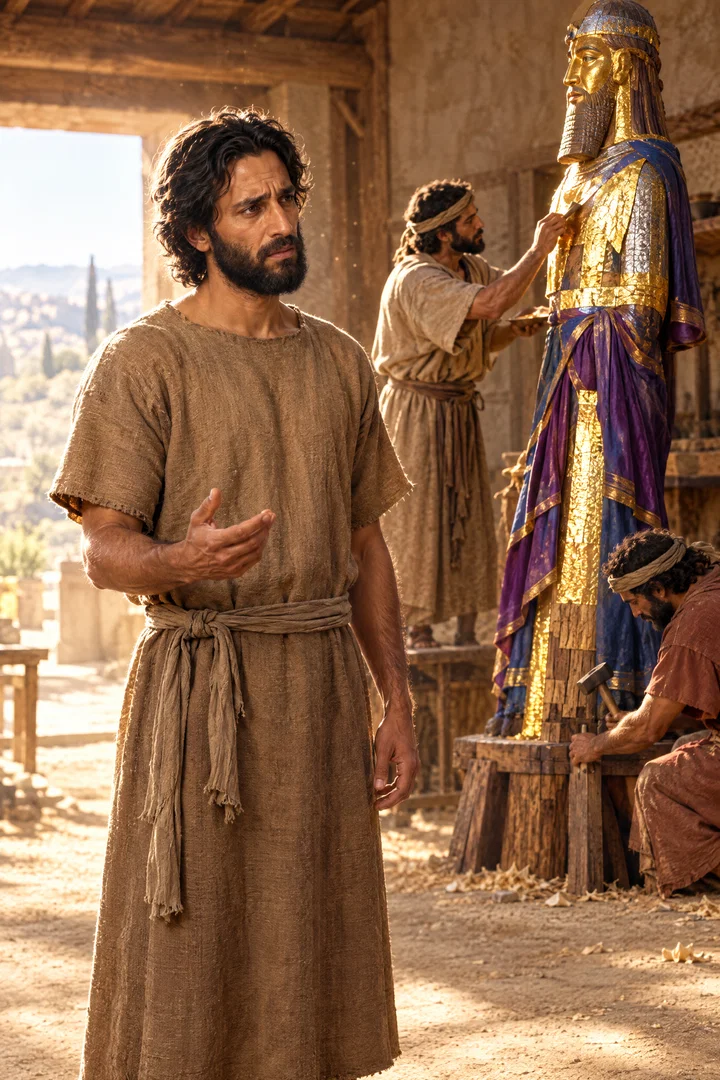
The smith with the tongs both worketh in the coals, and fashioneth it with hammers, and worketh it with the strength of his arms: yea, he is hungry, and his strength faileth: he drinketh no water, and is faint.
Translations
The smith with the tongs both works in the coals, and fashions it with hammers, and works it with the strength of his arms: yes, he is hungry, and his strength fails: he drinks no water, and is faint.
The smith with the tongs both worketh in the coals, and fashioneth it with hammers, and worketh it with the strength of his arms: yea, he is hungry, and his strength faileth: he drinketh no water, and is faint.
The smith with the tongs both worketh in the coals,
And fashioneth it with hammers,
And worketh it with the strength of his arms:
Yea, he is hungry, and his strength faileth:
He drinketh no water, and is faint.The smith with the tongs both worketh in the coals, and fashioneth it with hammers, and worketh it with the strength of his arms: yes, he is hungry, and his strength faileth: he drinketh no water, and is faint.
Revised Version, American Standard Version
The smith maketh an axe, and worketh in the coals, and fashioneth it with hammers, and worketh it with his strong arm: yea, he is hungry, and his strength faileth; he drinketh no water, and is faint.
He hath wrought iron [with] an axe, And hath wrought with coals, And with hammers doth form it, And doth work it by his powerful arm, Yea, he is hungry, and there is no power, He doth not drink water, and he is wearied.
The iron-smith [hath] a chisel, and he worketh in the coals, and he fashioneth it with hammers, and worketh it with his strong arm; — but he is hungry, and his strength faileth; he hath not drunk water, and he is faint.
As for the smith, [with his] cutting-tool,—When he hath wrought in the live coals, And, with hammers, hath fashioned it,—And hath wrought it with his strong arm, Anon he is hungry, and hath no strength, He hath drunk no water and so hath become faint!
Berean Standard Bible, Majority Standard Bible
The blacksmith takes a tool
and labors over the coals;
he fashions an idol with hammers
and forges it with his strong arms.
Yet he grows hungry and loses his strength;
he fails to drink water and grows faint.The blacksmith takes an ax,
works in the coals,
fashions it with hammers,
and works it with his strong arm.
He is hungry,
and his strength fails;
he drinks no water,
and is faint.The iron-worker is heating the metal in the fire, giving it form with his hammers, and working on it with his strong arm: then for need of food his strength gives way, and for need of water he becomes feeble.
The smith taketh an instrument, and worketh in the coles, and facioneth it with hammers, and worketh it with the strength of his armes: yea, he is an hungred, and his strength faileth: he drinketh no water, and is faint.
Douay-Rheims (Challoner revision)
The smith hath wrought with his file, with coals, and with hammers he hath formed it, and hath wrought with the strength of his arm: he shall hunger and faint, he shall drink no water, and shall be weary.
Pictures
Cross-references
- Isaiah 41:7
So the carpenter encouraged the goldsmith, and he that smootheth with the hammer him that smote the anvil, saying, It is ready for the sodering: and he fastened it with nails, that it should not be moved.
Both describe craftsmen laboring together to make an idol.
Commentary
Each commentary is drawn from primary sources: the writings of Ellen G. White and Adventist pioneers and periodicals. Each commentary is separate. Its own words are not a quotation; follow the references to read the source passages.
Ellen G. White
4 sources
Isaiah 44:12 belongs to Isaiah 41-45, where God very fully reveals His purpose for His people.JIOKP 15.2–16.1Ms 73, 1907, par. 8–9 Those chapters should be prayerfully studied.Ms 73, 1907, par. 8–9 They direct God's people to rely on His wisdom, and not to turn away from Him to look to finite man for wisdom.JIOKP 15.2–16.1Ms 73, 1907, par. 8–9
The verse belongs to a passage contrasting idols made by human hands with the true God as the Maker of heaven and earth.STE 63.3 That contrast teaches that people can learn from God's works to recognize the difference between their own powerless creations and their Creator.STE 63.3 Isaiah 44:9-17 describes people making idols from materials God created and then worshiping the work of their own hands instead of the Creator.SG3 62.1 This applied to people who used gold, silver, precious stones, and wood to make images, gloried in their craftsmanship, and taught their children to treat those images as gods.SG3 62.1
Sources
Pioneers and periodicals
23 sources
The verse pictures a blacksmith shaping metal for an idol in hot coals with tongs and hammers, straining with all his arm strength until hunger and thirst leave him exhausted and faint.RH Jul 6, 1916ST Apr 22, 1889ST Nov 21, 1892 It belongs to Isaiah's exposure of the foolishness and vanity of idolatry in contrast to worship of the true God.ST Aug 29, 1911ST Jun 25, 1912RH Mar 30, 1869 The maker's hunger, thirst, weakness and faintness prove his own frailty and mortality, showing he himself is powerless and dependent on food and water.ST Nov 21, 1892ST Oct 6, 1909ST Jan 13, 1887 His work therefore produces only a human-made object that cannot hear prayer, save, heal, or care for those who trust in it.HM Jun 1889ST Jan 13, 1887HM Jun 1889 Against such helpless workmanship stands God as the self-existent Creator, Redeemer and Saviour, alone eternal and unchanging, who gives life and breath to all and hears those who pray to Him.ST Aug 29, 1911ST Nov 6, 1893ST Jun 25, 1912ST May 20, 1913
Setting and Plain Meaning
Isaiah 44:12 stands in the second part of Isaiah, chapters 40–66, and Isaiah's prophecies began during the reign of Uzziah and continued through Jotham, Ahaz, and Hezekiah, in a crucial period for Judah.ST May 28, 1912 It belongs to the part of Isaiah's prophecy that carries the reader forward to Christ's sufferings and the glory of His reign.
The verse depicts a smith laboring to make an idol, working metal in the coals and fire with tongs and fashioning it with hammers and the strength of his arms.RH Jul 6, 1916ST Apr 22, 1889HM Jun 1889ST Oct 6, 1909RH Nov 3, 1910 He puts his own bodily strength into shaping it with tools, yet hunger and thirst overcome him until his strength fails and he grows weak, exhausted, and faint.RH Jul 6, 1916ST Apr 22, 1889ST Nov 21, 1892ST Oct 6, 1909RH Nov 3, 1910 This shows the maker's human frailty and dependence on food and water, spending his strength and becoming hungry, thirsty, weak, and faint.ST Apr 22, 1889ST Nov 21, 1892HM Jun 1889ST Oct 6, 1909RH Nov 3, 1910 The fashioned object is therefore merely a human-made thing produced by human hands, tools, and effort, not a divine being worthy of worship.ST Apr 22, 1889ST Nov 21, 1892HM Jun 1889ST Oct 6, 1909RH Nov 3, 1910
Folly of Idol Making
Isaiah 44:12 belongs to a vivid portrayal that lays bare the foolishness, blindness, vanity and weakness of idolatry over against the worship of the true God.ST Aug 29, 1911ST Jun 25, 1912RH Mar 30, 1869ST Jul 22, 1875 The passage to which it belongs exposes the folly of fashioning objects that men then bow down to as gods, and the vanity of trusting in them.RH Mar 30, 1869ST Jul 22, 1875 It sets the human effort and weakness involved in making an idol against the power and wisdom of God.ST Jun 25, 1912
The verse shows deluded makers busily laboring with energy, harmony and devotion, in a misguided zeal worthy of a better cause.RH Nov 6, 1900 They work with all the strength of their arms until hunger, thirst and exhaustion cause their strength to fail.RH Nov 6, 1900 The smith works the metal in coals and fire with tongs and fashions it with hammers, yet he grows hungry and faint.RH Mar 30, 1869
The maker spends his strength and becomes hungry, thirsty, weak, exhausted and faint, proving himself mortal, frail and powerless and dependent on food and water.ST Nov 21, 1892ST Oct 6, 1909ST Jan 13, 1887ST Jun 14, 1910 He shapes the idol with tools and the strength of his arms, yet hunger and thirst leave him weak.ST Oct 6, 1909 Such a human being, who himself needs food and water, cannot make a god worthy of worship, and it is foolish to trust such a work to save or deliver.ST Nov 21, 1892ST Jan 13, 1887
The idol is therefore merely a human-made object fashioned by human hands, tools, effort and fire, not by the Creator.RH Nov 3, 1910RH Mar 7, 1907ST Nov 7, 1892 It is only a piece of wood from a tree, only a block of wood, with no more power to help as a frightful image than it had out in the woods.HM Jun 1889ST Nov 7, 1892 Human labor cannot give the made object divine power or make it a living spirit.ST Jun 14, 1910ST Nov 7, 1892 It is not a divine being worthy of worship, yet men worship it, bow to it, and seek help from it.RH Nov 3, 1910RH Mar 7, 1907RH Apr 23, 1901
With scathing irony the verse exposes the senseless impotence of such man-made gods, helpless and without power of will.ST Apr 22, 1889 They are like the many gods of heathen lands, including the god of war and the queen of heaven and the goddess of maternity. They are disgraced and dethroned when people no longer fear them and bow down to them but cast them aside for the true God who hears prayer and to whom all flesh comes. The fashioned object has no power to help anyone, for the smith labors to shape it while becoming hungry, exhausted and thirsty.ST Aug 20, 1894ST Aug 6, 1894
It cannot hear prayer or help its worshiper, cannot save those made from wood and stone, and cannot deliver those who trust in it.HM Jun 1889ST Jan 13, 1887ST Jun 17, 1886RH Apr 23, 1901ST Aug 6, 1894 It cannot know about pain, cure sickness, or heal, and it cannot care for or love those who pray to it.HM Jun 1889 Sincere belief in it is not enough, because faith must believe right.HM Jun 1889
Contrast With True God
The verse sets powerless human workmanship against God's power and wisdom, as part of a vivid exposure of the folly and weakness of idolatry in contrast with worship of the true God.ST Aug 29, 1911ST Jun 25, 1912ST Oct 6, 1909 God is the self-existent Creator of heaven and earth, the one only Creator, Redeemer, and Saviour, with no God beside Him.ST Nov 6, 1893 He alone possesses eternity and immutability of being and is the source of all life and power, who created all things by the word of His power and gives to all life and breath, in whom all live and move and have being.ST Nov 6, 1893 The smith shapes his idol with tools and the strength of his arms, yet hunger and thirst leave him weak and faint, showing the maker's human frailty against the divine power such workmanship cannot possess.ST Oct 6, 1909
In contrast to idols, the true God hears prayer, to whom all flesh comes, and He is near.ST May 20, 1913 The idol fashioned by a workman with his own failing strength is helpless and senseless, like the many gods of heathen lands, including the god of war and the queen of heaven and the goddess of maternity. Such gods are disgraced and dethroned when people no longer fear them and bow down to them but cast them aside for the true God who hears prayer and to whom all flesh comes. The wooden god cannot care for or love the one who prays to it, while God is near and can care for and love him.ST May 20, 1913
Sincere belief in an idol is not enough, because faith must believe right.HM Jun 1889 The idol is only a piece of wood from a tree, shaped by a hungry, thirsty, faint and failing workman, and it has no more power to help as a frightful image than it had out in the woods.HM Jun 1889 It cannot know about pain, hear prayer, or cure sickness and heal.HM Jun 1889 The Bible teaches what to believe in order to have right faith in the living God who hears and helps.HM Jun 1889
Sources