Isaiah 6:4
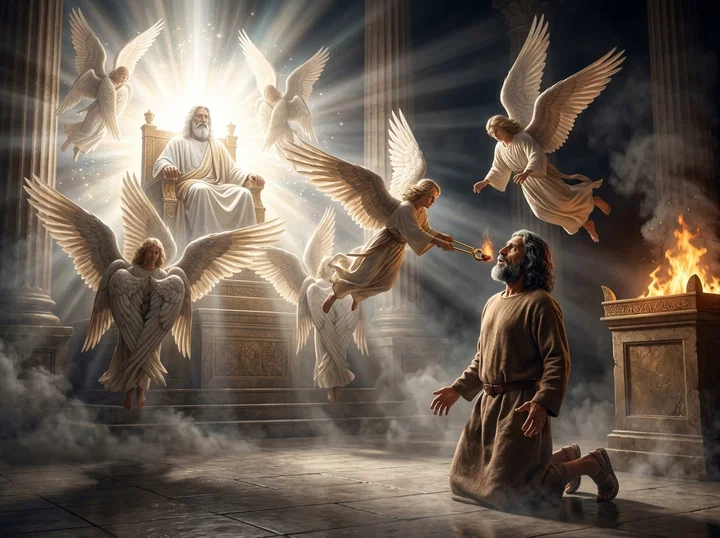
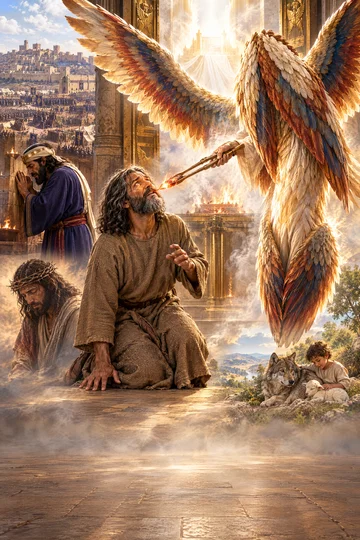
And the posts of the door moved at the voice of him that cried, and the house was filled with smoke.
Translations
American King James Version, King James Version, KJV Cambridge Paragraph Bible, Webster Bible
And the posts of the door moved at the voice of him that cried, and the house was filled with smoke.
And the foundations of the thresholds were moved at the voice of him that cried, and the house was filled with smoke.
American Standard Version, Darby Translation
And the foundations of the thresholds shook at the voice of him that cried, and the house was filled with smoke.
And the posts of the thresholds are moved by the voice of him who is calling, and the house is full of smoke.
And the foundations of the porch, were moved at the voice of him that cried,—and the house, was filled with smoke.
Berean Standard Bible, Majority Standard Bible
At the sound of their voices the doorposts and thresholds shook, and the temple was filled with smoke.
The foundations of the thresholds shook at the voice of him who called, and the house was filled with smoke.
And the bases of the door-pillars were shaking at the sound of his cry, and the house was full of smoke.
And the lintles of the doore cheekes moued at the voyce of him that cryed, and the house was filled with smoke.
Douay-Rheims (Challoner revision)
And the lintels of the doors were moved at the voice of him that cried, and the house was filled with smoke.
Pictures
Cross-references
- John 12:41
These things said Esaias, when he saw his glory, and spake of him.
John identifies Isaiah’s vision of glory as a sight of Christ.
- Revelation 4:1-2
After this I looked, and, behold, a door was opened in heaven: and the first voice which I heard was as it were of a trumpet talking with me; which said, Come up hither, and I will shew thee things which must be hereafter.
John sees the same heavenly place and throne Isaiah describes.
- Psalms 18:6-7
In my distress I called upon the LORD, and cried unto my God: he heard my voice out of his temple, and my cry came before him, even into his ears.
A cry from God’s temple is heard, followed by shaking.
- 1 Kings 8:10-11
And it came to pass, when the priests were come out of the holy place, that the cloud filled the house of the LORD,
The Lord’s glory fills the temple.
- Exodus 40:34-35
Then a cloud covered the tent of the congregation, and the glory of the LORD filled the tabernacle.
God’s glory fills the sanctuary.
- Revelation 4:5-8
And out of the throne proceeded lightnings and thunderings and voices: and there were seven lamps of fire burning before the throne, which are the seven Spirits of God.
The passage compares these sanctuary scenes with Isaiah’s vision.
- 2 Samuel 22:7-8
In my distress I called upon the LORD, and cried to my God: and he did hear my voice out of his temple, and my cry did enter into his ears.
God hears a cry from his temple, then the earth shakes in his anger.
- Ezekiel 10:3-4
Now the cherubims stood on the right side of the house, when the man went in; and the cloud filled the inner court.
Both texts describe the house filled with a manifestation of God’s glory.
Commentary
Each commentary is drawn from primary sources: the writings of Ellen G. White and Adventist pioneers and periodicals. Each commentary is separate. Its own words are not a quotation; follow the references to read the source passages.
Ellen G. White
29 sources
The shaking of the thresholds and doorposts at the voice of the crying one and the filling of the house with smoke belong to Isaiah's vision of the Lord seated upon a throne high and lifted up with His train filling the temple, and the cry that moved them was the seraphim's proclamation of the holiness of the Lord of hosts.8T 281.1–4MH 432.1–433.2CT 374.2Ms 27, 1891, par. 12–13Ms 48, 1903, par. 4–6 The trembling and the smoke reveal the greatness, holiness, glory, majesty, and awe-inspiring power of God's presence, whose true sight stirs heaven and earth.8T 281.1–4MH 432.1–433.2CT 374.2Ms 48, 1903, par. 4–6 That revelation teaches reverence before the great and holy God, before whom even angels veil their faces, and shapes humble awe in approaching Him and handling sacred things.Lt 71, 1895, par. 33–34Ms 64, 1895, par. 1–3Ms 174, 1897, par. 25–26 Beholding it led Isaiah to recognize his own imperfection and unclean lips and the sinfulness of his people, overwhelming human self-importance and pride until self-righteousness is laid aside in contrition and meekness.CT 374.2Ms 27, 1891, par. 12–13Ms 9, 1894, par. 14–15Ms 126, 1899, par. 32–35Lt 71, 1895, par. 35 The full pattern is conviction that one is undone and unfit to be sent until iniquity is taken away and sin purged by the live coal from the altar, so that cleansed lips and a Spirit-filled heart can answer with willingness to go, which every worker chosen of God still needs in depending on God as instructor, receiving orders from Him enthroned, and bearing truth in divine power.Ms 27, 1891, par. 12–13Ms 48, 1903, par. 4–6Ms 37, 1902, par. 4–9Lt 58, 1895, par. 22–25Lt 31, 1892, par. 15–18
The Shaking Temple Vision
The thresholds and doorposts moved at the voice of the one crying out, and the house was filled with smoke, in Isaiah's vision of the Lord sitting upon a throne high and lifted up with His train filling the temple.8T 281.1–4MH 432.1–433.2CT 374.2Lt 71, 1895, par. 33–34Ms 64, 1895, par. 1–3 The shaking thresholds and the smoke-filled house belonged to an overwhelming display of glory and majesty that revealed greatness and holiness.8T 281.1–4MH 432.1–433.2CT 374.2 The doorposts shook at the seraph's cry and the pillars trembled, conveying the awe-inspiring power of the divine presence.GW 21.1–2Lt 71, 1895, par. 33–34Ms 64, 1895, par. 1–3 The cry that moved the posts was the seraphim's proclamation, Holy, holy, holy, is the Lord of hosts, revealing holiness and glory.Ms 27, 1891, par. 12–13Ms 48, 1903, par. 4–6 A true sight of that holiness carries overwhelming majesty and power that stirs heaven and earth.Ms 48, 1903, par. 4–6
In one telling the posts, pillars, and cedar gate tremble at the resounding praise of the seraphim, and the house is filled with their praise.5T 749.2–751.1 The moving posts of the door and the house filled with smoke manifest Christ Himself as Lord of the temple, seen sitting upon a throne high and lifted up.Ms 71, 1897, par. 21–22 They manifest the Shekinah, the visible pavilion of Jehovah.Ms 71, 1897, par. 21–22 That is the same glory once visible in the holy of holies over the mercy seat, where the high priest entered only once a year on the great day of atonement with the blood of the slain victim typical of the blood of the Son of God shed for the sins of the world.Ms 71, 1897, par. 21–22 When Christ should leave the temple its glory would depart.Ms 71, 1897, par. 21–22
The vision places God enthroned in the most holy place, above the ark containing His commandments and surrounded by cherubim and His ministers.Ms 7, 1902, par. 7 The glory shining from that holy place shows that God is enthroned there.Ms 7, 1902, par. 7 The heavenly sanctuary parallels this, where incense rises like smoke and the glory from God's throne fills the temple.SG1 158.1
God's Holiness Revealed
The shaking thresholds and the smoke filling the house reveal the greatness, holiness, glory, majesty, and awe-inspiring power of God's presence.8T 281.1–4MH 432.1–433.2CT 374.2GW 21.1–2Lt 71, 1895, par. 33–34 The trembling doorposts and pillars under the seraphim's cry, with the temple filled with smoke, are an overwhelming display of divine glory in which even the seraphim veil themselves in humility.8T 281.1–4CT 374.2GW 21.1–2Lt 71, 1895, par. 33–34Ms 64, 1895, par. 1–3 A true sight of that holiness and glory carries overwhelming majesty and power that stirs heaven and earth.Ms 48, 1903, par. 4–6
The vision teaches reverence for God and holy things, for awareness of the great and holy God before whom angels veil their faces should shape how people approach Him.Lt 71, 1895, par. 33–34Ms 64, 1895, par. 1–3Ms 174, 1897, par. 25–26Lt 5, 1896, par. 7–8 Those who handle sacred things should tremble with awe and fear and humble themselves continually before the Lord of hosts in recognition of His majesty.Lt 71, 1895, par. 33–34Ms 174, 1897, par. 25–26Lt 5, 1896, par. 7–8 Beholding the scene led Isaiah to recognize his own imperfection and unclean lips and the sinfulness of his people before the Lord.CT 374.2Ms 27, 1891, par. 12–13Ms 9, 1894, par. 14–15Ms 22, 1895, par. 8–11Ms 126, 1899, par. 32–35 That sight of overwhelming holiness and glory revealed his sinfulness so powerfully that it prepared for his cleansing and call to serve.Ms 27, 1891, par. 12–13Ms 9, 1894, par. 14–15Ms 22, 1895, par. 8–11Ms 126, 1899, par. 32–35Ms 37, 1902, par. 4–9
That revealed majesty overwhelms human self-importance, leading people to see their sinfulness, let go of self-righteousness and pride, and respond with contrition and meekness.Ms 126, 1899, par. 32–35Lt 71, 1895, par. 35 This prepares for cleansing and the call to serve, for no one is fit to be sent in answer to "Whom shall I send" until iniquity is taken away and sin purged.Ms 27, 1891, par. 12–13Ms 126, 1899, par. 32–35Ms 37, 1902, par. 4–9 The full pattern is conviction that one is undone and a man of unclean lips, then purging by the live coal from the altar, the refining Spirit, so that he can answer with willingness, "Here am I; send me."Ms 27, 1891, par. 12–13Ms 37, 1902, par. 4–9
The vision shows heaven closely connected with events on earth and God's care for those loyal to Him.Ms 143, 1899, par. 21Lt 58, 1895, par. 22–255T 753.3 It gives workmen the lesson that God's work is carried out with divine power, order, and infinite wisdom that brings into perfect harmony what appears intricate, confusing, and beyond human explanation.Ms 143, 1899, par. 21Lt 58, 1895, par. 22–255T 753.3 The temple-filling glory is contrasted with its apparent absence among people living amid sin and sorrow whose iniquities separate them from God.RH Jan 2, 1900Ms 48, 1894, par. 6–7 At first the vision made God seem great, high, and frightening, while His graciousness, compassion, tenderness, goodness, and love were not yet understood.RH Jan 2, 1900Ms 48, 1894, par. 6–7
The chapter is to be read with the exposure of perpetual backsliding, refusal to return, failure to repent, rejection of the word, false wisdom, and healing hurt slightly by saying peace when there is no peace.Lt 43, 1898, par. 8–12 It belongs with the command to amend ways and doings, execute just judgment, not oppress the stranger, fatherless, and widow, shed no innocent blood, forsake other gods, and obey God's voice and walk forward not backward.Lt 43, 1898, par. 8–12 It stands against trusting in lying words about the temple while continuing in stealing, murder, adultery, false swearing, and idolatry, and with the free invitation to everyone who thirsts to come, buy without money, hear diligently, eat what is good, live, and enter the everlasting covenant.Lt 43, 1898, par. 8–12 The verse belongs to a vivid description of heavenly glory and of glorious things to be revealed.STE 23.1
Call to God's Workers
Every worker chosen of God needs a similar experience of seeing the throne high and lifted up with its train filling the temple, where at the seraphim's cry of Holy, holy, holy is the Lord of hosts the doorposts moved and the house was filled with smoke, revealing God's holiness and glory.Ms 27, 1891, par. 12–13 That sight brings the conviction of being a person of unclean lips, and no one is fit to answer the call of whom shall be sent until iniquity is taken away and sin purged by the live coal from the altar, the refining Spirit upon him, so that he can say here am I, send me.Ms 27, 1891, par. 12–13 Human workers must not try to control the work themselves but depend on God as its instructor and give Him the glory, for what appears intricate and beyond human explanation is brought into perfect harmony by His infinite wisdom ordering His work.Lt 58, 1895, par. 22–25 God is enthroned in the most holy place above the ark containing His commandments and surrounded by cherubim and His ministers, and the glory shining from that holy place shows those carrying forward His work on earth should look to Him enthroned and receive their orders from Him.Ms 7, 1902, par. 7
Workers for God cannot succeed if they move in their own spirit but must be imbued with the Holy Spirit, first meeting with Christ in private and deriving their efficiency from Him.Lt 31, 1892, par. 15–18 A true sight of God's holiness and glory carries overwhelming majesty and power that stirs heaven and earth, shaking the posts of the door and filling the house with smoke at the seraphim's cry.Ms 48, 1903, par. 4–6 For today that means coming with hearts imbued with the Holy Spirit and lips touched with live coals from the divine altar, so that every worker feels his hand upon a lever that will move the world.Ms 48, 1903, par. 4–6Lt 31, 1892, par. 15–18
Fresh from that vision workers come to the people with truth, as Moses descended from the holy mount with face glorified by communion and as the high priest reappeared from within the holy of holies.3MR 15.1 They bear a plain, clear message of Bible truth filled with earnestness and power, coming from hearts imbued and lips touched from the altar.Ms 48, 1903, par. 4–6 None of them brings truth greater or more precious than the doctrine of the cross and the imputed righteousness of Christ, to be borne to the people not in word only but in the power of God to everyone who believes to bring souls back to God by representing in actions the character of God.3MR 15.1Lt 31, 1892, par. 15–18 Seeing God's majesty in the shaking, smoke-filled presence of the King, the Lord of hosts, prepares those ministering to souls who do not know present truth and sounding the note of warning in the byways and highways to prepare a people for the great day of God.Lt 122, 1899, par. 8–10 That representation will be acted over and over again when canvassers press close to Christ, wear His yoke, daily learn of Him, and, imbued with His Spirit, carry messages of peace and comfort to sorrowing, disappointed, sad, and brokenhearted souls.Lt 122, 1899, par. 8–10
Sources
Pioneers and periodicals
42 sources
The shaking thresholds and smoke-filled house came at the cry of the seraphim in Isaiah's vision of God's glory.ST Apr 1, 1889ST Oct 6, 1898ST Oct 6, 1898 It was the heavenly temple, the first apartment of the heavenly sanctuary with its altar, the same throne-place John saw, testifying that a real sanctuary exists in heaven and displaying the majesty and power of the Lord's presence there.RH Mar 15, 1870RH Nov 17, 1863RH Aug 28, 1853RH Aug 18, 1863RH Feb 18, 1858 The One seated high and lifted up on the throne is Christ in heavenly glory before His coming to earth, proclaimed holy by the six-winged seraphim who veil their faces before Him.ST Apr 1, 1889ST Jun 21, 1883 In that light of overwhelming purity Isaiah saw himself undone as a man of unclean lips, for true knowledge of self comes by beholding God's greatness rather than by looking inward, and after confession an angel touched his lips with a live coal from the altar so his iniquity was taken away.ST Jul 9, 1896ST Feb 19, 1902RH Sep 17, 1857 Only thus cleansed was he ready to hear the call for a messenger and answer, Here am I, send me, showing that beholding God's holiness must lead to cleansing, to mission, and to speaking abroad His excellencies in reverent, self-abasing worship.RH Aug 20, 1903ST Jan 2, 1901ST Jun 28, 1899
Historical Setting and Wording
Isaiah 6:4 belongs to the first part of Isaiah, chapters 1 to 39, which contains the prophecies and historical accounts from Isaiah's active work as God's messenger mingling in the public concerns of the rulers and the people of the nation.RH Jul 6, 1916 That part is made up of single distinct prophecies published at different times and on different occasions and afterward brought together into one collection.RH Jul 6, 1916 The vision to which the verse belongs was given in the year that King Uzziah died as Isaiah's call to service and to God's work.ST Dec 8, 1898ST Jun 4, 1912 Isaiah's home was in Jerusalem and his father's name was Amoz.ST Dec 8, 1898 His prophecies belong to the days of Uzziah, Jotham, Ahaz and Hezekiah, kings of Judah, contemporary with Hosea in Israel and with Nahum and Micah in Judah, only a few years from the founding of Rome and the rise of Corinth.ST Dec 8, 1898
When the mortal shadow of kingly power passed away in the death of Uzziah, the immortal and real King who abides and rules forever was revealed sitting upon a throne.ST Jul 5, 1910 Amid the ever-changing a heavenly vision is needed to behold the never-changing.ST Jul 5, 1910 As leaves dropping from trees in autumn reveal the enduring rock cliff where the trees root, so the passing of the temporal and human makes the rock background of the enduring God and His unchangeable Word stand out more clearly.ST Jul 5, 1910
At the voice of the seraphim crying out, the posts of the door moved and shook.ST Apr 1, 1889ST Oct 6, 1898 The thresholds shook under that cry.ST Oct 6, 1898ST Oct 6, 1898 And the house was filled with smoke.ST Apr 1, 1889ST Oct 6, 1898ST Oct 6, 1898
Heavenly Temple Vision
The shaking of the doorway posts at the crying voice and the filling of the house with smoke belong to the vision of God's temple in heaven.RH Mar 15, 1870RH Feb 3, 1853RH Nov 17, 1863 That temple is the heavenly tabernacle and not the temple at Jerusalem.RH Nov 17, 1863 It is the heavenly sanctuary in its first apartment, where the ministry of Christ begins.RH Mar 15, 1870 The altar stands in that scene before the throne, and from it the seraph takes the live coal.RH Mar 15, 1870
Isaiah and John beheld the same place, for both beheld the throne of God and the six-winged living beings around it.RH Feb 3, 1853RH Feb 25, 1858 The moving of the doorposts and the filling with smoke belong to that shared vision of the glory of God also beheld in Revelation.RH Feb 3, 1853RH Feb 25, 1858
The depiction of the house of the Lord filled with smoke at the cry of the heavenly beings is testimony that a temple and sanctuary exist in heaven.RH Aug 28, 1853RH Aug 18, 1863RH Feb 18, 1858ST Jun 3, 1880 The shaking of the temple by the seraph's cry and its filling with smoke display the majesty and presence of the Lord in His heavenly temple.ST May 16, 1878RH Jan 4, 1870 That shaking marks the scene with a display of divine power.ST May 16, 1878
Lord Seen in Glory
The Lord whom Isaiah saw seated on a throne high and lifted up is Christ enthroned in heavenly glory, the Adonai of the vision identified as the Messiah, the Son of God before He came to earth, as shown by the application of Isaiah's words in John 12:40-41.ST Apr 1, 1889ST Jun 21, 1883ST Oct 31, 1895 At the voice of the seraphim crying out the posts of the temple door moved and shook and the house was filled with smoke, displaying His divine majesty and the glory filling the heavenly temple.ST Apr 1, 1889ST Oct 31, 1895 The seraphim in reverence shield their faces before Him and proclaim His holiness and that the whole earth is full of His glory.ST Oct 31, 1895 The scene is a sublime and dramatic portrayal of God's glory and the greatness of the divine nature, with His train filling the temple, the temple shaking and filled with smoke, and each seraph having six wings, covering face and feet and flying and crying Holy, holy, holy is the Lord of hosts.RH Jan 2, 1900ST May 18, 1915ST Mar 25, 1880 The overwhelming glory surrounding God's throne overcame Isaiah so that he cried that he was undone.ST May 18, 1915 That glory filling the temple stands in contrast to its apparent absence among people living amid sin and sorrow, whose iniquities separate them from God.RH Jan 2, 1900
The vision proves God is a being of glorious form and terrible majesty, with tangible form and infinite personality, having bodily form like the Father, and is not formless character or principle or an impersonal essence.ST Feb 27, 1907 The Lord is seen sitting upon a throne high and lifted up with His train filling the temple and the seraphim standing above Him, while the foundations of the threshold shake at the voice and the house is filled with smoke. The vision of the seraphim and God's throne was given to assure Isaiah that the Most High ruled even when Judah seemed about to be overwhelmed by wicked powers.ST Jan 31, 1911
Conviction Cleansing and Call
In the light of God's overwhelming majesty, with the temple shaking and filled with smoke around His throne, Isaiah recognized his own sin and imperfection and saw himself lost and undone.ST Feb 19, 1902ST May 18, 1915 Because his eyes had seen the King, the Lord of hosts, high and lifted up, he cried out that he was a man of unclean lips dwelling among a people of unclean lips.ST Feb 19, 1902 The vision of divine glory thus exposed his undone condition and uncleanness.ST Feb 19, 1902ST May 18, 1915
Genuine contrition and true knowledge of self come not by turning the mind inward upon self but by beholding God's greatness, purity and goodness.ST Jul 9, 1896 In the presence of divine glory human nothingness is seen by beholding His greatness, sin by beholding His purity, and badness by beholding His goodness, especially in knowing He gave all in Christ, and there is tasted healing, life-giving power.ST Jul 9, 1896 Seeing God's holiness gives a true knowledge of self, so that human sin and need become clear and defects of character are shown by contrast with His holiness and clarified through His presence and Spirit.ST Nov 12, 1894ST Nov 27, 1901 This revelation of sin was meant to bring cleansing, not discouragement, and leads to blessing when sin is renounced and God is chosen.ST Nov 12, 1894
The sight of divine purity leads to recognition and confession of sin and repentance, after which sin is purged.ST Jan 8, 1902 In that light Isaiah saw his own sinfulness and confessed himself a man of unclean lips, and was cleansed by God.ST Jan 8, 1902 A high and holy ministering angel came to his relief and touched his lips with a live coal from the heavenly altar, and his iniquity was taken away and his sin purged, so that after cleansing he could speak with God without fear.RH Sep 17, 1857 Only after that cleansing did he hear the voice of the Lord saying, Whom shall I send, and who will go for us, and instantly answer, Here am I; send me, and then the Lord sent him to go with a definite message of what to say and do.
The coal signifies that he had been given a message to speak, with the temple setting belonging to that experience of receiving a divine message.RH Aug 20, 1903 Beholding God's holiness and recognizing his own unworthiness came before receiving the divine message.ST Jun 28, 1899 Only after confession and cleansing was he ready to serve as God's messenger.ST Jun 28, 1899
Prophecy and Future Glory
With the rest of the vision of the Lord sitting upon a throne high and lifted up, with the moving of the posts of the door at the seraphim's cry and the filling of the house with smoke, the verse shows that God calls men to the ministry to preach the gospel, and it belongs to a vision concerning God's mission and the consecrated messengers whose lives He has cleansed.RH Dec 25, 1913ST May 31, 1910 The new view of the Lord and His glory humbled Isaiah and made him cry out that he was undone because he was a man of unclean lips dwelling among a people of unclean lips, and that encounter with God's majesty led him to recognize his sin and need.ST Jun 28, 1899 A high and holy ministering angel came to his relief and touched his lips with a live coal from the heavenly altar, and his iniquity was taken away and his sin purged, so that after confession and cleansing he was ready to serve as God's messenger.ST Jun 28, 1899
Only after that cleansing did he hear the voice of the Lord saying, Whom shall I send, and who will go for us, and instantly answer, Here am I; send me. Then the Lord sent him to go with a definite message of what to say and do. The vision given to the prophet was fulfilled when Israel was cast off as a nation.ST Sep 22, 1909 The wonderful view granted to Isaiah was a foreshadowing of the outshining of God's glory to be revealed in Christ, and such an exhibition of the glory of the Lord would blind the eyes of those who had persistently refused to receive the light as it was gradually revealed and as they were able to bear it, just as one who persists in living in a dark cave is blinded when a bright light suddenly breaks upon the vision.ST Feb 4, 1897
Angels and Practical Application
The seraphim around the throne are real, visible, personal beings with bodily form and shape, not an impersonal essence filling the universe.ST Aug 23, 1877 They serve around God upon His throne and are sent forth to carry out His commands on earth.ST Aug 10, 1915 Angelic agencies can appear arranged in different forms, including the forms represented by living creatures, and those forms do not necessarily describe their constant form.ST Jul 9, 1912 The cherubim are seen with six wings, matching the six-winged living creatures in Revelation 4, and their changing forms across Isaiah, Ezekiel, and Revelation show that these heavenly beings are represented differently in different times and ages.ST Nov 23, 1915
The moving doorposts and smoke-filled house reveal the infinite wisdom and power and holiness and justice of God that awaken reverence and awe in worship.ST Jan 2, 1901 They belong to the sublime vision of the great God sitting upon a throne high and lifted up, His train filling the temple, with seraphim above it each having six wings, covering face and feet and flying, crying Holy, holy, holy is the Lord of hosts and the whole earth full of His glory.ST Jan 2, 1901 That vision brings self-abasement over sin, as when Isaiah cried woe upon himself for being undone as a man of unclean lips dwelling among a people of unclean lips because his eyes had seen the King, the Lord of hosts.ST Jan 2, 1901 To behold God in His beauty and majesty of holiness in His temple in Zion is to lose sight of self and to know oneself to be inefficient and unworthy.RH May 8, 1913 This beholding communion is what God is calling all to now, and the same spiritual experience must be had in order to do a work like that of John the Baptist just prior to the second coming of Christ in the clouds of heaven.RH May 8, 1913
Isaiah beheld the glory of Christ Himself in the temple vision, and his example teaches that sight must lead to speech. Those who contemplate Christ are not only to behold but to speak of His excellencies and proclaim His glory abroad. The glory that fills the temple when the exalted Lord is seen stands in contrast to its apparent absence among people living amid sin and sorrow.RH Jan 2, 1900 Their iniquities separate them from God.RH Jan 2, 1900
Sources