Jeremiah 27:2
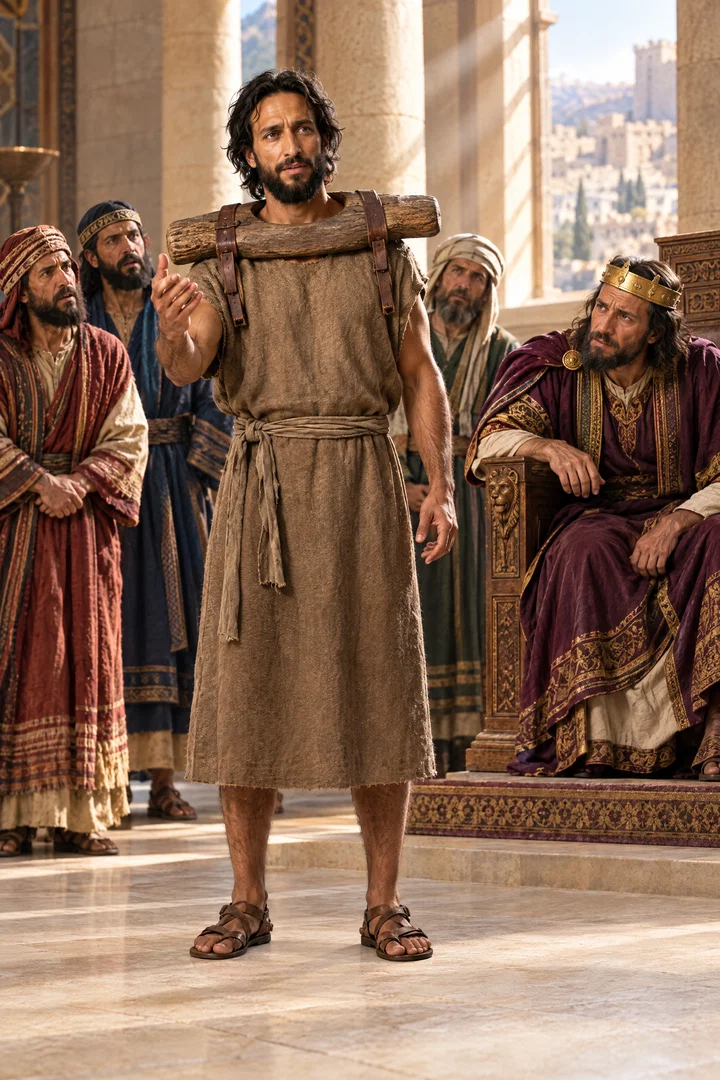
Thus saith the LORD to me; Make thee bonds and yokes, and put them upon thy neck,
Translations
Thus says the LORD to me; Make you bonds and yokes, and put them on your neck,
Thus saith the LORD to me; Make thee bonds and yokes, and put them upon thy neck,
Thus saith the Lord to me; Make thee bonds and yokes, and put them upon thy neck,
Thus saith the LORD to me; Make for thee bonds and yokes, and put them upon thy neck,
Thus saith the LORD to me: Make thee bands and bars, and put them upon thy neck;
Thus saith Jehovah to me: Make thee bonds and bars, and put them upon thy neck;
'Thus said Jehovah unto me, Make to thee bands and yokes,
Thus hath Jehovah said unto me: Make thee bonds and yokes, and put them upon thy neck;
Thus, said Yahweh unto me, Make thee, bonds and bars, and put them upon thine own neck.
Berean Standard Bible, Majority Standard Bible
This is what the LORD said to me:“ Make for yourself a yoke out of leather straps and put it on your neck.
the LORD says to me: “ Make bonds and bars, and put them on your neck.
This is what the Lord has said to me: Make for yourself bands and yokes and put them on your neck;
Thus saith the Lord to me, Make thee bonds, and yokes, and put them vpon thy necke,
Douay-Rheims (Challoner revision)
Thus saith the Lord to me: Make thee bands, and chains: and thou shalt put them on thy neck.
Pictures
Cross-references
- Jeremiah 28:1-4
And it came to pass the same year, in the beginning of the reign of Zedekiah king of Judah, in the fourth year, and in the fifth month, that Hananiah the son of Azur the prophet, which was of Gibeon, spake unto me in the house of the LORD, in the presence of the priests and of all the people, saying,
Hananiah counters Jeremiah’s yoke prophecy with a false promise of Babylon’s swift defeat.
- Jeremiah 25:11-12
And this whole land shall be a desolation, and an astonishment; and these nations shall serve the king of Babylon seventy years.
Foretells seventy years of Babylonian rule and Babylon’s later punishment.
- Jeremiah 27:8-11
And it shall come to pass, that the nation and kingdom which will not serve the same Nebuchadnezzar the king of Babylon, and that will not put their neck under the yoke of the king of Babylon, that nation will I punish, saith the LORD, with the sword, and with the famine, and with the pestilence, until I have consumed them by his hand.
Resisting Babylon brings punishment, while submitting allows the nations to remain in their lands.
- Jeremiah 27:12
I spake also to Zedekiah king of Judah according to all these words, saying, Bring your necks under the yoke of the king of Babylon, and serve him and his people, and live.
Jeremiah urges Judah’s king to submit to Babylon’s yoke.
- Jeremiah 27:6
And now have I given all these lands into the hand of Nebuchadnezzar the king of Babylon, my servant; and the beasts of the field have I given him also to serve him.
God calls Nebuchadnezzar his servant and gives him rule.
- Jeremiah 27:17
Hearken not unto them; serve the king of Babylon, and live: wherefore should this city be laid waste?
The people are urged to serve Babylon and live rather than rebel.
- 2 Chronicles 36:22-23
Now in the first year of Cyrus king of Persia, that the word of the LORD spoken by the mouth of Jeremiah might be accomplished, the LORD stirred up the spirit of Cyrus king of Persia, that he made a proclamation throughout all his kingdom, and put it also in writing, saying,
Jeremiah’s yoke signified Babylonian rule, which ended as Persia rose.
- 2 Kings 24:1-4
In his days Nebuchadnezzar king of Babylon came up, and Jehoiakim became his servant three years: then he turned and rebelled against him.
Describes Judah’s subjection to Babylon and the removal of its people.
- Daniel 2:37-38
Thou, O king, art a king of kings: for the God of heaven hath given thee a kingdom, power, and strength, and glory.
God gave Nebuchadnezzar his kingdom and dominion.
- Jeremiah 27:7
And all nations shall serve him, and his son, and his son’s son, until the very time of his land come: and then many nations and great kings shall serve themselves of him.
The message specifies how long the nations would serve Babylon’s kings.
- Daniel 4:34-37
And at the end of the days I Nebuchadnezzar lifted up mine eyes unto heaven, and mine understanding returned unto me, and I blessed the most High, and I praised and honoured him that liveth for ever, whose dominion is an everlasting dominion, and his kingdom is from generation to generation:
Nebuchadnezzar later acknowledges God’s rule over him.
- Isaiah 39:6-7
Behold, the days come, that all that is in thine house, and that which thy fathers have laid up in store until this day, shall be carried to Babylon: nothing shall be left, saith the LORD.
Isaiah foretells Jerusalem’s fall and the deportation of its people to Babylon.
Commentary
Each commentary is drawn from primary sources: the writings of Ellen G. White and Adventist pioneers and periodicals. Each commentary is separate. Its own words are not a quotation; follow the references to read the source passages.
Ellen G. White
7 sources
God told Jeremiah to make bonds and yokes and put them upon his own neck as a visible acted sign of subjection to Babylon.4T 168.4–169.2PK 442.3–444.1ST Feb 12, 1880ST Jun 1, 1876PK 423.1 The instruction belongs to Jeremiah's messages during the Babylonian captivity marked by conflict between the true prophet and false prophets.RH Mar 21, 1907
During Zedekiah's reign, as Babylon's threat drew nearer, Jeremiah carried this sign before ambassadors from the neighboring nations and sent yokes to their rulers.PK 442.3–444.1PK 423.1 The yoke declared God's decree that Judah and the surrounding nations were given into the hand of Nebuchadnezzar, king of Babylon, to serve him for a limited time appointed by God, signifying coming judgment and obligation to God.4T 168.4–169.2PK 442.3–444.1ST Feb 12, 1880ST Jun 1, 1876ST Feb 12, 1880 By the sign Jeremiah urged Judah to accept Babylonian rule and maintain friendly relations with Babylon rather than provoke its rule or rely on entangling alliances with Egypt.4T 168.4–169.2PK 423.1
Submission would allow the nations to remain in their own lands, while resistance and refusal of the yoke would bring more severe punishment in famine, war, and pestilence.4T 168.4–169.2ST Feb 12, 1880ST Jun 1, 1876 The servitude, the captivity, and the Temple vessels were to remain in Babylon for seventy years, after which God would deliver the captives and punish Babylon.ST Feb 12, 1880ST Jun 1, 1876 The warning called the people to submit for the time God had set, with their return from captivity depending on repentance and obedience.ST Feb 12, 1880
Sources
Pioneers and periodicals
22 sources
Jeremiah was to make bonds and yokes and put them on his own neck as a literal, visible sign and acted prophecy of coming captivity and subjection.ST Nov 11, 1897ST Dec 29, 1887ST Aug 20, 1885 The yokes he made and wore were also to be sent with messages to the king of Judah and the rulers of the surrounding kingdoms through their messengers at Jerusalem.ST Jul 12, 1910ST Feb 15, 1905ST Nov 11, 1897 The yoke declared that God had given the lands, peoples, kingdoms and even the beasts to Nebuchadnezzar of Babylon, whom He called His servant and set in dominion over them.ST Nov 11, 1897ST Aug 20, 1885ST Aug 28, 1901 Those who accepted the yoke and submitted to Babylon could remain in their own land, while rebellion would bring sword, famine and pestilence, for the servitude was appointed for seventy years.ST Feb 12, 1880ST Jun 1, 1876ST Jul 26, 1910 The warning was aimed especially at Zedekiah because he was inclined to rebel, and it stands in the conflict between the true prophet and false prophets who promised deliverance, showing that Nebuchadnezzar's God-given civil rule did not give him right to direct worship.ST Aug 28, 1901ST Aug 16, 1905ST Mar 6, 1907
The Sign and Setting
The command is to make bonds and yokes as a literal, visible sign and to put them upon the neck as an acted prophecy of the coming captivity and of the message to be delivered.ST Nov 11, 1897ST Dec 29, 1887ST Aug 20, 1885RH Sep 30, 1873 The yoke worn on the neck is a sign of service and subjection declaring that God had given the lands, the peoples and kingdoms, even the beasts, to Nebuchadnezzar of Babylon and that they were to submit to Babylonian rule.ST Nov 11, 1897ST Aug 20, 1885ST Feb 15, 1905 The sign belongs to a message to be delivered to the surrounding nations and to the neighboring kings.ST Nov 11, 1897ST Dec 29, 1887 Yokes were made, one was worn, and others were sent with messages to the rulers of Judah and the surrounding kingdoms through their ambassadors and messengers present at Jerusalem, warning them of Nebuchadnezzar as the coming conqueror and that they would serve the king of Babylon seventy years.ST Jul 12, 1910ST Feb 15, 1905ST Nov 11, 1897
The verse belongs to the book of Jeremiah that grew from the roll Baruch wrote at Jeremiah's mouth in the fourth year of Jehoiakim, for prophets kept written records of their predictions and gathered those intended for permanent use into larger volumes, and it stands with Jeremiah 21, 24, 27 and 28.RH Jul 27, 1916 It belongs to the prophecies concerning Jerusalem's fall.RH Jul 27, 1916 The section is not in chronological order, for up to chapter 20 the chapters are fairly chronological, but chapters 20 to 46 are out of order.ST Jul 12, 1910 In chronological order chapter 27 follows chapters 30 and 31 and comes before chapter 28.ST Jul 12, 1910
Its setting is after the crown was removed from Zedekiah and the kingdom passed to Nebuchadnezzar, and the bonds and yoke indicate the extent of Nebuchadnezzar's dominion.ST Jan 1, 1894 The command was given years before Zedekiah became king, showing foreknowledge that he would rule, and the message was especially meant for him because he was inclined to rebel against Babylon.ST Nov 11, 1897 Its warnings to Judah and the nations that they were to submit to Nebuchadnezzar were rejected by Zedekiah and his officers as they relied on opposing prophets and hoped for help from Egypt, and his rebellion led to the complete overthrow of him and Judah.ST Aug 16, 1905ST Nov 11, 1897
Subjection to Babylon Decreed
The yoke was a sign of service and subjection, declaring that God had given the lands, peoples and kingdoms to Nebuchadnezzar of Babylon.ST Nov 11, 1897ST Aug 20, 1885ST Aug 28, 1901 The gift included even the beasts, and Nebuchadnezzar is called God's servant, given dominion over the whole earth including Israel.ST Aug 20, 1885ST Mar 6, 1907ST Sep 29, 1898ST Feb 15, 1905 The proud king acknowledged God only later.ST Aug 28, 1901
His rule was appointed by God and required submission, with the yoke representing the required service of Judah and the surrounding nations to Babylon for a set time.ST Feb 12, 1880ST Jun 1, 1876ST Jul 26, 1910 Those who accepted the yoke could remain in their own lands.ST Feb 12, 1880ST Jun 1, 1876ST Jul 26, 1910 Rebellion would bring punishment and removal, by famine, war and pestilence.ST Feb 12, 1880ST Jun 1, 1876ST Jul 26, 1910
That servitude was to last seventy years, during which the captivity would continue and the vessels of the Temple would remain in Babylon.ST Feb 12, 1880ST Jun 1, 1876 The subjection began when Nebuchadnezzar started his great campaign and brought all the nearby kingdoms under his power, and that beginning dates the seventy years ending in 536 rather than the later captivity of Judah itself.ST Jul 12, 1910 Afterward God would deliver the captives and punish Babylon.ST Feb 12, 1880ST Jun 1, 1876
The message was also sent to the surrounding kings and was especially aimed at Zedekiah because he was inclined to rebel, the command being given years before he became king in foreknowledge that he would rule.ST Nov 11, 1897 Zedekiah and his officers rejected the warnings, relying on opposing prophets and hoping for help from Egypt.ST Aug 16, 1905 His rebellion led to his complete overthrow and that of Judah.ST Nov 11, 1897
Warning and Wider Application
The wearing of the yoke belongs to the conflict between the true prophet and the false prophets during the Babylonian captivity.RH Mar 21, 1907RH Apr 27, 1916ST Aug 16, 1905 The chapter stands among the places where those who teach what is false and prophesy lies in God's name are condemned for leading others to trust a lie.RH Apr 27, 1916 Such false teaching is a warning because it can destroy those who believe it.RH Apr 27, 1916 The warnings to Judah and the nations to submit to Nebuchadnezzar, king of Babylon, were rejected by Zedekiah and his officers as they relied on opposing prophets and hoped for help from Egypt.ST Aug 16, 1905
The making and wearing of bonds and yokes was a sign connected with the rule of Nebuchadnezzar, whom God called His servant.ST Mar 6, 1907 His God-given authority as ruler is to be distinguished from worship.ST Mar 6, 1907 That civil authority did not give him the right to direct God's people in worship.ST Mar 6, 1907
A yoke is a sign of service and subjection, made and worn and given to the king of Judah as a visible sign that Judah and the surrounding nations would be subject to Babylon.ST Feb 12, 1880ST Feb 15, 1905RH Jul 7, 1859 The command to wear it carried the warning to submit for the time God had appointed, with judgment coming on Judah and the surrounding nations.ST Feb 12, 1880 Return from captivity depended on repentance and obedience.ST Feb 12, 1880 The yoke also illustrates bondage to sin, which rules a person until conversion to Christ.ST Feb 15, 1905 The bonds and yokes placed on the neck were a sign of Judah's captivity and subjection to Gentile rule, representing the continuing oppression of God's people under foreign nations.RH Jul 7, 1859
Sources