Jeremiah 35:19
Therefore thus saith the LORD of hosts, the God of Israel; Jonadab the son of Rechab shall not want a man to stand before me for ever.
Translations
Therefore thus says the LORD of hosts, the God of Israel; Jonadab the son of Rechab shall not want a man to stand before me for ever.
King James Version, Webster Bible
Therefore thus saith the LORD of hosts, the God of Israel; Jonadab the son of Rechab shall not want a man to stand before me for ever.
therefore thus saith the Lord of hosts, the God of Israel; Jonadab the son of Rechab shall not want a man to stand before me for ever.
therefore thus saith the LORD of hosts, the God of Israel: Jonadab the son of Rechab shall not want a man to stand before me for ever.
therefore thus saith Jehovah of hosts, the God of Israel: Jonadab the son of Rechab shall not want a man to stand before me for ever.
therefore, thus said Jehovah of Hosts, God of Israel, Of Jonadab son of Rechab one standing before me is not cut off all the days.'
therefore thus saith Jehovah of hosts, the God of Israel, There shall not fail to Jonadab the son of Rechab a man to stand before me, for ever.
Therefore, Thus, saith Yahweh of hosts, God of Israel,—Jonadab son of Rechab shall not want one to stand before me, all the days!
Berean Standard Bible, Majority Standard Bible
this is what the LORD of Hosts, the God of Israel, says: Jonadab son of Rechab will never fail to have a man to stand before Me.’”
therefore the LORD of Armies, the God of Israel, says: ‘ Jonadab the son of Rechab will not lack a man to stand before me forever.’”
For this reason the Lord of armies, the God of Israel, has said, Jonadab, the son of Rechab, will never be without a man to take his place before me.
Therefore thus saith the Lord of hostes, the God of Israel, Ionadab the sonne of Rechab shall not want a man, to stand before me for euer.
Douay-Rheims (Challoner revision)
Therefore thus saith the Lord of host the God of Israel: There shall not be wanting a man of the race of Jonadab the son of Rechab, standing before me for ever.
Pictures
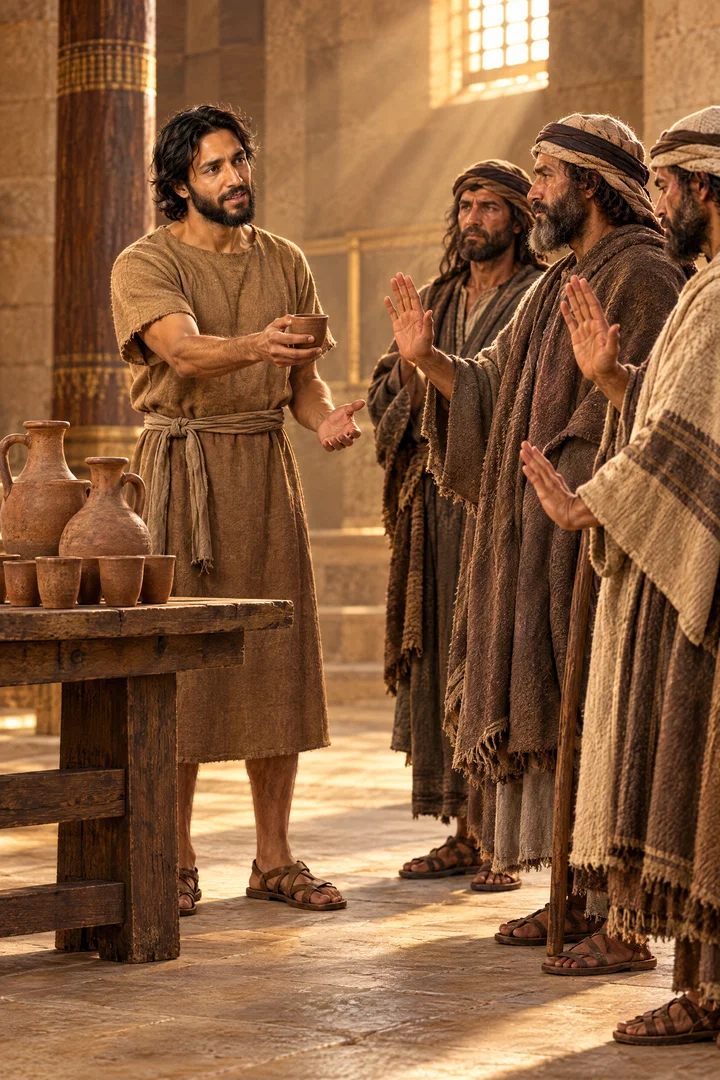
Cross-references
- Jeremiah 35:6
But they said, We will drink no wine: for Jonadab the son of Rechab our father commanded us, saying, Ye shall drink no wine, neither ye, nor your sons for ever:
The Rechabites explain the command of Jonadab that they obeyed.
- Jeremiah 35:14
The words of Jonadab the son of Rechab, that he commanded his sons not to drink wine, are performed; for unto this day they drink none, but obey their father’s commandment: notwithstanding I have spoken unto you, rising early and speaking; but ye hearkened not unto me.
The Rechabites obey Jonadab, unlike Judah, which refuses to heed God.
- 2 Kings 10:15
And when he was departed thence, he lighted on Jehonadab the son of Rechab coming to meet him: and he saluted him, and said to him, Is thine heart right, as my heart is with thy heart? And Jehonadab answered, It is. If it be, give me thine hand. And he gave him his hand; and he took him up to him into the chariot.
Jehonadab's right heart joins Jehu in chariot
- 2 Kings 10:23
And Jehu went, and Jehonadab the son of Rechab, into the house of Baal, and said unto the worshippers of Baal, Search, and look that there be here with you none of the servants of the LORD, but the worshippers of Baal only.
Jehonadab helps Jehu search the Baal temple for worshippers.
- 1 Chronicles 2:55
And the families of the scribes which dwelt at Jabez; the Tirathites, the Shimeathites, and Suchathites. These are the Kenites that came of Hemath, the father of the house of Rechab.
Identifies the Rechabite family as descended from the Kenites.
- 2 Kings 10:16
And he said, Come with me, and see my zeal for the LORD. So they made him ride in his chariot.
Jehonadab shares Jehu's zeal for the Lord
- Jeremiah 34:8-22
This is the word that came unto Jeremiah from the LORD, after that the king Zedekiah had made a covenant with all the people which were at Jerusalem, to proclaim liberty unto them;
Judah breaks its covenant to release servants and faces judgment for disobedience.
Commentary
Each commentary is drawn from primary sources: the writings of Ellen G. White and Adventist pioneers and periodicals. Each commentary is separate. Its own words are not a quotation; follow the references to read the source passages.
Ellen G. White
7 sources
The promise is that Jonadab the son of Rechab shall not want a man to stand before God forever, meaning his descendants will always have a continuing and enduring place of service before Him.Lt 282, 1908, par. 8–11PK 425.3Lt 152, 1907, par. 11–13ST Jun 1, 18764T 175.2 That lasting blessing was given because the Rechabites obeyed the commands of Jonadab their father, keeping all his precepts and doing all that he commanded them.Lt 282, 1908, par. 8–11PK 425.3Lt 152, 1907, par. 11–13ST Jun 1, 18764T 175.1 Their constancy was fully proved in loyalty to their father's command not to drink wine, and nothing was required of them beyond what they were able to perform.Lt 282, 1908, par. 8–11
The blessing teaches that faithfulness and obedience to God's rightful requirements bring blessing.PK 425.3ST Jun 1, 18764T 175.24T 175.1 Their obedience stands in contrast to Judah and Jerusalem, who refused to hearken to God and heed His words and warnings.Lt 282, 1908, par. 8–11Lt 152, 1907, par. 11–13ST Jun 1, 1876 The contrast exposes aggravated disobedience and an unrighteous course, because God spoke rising early and sent all His servants the prophets calling His people to return from evil and amend their doings.Lt 282, 1908, par. 8–11 The contrast shows that people who have received great light and warnings dishonor God when they turn from them to follow their own impulses.Lt 152, 1907, par. 11–13 Their obedience shows how much more reverence is due to God, and that rejecting His counsel and reproof leads to ruin.4T 175.3
Sources
Pioneers and periodicals
15 sources
God promises Jonadab the son of Rechab that his house will endure forever and never lack a man to stand and serve before Him.ST Jan 7, 1886ST Mar 11, 1908ST Jul 12, 1910 He gives this enduring place because they faithfully kept their father's command, showing the blessing that follows keeping sacred commitments with integrity for both the faithful and their families.ST Jun 1, 1876 Their loyalty is set against Judah's refusal to heed God's warnings, so their obedience both rebukes disloyalty and teaches that faithfulness to God's requirements brings blessing.ST Jun 1, 1876ST Jan 7, 1886ST Mar 16, 1904 Their obedience was total and included abstaining from wine and strong drink, making them an example of temperance and of accepting God's command without choosing which parts to follow.ST Mar 11, 1908ST May 30, 1911ST Apr 24, 1901ST Apr 8, 1886 The promise holds in the continued existence of Jonadab's descendants as a distinct people who still keep his command to drink no wine, plant no vineyards, and live in tents.ST Apr 24, 1901ST Mar 6, 1884ST Aug 21, 1893
Rechabites and Historical Setting
The Rechabites were Kenites of the house of Rechab, descended from Moses's father-in-law.ST Jan 7, 1886 That father-in-law had visited Moses in the wilderness with Moses's wife and two sons shortly after Israel left Egypt and then had gone his way into his own land, while Moses urged Hobab the son of Raguel the Midianite to journey with Israel to the promised place, to guide them in the wilderness, with the pledge that whatever goodness the Lord did to Israel would be shared with him.ST Jan 7, 1886
Jehonadab the son of Rechab took special precaution to keep his family pure in the midst of the corruption and iniquity of Israel by pledging them to drink no wine, neither they nor their sons forever.ST Oct 15, 1885 He is the man who met Jehu on the way from Jezreel to Samaria, whose heart was right as Jehu's heart was right in zeal for the Lord.ST Oct 15, 1885 He gave Jehu his hand, was taken up to ride with him in his chariot to see his zeal for the Lord, acted in concert with him, and went with him through the crowd of Baal-worshippers in the house of Baal to search and see that no worshippers of the Lord were there, which proves Jehu's zeal was not false zeal.ST Oct 15, 1885
The rules the Rechabites were still obeying were given by that same Jehonadab who met Jehu and rode with him in the chariot to execute judgment on the house of Ahab.ST Jan 7, 1886 That command had been given about two hundred and seventy-seven years earlier with no record of the family between, and God takes their unbroken obedience through all those years as the means of teaching His people.ST Jan 7, 1886
The verse belongs to events in Jehoiakim's reign, earlier than some events recorded in later chapters of Jeremiah.ST Jul 12, 1910 It stands in the part of Jeremiah from chapter 20 on where the chapters are not in chronological order, coming in chronological sequence after chapters 22, 23, 25, 26 and before chapters 36, 45, 24, 29.ST Jul 29, 1913 It belongs with the sad conditions in Judah surrounding the weeping prophet — false prophets, utter repudiation of the law of God and the principles of righteousness, and persecutions of Jeremiah himself — which show the awful enormity of sin and its sure consequences.ST Jul 29, 1913
Promise and Its Fulfillment
The promise declares that Jonadab the son of Rechab shall never lack a man to stand before God forever, so that his house will endure with a lasting place of service before Him.ST Jan 7, 1886ST Mar 11, 1908ST Jul 12, 1910ST Jan 7, 1886ST Mar 6, 1884 It means his family line will be preserved and will always have a man standing and serving before God.ST Mar 11, 1908ST Jul 12, 1910ST Jan 7, 1886ST Mar 6, 1884ST Aug 21, 1893 That continuance is presented as evidence that the Rechabites were an early temperance organization.ST Mar 11, 1908
This enduring place in His service was promised to Jonadab's descendants because they faithfully obeyed his command.ST Jun 1, 1876 Keeping sacred commitments with integrity brings blessing, benefiting both the faithful themselves and their families.ST Jun 1, 1876 Faithfulness to requirements brings blessing.ST Jun 1, 1876
The fulfillment is seen in the continued existence of Jonadab's descendants, who identify themselves as his descendants and cite the promise as fulfilled in themselves.ST Mar 6, 1884ST Aug 21, 1893 It is fulfilled in 60,000 descendants still living in the deserts near Mecca in Arabia, who drink no wine and plant no vineyards and live in tents as Jonadab commanded them.ST Mar 6, 1884 They are represented in Arabia, abstaining from wine and strong drink as an inherited practice separate from Sunday observance.ST Apr 24, 1901ST Mar 6, 1884ST Aug 21, 1893
Obedience, Rebuke, and Temperance
Jonadab's descendants were promised an enduring place of service before God because they faithfully obeyed his commands, and their obedience with its promised blessing stands in contrast to Judah's refusal to heed God's warnings, teaching that faithfulness to God's requirements brings blessing.ST Jun 1, 1876 This contrast forms Jeremiah's rebuke of disloyalty, setting the people's disloyalty against the Rechabites' loyalty to the principles of their father Jonadab.ST Jun 1, 1876ST Mar 16, 1904
The Rechabites are commended for firm obedience to their father's command, and their example rebukes those who follow human tradition while refusing God's plain commands.ST Jan 7, 1886 Those faithful ones will rise in judgment and condemn those who disobey God.ST Jan 7, 1886 Their obedience was total, accepting God's command without choosing which parts to follow or bargaining over its cost.ST Apr 8, 1886
The verse commends the Rechabites for abstaining from wine and for faithfully obeying their father's command to do so, presenting their temperance as an example of obedience to God.ST May 30, 1911ST May 10, 1877 It records God's promise that Jonadab's descendants would continue to have a man serving before Him, and is evidence that the Rechabites were an early temperance organization.ST Mar 11, 1908ST May 10, 1877 They are described as abstaining from strong drink and as represented in Arabia at the time.ST Apr 24, 1901 Their abstinence from wine is a separate inherited practice, not a result of Sunday observance, even as they cite the promise as fulfilled in their continued existence and identify themselves as Jonadab's descendants.ST Aug 21, 1893
Sources