Jeremiah 36:4
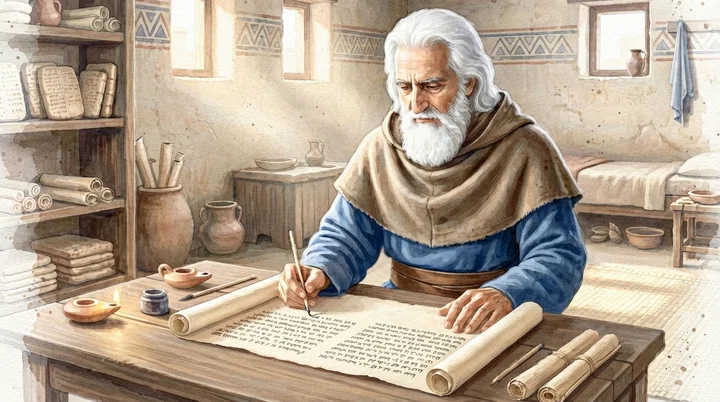
Then Jeremiah called Baruch the son of Neriah: and Baruch wrote from the mouth of Jeremiah all the words of the LORD, which he had spoken unto him, upon a roll of a book.
Translations
Then Jeremiah called Baruch the son of Neriah: and Baruch wrote from the mouth of Jeremiah all the words of the LORD, which he had spoken to him, on a roll of a book.
Then Jeremiah called Baruch the son of Neriah: and Baruch wrote from the mouth of Jeremiah all the words of the LORD, which he had spoken unto him, upon a roll of a book.
Then Jeremiah called Baruch the son of Neriah: and Baruch wrote from the mouth of Jeremiah all the words of the Lord, which he had spoken unto him, upon a roll of a book.
Then Jeremiah called Baruch the son of Neriah: and Baruch wrote from the mouth of Jeremiah all the words of the LORD, which he had spoken to him, upon a roll of a book.
Then Jeremiah called Baruch the son of Neriah; and Baruch wrote from the mouth of Jeremiah all the words of the LORD, which he had spoken unto him, upon a roll of a book.
Then Jeremiah called Baruch the son of Neriah; and Baruch wrote from the mouth of Jeremiah all the words of Jehovah, which he had spoken unto him, upon a roll of a book.
And Jeremiah calleth Baruch son of Neriah, and Baruch writeth from the mouth of Jeremiah all the words of Jehovah, that He hath spoken unto him, on a roll of a book.
And Jeremiah called Baruch the son of Nerijah; and Baruch wrote from the mouth of Jeremiah all the words of Jehovah, which he had spoken unto him, upon a roll of a book.
So Jeremiah called Baruch, son of Neriah,—and Baruch wrote, from the mouth of Jeremiah, all the words of Yahweh which he had spoken unto him upon a scroll.
Berean Standard Bible, Majority Standard Bible
So Jeremiah called Baruch son of Neriah, and at the dictation of Jeremiah, Baruch wrote on a scroll all the words that the LORD had spoken to Jeremiah.
Then Jeremiah called Baruch the son of Neriah; and Baruch wrote from the mouth of Jeremiah all the LORD’s words, which he had spoken to him, on a scroll of a book.
Then Jeremiah sent for Baruch, the son of Neriah; and Baruch took down from the mouth of Jeremiah all the words of the Lord which he had said to him, writing them in a book.
Then Ieremiah called Baruch the sonne of Neriah, and Baruch wrote at the mouth of Ieremiah all the wordes of the Lord, which hee had spoken vnto him, vpon a roule or booke.
Douay-Rheims (Challoner revision)
So Jeremias called Baruch the son of Nerias: and Baruch wrote from the mouth of Jeremias all the words of the Lord, which he spoke to him, upon the roll of a book.
Pictures

Cross-references
- Jeremiah 36:23
And it came to pass, that when Jehudi had read three or four leaves, he cut it with the penknife, and cast it into the fire that was on the hearth, until all the roll was consumed in the fire that was on the hearth.
Jehoiakim cuts up and burns the scroll as it is read.
- Jeremiah 36:32
Then took Jeremiah another roll, and gave it to Baruch the scribe, the son of Neriah; who wrote therein from the mouth of Jeremiah all the words of the book which Jehoiakim king of Judah had burned in the fire: and there were added besides unto them many like words.
The burned scroll is rewritten, with many additional words.
- Jeremiah 36:28-31
Take thee again another roll, and write in it all the former words that were in the first roll, which Jehoiakim the king of Judah hath burned.
The burned scroll is rewritten, and judgment is announced for rejecting its warnings.
- Jeremiah 36:26
But the king commanded Jerahmeel the son of Hammelech, and Seraiah the son of Azriel, and Shelemiah the son of Abdeel, to take Baruch the scribe and Jeremiah the prophet: but the LORD hid them.
The king sought Jeremiah and Baruch, but the LORD hid them.
- Jeremiah 36:10
Then read Baruch in the book the words of Jeremiah in the house of the LORD, in the chamber of Gemariah the son of Shaphan the scribe, in the higher court, at the entry of the new gate of the LORD’s house, in the ears of all the people.
Baruch reads Jeremiah’s written words to the people.
Commentary
Each commentary is drawn from primary sources: the writings of Ellen G. White and Adventist pioneers and periodicals. Each commentary is separate. Its own words are not a quotation; follow the references to read the source passages.
Ellen G. White
9 sources
Jeremiah called Baruch the son of Neriah and dictated to him all the words of the Lord that had been spoken to him, and Baruch wrote them by dictation with ink upon a roll of a book or scroll of parchment.Lt 66, 1897, par. 9–10Lt 152, 1907, par. 14–224T 177.1–2PK 432.2–433.1PK 433.2–434.1 This was done in obedience to God's command in the fourth year of Jehoiakim son of Josiah to put in writing all His messages from the days of Josiah to that day against Israel and Judah and all the nations.Lt 152, 1907, par. 14–22PK 432.2–433.1Ms 65, 1912, par. 19–20 Jeremiah was shut up as a prisoner and could not go into the house of the Lord himself, so Baruch served as his faithful scribe friend and carefully wrote what was dictated.Lt 152, 1907, par. 14–22PK 432.2–433.1Ms 65, 1912, par. 19–20
The roll contained a solemn reproof for many sins, a warning of the evil purposed against them and the sure result of continual apostasy, and an earnest appeal to renounce all evil and return to God.Lt 152, 1907, par. 14–224T 177.1–2PK 432.2–433.1Lt 18, 1876, par. 2–3 It was written so that the house of Judah hearing all the evil purposed against them might every man return from his evil way, present supplication before the Lord and turn, because great is the anger and fury pronounced against them, that God might forgive their iniquity and sin.Lt 152, 1907, par. 14–22PK 432.2–433.1Ms 65, 1912, par. 19–20 Because Jeremiah could not go himself, Baruch was charged to go and read the roll in the ears of the people in the Lord's house upon the fasting day and in the ears of all Judah coming out of their cities, and Baruch did according to all that Jeremiah commanded.Lt 152, 1907, par. 14–22PK 433.2–434.1Ms 65, 1912, par. 19–20
Baruch read it before all the people of Judah and afterward before the princes, who listened with great interest and promised to tell the king what they had heard.Lt 152, 1907, par. 14–22PK 433.2–434.1 They counseled Baruch to hide himself because they feared the king would reject the testimony and seek to slay those who had prepared and delivered the message, and a search was afterward made for Jeremiah and Baruch.Lt 66, 1897, par. 9–10PK 433.2–434.1 When the scroll was read to the king, the people refused to receive its reproofs, and the king showed no fear but cut the roll with a penknife and burned it.Lt 66, 1897, par. 9–10Lt 152, 1907, par. 14–22MWISDAP 58.2–59.1Lt 18, 1876, par. 2–3
By God's command the message was written again with all the former words and more added, showing that burning the first scroll did not destroy God's message.Lt 152, 1907, par. 14–22MWISDAP 58.2–59.1 Hostility toward the messenger or destruction of the written warning did not prevent God's threatened judgments, for the written message was God's word delivered through a chosen prophet.Lt 152, 1907, par. 14–224T 180.1–2 Those judgments included that Jehoiakim would have none to sit upon the throne of David, his dead body would be cast out to the heat by day and frost by night, and punishment would come upon him and his seed and servants and upon Jerusalem and Judah for not hearkening.Lt 152, 1907, par. 14–22 Jeremiah's persecution for faithfully obeying God in delivering reproof and warning illustrates the opposition faithful servants may face.4T 180.1–2 The account serves as a warning that similar rejection of God's messages would recur in a later time, for rejecting the written messages repeats Jehoiakim's act of burning and trifles with the Lord, while God repeats the warnings to call to repentance and reform.Lt 66, 1897, par. 9–10Lt 152, 1907, par. 14–22
Sources
Pioneers and periodicals
15 sources
Baruch the son of Neriah acted as Jeremiah's scribe and wrote from his mouth upon a roll of a book all the words of the Lord spoken to him, and that roll became the beginning of the book of Jeremiah as prophetic words were gathered for lasting use.RH Jul 27, 1916RH Jul 27, 1916ST Nov 24, 1898 Jeremiah was shut up and could not go into the house of the Lord, so in obedience to the command in the fourth year of Jehoiakim he dictated the message for Baruch to carry.RH Jul 26, 1870RH Jan 3, 1865RH Sep 13, 1906ST Nov 24, 1898 Baruch was to read it in the Lord's house upon the fasting day in the ears of the people and of all Judah, and afterward in the ears of the princes and in part before the king who sent for it himself.RH Jul 26, 1870RH Sep 13, 1906ST Aug 9, 1905 The words were warnings and declarations of all the evil and fury purposed against Judah and Jerusalem, that the house of Judah might hear, return every man from his evil way, present supplication, and receive forgiveness and deliverance from ruin.RH Jan 3, 1865RH Sep 13, 1906ST Jul 21, 1881 Jehoiakim's cutting and burning of the roll gained nothing, for the writing was replaced with many like words added, showing such opposition to be only penknife weapons against what God has uttered by inspiration.RH Jul 26, 1870ST Sep 21, 1876 Baruch faithfully did this public work as Jeremiah's earnest helper, showing that when God has a special work to do He raises up such helpers so His ministers are not left alone but are lightened to give themselves to prayer and the ministry of the word.RH Apr 4, 1871RH Dec 13, 1870
Writing and Historical Setting
Jeremiah called Baruch the son of Neriah, his scribe and amanuensis, and Baruch wrote from Jeremiah's mouth upon a roll of a book all the words of the Lord which had been spoken to Jeremiah.RH Jul 27, 1916RH Jul 26, 1870RH Jul 27, 1916RH Sep 13, 1906ST Nov 24, 1898 The dictation was given because Jeremiah was shut up, confined and imprisoned for his bold speaking, and could not go into the house of the Lord, so he forwarded his message through Baruch.RH Jul 26, 1870RH Jan 3, 1865RH Sep 13, 1906ST Jul 21, 1881RH Dec 13, 1870
The writing was done in obedience to the command given in the fourth year of Jehoiakim to take a roll and record all the words spoken against Israel and against Judah and against all the nations from the days of Josiah even to that day.RH Sep 13, 1906ST Nov 24, 1898 That roll written at Jeremiah's mouth in Jehoiakim's fourth year became the starting point for the book of Jeremiah.RH Jul 27, 1916RH Jul 27, 1916 In this way prophetic words were recorded and gathered into larger volumes for lasting use.RH Jul 27, 1916
The chapter belongs to the period of Jehoiakim's reign, even though the chapters of Jeremiah are not arranged in chronological order.ST Jul 12, 1910ST Oct 27, 1909 The order was likely changed when manuscript rolls were gathered into one book, which does not change Jeremiah's teaching, and the chapter itself indicates its chronology.ST Jul 12, 1910ST Oct 27, 1909
The verse is an example of Scripture being written by inspiration or at the dictation of an inspired teacher.ST Sep 21, 1876
Reading and Divine Purpose
The words Baruch wrote were warnings and denunciations declaring all the evil and the great anger and fury purposed against Judah and Jerusalem.RH Jan 3, 1865RH Sep 13, 1906ST Jul 21, 1881 They were written against Israel and against Judah and against all the nations from the days of Josiah even to that day, so that the house of Judah might hear all the evil purposed against them.RH Sep 13, 1906 The intent was that they might present their supplication before the Lord and return every man from his evil way, that God might forgive their iniquity and sin.RH Jan 3, 1865RH Sep 13, 1906ST Jul 21, 1881 By this public written warning God sought once more to turn them from evil ways to repentance and to save them from ruin.RH Jan 3, 1865ST Jul 21, 1881RH Dec 13, 1870
Because Jeremiah was shut up and could not go into the house of the Lord, Baruch was commanded to go and read the words in the Lord's house upon the fasting day in the ears of the people and in the ears of all Judah coming out of their cities.RH Sep 13, 1906 The roll so written was read in the Lord's house, then at their own request in the ears of the princes, who reported it to the king.RH Jul 26, 1870RH Dec 13, 1870 The king sent for the roll to hear it himself rather than act from hearsay, and it was read in part before him.RH Jul 26, 1870RH Sep 13, 1906 The message was thus taken directly to the people first, not carried first to the king, and was only afterward called for by the king.RH Sep 13, 1906 In this way the dictated message was read to the people and to the princes and people publicly.ST Aug 9, 1905RH Dec 13, 1870ST Nov 24, 1898
Jehoiakim's wrathful cutting and burning of that roll gained nothing, for though he and his courtiers disbelieved, the uttered thing of God would be.RH Jul 26, 1870 The writing was replaced with many like words added, proving such opposition is only penknife weapons against the Most High.RH Jul 26, 1870 The message directly from the Lord in this chapter was not preserved but was allowed to be lost, and much has been written by inspiration that has not been given.ST Jul 3, 1884 Why God allowed it to be lost cannot be told and does not concern us, and it was not of especial importance or it would have been preserved.ST Jul 3, 1884 God has given in His word everything necessary to enable obedience to His will, and until all that has been received is put into practice there is no ground to find fault with Him for not giving more of the same kind of instruction.ST Jul 3, 1884
Enduring Lessons and Application
Baruch the son of Neriah was Jeremiah's faithful, earnest helper in the Lord, who wrote from Jeremiah's mouth upon a roll all the words the Lord had spoken to him.RH Apr 4, 1871RH Dec 13, 1870 While Jeremiah was shut up and imprisoned and could not go into the house of the Lord, Baruch faithfully carried out this work and read the written warning publicly to the princes and people as another means by which God sought to warn them and save them from ruin.RH Apr 4, 1871RH Dec 13, 1870 God always raises up this class of helpers when He has a special work to do, so that faithful ministers are not left alone to bear burdens they ought not to carry.RH Apr 4, 1871 Helpers lighten their burdens and hold up their hands and do the serving of tables and business of the cause, while ministers can give all their time to prayer and to ministry of the word.RH Apr 4, 1871
The message written at Jeremiah's mouth was taken directly to the people first and was not carried first to the king, but was read in the Lord's house upon the fasting day in the ears of the people and of all Judah coming out of their cities, and was only afterward at their request read in the ears of the princes and then called for by the king and read in part before him.RH Sep 13, 1906 This course illustrates God's manner of dealing when an individual so apostatizes that the message sent for personal correction is used to create distrust of the instrument.RH Sep 13, 1906 Then the Lord no longer sends the messages to him but gives them directly to the church.RH Sep 13, 1906 This stands as a warning to those who mistreat God's messages.RH Sep 13, 1906
The setting in Jeremiah 34-39 holds a most wonderful lesson to guide God's people in the last days.RH Jan 2, 1900 It guides them in their relation toward the humble instrument through whom God has spoken for the last half-century.RH Jan 2, 1900 It guides them likewise in their relation toward the Testimonies sent to leading men and to the people.RH Jan 2, 1900
Sources