Jeremiah 36:23
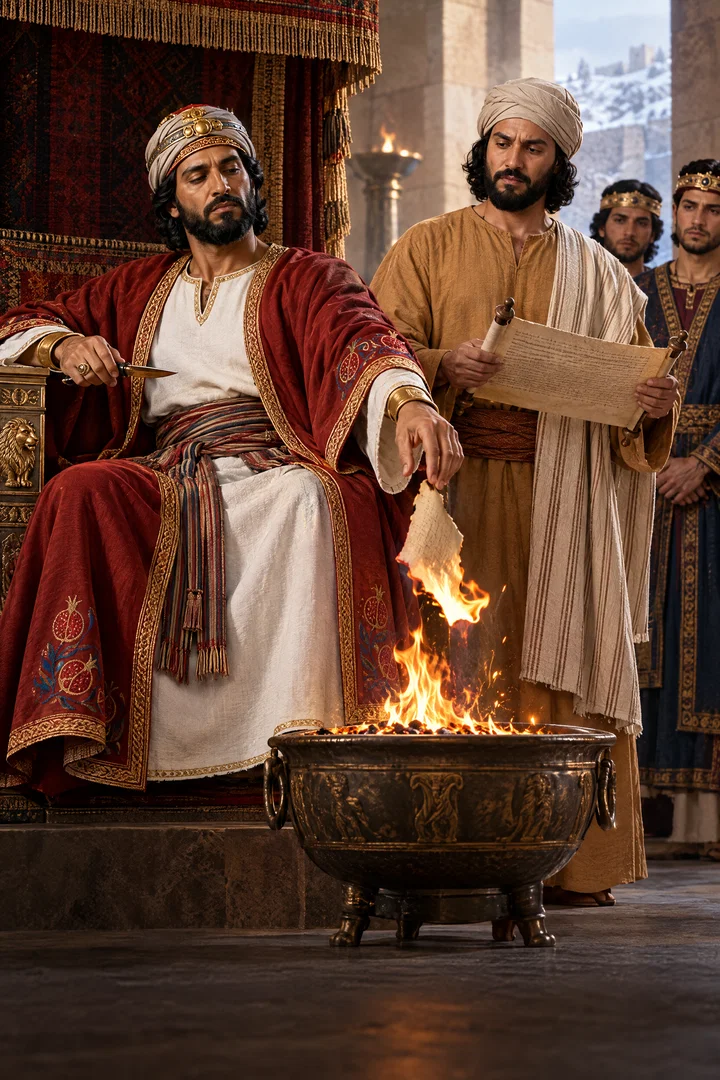
And it came to pass, that when Jehudi had read three or four leaves, he cut it with the penknife, and cast it into the fire that was on the hearth, until all the roll was consumed in the fire that was on the hearth.
Translations
American King James Version, King James Version, KJV Cambridge Paragraph Bible
And it came to pass, that when Jehudi had read three or four leaves, he cut it with the penknife, and cast it into the fire that was on the hearth, until all the roll was consumed in the fire that was on the hearth.
And it came to pass, that when Jehudi had read three or four leaves, he cut it with the scribe's pen-knife, and cast it into the fire that was on the hearth, until all the roll was consumed in the fire that was on the hearth.
And it came to pass, when Jehudi had read three or four leaves, that the king cut it with the penknife, and cast it into the fire that was in the brasier, until all the roll was consumed in the fire that was in the brasier.
And it came to pass, when Jehudi had read three or four leaves, that the king cut it with the penknife, and cast it into the fire that was in the brazier, until all the roll was consumed in the fire that was in the brazier.
and it cometh to pass, when Jehudi readeth three or four leaves, he cutteth it out with the scribe's knife, and hath cast unto the fire, that [is] on the stove, till the consumption of all the roll by the fire that [is] on the stove.
And it came to pass, that when Jehudi had read three or four columns, he cut it with the scribe's knife, and cast it into the fire that was in the pan until all the roll was consumed in the fire that was in the pan.
So then it came to pass when Jehudi had read three or four columns that he cut it up into fragments with a scribe’s knife, and cast them into the fire that was in the stove,—until, all the roll, was consumed on the fire that was on the stove.
Berean Standard Bible, Majority Standard Bible
And as soon as Jehudi had read three or four columns, Jehoiakim would cut them off with a scribe’s knife and throw them into the firepot, until the entire scroll had been consumed by the fire.
When Jehudi had read three or four columns, the king cut it with the penknife, and cast it into the fire that was in the brazier, until all the scroll was consumed in the fire that was in the brazier.
And it came about that whenever Jehudi, in his reading, had got through three or four divisions, the king, cutting them with his penknife, put them into the fire, till all the book was burned up in the fire which was burning in the fireplace.
And when Iehudi had read three, or foure sides, hee cut it with the penknife and cast it into the fire, that was on the hearth vntil all the roule was consumed in the fire, that was on the hearth.
Douay-Rheims (Challoner revision)
And when Judi had read three or four pages, he cut it with the penknife, and he cast it into the Are, that was upon the hearth, till all the volume was consumed with the fire that was on the hearth.
Pictures
Cross-references
- Jeremiah 36:27-32
Then the word of the LORD came to Jeremiah, after that the king had burned the roll, and the words which Baruch wrote at the mouth of Jeremiah, saying,
The burned scroll is rewritten with the former words and further warnings of judgment added.
- Jeremiah 36:32
Then took Jeremiah another roll, and gave it to Baruch the scribe, the son of Neriah; who wrote therein from the mouth of Jeremiah all the words of the book which Jehoiakim king of Judah had burned in the fire: and there were added besides unto them many like words.
The burned scroll’s words were rewritten, with many additional words.
- Jeremiah 36:2
Take thee a roll of a book, and write therein all the words that I have spoken unto thee against Israel, and against Judah, and against all the nations, from the day I spake unto thee, from the days of Josiah, even unto this day.
Identifies the roll that Baruch wrote and Jehoiakim later burned.
- Jeremiah 36:29-31
And thou shalt say to Jehoiakim king of Judah, Thus saith the LORD; Thou hast burned this roll, saying, Why hast thou written therein, saying, The king of Babylon shall certainly come and destroy this land, and shall cause to cease from thence man and beast?
Jehoiakim’s destruction of the scroll is followed by judgment against him and his house.
- Jeremiah 36:4
Then Jeremiah called Baruch the son of Neriah: and Baruch wrote from the mouth of Jeremiah all the words of the LORD, which he had spoken unto him, upon a roll of a book.
Identifies the burned roll as Jeremiah’s message written by Baruch.
- Jeremiah 36:5
And Jeremiah commanded Baruch, saying, I am shut up; I cannot go into the house of the LORD:
The account links Jeremiah’s confinement with the rejection of his written prophecy.
- Jeremiah 36:30
Therefore thus saith the LORD of Jehoiakim king of Judah; He shall have none to sit upon the throne of David: and his dead body shall be cast out in the day to the heat, and in the night to the frost.
pronounces Jehoiakim's death and Babylonian destruction
- Jeremiah 26:20-23
And there was also a man that prophesied in the name of the LORD, Urijah the son of Shemaiah of Kirjath-jearim, who prophesied against this city and against this land according to all the words of Jeremiah:
Jehoiakim persecuted prophets, killing Urijah and burning Jeremiah’s words.
- Jeremiah 36:3
It may be that the house of Judah will hear all the evil which I purpose to do unto them; that they may return every man from his evil way; that I may forgive their iniquity and their sin.
The warnings were intended to turn Judah from evil.
Commentary
Each commentary is drawn from primary sources: the writings of Ellen G. White and Adventist pioneers and periodicals. Each commentary is separate. Its own words are not a quotation; follow the references to read the source passages.
Ellen G. White
16 sources
Jeremiah's roll of reproof and warning was read before Jehoiakim king of Judah and his princes in the winter house, and when only three or four leaves had been heard the king in a frenzy of rage took the roll with a penknife and deliberately cut it and cast it into the fire on the hearth until it was wholly consumed.Lt 152, 1907, par. 14–22Ms 65, 1912, par. 21–23PK 433.2–434.1PK 439STB 401.2 Neither he nor his servants were afraid or rent their garments or showed remorse, even though Elnathan and Delaiah and Gemariah pleaded with him not to burn it.Lt 152, 1907, par. 14–22Lt 66, 1897, par. 9–10Lt 35, 1891, par. 22–27 The burning was deliberate destruction and defiant contempt for God's call to hear and turn every man from his evil way to receive forgiveness, refusing the binding claims of His law when hearers feel their characters in contrast to its requirements.Lt 152, 1907, par. 14–22Ms 65, 1912, par. 21–23PK 433.2–434.1Lt 35, 1891, par. 22–27Ms 111, 1905, par. 5 Defiance could not get the message out of sight or prevent the threatened punishment, for it could not destroy the Word that never returns void, and the same Holy Spirit caused the rejected testimony to be written again with much added, only giving increased publicity and confirmation to what was repulsed.Ms 65, 1912, par. 21–23Lt 35, 1891, par. 22–27STB 401.2MWISDAP 58.2–59.14T 180.1–2 The same act is virtually repeated in these last days when those who have had great light by criticism and refusal to repent and reform burn the messages of the Spirit of God and despise faithful reproof, and opposition will not hinder execution but ends in ruin for those who refuse to be corrected.Lt 152, 1907, par. 14–22Lt 66, 1897, par. 9–10STB 401.24T 180.1–25T 678.1
Setting and Defiant Act
Jeremiah entrusted a written roll to Baruch the scribe to be read to the king, and after Baruch had read it to the people and to the princes, Jehudi fetched the roll and began reading its words of reproof and warning before Jehoiakim king of Judah and the princes of Judah gathered about an open fire in the winter house.Lt 152, 1907, par. 14–22PK 433.2–434.1Lt 18, 1876, par. 2–3 The king was seated on his throne as the reading went forward, holding the written roll in one hand and a penknife in the other.Lt 152, 1907, par. 14–22PK 433.2–434.1PK 439
Only three or four leaves had been read in the king's hearing when he acted, a small portion of only three or four pages of the special message sent to him.Lt 152, 1907, par. 14–22PK 433.2–434.1STB 401.2MWISDAP 58.2–59.1Lt 326, 1905, par. 4 The hearing of so little did not restrain him, for after listening to those three or four pages he cut into the roll.STB 401.2MWISDAP 58.2–59.1Lt 326, 1905, par. 4Ms 111, 1905, par. 5
Far from trembling at the danger hanging over himself and his people, he in a frenzy of rage seized the roll and deliberately cut it with the penknife and cast it into the fire on the hearth burning beside him.Lt 152, 1907, par. 14–22PK 433.2–434.1PK 439 As Jehudi read, the king cut the scroll into pieces and burned it in the fire until the whole roll was completely consumed.Lt 152, 1907, par. 14–22Lt 66, 1897, par. 9–10Ms 65, 1912, par. 21–23PK 433.2–434.1PK 439
Neither the king nor his servants were afraid, and they showed no fear or remorse or sorrow and did not rend their garments.Lt 152, 1907, par. 14–22Lt 66, 1897, par. 9–10Lt 35, 1891, par. 22–27 The burning showed contempt for the warning that exposed the people's true condition.Lt 152, 1907, par. 14–22Lt 35, 1891, par. 22–27 Elnathan and Delaiah and Gemariah interceded and pleaded with him not to burn the scroll, yet he would not heed them.Lt 152, 1907, par. 14–22Lt 35, 1891, par. 22–27
Meaning and Enduring Message
Jehoiakim's cutting and burning of the roll was deliberate destruction and defiant rejection of God's written warning, showing contempt for His call to hear, that every man might return from his evil way and receive forgiveness.Lt 152, 1907, par. 14–22Ms 65, 1912, par. 21–23PK 433.2–434.1Lt 35, 1891, par. 22–274T 180.1–2 It was refusal of the binding claims of the law of God and of enjoined obedience to His commandments when hearers feel their own characters in contrast to its requirements, leaving the rejecter without willingness to be called back to repentance.Lt 35, 1891, par. 22–27Ms 111, 1905, par. 5Lt 28, 1896, par. 6–8 It was trifling with the Lord, passing the boundary line by turning from light to follow selfish devisings and man-formed opinions and joining the enemy.Lt 152, 1907, par. 14–22
Burning the roll was defiance that could not prevent the threatened punishment, could not destroy the message, and could not get it out of sight or bring it to an end, for the Word of God will never return void.Ms 65, 1912, par. 21–23Lt 35, 1891, par. 22–274T 180.1–2Ms 111, 1905, par. 5Ms 111, 1905, par. 6 The same Holy Spirit who gave the first testimony that was refused and burned gave the rejected message again to Jeremiah's servant who had caused the first roll to be written, had it written once more with much added, repeating the very rejected message with a great deal more.Lt 35, 1891, par. 22–27STB 401.2MWISDAP 58.2–59.1Lt 326, 1905, par. 4Ms 111, 1905, par. 5 Opposition to God's threatenings will not hinder their execution, and resisting His warnings provokes His anger and ends in ruin.MWISDAP 58.2–59.14T 180.1–25T 678.1 Cutting up and consuming His straight, plain message only gives increased publicity to and confirmation of the message dismissed and repulsed, for when God sends a correcting message all the transaction is recorded and those who refuse to be corrected pronounce their own sentence against themselves.MWISDAP 58.2–59.1Lt 326, 1905, par. 5–7Ms 111, 1905, par. 6
Warning Repeated Today
In these last days those who have had great light virtually repeat Jehoiakim's act when by criticism and refusal to repent and reform they burn the messages of the Spirit of God.Lt 152, 1907, par. 14–22 The warning was given concerning Battle Creek that a similar rejection of God's messages would occur in that generation.Lt 66, 1897, par. 9–10
People who turn from God and His light may repeat the same rejection under the influence of the same evil spirit.Lt 35, 1891, par. 22–27 Those who hear the evidence today revealing character in contrast to God's requirements would do what Jehoiakim did if placed in similar circumstances.Ms 111, 1905, par. 5
The same act is repeated when faithful reproof given of God in testimony is despised and written words of rebuke and warning are burned or thrown into the fire rather than heeded.5T 678.1Lt 28, 1896, par. 6–8 Rejecting a message calling for obedience to God's commandments does not make that message void.STB 401.2 Destroying the written roll could not destroy the message.STB 401.2
Those who deliver God's reproof may face the same opposition and persecution Jeremiah endured.4T 180.1–2 Indignation often kindles in the sinner's heart against the agent God chooses to deliver His reproofs, and the same spirit that persecuted and imprisoned Jeremiah for obeying the word of the Lord exists today.5T 678.1 Resisting His warnings provokes His anger and ends in ruin, and opposition to His threatenings will not hinder their execution.4T 180.1–25T 678.1
When God sends a message to any man or woman, minister or doctor, to correct principles and turn the heart to repentance, refusal to be corrected and receive it is not the end.Lt 326, 1905, par. 5–7Ms 111, 1905, par. 6 All the transaction is recorded, and those who refuse to be corrected pronounce their own sentence against themselves.Lt 326, 1905, par. 5–7Ms 111, 1905, par. 6 Those who pursue a course to make the correcting message of no effect and destroy the influence God designed to change principles only sustain presumption and leave wickedness remaining.Lt 326, 1905, par. 5–7 Cutting up and consuming His straight, plain message to get it out of sight does not bring it to an end, but only gives increased publicity to and confirmation of the message dismissed and repulsed.Lt 326, 1905, par. 5–7Ms 111, 1905, par. 6
Those who step in between God and the one mercifully warned and justify and vindicate him while claiming to be ministers and doctors of the Lord leave wickedness and deceit remaining in him.Lt 326, 1905, par. 5–7 They sustain him in presumption in his own course until sin in deception, falsehood, unprincipled working and underhand dealing becomes current, and build him up in a crooked course that is not justice and righteousness.Lt 326, 1905, par. 5–7 They will suffer with the transgressor unless they humble themselves before God with repentance that needeth not to be repented of, and it would be better for such men if they had never been born.Lt 326, 1905, par. 5–7
The messages of warning are repeated as the roll was rewritten, and judgment follows those who hearken not.Lt 152, 1907, par. 14–22 God as the high and holy One who inhabiteth eternity will be vindicated in seeking to bring men to repentance to see crooked ways and turn and be converted.Lt 326, 1905, par. 5–7 His purpose is to save erring men from a wrong course that would destroy usefulness, that sins now registered in the books of heaven may be blotted out.Lt 326, 1905, par. 5–7 So it was seen in the persecution Christ endured and the treatment of faithful servants in every age.Lt 152, 1907, par. 14–22
Sources
Pioneers and periodicals
36 sources
The verse tells how Jehoiakim cut up the scroll piece by piece with a penknife as Jehudi read it and threw it into the hearth fire until the whole roll was consumed after only a few leaves had been read.ST Aug 9, 1905ST Nov 24, 1898ST Aug 9, 1905 It was a message directly from the Lord, warning that Babylon would come against the land and calling to turn from idolatry to obedience with rebuke, counsel and entreaty.ST Nov 24, 1898RH Nov 22, 1906ST Jul 3, 1884 The burning was deliberate, wrathful defiance showing contempt for God and His written word, and neither the king nor his servants who heard it were afraid nor tore their garments in repentance.ST Aug 9, 1905RH Nov 22, 1906RH Apr 29, 1875 Destroying the written roll did not destroy the message or avert the threatened judgments, for at the Lord's direction the words were written again with many like and additional words, which were fulfilled.ST Aug 9, 1905ST Aug 9, 1905ST Dec 8, 1898 The defiance brought added and greater judgments on the king and cast away the last hope of sparing the city, proving that God's word endures and will stand in the judgment despite every effort to cut, burn or discredit it.ST Sep 13, 1905RH Nov 22, 1906RH Jan 2, 1900RH Apr 29, 1875RH Aug 6, 1857
The Scroll and Its Burning
When Jehudi had read only three or four leaves or a few sections, Jehoiakim took the scroll and cut it with a penknife, casting it piece by piece leaf by leaf into the fire until the whole roll was wholly consumed and reduced to ashes.ST Aug 9, 1905ST Nov 24, 1898ST Aug 9, 1905ST May 2, 1878ST Dec 8, 1898 The cutting and burning went on as the reading went on, so that after only a small part had been heard the king destroyed the written message of truth sent by the Lord rather than hear it to the end.ST Nov 24, 1898ST Aug 9, 1905ST Apr 14, 1881ST Nov 24, 1898 The destruction was complete, leaving nothing of the roll unconsumed.ST Aug 9, 1905ST Nov 24, 1898ST May 2, 1878
The reading happened while the king sat in his winter house in the ninth month with a fire burning on the hearth or brazier before him, surrounded by his princes, with Jehudi reading in the ears of the king and all the princes beside him.RH Jul 26, 1870RH Sep 13, 1906 The king himself had sent for the roll so that it might be read in his own hearing rather than acting from hearsay, controlling his chagrin while Jehudi read and then in undignified frenzy snatching the roll, cutting it in shreds and casting the tatters into the fire on the hearth.RH Jul 26, 1870RH Sep 13, 1906
The penknife was the knife used to cut the reed pen with which the prophets wrote.ST Apr 30, 1902 The roll so destroyed was the one Baruch wrote at Jeremiah's direction in Jehoiakim's fourth year, which contributed to the book of Jeremiah.RH Jul 27, 1916 It was the first scroll, burned within the two years before Jerusalem fell, and it may have contained prophecies written by Baruch.RH Jul 27, 1916RH Jul 27, 1916 The chapter belongs to Jehoiakim's reign and not to the later events of Zedekiah's reign, and its place follows a chronological sequence differing from the book's printed order.ST Jul 12, 1910 This is because the manuscript rolls were gathered together into one book, which makes no change in the teaching, and from Jeremiah 20 onward the chronological order places Jeremiah 36 after Jeremiah 35 and before Jeremiah 45, the chapter itself making its time clear.ST Jul 12, 1910ST Oct 27, 1909
The roll was a message directly from the Lord, first carried directly to the people and afterward called for by the king and read in part before him.ST Jul 3, 1884RH Sep 13, 1906 It warned that Babylon would come against the land, and it was the Lord's merciful warning and rebuke with reproof, counsel, warning, and entreaty.ST Nov 24, 1898ST Nov 24, 1898 It was Jeremiah's last appeal after years of pleading and repeated warnings to turn from the idolatry of the time and come back to obedience to the law, calling the king to humility, confession of sin, and self-denial.RH Nov 22, 1906RH Sep 13, 1906ST Nov 24, 1898
The burning took place when wickedness was widespread in Jerusalem and Jehoiakim made no effort to restrain it.ST Jan 7, 1886 The reading of the prophetic scroll before the king who cuts it with a knife and burns it in rejection of the message stands joined to Jeremiah's refusal to surrender his prophetic charge to a court's command.ST Jan 7, 1886RH Jul 10, 1860
Defiant Rejection Is Futile
The cutting and burning was deliberate, wrathful, defiant rejection, showing contempt, disrespect, and want of reverence for God and for His written word and testimony, and neither the king nor his servants who heard the words were afraid nor rent their garments in repentance and fear.ST Aug 9, 1905RH Nov 22, 1906RH Apr 29, 1875RH Sep 13, 1906RH Dec 13, 1870 It was done because the message displeased the king, because its teaching troubled his conscience and condemned him, and because he rejected its call to humility, confession of sin, and self-denial, destroying the evidence that confused, hurt, and condemned him in order to ease his conscience instead of obeying it.RH Jul 23, 1901ST Nov 24, 1898ST Apr 13, 1915ST Nov 24, 1898ST Dec 1, 1898 The deed exemplifies trying to answer truth by destroying it, and rulers rejecting and trying to silence prophetic communications.ST Apr 14, 1881RH Sep 30, 1915RH Jul 10, 1860 It was Satan's work to create distrust and contempt for God's word, carried out through criticizing and dissecting Jeremiah's writings to find technical errors or inconsistencies on which to base rejection, through condemning the literature carrying truth as dangerous and unfit to remain, and through apostate Israel persecuting the prophet on the principle that he that is born after the flesh persecutes him that is born after the Spirit because the wicked's own works are evil and their brother's are righteous.RH Jun 8, 1916RH Jun 27, 1871RH Jun 10, 1915ST Nov 16, 1882
Destroying the written roll did not destroy the message, nor frustrate God's purposes, nor avert the threatened judgments.ST Dec 8, 1898ST Apr 13, 1915ST Jul 21, 1881RH Jan 3, 1865 At the Lord's direction the words were resolutely written again, even while Jeremiah was in prison, with many like or additional words and threatened judgments added, which were fulfilled.ST Aug 9, 1905ST Aug 9, 1905ST Apr 13, 1915RH Jan 3, 1865RH Jun 27, 1871 Wrathful, demonstrative opposition to God's uttered word prevails only for a brief space, proving mere penknife weapons against the Most High whose purpose still lives, for though the king and all his courtiers disbelieved, the uttered thing of God would be.RH Jul 26, 1870 Such attempts to destroy truth by condemning its literature as dangerous and corrupting and unfit to remain do not always succeed, but can excite curiosity so that people read for themselves, weigh doctrine by the Bible, and become established in truth.RH Jul 26, 1870ST Nov 16, 1882
The verse proves God's word endures and is especially preserved despite efforts to cut, burn, destroy, or discredit it.ST Sep 13, 1905RH Jun 27, 1871RH Aug 6, 1857ST Aug 23, 1899 Even the killing of the Lord could not destroy its power or integrity, and it will stand in the judgment as the standard of condemnation or acquittal.ST Sep 13, 1905ST Aug 23, 1899 The defiance brought added, greater, and special judgments against the king, for want of reverence drew greater judgments upon those who were not afraid.RH Nov 22, 1906RH Apr 29, 1875RH Dec 13, 1870 The life of the king and his house and whether the city would be burned depended on obeying Jeremiah's voice, and refusal cast away the last hope and last offer to spare the city, while the people still did not turn from wickedness.RH Jan 2, 1900RH Dec 13, 1870
Where the plain, straight testimony is not allowed to live the curse of God rests upon His people as surely as it did upon ancient Israel.RH Nov 22, 1906 Disrespectful destruction of warnings and entreaties means the Lord no longer sends messages to such an individual but gives them directly to the church, and stands as a warning to those in later time who mistreat God's messages until they are passed by.RH Sep 13, 1906 With Jeremiah 34-39 it is a lesson for conduct in the last days toward the humble instrument through whom God has spoken for the last half-century and toward the Testimonies, for heeding such prophetic instruction brings rich blessing, but treating it so makes shipwreck of faith and Christian experience.RH Jan 2, 1900RH Jun 10, 1915 The loss of the burned message shows that much written by inspiration has not been preserved, including inspired records by Nathan, Samuel, Gad, Abijah, and Iddo that are no longer extant.ST Jul 3, 1884 What was lost was not of especial importance or it would have been preserved, for God has given everything necessary to enable obedience, and until all that has been received is practiced there is no ground to fault Him for not giving more.ST Jul 3, 1884
Sources