Job 1:3
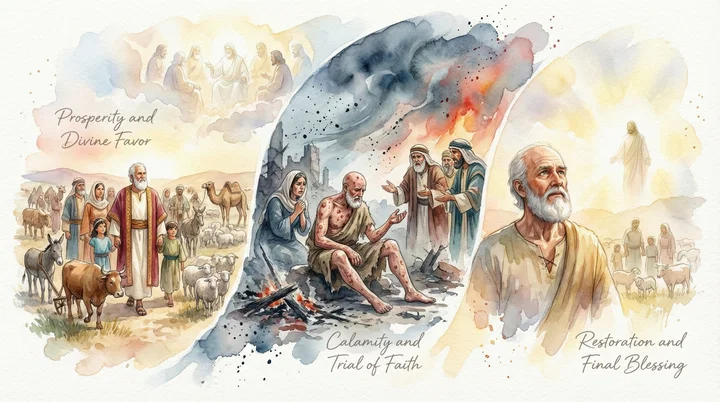
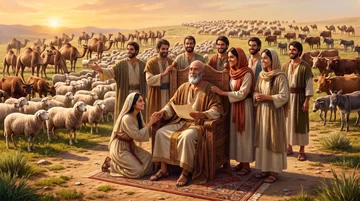
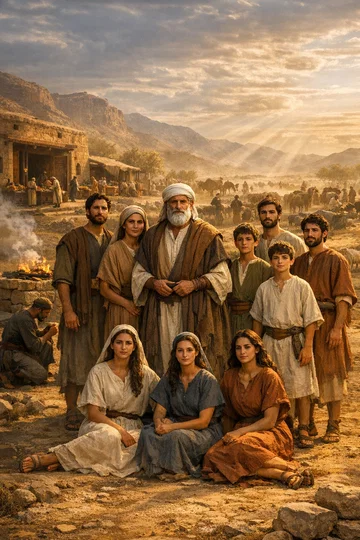
His substance also was seven thousand sheep, and three thousand camels, and five hundred yoke of oxen, and five hundred she asses, and a very great household; so that this man was the greatest of all the men of the east.
Translations
American King James Version, King James Version, KJV Cambridge Paragraph Bible
His substance also was seven thousand sheep, and three thousand camels, and five hundred yoke of oxen, and five hundred she asses, and a very great household; so that this man was the greatest of all the men of the east.
His substance also was seven thousand sheep, and three thousand camels, and five hundred yoke of oxen, and five hundred she-asses, and a very great household; so that this man was the greatest of all the men of the east.
Revised Version, American Standard Version
His substance also was seven thousand sheep, and three thousand camels, and five hundred yoke of oxen, and five hundred she-asses, and a very great household; so that this man was the greatest of all the children of the east.
and his substance is seven thousand sheep, and three thousand camels, and five hundred pairs of oxen, and five hundred she-asses, and a service very abundant; and that man is greater than any of the sons of the east.
And his substance was seven thousand sheep, and three thousand camels, and five hundred yoke of oxen, and five hundred she-asses, and very many servants; and this man was greater than all the children of the east.
And his substance was—seven thousand sheep, and three thousand camels, and five hundred yoke of oxen, and five hundred she-asses, and a body of servants exceeding large,—thus was that man the greatest of all the sons of the East.
Berean Standard Bible, Majority Standard Bible
and he owned 7,000 sheep, 3,000 camels, 500 yoke of oxen, 500 female donkeys, and a very large number of servants. Job was the greatest man of all the people of the East.
His possessions also were seven thousand sheep, three thousand camels, five hundred yoke of oxen, five hundred female donkeys, and a very great household; so that this man was the greatest of all the children of the east.
And of cattle he had seven thousand sheep and goats, and three thousand camels, and a thousand oxen, and five hundred she-asses, and a very great number of servants. And the man was greater than any of the sons of the east.
His substance also was seuen thousande sheepe, and three thousand camels, and fiue hundreth yoke of oxen, and fiue hundreth shee asses, and his family was very great, so that this man was the greatest of all the men of the East.
Douay-Rheims (Challoner revision)
And his possession was seven thousand sheep, and three thousand camels, and five hundred yoke of oxen, and five hundred she asses, and a family exceeding great: and this man was great among all the people of the east.
Pictures
Cross-references
- Job 1:13-19
And there was a day when his sons and his daughters were eating and drinking wine in their eldest brother’s house:
Job loses his possessions, livestock, and family.
- Ezekiel 14:14
Though these three men, Noah, Daniel, and Job, were in it, they should deliver but their own souls by their righteousness, saith the Lord GOD.
Names Job as an example of righteousness.
- Job 1:8
And the LORD said unto Satan, Hast thou considered my servant Job, that there is none like him in the earth, a perfect and an upright man, one that feareth God, and escheweth evil?
God describes Job as upright and devoted to him.
- Job 1:12
And the LORD said unto Satan, Behold, all that he hath is in thy power; only upon himself put not forth thine hand. So Satan went forth from the presence of the LORD.
God permits Job’s possessions to be afflicted as a test of his faith.
- Job 2
Again there was a day when the sons of God came to present themselves before the LORD, and Satan came also among them to present himself before the LORD.
Satan continues afflicting Job, testing his integrity through suffering.
Commentary
Each commentary is drawn from primary sources: the writings of Ellen G. White and Adventist pioneers and periodicals. Each commentary is separate. Its own words are not a quotation; follow the references to read the source passages.
Ellen G. White
1 source
The inventory of seven thousand sheep, three thousand camels, five hundred yoke of oxen, five hundred she-asses, and a very great household records the extent of Job's great worldly possessions.RH Sep 12, 1912 He was stripped of those possessions for the truth's sake, as one of God's appointed witnesses exposed to reproach and persecution.RH Sep 12, 1912 He was also afflicted in body until he was abhorred by his relatives and friends, yet he maintained his integrity.RH Sep 12, 1912
His steadfastness bears witness to the faithfulness of God's promises, His abiding presence and sustaining grace, and the power of faith to withstand the powers of the world, to rest in God in the darkest hour and know that the Father is in control.RH Sep 12, 1912 His trial shows that God does not prevent the plottings of wicked men but causes their devices to work for good for those who in trial and conflict maintain faith and loyalty.RH Sep 12, 1912 Through such trial God brings His children near to Him to show them their weakness and His strength and to teach them to lean on Him.RH Sep 12, 1912 He prepares them in the furnace of trial and affliction for emergencies, positions of trust, and the great purpose for which their powers were given, an experience worth more than all the pain it costs.RH Sep 12, 1912
Sources
Pioneers and periodicals
25 sources
His substance is counted as seven thousand sheep, three thousand camels, five hundred yoke of oxen, five hundred she asses, and a very great household, making him the greatest of all the men of the east.ST Sep 17, 1912ST Feb 22, 1877 Those flocks and herds were real possessions that were really taken and destroyed.ST Nov 30, 1882 That prosperity is what Satan seized upon to charge that Job served God from selfish motives, so God allowed a real personal adversary to test him with disaster upon his property and family while sparing his life.ST Sep 17, 1912RH Jun 26, 1856 The sweeping away of so great an estate was not punishment for sin but the trial of an upright man who suffered because he was faithful, teaching that calamity of itself does not prove guilt.RH Aug 16, 1906ST Aug 12, 1875ST Mar 8, 1905 His patient endurance under loss and his later restoration made him an encouraging pattern of integrity kept through suffering.RH Aug 16, 1906RH Aug 27, 1872ST Nov 13, 1884RH Jan 14, 1904
Wealth and Its Setting
His substance was seven thousand sheep and three thousand camels and five hundred yoke of oxen and five hundred she asses, besides a very great household, so that he was the greatest of all the men of the east.ST Sep 17, 1912ST Feb 22, 1877RH Mar 14, 1912RH Aug 27, 1872 His flocks and herds were vast and his household very large, giving him wealth and prominence and great status among the people of the East.ST Feb 22, 1877RH Aug 27, 1872ST Dec 23, 1889 The sheep and the other possessions were literal animals and real substance that was really taken and destroyed, a statement to be read literally and not as symbols.ST Nov 30, 1882
The verse stands in the prologue in chapters 1 and 2, written in prose like the epilogue in chapter 42:7-17, distinct from the poetic debate in chapters 4 to 31 and the speeches of Elihu in chapters 32 to 37 and the speeches of the Lord out of the storm-cloud.ST The opening chapter belongs to the flow of the whole book rather than to be taken as an isolated fragment.ST Sep 22, 1890 The opening narrative presents a real, upright man who shared the common experiences of men, and the book treats him as a real person in a work said to have been written before the Exodus.ST Mar 27, 1893RH Mar 14, 1912
He was of the east, the country of the Chaldeans and Arabians, who from early times were noted for astrological investigations and wisdom, a quarter that may also include India with its profound learning, and his friends were doubtless from the same eastern country as well.ST Oct 1, 1896 His affluent circumstances joined wealth with honor and influence, with large herds of livestock and a very large household and standing as the greatest man of the East.ST Dec 23, 1889ST Dec 29, 1887 That prosperity explains why people once showed him deference and sought his attention.ST Dec 29, 1887
Satan's Accusation and Warfare
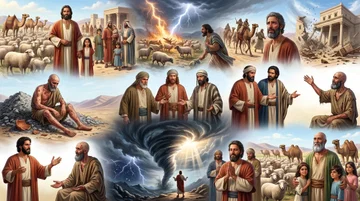
The livestock, servants and high standing in the east were part of the prosperity Satan pointed to when he charged that Job served God only from selfish motives, and God permitted Satan to test him while forbidding him to take his life.ST Sep 17, 1912 Satan who did this was a real personal being and not merely a figure for evil or a principle of evil, bringing disaster upon Job's property and family and performing wonderful works by actual agency.RH Jun 26, 1856 He brought the Sabeans upon the oxen to take them away, caused the fire of God to fall from heaven to burn up the sheep, caused a wind to blow down the house to kill the children, and smote Job with sore boils from head to foot.
The account shows that Satan still had access to heaven after man fell, when the representatives of the different worlds called sons of God came together in great assemblies and councils in heaven.ST Jul 6, 1915ST Aug 27, 1902 Having overcome Adam the first ruler of the earth, he came with them and represented himself as governor of this world.ST Aug 27, 1902 There he accused God of injustice and lack of wisdom and accused God's servants.ST Jul 6, 1915
The conflict between God and Satan was already present in this earliest biblical setting, giving a glimpse of spiritual warfare that began before humans could witness it and continued until Christ conquered him by going down the road of righteousness to the cross and the tomb and rising again, with victory through his death and resurrection.ST Jul 6, 1915ST Jun 12, 1907 His claim to dominion over the earth was not rightful or uncontested, for God pointed to Job as a loyal servant, demonstrating that He still had people on earth who belonged to Him.ST May 1, 1901 Because Job was already exceptionally wealthy and prominent with vast herds and a very large household, Satan's attacks upon him took the form of afflicting terror rather than enticing him with wealth or pleasure.ST Dec 22, 1887 The evil that befell him when Satan came among those presenting themselves before the Lord stands as a warning that wine can serve as an instrument of Satan and bring harm to people who gather to worship.ST Feb 22, 1877
Trial's Meaning and Example
The listing of great wealth and a very great household sets the scene before the trial for the loss of those material blessings and for their later restoration.RH Aug 16, 1906RH Feb 24, 1916 In the days of Job there was a prevailing impression that bodily affliction was the direct result of personal or parental sin, yet calamity by itself does not prove that a person is being punished for sin.RH Aug 16, 1906ST Mar 8, 1905 Unless God makes that cause plain, others should not condemn or reproach the sufferer.RH Aug 16, 1906 The sweeping away of his great estate and place as the greatest of the men of the east was not punishment for badness but the use of him as an example of a perfect and upright man.ST Aug 12, 1875 He suffered because he was so much better than other men, not worse, even as Jesus also suffered.ST Aug 12, 1875
These possessions alone would not have made him a pattern for believers or drawn the world's attention to his story; his trials, rather than his prosperity, made his story an encouragement to faith.ST Nov 13, 1884 He endured his trial faithfully, retained his integrity, showed patience through severe suffering, and remained faithful to God.RH Aug 16, 1906RH Aug 27, 1872RH Jan 14, 1904 His later blessings showed that his misfortune did not give his enemy cause to triumph over him, and his life rebukes those who murmur and lack Christian grace.RH Aug 16, 1906RH Aug 27, 1872 He was deprived of great worldly possessions for the truth's sake as one of God's appointed witnesses in all ages exposed to reproach and persecution, and was so afflicted in body that he was abhorred by relatives and friends, yet he maintained his integrity.RH Sep 12, 1912RH Feb 8, 1912
His steadfastness bears witness to the faithfulness of God's promises, His abiding presence and sustaining grace, and the power of faith to withstand the powers of the world, to rest in God in the darkest hour and feel that the Father is at the helm.RH Sep 12, 1912 His trial shows that God does not prevent the plottings of wicked men but causes their devices to work for good to those who in trial and conflict maintain faith and loyalty.RH Sep 12, 1912 He brings His children near to show them their weakness and His strength, teaches them to lean on Him, and prepares them in the furnace of trial and affliction for emergencies, positions of trust, and the great purpose for which their powers were given, an experience worth more than all the pain it costs.RH Sep 12, 1912 God permitted a real, testing trial to come in which Satan worked to throw doubt into Job's mind that God had forgotten him, and that experience refutes Satan's claims and encourages standing the test God permits instead of complaining and rebelling. Trial is not strange but God's proving of His beloved with purpose, making them partakers of Christ's sufferings that they may also share His rejoicing, so those who pray to be used to God's glory must be ready to be used in the same way, meeting vanishing wealth with the grace to say if they can serve God better in poverty than with wealth, here they are.ST Aug 12, 1875
Sources