Job 2:13
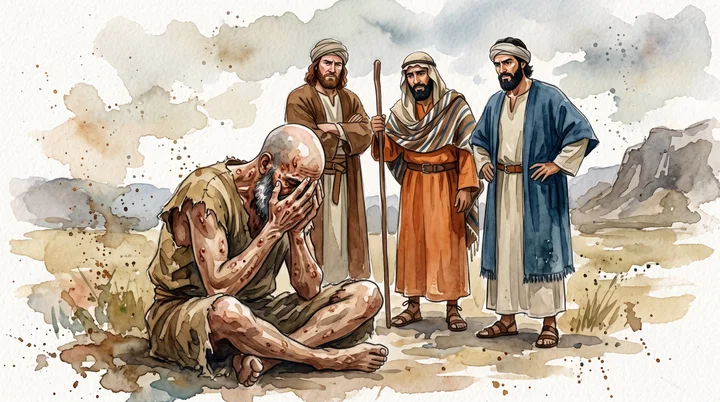
So they sat down with him upon the ground seven days and seven nights, and none spake a word unto him: for they saw that his grief was very great.
Translations
So they sat down with him on the ground seven days and seven nights, and none spoke a word to him: for they saw that his grief was very great.
King James Version, KJV Cambridge Paragraph Bible, Revised Version, American Standard Version
So they sat down with him upon the ground seven days and seven nights, and none spake a word unto him: for they saw that his grief was very great.
So they sat down with him upon the ground seven days and seven nights, and none spoke a word to him: for they saw that his grief was very great.
And they sit with him on the earth seven days and seven nights, and there is none speaking unto him a word when they have seen that the pain hath been very great.
And they sat down with him on the ground seven days and seven nights; and none spoke a word to him; for they saw that [ his] anguish was very great.
And they sat with him upon the ground, seven days and seven nights,—and none was speaking unto him a word, for they saw that, exceeding great, was the stinging pain.
Berean Standard Bible, Majority Standard Bible
Then they sat on the ground with him for seven days and seven nights, but no one spoke a word to him because they saw how intense his suffering was.
So they sat down with him on the ground seven days and seven nights, and no one spoke a word to him, for they saw that his grief was very great.
And they took their seats on the earth by his side for seven days and seven nights: but no one said a word to him, for they saw that his pain was very great.
So they sate by him vpon the ground seuen dayes, and seuen nights, and none spake a worde vnto him: for they sawe, that the griefe was very great.
Douay-Rheims (Challoner revision)
And they sat with him on the ground seven days and seven nights, and no man spoke to him a word: for they saw that his grief was very great.
Pictures





Cross-references
- Job 1:6-22
Now there was a day when the sons of God came to present themselves before the LORD, and Satan came also among them.
Together with Job 2, it recounts Satan’s attacks on Job.
- Genesis 50:10
And they came to the threshingfloor of Atad, which is beyond Jordan, and there they mourned with a great and very sore lamentation: and he made a mourning for his father seven days.
Both describe mourning lasting seven days.
- James 5:11
Behold, we count them happy which endure. Ye have heard of the patience of Job, and have seen the end of the Lord; that the Lord is very pitiful, and of tender mercy.
Both texts present Job as an example of patience amid suffering.
- Job 42:8
Therefore take unto you now seven bullocks and seven rams, and go to my servant Job, and offer up for yourselves a burnt offering; and my servant Job shall pray for you: for him will I accept: lest I deal with you after your folly, in that ye have not spoken of me the thing which is right, like my servant Job.
Job’s friends are associated with seven days of silence and an offering of seven bullocks and rams.
- Ezekiel 14:14
Though these three men, Noah, Daniel, and Job, were in it, they should deliver but their own souls by their righteousness, saith the Lord GOD.
Job is named as a righteous man and historical person.
- Job 2:6
And the LORD said unto Satan, Behold, he is in thine hand; but save his life.
Satan is allowed to afflict Job but forbidden to take his life.
- Ezekiel 14:20
Though Noah, Daniel, and Job, were in it, as I live, saith the Lord GOD, they shall deliver neither son nor daughter; they shall but deliver their own souls by their righteousness.
Names Job as a historical person.
Commentary
Each commentary is drawn from primary sources: the writings of Ellen G. White and Adventist pioneers and periodicals. Each commentary is separate. Its own words are not a quotation; follow the references to read the source passages.
Ellen G. White
1 source
Job's friends were brought face to face with his humiliation and suffering, and they were unable to understand it.DA 87.2 They saw the depth of his grief yet could not grasp its meaning or purpose.DA 87.2 That same failure to understand is seen in the brothers of Jesus, who could not comprehend the mystery of His mission.DA 87.2 When they looked upon His poverty, trial, and deprivation, they misjudged Him just as Job's friends had misjudged Job.DA 87.2
Sources
Pioneers and periodicals
23 sources
Job's three friends came to mourn with him and comfort him after his sudden calamities, while he sat among the ashes in deepest sorrow and mourning.ST Mar 26, 1896 Overwhelmed at his condition, they wept, rent their garments, sprinkled dust upon their heads, and sat with him upon the ground seven days and seven nights without a word, because they saw his grief was very great.ST Mar 26, 1896ST Oct 11, 1877 Their silence before he spoke shows the gravity of his suffering and the value of quiet sympathy, though when they spoke they wounded him by insisting his affliction proved his sin and God's displeasure, becoming miserable comforters.ST Mar 26, 1896RH Mar 21, 1912ST Dec 23, 1889ST Oct 18, 1883 His affliction was real trial and patience under a real personal Satan, whom God permitted to strip him of property and children and to cover him with boils from head to foot, yet forbade to take his life, to test his loyalty and integrity.ST Sep 17, 1912RH Jun 26, 1856ST Mar 27, 1893RH Jul 21, 1853 Such calamity does not automatically prove God's judgment upon the sufferer, for God permits the faithful to suffer to refute Satan, to humble them, and to bring blessing and hope to others.ST Mar 27, 1893ST Aug 8, 1906ST Nov 7, 1906ST May 15, 1901 The complete seven days and nights shows the seven-day week was already known and observed from the patriarchal period, reckoned from nothing in nature but from creation and its sanctified rest-day.RH Jun 6, 1912RH Dec 10, 1861RH Oct 31, 1854RH Aug 17, 1905
Silent Friends in Grief
Job's three friends came to mourn with him and to comfort him after his sudden calamities and afflictions, while he sat among the ashes in deepest sorrow and grief and mourning.ST Mar 26, 1896 Overwhelmed with consternation at his condition, they lifted up their voices and wept, rent their garments, and sprinkled dust upon their heads toward heaven.ST Mar 26, 1896 Then they sat down with him upon the ground seven days and seven nights without speaking a word, because they saw that his grief was very great.ST Mar 26, 1896ST Oct 11, 1877RH Mar 21, 1912ST Dec 23, 1889 That seven-day vigil is one of the Bible's uses of seven, and the full seven days and seven nights was a known and observed period in his time.
Their seven days and nights of silence reflect the gravity and depth of his suffering.RH Mar 21, 1912ST Dec 23, 1889ST Oct 18, 1883 It stands as sympathetic presence and astonishment at the depth of his suffering before he begins to speak.ST Dec 23, 1889ST Oct 18, 1883 The verse thus illustrates the value of quiet sympathy with someone in deep suffering before words begin, since their later words were wrong.
When they finally spoke, their comfort wounded rather than helped, like an arrow to the wounded soul.ST Mar 26, 1896 They assured him his sufferings were because of his sins and God's displeasure and tried to convince him he was unrighteous, making them miserable comforters.ST Mar 26, 1896 Their later labor with him was a mistake made in pride rather than humility, lacking knowledge of their own hearts and discernment of God's work in the heart.RH Mar 21, 1912RH Aug 8, 1871 They presumed they knew the cause of his calamities and judged him as though they themselves had escaped suffering through their own wisdom.RH Mar 21, 1912
Their coming in his grief is the pattern of the natural human way of treating those in need, which inquires first if the sufferer is worthy.ST Aug 29, 1895 It meets trouble with reproach, telling him he brought it all upon himself and suffers no more than he deserves.ST Aug 29, 1895 It then withdraws further help on the ground that past advice and help were neglected and wasted.ST Aug 29, 1895
Satan, Trial and Faith
The verse belongs to the account of Job's real trial and patience, in which God permitted Satan to afflict his person and change him from a healthy man to one covered with boils from the crown of his head to the soles of his feet, but expressly forbade him to take his life.ST Sep 17, 1912ST Mar 27, 1893RH Jul 21, 1853 His great suffering explains why his friends sat silently with him, for his grief was very great.ST Mar 27, 1893 In that extremity his wife and three friends, his last remaining earthly consolation, turned and reproached him.RH Jul 21, 1853
The history shows the devil is a real personal spiritual being and not a mere figure of speech or personification of evil, because he appeared in the presence of God and conversed with Him concerning Job.RH Jun 26, 1856 He stood accusing God and God's servants before the heavenly assembly, to which he had access until Christ conquered him.ST Jul 6, 1915 His reality is proved by his real acts of bringing the Sabeans upon the oxen, bringing fire from heaven upon the sheep, bringing wind to throw down the house upon the children to kill them, and smiting Job with sore boils from head to foot.RH Jun 26, 1856 The very great grief that left his friends sitting silent with him on the ground seven days and seven nights could only be produced by such real afflictions, which no mere figure of speech or metaphor could do.RH Jun 26, 1856
The account shows that Satan's power over God's people to trouble them is permitted and limited by God, and it stands as an example of the fallen angels' efforts to bring ruin on humanity.ST Sep 17, 1912ST Sep 6, 1883ST Oct 11, 1877 This loss of property and children, with honor laid in the dust and with grief and humiliation, was permitted to test his servant's faith and to prove his loyalty and integrity under all circumstances.ST Aug 8, 1906ST May 15, 1901 In this affliction Job was made an example of suffering and patience for those who should afterwards live godly.RH Jul 21, 1853 It was permitted also to develop the grace of humility in one who had thought himself righteous, leading him to abhor himself and repent.ST May 15, 1901
His affliction did not prove that God was displeased with him, for suffering may come to a faithful person and calamity should not automatically be treated as God's judgment.ST Mar 27, 1893ST Nov 7, 1906 God can use such suffering for good and for the comfort and hope of others.ST Mar 27, 1893 His experience refutes Satan's claims and encourages God's people to stand firm through trials. The same kind of test can come to God's people amid loss, yet they can remain hopeful because God lives, reigns, loves them, and can bring blessing from calamity, responding with humility and building again.ST Aug 8, 1906ST Nov 7, 1906
Seven Days and Sabbath
Job lived in the patriarchal period, and the sitting of his friends with him upon the ground seven days and seven nights was a token of sympathetic grief because his grief was very great.RH Jun 6, 1912 That seven days and seven nights was a known and observed period in his time, a complete set period which Job and his friends kept together.RH Aug 17, 1905RH Nov 26, 1861 It stands as an example of early respect shown to the number seven, called the number of perfection, and as one of the Bible's uses of seven.RH Jun 6, 1912RH Jan 22, 1857 The number was already emblematical and sacred, belonging to the septenary division of time that becomes the basis of many Scriptural symbols in the Old and New Testaments.RH Dec 11, 1856
The complete seven-day period spent with Job proves that Job and his friends and the patriarchs reckoned time by weeks and by sevens of days, showing that the seven-day week was known from ancient times.RH Dec 10, 1861RH Oct 31, 1854RH Aug 17, 1905 Job and his friends keeping together that set period is one of several early biblical instances of reckoning time by sevens.RH Nov 26, 1861 This reckoning by weeks was established at creation and is marked only by the recurrence of the Creator's sanctified rest-day.RH Dec 10, 1861RH Oct 31, 1854 It is derived from nothing in nature but only from the six days of creation and the Creator's sanctified rest-day that alone marks it, so retaining the week means retaining the Sabbath by which alone the week is marked.RH Dec 10, 1861 With other seven-day periods it indicates a general regard for the weekly cycle, showing knowledge of the weekly period and of a stated rest day from the Sabbath's institution at creation and its continued obligation.RH Jun 6, 1912
This seven-day pattern points back to the Sabbath blessed and sanctified by God immediately after the close of the work of creation, and not first instituted when the law was given to Moses at Mount Sinai.RH Nov 26, 1861 Its age is a matter of doubt and controversy, so it does not demonstrate that this septenary arrangement existed from the beginning before the establishment of the Jewish economy and the promulgation of the Jewish code.RH Dec 11, 1856
Sources