Job 39:19
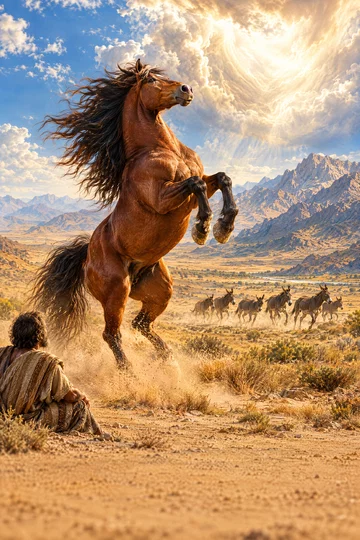
Hast thou given the horse strength? hast thou clothed his neck with thunder?
Translations
Have you given the horse strength? have you clothed his neck with thunder?
King James Version, Webster Bible
Hast thou given the horse strength? hast thou clothed his neck with thunder?
Hast thou given the horse strength?
Hast thou clothed his neck with thunder?Hast thou given the horse his might? hast thou clothed his neck with the quivering mane?
Hast thou given the horse his might?
Hast thou clothed his neck with the quivering mane?Dost thou give to the horse might? Dost thou clothe his neck [with] a mane?
Hast thou given strength to the horse? hast thou clothed his neck with the quivering mane?
Couldst thou give—to the Horse—strength? Couldst thou clothe his neck with the quivering mane?
Berean Standard Bible, Majority Standard Bible
Do you give strength to the horse
or adorn his neck with a mane?“ Have you given the horse might?
Have you clothed his neck with a quivering mane?Do you give strength to the horse? is it by your hand that his neck is clothed with power?
He sheweth himselfe cruell vnto his yong ones, as they were not his, and is without feare, as if he trauailed in vaine.
Douay-Rheims (Challoner revision)
Wilt thou give strength to the horse, or clothe his neck with neighing?
Pictures

Commentary
Each commentary is drawn from primary sources: the writings of Ellen G. White and Adventist pioneers and periodicals. Each commentary is separate. Its own words are not a quotation; follow the references to read the source passages.
Ellen G. White
2 sources
The question about giving the horse strength belongs with God's questions about the created world that direct attention to His power as Creator beyond human understanding.Ms 236, 1902, par. 2–4MH 431.2–3 The strength of the horse and its powerful, thunder-like neck are set forth as mysteries of nature that make that divine power known.MH 431.2–3 The question is given to mark the limits of human wisdom, not as a puzzle that people are expected to solve.MH 431.2–3
Sources
Pioneers and periodicals
12 sources
God asks Job whether he gave the horse its strength and clothed its neck with thundering power, pointing to a creature's might as God's work beyond human making.ST Jul 31, 1879ST Dec 17, 1912RH Apr 28, 1863ST Feb 5, 1880 The question belongs to the Lord's speeches out of the storm at the close of Job, appealing to familiar creatures to show Job how little he knows and how great God's might, wisdom and power are.ST Jun 30, 1909ST Jul 31, 1879ST Jun 24, 1913ST Dec 17, 1912ST By setting God's infinite power against man's smallness, things beyond understanding expose human ignorance and the folly of questioning His providence, humbling Job and silencing complaint.ST Jun 30, 1909ST Jul 22, 1908ST Feb 5, 1880 The wonders of nature in that answer also show His goodness, love and tender care for all His works.ST Apr 10, 1893 The revelation was given not for Job alone but for all who should come after, to bring submission, trust, patience and repentance when circumstances cannot be understood.ST Jun 24, 1913ST Apr 10, 1893ST Feb 5, 1880
Setting in God's Answer
Job 39:19 belongs to the Lord's speeches out of the storm-cloud that form the closing section of the book of Job, given in its last chapters as God's own instruction in natural history.ST Dec 17, 1912ST The book of Job is a poem whose meaning and force are best grasped by reading the book through as a whole.ST Sep 22, 1890
The verse is part of God's answer to Job pointing out His mighty works in creation, appealing to familiar creatures and parts of creation, including the beasts He created and the horse as material works, to show Job how little he knows and how great God's might, power, greatness and infinite wisdom are in what He has made, and by contrast how exceedingly small Job is.ST Jun 30, 1909ST Jul 31, 1879ST Jun 24, 1913 By setting that infinite power and wisdom against Job's smallness, familiar things beyond his understanding expose human ignorance and show the folly of questioning God's providence.ST Jun 30, 1909ST Jul 22, 1908ST Feb 5, 1880 That sermon from nature humbles Job, silences his complaints, and leads him to patience and repentance.ST Feb 5, 1880
The wonders of nature in that answer also show God's goodness, love and tender care for all His works, from which His goodness is to be clearly inferred.ST Apr 10, 1893 The revelation was spoken not only for Job's sake but for all who should come after, teaching trust in God whatever may come and submission to Him even when circumstances cannot be understood.ST Jun 24, 1913ST Apr 10, 1893 By this revelation Job came to a new experience, moving from having heard of God to seeing Him.
If this display is true in a material sense which can only partly be comprehended, it is true in God's moral dealings with men, whose great purposes where eternal life itself is at stake can be little understood.ST Jun 30, 1909
Power Shown in Horse
The question presses whether Job himself imparted vigor to the horse, fixing attention on a power in the animal that is God's handiwork and beyond human making or mastery.ST Jul 31, 1879ST Feb 5, 1880 The horse takes its place among the beasts brought forward as material products of divine creation, set forth as proof of divine might and greatness.ST Jul 31, 1879
This teaching belongs to the instruction in natural history given to Job in the closing chapters, whose account of the horse is lofty precisely through plainness.ST Dec 17, 1912 The neck is invested with thunder, a figure for impressive force and majestic bearing in a living creature.RH Apr 28, 1863ST Feb 5, 1880 That strength and thunder-like covering are the Creator's doing.ST Feb 5, 1880ST Apr 29, 1908
The same creature made by the Creator is fearless in combat, scorning terror when brought into battle.ST Apr 29, 1908 In the fuller portrait of the war-horse that opens here and extends through the following verses, the animal perceives the approaching fight from afar.ST Dec 16, 1886 So begun, the passage stands as a picture of alertness and eagerness for conflict.ST Dec 16, 1886
Sources