Joel 1:4
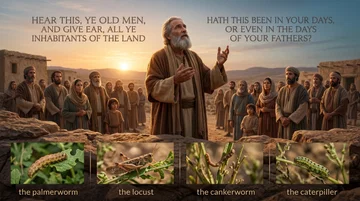
That which the palmerworm hath left hath the locust eaten; and that which the locust hath left hath the cankerworm eaten; and that which the cankerworm hath left hath the caterpiller eaten.
Translations
That which the palmerworm has left has the locust eaten; and that which the locust has left has the cankerworm eaten; and that which the cankerworm has left has the caterpillar eaten.
King James Version, Revised Version
That which the palmerworm hath left hath the locust eaten; and that which the locust hath left hath the cankerworm eaten; and that which the cankerworm hath left hath the caterpiller eaten.
That which the palmerworm hath left hath the locust eaten;
And that which the locust hath left hath the cankerworm eaten;
And that which the cankerworm hath left hath the caterpillar eaten.Webster Bible, American Standard Version
That which the palmer-worm hath left hath the locust eaten; and that which the locust hath left hath the canker-worm eaten; and that which the canker-worm hath left hath the caterpillar eaten.
What is left of the palmer-worm, eaten hath the locust, And what is left of the locust, Eaten hath the cankerworm, And what is left of the cankerworm, Eaten hath the caterpillar.
that which the palmer-worm hath left hath the locust eaten; and that which the locust hath left hath the cankerworm eaten; and that which the cankerworm hath left hath the caterpillar eaten.
That which was left by the creeping locust, hath the swarming locust eaten, and, that which was left by the swarming locust, hath the grass locust eaten; and, that which was left by the grass locust, hath the corn locust eaten.
Berean Standard Bible, Majority Standard Bible
What the devouring locust has left,
the swarming locust has eaten;
what the swarming locust has left,
the young locust has eaten;
and what the young locust has left,
the destroying locust has eaten.What the swarming locust has left, the great locust has eaten.
What the great locust has left, the grasshopper has eaten.
What the grasshopper has left, the caterpillar has eaten.What the worm did not make a meal of, has been taken by the locust; and what the locust did not take, has been food for the plant-worm; and what the plant-worm did not take, has been food for the field-fly.
That which is left of ye palmer worme, hath the grashopper eaten, and the residue of ye grashopper hath the canker worme eaten, and the residue of the canker worme hath the caterpiller eaten.
Douay-Rheims (Challoner revision)
That which the palmerworm hath left, the locust hath eaten: and that which the locust hath left, the bruchus hath eaten: and that which the bruchus hath left, the mildew hath destroyed.
Pictures
Cross-references
- Joel 2:25
And I will restore to you the years that the locust hath eaten, the cankerworm, and the caterpiller, and the palmerworm, my great army which I sent among you.
Names the same insect army and promises restoration of what it consumed.
- Joel 2:7-9
They shall run like mighty men; they shall climb the wall like men of war; and they shall march every one on his ways, and they shall not break their ranks:
Describes Joel’s army, whose work begins in the grasshopper plague.
- Joel 1:10-12
The field is wasted, the land mourneth; for the corn is wasted: the new wine is dried up, the oil languisheth.
The devastated land and failed crops continue the calamity described in Joel 1:4.
- Exodus 10:15
For they covered the face of the whole earth, so that the land was darkened; and they did eat every herb of the land, and all the fruit of the trees which the hail had left: and there remained not any green thing in the trees, or in the herbs of the field, through all the land of Egypt.
Both describe locusts consuming the land.
- Exodus 10:4
Else, if thou refuse to let my people go, behold, to morrow will I bring the locusts into thy coast:
Both describe devastation by locusts.
- Joel 2:20
But I will remove far off from you the northern army, and will drive him into a land barren and desolate, with his face toward the east sea, and his hinder part toward the utmost sea, and his stink shall come up, and his ill savour shall come up, because he hath done great things.
Refers to the northern army in the same prophecy.
- Joel 2:3
A fire devoureth before them; and behind them a flame burneth: the land is as the garden of Eden before them, and behind them a desolate wilderness; yea, and nothing shall escape them.
Describes the land left desolate by the locusts.
- Revelation 9:3
And there came out of the smoke locusts upon the earth: and unto them was given power, as the scorpions of the earth have power.
Locusts are symbolic there, unlike the literal pests described here.
Commentary
Each commentary is drawn from primary sources: the writings of Ellen G. White and Adventist pioneers and periodicals. Each commentary is separate. Its own words are not a quotation; follow the references to read the source passages.
Ellen G. White
1 source
Joel 1:4 belongs to a prophecy of the condition of the world just before the second coming.Ms 110, 1893, par. 13 It marks a time when the end of all things is at hand and iniquity abounds, because by continual transgression men have transgressed the law and broken the everlasting covenant that was given on condition of obedience.Ms 110, 1893, par. 13 It portrays a world coming more and more under the sway of seducing spirits as men turn away from God and from His righteous government.Ms 110, 1893, par. 13 It portrays a time when even men professing godliness indulge their own traits of character and become self-indulgent and self-centered unless conscientiously under the control of God.Ms 110, 1893, par. 13
Sources
Pioneers and periodicals
31 sources
The verse describes wave after wave of devouring insects, each swarm eating what the one before it left until field and tree are stripped bare and nothing escapes.ST Sep 26, 1911ST Dec 3, 1874ST Nov 8, 1905 The four names are the locust in its different stages of growth, voracious and organized in every stage, while those who stress the names themselves teach that they mean devourer, licker-up and ravager to express its destructive character.ST May 27, 1875ST Jul 13, 1904RH Feb 18, 1875 In its setting this utter wasting of harvest and food and wine belongs to the near day of the Lord coming as destruction from the Almighty, with famine, drought, suffering of man and beast, and priests and husbandmen called to mourn.ST Nov 8, 1905ST Nov 21, 1895RH Mar 31, 1868 The same succession foretells the insect scourges of the last days before the great day of Jehovah, when their numbers and destroying power greatly increase as a sign of the approaching end.ST Dec 8, 1914STST Dec 8, 1909RH Jul 25, 1865RH Aug 20, 1908 Together the palmerworm, locust, cankerworm and caterpillar are branches of the Lord's great army, whose famine and pestilence belong with the coming destruction of the world and the last plagues of Revelation 16.ST Jul 13, 1904ST Jan 17, 1911RH Sep 29, 1868RH Jul 25, 1865RH Aug 22, 1865
Words and Ancient Judgment
The verse pictures total stripping of the land by successive waves of insects, each kind eating what the one before it left until crops, trees, harvest and every green thing are gone and nothing escapes.ST Dec 3, 1874ST Nov 8, 1905ST May 27, 1875ST Jul 13, 1904ST Nov 21, 1895 The succession leaves the land wasted, its crops failed and its joy withered from the people, with widespread ruin, loss of food and wine, and sorrow among people and animals.ST Sep 26, 1911ST Nov 8, 1905ST Nov 21, 1895 The four names denote the locust in its different stages of development, in every stage an organized and animated voraciousness whose ravages on visited lands are appalling in the extreme.ST May 27, 1875RH Feb 18, 1875 Those who held the names to be descriptive rather than distinctive taught that they mean devourer, to lick up, and ravager, expressing destructive character rather than necessarily identifying distinct species or stages.ST Jul 13, 1904
Such insect scourges were frequent and familiar in that country and so well understood as to need no announcement or description.ST May 27, 1875RH Feb 18, 1875 This visitation was especially destructive and appalling beyond the familiar kind, leaving no green thing behind and showing severe devastation by wave upon wave of locusts consuming what earlier waves left.ST May 27, 1875RH Feb 18, 1875ST Oct 20, 1909 It was a literal plague of locusts visited upon the Jews that made their hearts faint and consumed their strength by famine.RH Mar 18, 1875 That weakening left them in misfortune, while the watchful heathen stood ready to war against them and bring them into subjection.RH Mar 18, 1875
In its setting the devastation belongs to the approaching and near day of the Lord, coming as destruction from the Almighty amid famine and destruction before Christ's coming.ST Nov 8, 1905ST Nov 21, 1895RH Mar 31, 1868 The wasted harvest brings withered joy, famine, drought and plant disease, loss of food and wine, suffering among animals with widespread disease and death, and suffering of people, animals and livestock.ST Nov 8, 1905ST Nov 21, 1895RH Mar 31, 1868ST Feb 13, 1901ST Dec 22, 1914 Husbandmen and vinedressers and priests, the ministers of the altar, are therefore called to howl because the meat-offering and drink-offering are withheld from the house of God.RH Oct 28, 1858
Prophecy for the Last Days
Joel 1:4 foretells insect pests for the closing hours of time and the last days, using local conditions as illustrations of calamities that will precede the great day of Jehovah and the closing time of war and trouble in earth's history.ST Dec 8, 1914STST Dec 8, 1909 It describes successive pests in which each kind consumes what the earlier kind leaves, destroying crops until the land is stripped, and this destruction is a sign that the prophecies of the last days are being fulfilled.ST Dec 8, 1914STST Sep 23, 1913 The verse concerns literal devouring pests, serving as a picture of the many destructive insects that damage crops, especially fruit, and require costly efforts to control, as multiplying creatures become formidable foes in the last days.ST Sep 23, 1913
The grasshopper devastation in Nebraska and Kansas is at least a beginning of the work of Joel's army, which is described as occurring just before the day of the Lord and the coming of Christ.ST Dec 3, 1874ST Dec 3, 1874 The succession of insects consuming what the previous swarm leaves is reflected in that plague devastating Nebraska and Kansas.ST Dec 3, 1874ST Dec 3, 1874
The ravages are a sign of the approaching end, for the palmerworm, locust, cankerworm, and caterpillar eat in succession what each leaves, meaning literal destructive insects whose numbers and destructive power are increasing more than tenfold.RH Jul 25, 1865 They are a great army without number that climbs walls, enters windows, and does not break ranks.RH Jul 25, 1865 They destroy whole forests until trees stand leafless as if burnt with fire, march into schoolhouses, swim across streams to strip forests beyond, and overcome kerosene, furrows, and ditches, with no such general attack on grains and fruits in this day or in the fathers' day.RH Jul 25, 1865 They cause loss of millions of dollars and extensive damage and expense, proving a marked fulfillment of the prophecy.RH Jul 25, 1865RH Aug 20, 1908
The destructive insect armies of the present are a partial and marked fulfillment and a sign that the day of the Lord is approaching and last-day prophecies are being fulfilled.ST Jul 18, 1916ST The prophecy shows insect pests becoming increasingly numerous until it is almost impossible to reap crops, and their increase and the efforts of governments to combat them belong to its fulfillment.ST Reported caterpillar, beetle, and red spider infestations illustrate this kind of devastation in which successive swarms consume what the previous swarm leaves until the land is stripped bare.ST Jul 18, 1916ST Jul 18, 1916 These pests damage crops, especially fruit, and require costly efforts to control.ST Sep 23, 1913
The sequence depicts devastation so complete that crops and trees are stripped bare, and it typifies the destructive insect plagues of the last days, compared to an invading army.ST Jul 13, 1904 The names mean devourer, to lick up, and ravager, expressing the insects' destructive character rather than necessarily identifying distinct species or stages.ST Jul 13, 1904 The palmerworm, locust, cankerworm, and caterpillar together represent branches of the Lord's great and numberless army, a destructive force recognized in eastern locust swarms.RH Jul 25, 1865RH Aug 22, 1865
The famine and pestilence described belong with the coming destruction of the world and the last plagues understood together with Revelation 16, for which God's people must prepare.RH Sep 29, 1868RH Mar 19, 1901 The verse applies to a time of severe crop loss and near-total agricultural ruin, increasingly visible in widespread damage to fields, orchards, and harvests, and it points toward fuller devastation associated with the plagues.ST Jan 17, 1911 It points to a future time when restraining power is withdrawn and an army of destructive insects will be released alongside the plagues of Revelation, afflicting those outside the ark of safety.
Joel 1 shows a work to be done before the Lord comes, the same typical work of the feast of tabernacles and the day of atonement that follows the Third Angel's Message and does not belong to immortal saints.RH Sep 11, 1856 As present truth concerning the cankerworm and caterpillar it belongs to the present and calls for action now while it is passing and cannot be put off to past or future at pleasure.RH Mar 11, 1873
Under the figure of a land whose fruit has been eaten, the verse shows the church near the end in complete destruction by a numerous and powerful destroyer, with palmerworm, locust, cankerworm and caterpillar marking the completeness of the destruction.RH Oct 28, 1858 The waste leaves husbandmen and vinedressers and priests, the ministers of the altar, called to howl because the meat-offering and drink-offering are withheld from the house of God.RH Oct 28, 1858 The desolation runs through the rest of the chapter and into the terrors of the day of God in the next chapter, until a way of hope and mercy is opened.RH Oct 28, 1858
The verse shows the land's crops being devastated in successive waves in which each kind of insect consumes what the one before it leaves, presenting an example of the earth's decay under the curse, bringing widespread crop failure and loss.ST Sep 26, 1911ST Feb 13, 1901ST These agricultural judgments, including plant diseases, are consequences of human vice and wickedness and prove the curse is fast devouring the earth.RH Jul 25, 1865ST In the setting of the first chapter this devastation belongs to the scenes of the last days and accompanies suffering among animals, widespread disease and death, livestock affliction by drought and insect destruction, and joy fading and withered from people and from the sons of men.ST Feb 13, 1901RH Jul 25, 1865RH Dec 10, 1914
Sources