John 11:2
(It was that Mary which anointed the Lord with ointment, and wiped his feet with her hair, whose brother Lazarus was sick.)
Translations
American King James Version, King James Version, KJV Cambridge Paragraph Bible
(It was that Mary which anointed the Lord with ointment, and wiped his feet with her hair, whose brother Lazarus was sick.)
(It was that Mary who anointed the Lord with ointment, and wiped his feet with her hair, whose brother Lazarus was sick.)
And it was that Mary which anointed the Lord with ointment, and wiped his feet with her hair, whose brother Lazarus was sick.
And it was that Mary who anointed the Lord with ointment, and wiped his feet with her hair, whose brother Lazarus was sick.
and it was Mary who did anoint the Lord with ointment, and did wipe his feet with her hair, whose brother Lazarus was ailing —
It was [ the] Mary who anointed the Lord with ointment and wiped his feet with her hair, whose brother Lazarus was sick.
And Mary was she who anointed the Lord with perfume, and wiped his feet with her hair—whose brother Lazarus was sick.
Berean Standard Bible, Majority Standard Bible
( Mary, whose brother Lazarus was sick, was to anoint the Lord with perfume and wipe His feet with her hair.)
It was that Mary who had anointed the Lord with ointment and wiped his feet with her hair, whose brother Lazarus was sick.
( The Mary whose brother Lazarus was ill, was the Mary who put perfumed oil on the Lord and made his feet dry with her hair.)
(And it was that Mary which anointed the Lord with oyntment, and wiped his feete with her heare, whose brother Lazarus was sicke.)
Douay-Rheims (Challoner revision)
( And Mary was she that anointed the Lord with ointment, and wiped his feet with her hair: whose brother Lazarus was sick.)
Pictures
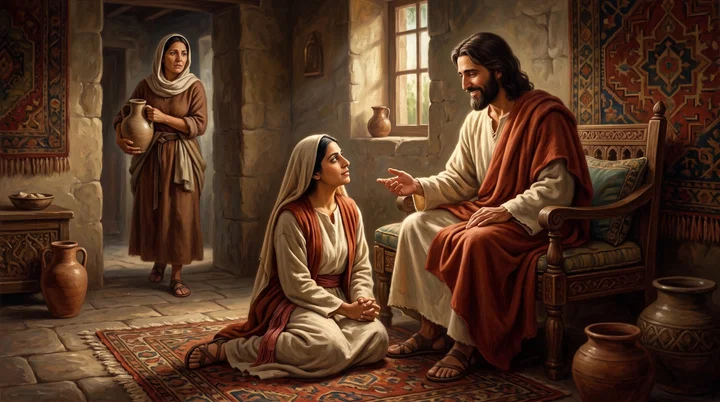
Cross-references 20 of 27
- John 11:43-44
And when he thus had spoken, he cried with a loud voice, Lazarus, come forth.
Jesus calls Lazarus from the tomb, and he comes out alive.
- John 11:25-26
Jesus said unto her, I am the resurrection, and the life: he that believeth in me, though he were dead, yet shall he live:
Jesus declares himself the resurrection and the life at Bethany.
- John 12:3
Then took Mary a pound of ointment of spikenard, very costly, and anointed the feet of Jesus, and wiped his feet with her hair: and the house was filled with the odour of the ointment.
Mary anoints Jesus’ feet and wipes them with her hair.
- John 11:11-14
These things said he: and after that he saith unto them, Our friend Lazarus sleepeth; but I go, that I may awake him out of sleep.
Jesus describes Lazarus’s death as sleep before plainly saying he is dead.
- John 12:10-11
But the chief priests consulted that they might put Lazarus also to death;
The priests plot to kill Lazarus because many believe in Jesus through him.
- John 11:35
Jesus wept.
Jesus weeps with those mourning Lazarus, showing compassion for human sorrow.
- Mark 14:3
And being in Bethany in the house of Simon the leper, as he sat at meat, there came a woman having an alabaster box of ointment of spikenard very precious; and she brake the box, and poured it on his head.
Mary anoints Jesus with ointment at Bethany.
- John 11:47-53
Then gathered the chief priests and the Pharisees a council, and said, What do we? for this man doeth many miracles.
After Lazarus is raised, the leaders plot to kill Jesus.
- John 11:15
And I am glad for your sakes that I was not there, to the intent ye may believe; nevertheless let us go unto him.
Jesus says his absence was intended to strengthen the disciples’ belief.
- Luke 10:39
And she had a sister called Mary, which also sat at Jesus’ feet, and heard his word.
Mary listens to Jesus at his feet in her home.
- John 11:17
Then when Jesus came, he found that he had lain in the grave four days already.
Jesus arrives after Lazarus has been dead four days.
- Matthew 26:6-7
Now when Jesus was in Bethany, in the house of Simon the leper,
Both accounts describe Mary’s anointing of Jesus at Bethany.
- Luke 7:37-38
And, behold, a woman in the city, which was a sinner, when she knew that Jesus sat at meat in the Pharisee’s house, brought an alabaster box of ointment,
A woman anoints Jesus’ feet and wipes them with her hair.
- John 11:6
When he had heard therefore that he was sick, he abode two days still in the same place where he was.
Jesus delays his journey after hearing Lazarus is ill.
- John 11:21
Then said Martha unto Jesus, Lord, if thou hadst been here, my brother had not died.
Martha tells Jesus Lazarus would not have died if he had been there.
- John 11:24
Martha saith unto him, I know that he shall rise again in the resurrection at the last day.
Martha affirms Lazarus will rise in the resurrection at the last day.
- John 11:28
And when she had so said, she went her way, and called Mary her sister secretly, saying, The Master is come, and calleth for thee.
Martha fetching Mary to meet Jesus
- John 12:2
There they made him a supper; and Martha served: but Lazarus was one of them that sat at the table with him.
Lazarus later sits at a meal while Martha serves.
- John 11:39
Jesus said, Take ye away the stone. Martha, the sister of him that was dead, saith unto him, Lord, by this time he stinketh: for he hath been dead four days.
Martha says Lazarus has been dead long enough for decomposition to begin.
- John 11:8
His disciples say unto him, Master, the Jews of late sought to stone thee; and goest thou thither again?
The disciples warn that returning to Judea risks stoning.
Commentary
Each commentary is drawn from primary sources: the writings of Ellen G. White and Adventist pioneers and periodicals. Each commentary is separate. Its own words are not a quotation; follow the references to read the source passages.
Ellen G. White
27 sources
The verse identifies Mary as the woman who anointed the Lord with ointment and wiped His feet with her hair, and identifies Lazarus as her brother.ST Mar 23, 1882Ms 1, 1867, par. 44–47Ms 47, 1897, par. 9–10 She lived with Martha and Lazarus in a humble home at Bethany where Jesus often found rest, welcome and a receptive heart.DA 524.2–3Ms 19, 1892, par. 7–96RED 88.1 When Lazarus fell violently sick the sisters sent a trusting message to Jesus, yet though He knew all and could have healed from afar He waited two days by divine wisdom to make the death undoubted proof of His power as the Son of God and Saviour of the world.ST Nov 10, 19093RED 102.221MR 109.2–4Ms 19, 1892, par. 7–9Ms 18, 1898, par. 5–7 Jesus wept in sympathy and then called Lazarus from the tomb after four days when his body had seen corruption, restoring him to mortal life still subject to death, not to immortality.ST Mar 23, 1882Ms 1, 1867, par. 44–47ST Feb 3, 1914COS 86.2–87.2Ms 115, 1897, par. 17–20 That crowning miracle gave convincing evidence that Jesus is the Messiah and Lifegiver, so many believed and glorified God while those who rejected the light were hardened, pointing forward to when the dead in Christ will rise to immortal life.21MR 110.7–111.220MR 147.3–5Ms 47, 1897, par. 9–104RED 18.1COS 86.2–87.2
Household at Bethany
John 11:2 identifies Mary as the woman who anointed the Lord with ointment and wiped His feet with her hair, distinguishing her from other women named Mary, and identifies Lazarus as her brother and her sister as Martha's household kin.ST Mar 23, 1882Ms 1, 1867, par. 44–47Ms 47, 1897, par. 9–10Ms 128, 1899, par. 1DA 564.2–4 She is thus known by that anointing and by being the sister of Lazarus whom Jesus raised from the dead.ST Mar 23, 1882Ms 1, 1867, par. 44–47Ms 128, 1899, par. 1 Her anointing was an act of love and reverence showing faith in Jesus as the Son of God and appreciation of Him as the world's Redeemer, with the ointment symbolizing her heart overflowing with love.DA 564.2–4
Mary lived together with her sister Martha and their brother Lazarus in a humble, peaceful home at Bethany.DA 524.2–3Ms 19, 1892, par. 7–93SP 250.3 That home was on the sloping descent of the Mount of Olives, and it was Lazarus's home where Mary lived.6RED 88.13SP 250.3ST Jan 4, 1883ST Oct 31, 1895 There Jesus often found rest, welcome, friendship, and a receptive audience for private instruction.DA 524.2–36RED 88.13SP 250.3ST Jan 4, 1883ST Oct 31, 1895
It was a home Jesus loved to visit, and the faith and love there gave Him rest amid the pain of being misunderstood, even at home, and the burden of His mission.21MR 110.7–111.2DA 326.4 Lazarus loved Jesus and believed Him to be the Way, the Truth, and the Life, Mary listened earnestly to His words, and the household sympathized with Him despite the Pharisees' hostility.21MR 110.7–111.2
Sickness, Delay and Death
Lazarus fell suddenly and violently sick with a rapidly rising fever and became seriously ill, and his sickness and death set the scene in Bethany in Judea.ST Nov 10, 19093RED 102.221MR 109.2–4Ms 19, 1892, par. 7–9 The sisters knew Jesus was able to heal every kind of disease and would feel for them in distress, so they sent only a trusting message that the one He loved was sick, without demanding His immediate presence.ST Nov 10, 190921MR 109.2–4Ms 19, 1892, par. 7–9 They fully expected their beloved friend to answer at once and come to Bethany as quickly as He could to heal him.ST Nov 10, 190921MR 109.2–4Ms 19, 1892, par. 7–9 They prayed and watched while the spark of life remained, looking to Him for help, comfort and healing, and clung to hope when told the sickness would not end in death.ST Nov 10, 1909Ms 19, 1892, par. 7–9Ms 31, 1892, par. 3–5
Jesus knew what was taking place at Bethany even before the messenger reached Him and could have stopped the power of death from where He was, yet He did not prevent it.3RED 102.2Ms 19, 1892, par. 7–9 He waited two days and did not go at once, because in His immediate presence disease was always rebuked, and He could not witness suffering, disease, or death without bringing relief and combatting the power of Satan.3RED 102.2Ms 19, 1892, par. 7–9Ms 18, 1898, par. 5–7 The sickness grew worse until death triumphed, and with anguished hearts the sisters watched their brother die.21MR 109.2–4Ms 19, 1892, par. 7–9 They prepared him for burial while anxiously looking for Christ and longing for His comfort, laid him in the grave, waited in grief for His coming, and then endured two long, sorrowful days before Jesus came.21MR 109.2–4Ms 19, 1892, par. 7–9
The delay was deliberate and not from lack of love or interest, but was done with divine wisdom to serve God's plan.3RED 102.221MR 110.7–111.2 It was to turn the death into undoubted proof of His divine power, to give the Jews the last and crowning evidence that Jesus is the Son of God and Saviour of the world, and to reveal the Father through His works.3RED 102.2Ms 18, 1898, par. 5–7Ms 41, 1897, par. 14–20 It was to join His disciples to Him in a faith that could not be broken and on which their faith could rest, and to work a crowning miracle to convince all who could be convinced.3RED 102.221MR 110.7–111.2Ms 41, 1897, par. 14–20 This was even while some disciples questioned whether the true Christ would let one He loved die, and while going to help meant returning to Judea where the Jews had lately sought to stone Him.3RED 102.2
In this conflict with evil Christ kept before Him the shadow of His own death and the ransom He must pay for souls.Ms 18, 1898, par. 5–7 He knew when He raised Lazarus that for that life He must pay the ransom on the cross of Calvary, that every rescue would bring Him deepest humiliation, and that He was to taste death for every man.Ms 18, 1898, par. 5–7 He wept at the grave at the thought that He could not save everyone whom Satan's power had laid low in death, though He gave Himself a ransom for many, even all who would come back to loyalty to God.Ms 18, 1898, par. 5–7
Raising and Its Meaning
Jesus wept at the grave of Lazarus in tender sympathy for the bereaved, and then by His own word called him out of the tomb after he had been dead four days.ST Mar 23, 1882COS 86.2–87.2 His body had already seen corruption, yet that word restored him to life and gave him back to Mary and Martha, to their great joy.Ms 1, 1867, par. 44–47COS 86.2–87.2Ms 41, 1897, par. 14–20 This raising belongs to the account of the resurrection of Lazarus and to the raising of the dead as part of Christ's mission, alongside His humble daily work and His death for humanity.Lt 122, 1896, par. 1Lt 1, 1880, par. 5–6 Done shortly before His entry into Jerusalem, it demonstrated that He is the Saviour and Lifegiver.Ms 128, 1899, par. 15
The life thus given was a restoration to mortal life, not a clothing with immortality.ST Feb 3, 1914Ms 115, 1897, par. 17–20 After he was raised Lazarus was still subject to death and decay, like the son of the widow of Nain and the ruler's daughter, Jairus' daughter, whom Jesus raised during His ministry.ST Feb 3, 1914Ms 115, 1897, par. 17–20 This is unlike those who came forth from the grave at Christ's own resurrection, who were raised to everlasting life as trophies of His victory over death and the grave.ST Feb 3, 1914Ms 115, 1897, par. 17–20
The raising was a testimony to Christ's divine power and a crowning miracle that powerfully affected the people.20MR 147.3–5Ms 128, 1899, par. 1 It drew a large enthusiastic multitude to where Jesus was staying.Ms 128, 1899, par. 1 It gave convincing and undisputable proof of His divinity, revealing the Father through the works He did and providing evidence on which the disciples' faith could rest, with undisputable evidence to Nicodemus that Jesus is the Messiah, the Son of God and the Saviour of the world.4RED 18.1Ms 41, 1897, par. 14–20 Lazarus himself testified that Christ was the Son of God, and his very presence at the feast testified to that divine power, though he had no experience of death to report.20MR 147.3–5Ms 47, 1897, par. 9–10
Many believed because of the miracle and glorified God, but those who had rejected the light remained hardened and reported it to the rulers, intensifying the hatred of the Pharisees.21MR 110.7–111.2 The raising illustrates Christ's power over death and points forward to the future resurrection, when the dead in Christ will rise to immortal life and be with the Lord.COS 86.2–87.2
Sources
Pioneers and periodicals
84 sources
The verse identifies Mary as the sister of Martha and Lazarus, marking them as one loving family whose sick brother sets the story in motion.ST Nov 10, 1909ST Apr 10, 1901ST Jan 20, 1914ST Jun 29, 1876ST Dec 24, 1896 They lived together at Bethany, less than two miles east of Jerusalem on the Mount of Olives, where their home welcomed Jesus and gave Him rest because He loved them.ST Apr 10, 1901ST Dec 19, 1916ST Mar 15, 1899ST Nov 29, 1910RH Feb 4, 1862 It names her by the later anointing in which she anointed the Lord with ointment and wiped His feet with her hair, mentioning a later event alongside the earlier sickness without keeping chronological order.ST Nov 17, 1898RH Aug 27, 1872RH Sep 10, 1872RH Dec 3, 1867ST Nov 10, 1914 That sickness led to Jesus raising Lazarus after four days dead, showing Him as the resurrection and the life who has divine creative power over death and the grave and giving decisive evidence that He is the Messiah.ST Dec 19, 1916ST Sep 17, 1912ST Nov 8, 1883ST May 30, 1895ST Dec 3, 1894 Lazarus lay in death as an unconscious sleep with no report of heaven, and he was restored to literal, recognizable mortal life still subject to death, not to immortality.ST Feb 3, 1914STRH Dec 28, 1911ST Jun 8, 1915ST Aug 12, 1889
Family Home and Friendship
The verse identifies Mary as the sister of Martha and Lazarus, and Lazarus as the sick brother of Mary and Martha, placing the three together as one loving family at Bethany.ST Apr 10, 1901ST Jun 29, 1876ST Dec 24, 1896RH Mar 9, 1905 The anointing with ointment and wiping of feet with hair makes Mary recognizable, and the family setting frames the account of Lazarus's illness, four days dead and buried, resurrection from the tomb, and the sisters' grief and hope of resurrection while Jesus shared their sorrow and wept.ST Apr 10, 1901ST Jun 29, 1876ST Dec 24, 1896RH Mar 9, 1905 Lazarus died and was dead four days, Jesus said he was dead and called that death a sleep He would awake, then brought him back to life, and his giving no report of heaven during those days shows the righteous dead do not go to heaven at death but remain unconscious in their graves with the wicked awaiting resurrection.RH Dec 28, 1911
Their home was at Bethany on the eastern slope of the Mount of Olives, less than two miles east of Jerusalem and about fifteen furlongs from Jerusalem.ST Mar 15, 1899ST Nov 29, 1910RH Feb 4, 1862 It lay about a mile beyond the summit near where the road from Jerusalem to Jericho begins its descent toward the Jordan Valley, and the place is now called Lazarieh or el-Aziriyeh, meaning the place of Lazarus.ST Mar 6, 1901 John’s naming of Lazarus, placing him at Bethany, describing his laying in a cave tomb with a stone at its entrance, detailing his death and emergence, and naming witnesses makes the account circumstantial and open to verification.RH Feb 4, 1862
That Bethany home welcomed Jesus and gave Him rest, and He often stopped, stayed, and rested there because He loved Martha and her sister and Lazarus.ST Jan 4, 1883ST Apr 10, 1901ST Mar 15, 1899ST Jun 25, 1912ST Aug 9, 1910 He was a frequent guest and close friend of the family, and in that household Martha voiced the hope set before the early disciples when told her brother would rise again and she answered that he would rise again in the resurrection at the last day.ST Jan 4, 1883ST Dec 19, 1916ST Aug 9, 1910 At the grave He wept in sympathy, dried the tears of the bereaved orphaned sisters, and restored their dead brother to their joyful embrace by breaking the chain that bound him in the prison of death.RH Jun 13, 1871
The siblings were among Jesus’ close friends and devoted disciples who had received His teaching, and in passing through childhood and youth He was able to meet other young persons as a most devoted friend and guest of Mary, Martha, and Lazarus. They were the one family He loved in human flesh, His special friends among many to whom He bore general good will, the congenial spirits and favored few at whose always-open table He was quite at home and at whose door He scarcely needed to knock.RH Aug 26, 1862 Made ever welcome, He came in and supped with them and they with Him, picturing the higher manifestations of communion, fellowship, and love belonging to the more advanced stages of the Christian life.RH Aug 26, 1862 He had personal friendships and preferred their society in liking and congenial fellowship because He found rest there, yet this preference does not mean He loved them more in saving love or would have died for them sooner than for others, for in laboring to save souls He loved everybody as purchased by His blood with possibilities of immortality, and His friendship never took Him from duty or turned Him from the mission given Him by God.ST Oct 13, 1909
One account places the siblings’ hospitable home where Jesus often stayed on journeys to Jerusalem at Nazareth.
Sickness Delay and Raising
Lazarus fell suddenly, violently and gravely sick with a sudden fatal disease in the peaceful home at Bethany, and his sisters sent Jesus word from Bethany while He was away at Bethabara beyond Jordan and in Perea that the man He loved was sick.ST Nov 10, 1909ST Jan 20, 1914ST Mar 15, 1899RH Aug 29, 1871 He was Mary's sick brother, and Mary and Martha his sisters sent the word concerning him.ST Jan 20, 1914ST Jesus later described him as sleeping and then plainly said that he was dead.ST Jan 20, 1914
The sisters sent only a trusting message without demanding His immediate presence, expecting He would answer at once and come to Bethany as quickly as He could.ST Nov 10, 1909 They prayed and watched for Him while the spark of life remained, waited anxiously, and clung to hope when told the sickness would not end in death.ST Nov 10, 1909ST May 18, 1915 His two-day delay deepened their sorrow and seemed like indifference, yet His love for the family is the foundation for trusting Him even when delay seems so, since a painful situation can prepare for a greater display of God's power and glory.ST Nov 10, 1909ST Dec 24, 1896ST May 18, 1915
Jesus did not start for Bethany until two days after receiving the summons and arrived when Lazarus had been dead and buried four days.ST Mar 15, 1899ST Oct 19, 1915 He had been laid in a cave tomb with a stone at its entrance, with details of death and emergence and named witnesses making the account specific and open to verification.RH Feb 4, 1862 Martha went out first to meet Him saying Lord if Thou hadst been here my brother had not died, and after talking with Him Jesus stayed outside until Martha went to the house and sent Mary out to greet Him.ST Mar 15, 1899
Jesus then called Lazarus from the tomb and restored him to life even after his body had begun to decay, proving His power over death.ST Aug 20, 1896RH Nov 6, 1866 Lazarus emerged alive after four days in the tomb, with no experiences or sights during that time reported.ST Jun 8, 1915RH Nov 6, 1866 Afterward he sat at table and served, his theme was glorifying the Lord who raised him, and his sisters led their brother home after Jesus raised him from the dead.ST Aug 20, 1896ST Jun 8, 1915
Christ's Power and Identity
The raising of Lazarus after four days closes the readings on life coming from Christ.ST Sep 17, 1912 It shows Jesus as the resurrection and the life in whom the believer though dead shall yet live.ST Dec 19, 1916 Christ's coming brings life as it did for Lazarus, and He will likewise give life to those who sleep in Him at His coming.ST May 30, 1895ST Feb 7, 1906
The miracle displays divine creative power over death and the grave.ST Jan 26, 1915 As Son of Man He worked miracles on human bodies by the same divine creative power through which He spoke the world into existence and upholds all things.ST Dec 3, 1894 That power restored Lazarus even after his body had begun to decay, proving God can restore what appears beyond repair.ST Mar 11, 1889 The same power that raised Lazarus and raised Jesus can change nature, strengthen against sin, keep through faith, and ultimately give life to mortal bodies.ST Mar 11, 1889 The act turned faith toward Jehovah as the great first cause beyond physical objects.ST May 6, 1913
The raising came by virtue of the sacrifice of the Son of God, even though that sacrifice had not yet taken place, because it was already established in God's purpose.ST Oct 12, 1876 It was settled in Christ's character beforehand, making Lazarus a victor over the power of death.ST Jan 11, 1905 The miracle was powerful evidence that Jesus was the Messiah and heir to David's throne.ST Nov 8, 1883 It was decisive evidence of His Messiahship and divine mission and a sign that He could give life.RH Sep 25, 1913ST Jan 3, 1911 After the resurrection a general desire on the part of all classes to see Jesus grew during His ministry, continuing from His triumphal entry into Jerusalem until His crucifixion.ST Oct 17, 1895
The Jesus who raised Lazarus is the very same Jesus who taught the people, healed the sick, fed the multitudes, suffered in Gethsemane, died on the cross, was buried, and rose again triumphant over death and the grave for Himself and for His people forever, and this same Jesus is coming again.ST Apr 15, 1897 The public, incontestable miracle intensified excitement about Jesus and led many to believe in Him.RH Nov 6, 1866ST Apr 20, 1882 Others were hardened: the chief priests and leading Pharisees met illegally to decide what to do, fearing the excitement might provoke a revolt and bring Roman retaliation.ST Apr 20, 1882 Unbelief plotted to kill not only Jesus the Life-giver but also Lazarus who had been given life, demanding Lazarus be killed as a troubling witness whose murder they would conceal.RH Nov 6, 1866ST Dec 20, 1910ST Sep 26, 1895
Death Sleep and Resurrection
Jesus called Lazarus sleeping and then said plainly that he was dead, naming death sleep and declaring that He would awake him.ST Jan 20, 1914RH Dec 28, 1911 Martha voiced the hope set before the early disciples when she was told her brother would rise again and answered that he would rise again in the resurrection at the last day.ST Dec 19, 1916ST The sickness, death, and raising after four days in the tomb show that the dead depend on resurrection for life beyond the grave.ST Jan 20, 1914ST
Lazarus gave no report of heaven, Paradise, or any conscious experience during his four days in the tomb, and afterward his theme was glorifying the Lord who raised him.RH Dec 28, 1911ST Jun 8, 1915RH Aug 24, 1905 His silence and total unconsciousness prove that the dead have no conscious thoughts, know nothing, do not go immediately to glory and conscious life in heaven at death, and depend on resurrection.STRH Dec 28, 1911RH Aug 24, 1905ST Feb 17, 1881ST Nov 4, 1880 The righteous dead do not go to heaven at death but stay in their graves with the wicked awaiting resurrection.RH Dec 28, 1911ST Feb 17, 1881 The case raises the question whether Lazarus was consciously enjoying heaven and was brought back from happiness into a sinful world, and the answer given is that he had not been in heaven.RH Dec 28, 1911ST Oct 19, 1915
Jesus did not teach that a person is alive while dead but that the dead shall live again, declaring Himself the resurrection and the life in whom the believer though dead shall yet live.ST Dec 19, 1916 Lazarus truly heard Christ's voice and lived, shortly after Jesus taught that the dead would hear His voice and come forth both to the resurrection of life and to the resurrection of damnation.ST Dec 19, 1916RH Dec 11, 1855RH Oct 19, 1869 That raising foreshadowed the future resurrection of all who are in the graves and stands in proof of Christ's power to give life to the dead.ST Dec 19, 1916RH Oct 19, 1869
His return was literal, material, recognizable bodily life that truly broke the power of death, not only spiritual or moral.ST Aug 9, 1905ST Aug 12, 1889ST Mar 13, 1907ST Oct 6, 1909ST Jul 21, 1909 To say Lazarus was resurrected only spiritually or to treat the account as conveying only a moral lesson and not literal truth denies a cardinal point of faith and a fundamental doctrine of Christianity belonging to the faith once delivered to the saints.ST Oct 6, 1909ST Jul 21, 1909 Denying that literal resurrection belongs with rejecting the Bible as infallible and discarding all doctrines of inspiration, denying devils, denying the virgin birth of Jesus and His physical resurrection, denying imputed righteousness and the immutability of the law, and treating what Matthew and Luke add to Mark as unreliable human embellishment.ST Mar 13, 1907
His return was not resurrection to immortality, for after he was raised he was still subject to death and was raised only to mortal life.ST Feb 3, 1914ST Aug 12, 1889 He was one of three dead people Jesus raised during His ministry, along with the son of the widow of Nain and the ruler's daughter, and one raised before Christ's own resurrection as an exception to the general rule.ST Feb 3, 1914ST Aug 12, 1889ST Jan 28, 1889RH Feb 25, 1873 Unlike those who came forth from the grave at Christ's resurrection to everlasting life as trophies of victory over death and the grave, Lazarus was raised only to mortal life.ST Feb 3, 1914 His raising came by virtue of Christ's death and resurrection, settled in Christ's character beforehand, making Lazarus a victor over the power of death, and Christ remains the firstfruits of those who sleep because firstfruits means first in pre-eminence, not first in time, so Lazarus being raised before Christ does not contradict that title.ST Jan 11, 1905 The teaching held by those who differed is that Lazarus was not dead, for his spirit had not entirely left his body but he was in a trance which Christ in His superior condition saw and reversed by magnetic power restoring the action of his system.RH Sep 8, 1853
Wording Links and History
The verse names Mary by what she would later do in pouring ointment on the Lord and wiping His feet with her hair, though Lazarus was already sick before that anointing took place.RH Aug 27, 1872ST Nov 10, 1914ST Aug 27, 1885ST Sep 16, 1889 A writer may name a later associated event alongside an earlier one without keeping chronological order.RH Aug 27, 1872 The parenthetical mark points to another occasion and to a circumstance not happening at the time being narrated, and the anointing itself is not described in this chapter.RH Sep 10, 1872
That anointing took place in Bethany at the family home at a feast prepared for Jesus after Lazarus had been raised, in the house of Simon the leper.ST Nov 17, 1898ST Mar 6, 1901 It was on the day before Jesus went to Jerusalem and was met by the throng with palm branches at the descent of the Mount of Olives.ST Nov 17, 1898 Mary had kept costly precious ointment for His burial and anointed Him beforehand because she had taken His words about His death to heart, and Jesus called it a good work done for Him to be remembered wherever the gospel is preached.RH Dec 3, 1867 Read with Luke 8:2 and Mark 14:3, the verse connects this anointing woman with Lazarus as his sister and identifies the woman described in Luke 7 as Mary Magdalene, from whom Jesus had cast seven demons and who was known in her community as a sinful woman.ST Oct 11, 1899
This Lazarus, brother of Martha and Mary and son of a wealthy Jew, is not the poor man in the parable of the rich man and Lazarus.ST Mar 24, 1909 John's account is circumstantial and open to verification, naming Lazarus, placing him at Bethany about fifteen furlongs from Jerusalem, describing him laid in a cave with a stone at its entrance, detailing his death and emergence from the tomb, and naming those who witnessed the events.RH Feb 4, 1862 The raising of Lazarus is counted among Jesus' miracles admitted in the Talmud.RH Sep 5, 1865 It belongs with the chapter 9 miracle and the Sabbath healings around which controversy with the Jews gathered, and it fell in the about five months between the incidents of one week before and the triumphal entry in the last week of Christ's life on earth.ST Aug 20, 1896ST Apr 14, 1898
The sudden fatal sickness that overcame Lazarus of Bethany is still experienced there, and its continuance bears witness to scriptural truth.RH Aug 29, 1871
Sympathy Trust and Example
At the tomb and grave of Lazarus Jesus wept in sympathy and shared the sorrow of Martha and Mary, though He loved their household and had come to give life.ST Mar 23, 1882RH Apr 27, 1911RH Mar 9, 1905RH Dec 15, 1859RH Jun 13, 1871 He comforted the weeping sisters with personal care, dried the tears of the bereaved orphaned sisters, and restored their dead brother to their joyful embrace by breaking the chain that bound him in the prison house of death.ST Mar 23, 1882RH Mar 9, 1905RH Jun 13, 1871 This was mercy in going about doing good, as bread cast upon the waters that returned again when multitudes believed.RH Jun 13, 1871 His grief was no indifference, for though He could have kept Lazarus from dying He permitted death so that raising him would show followers and the world His power to bring the faithful out of death, confirm hope of everlasting life, and demonstrate that death would not have the final victory.RH Apr 28, 1910 His love for the family is the foundation for trusting Him even when delay seems like indifference, for a painful situation can prepare for a greater display of God's power and glory.ST Dec 24, 1896
Mourners should not try to bear heavy sorrow alone, because Christ's mission is to heal the brokenhearted and bind up the wounded spirit.ST Oct 28, 1880 He stands at the door with pitying eye wanting to be asked for help, and no heart is strong enough to bear such grief alone long without fading.ST Oct 28, 1880 His comfort then proves He is the same yesterday, today and forever, and that there is no sorrow on earth He cannot heal.ST Oct 28, 1880 That same voice of love shown at the tomb at Bethany remains near to the meek, lowly and penitent.ST Jan 31, 1911 As Comforter in the little house at Bethany He binds up wounded hearts, as husband to the widow and father to the fatherless, as rest for the weary and friend to the friendless.RH Feb 8, 1915 He never varies, never fails and never dies, with sympathy ever fresh and love ever free, so widows and orphans and all who sorrow and mourn have cause to thank God for Christ the Comforter, especially shown at Lazarus's grave.RH Feb 8, 1915ST Jan 16, 1896 Doubting the raising of Lazarus is doubting the testimony of John's Gospel, which consoles mourners.RH May 23, 1912
His call to a sinner to rise from spiritual death and come into Christ's light is a miracle of grace comparable to calling Lazarus back to life after four days in the tomb.ST Nov 29, 1905 The account of Lazarus's resurrection defends belief in the resurrection of the dead.RH Jun 8, 1916 The same power that raised Lazarus and raised Jesus can change nature, strengthen against sin, keep through faith, heal disease by God's direct power apart from means, and ultimately give life to mortal bodies even when the body has begun to decay.ST Mar 11, 1889ST Mar 31, 1898 Jesus' visits place domestic life and family love where He comes and ministers, and the Bethany home that welcomed Him and where He often stayed makes a Christian home a light in the world where He is welcomed.ST Jun 25, 1912ST Dec 4, 1901
The account shows the dead have no conscious thoughts and depend on resurrection for life beyond the grave, with Martha looking forward to her brother's rising at the last day.ST It is one of three instances in which Jesus raised the dead, showing His works were public rather than done in secret.ST May 8, 1907 It displays divine creative power.ST May 8, 1907 That Jesus was away from Bethany while Lazarus was sick illustrates that in bodily presence He could be in only one place at a time, unlike the Holy Spirit whose ministry extends throughout the world.ST Oct 5, 1904
Sources