John 11:38
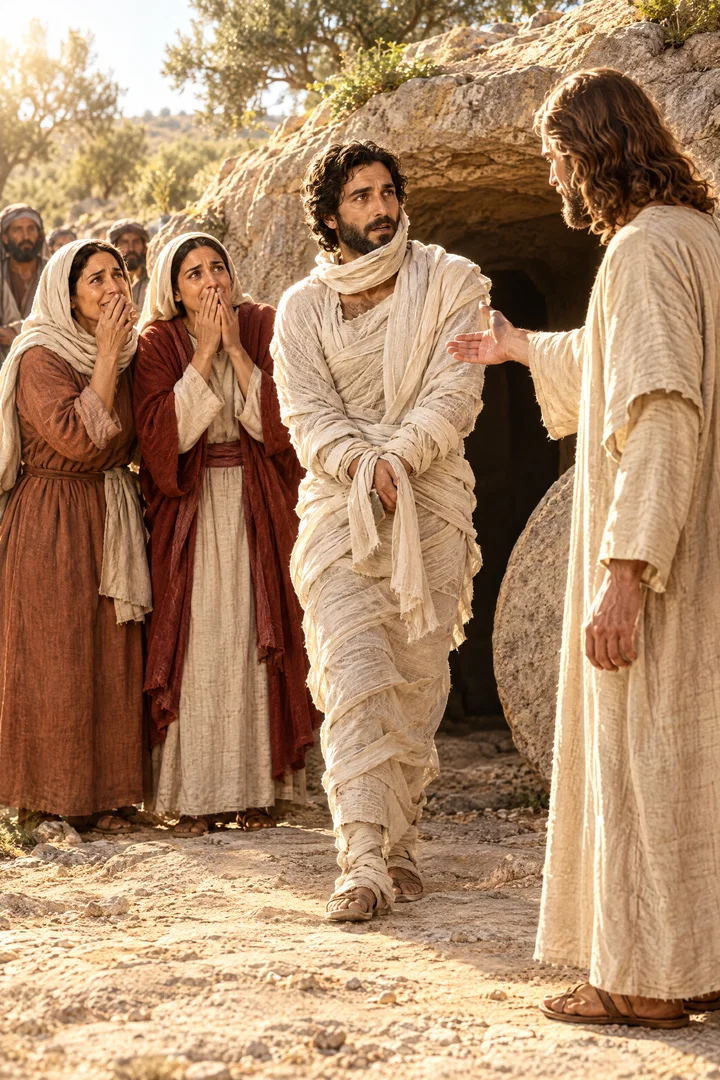
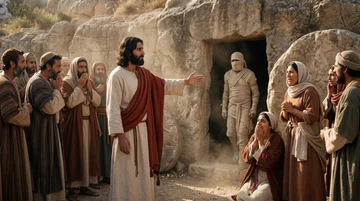
Jesus therefore again groaning in himself cometh to the grave. It was a cave, and a stone lay upon it.
Translations
Jesus therefore again groaning in himself comes to the grave. It was a cave, and a stone lay on it.
King James Version, KJV Cambridge Paragraph Bible
Jesus therefore again groaning in himself cometh to the grave. It was a cave, and a stone lay upon it.
Jesus therefore again groaning in himself, cometh to the grave. It was a cave, and a stone lay upon it.
Revised Version, American Standard Version
Jesus therefore again groaning in himself cometh to the tomb. Now it was a cave, and a stone lay against it.
Jesus, therefore, again groaning in himself, cometh to the tomb, and it was a cave, and a stone was lying upon it,
Jesus therefore, again deeply moved in himself, comes to the tomb. Now it was a cave, and a stone lay upon it.
Jesus, therefore, again, being indignant within himself, cometh unto the tomb. Now it was a cave, and, a stone, was lying thereon.
Berean Standard Bible, Majority Standard Bible
Jesus, once again deeply moved, came to the tomb. It was a cave with a stone laid across the entrance.
Jesus therefore, again groaning in himself, came to the tomb. Now it was a cave, and a stone lay against it.
So Jesus, deeply troubled in heart, came to the place of the dead. It was a hole in the rock, and a stone was over the opening.
Iesus therefore againe groned in himselfe, and came to the graue. And it was a caue, and a stone was layde vpon it.
Douay-Rheims (Challoner revision)
Jesus therefore again groaning in himself, cometh to the sepulchre. Now it was a cave; and a stone was laid over it.
Pictures
Cross-references 20 of 36
- John 11:25
Jesus said unto her, I am the resurrection, and the life: he that believeth in me, though he were dead, yet shall he live:
Jesus declares himself the resurrection and the life before raising Lazarus.
- John 11:43-44
And when he thus had spoken, he cried with a loud voice, Lazarus, come forth.
Jesus calls Lazarus from the grave, and Lazarus comes out alive.
- John 12:10-11
But the chief priests consulted that they might put Lazarus also to death;
Lazarus’s witness leads many to believe in Jesus, prompting leaders to plot his death.
- Luke 7:14-15
And he came and touched the bier: and they that bare him stood still. And he said, Young man, I say unto thee, Arise.
Jesus raises the dead, as he later raises Lazarus.
- John 11:33
When Jesus therefore saw her weeping, and the Jews also weeping which came with her, he groaned in the spirit, and was troubled,
Jesus groans in sympathy with the mourners before going to Lazarus’s tomb.
- John 11:11-14
These things said he: and after that he saith unto them, Our friend Lazarus sleepeth; but I go, that I may awake him out of sleep.
Jesus describes Lazarus’s death as sleep and his raising as awakening.
- John 5:28-29
Marvel not at this: for the hour is coming, in the which all that are in the graves shall hear his voice,
The dead hear Christ’s voice and come forth from their graves to resurrection and judgment.
- 1 Corinthians 15:20
But now is Christ risen from the dead, and become the firstfruits of them that slept.
Lazarus was raised beforehand, yet Christ remains firstfruits by pre-eminence.
- John 5:25
Verily, verily, I say unto you, The hour is coming, and now is, when the dead shall hear the voice of the Son of God: and they that hear shall live.
Lazarus heard the Son’s voice and lived, as Christ says the dead will do.
- John 11:45-53
Then many of the Jews which came to Mary, and had seen the things which Jesus did, believed on him.
Lazarus’s raising prompts belief among many and intensifies the authorities’ hostility toward Jesus.
- John 11:24
Martha saith unto him, I know that he shall rise again in the resurrection at the last day.
Martha looks forward to Lazarus rising at the last-day resurrection.
- Matthew 28:9-10
And as they went to tell his disciples, behold, Jesus met them, saying, All hail. And they came and held him by the feet, and worshipped him.
The risen Jesus appears to the women and sends them to tell the disciples.
- John 11:14
Then said Jesus unto them plainly, Lazarus is dead.
Jesus plainly identifies Lazarus as dead.
- John 11:5-6
Now Jesus loved Martha, and her sister, and Lazarus.
Jesus loved the family but delayed going to them.
- 2 Kings 4:32-35
And when Elisha was come into the house, behold, the child was dead, and laid upon his bed.
Elisha raised the Shunammite’s son before Christ’s resurrection.
- Isaiah 26:19
Thy dead men shall live, together with my dead body shall they arise. Awake and sing, ye that dwell in dust: for thy dew is as the dew of herbs, and the earth shall cast out the dead.
The risen saints illustrate the prophecy that the dead will live and rise.
- 1 Corinthians 15:22
For as in Adam all die, even so in Christ shall all be made alive.
All who die in Adam are made alive in Christ.
- 1 Kings 17:21-22
And he stretched himself upon the child three times, and cried unto the LORD, and said, O LORD my God, I pray thee, let this child’s soul come into him again.
Elijah raises the widow’s son from the dead.
- John 11:34
And said, Where have ye laid him? They said unto him, Lord, come and see.
question and answer leading to the walk to the grave
- Luke 24:1-7
Now upon the first day of the week, very early in the morning, they came unto the sepulchre, bringing the spices which they had prepared, and certain others with them.
Jesus’ resurrection is another setting in which faith might arise.
Commentary
Each commentary is drawn from primary sources: the writings of Ellen G. White and Adventist pioneers and periodicals. Each commentary is separate. Its own words are not a quotation; follow the references to read the source passages.
Ellen G. White
27 sources
Jesus groaning within Himself again came to the grave, a cave in the rock closed by a massive stone laid upon its entrance.ST Nov 10, 1909DA 534.3–535.416MR 324.2–326.3 He came there together with Martha, Mary, and the comforting friends after asking where he was laid and being answered to come and see.ST Nov 10, 1909ST Apr 13, 18823RED 104.2 Lazarus had already lain there four days and begun to decay, so the work could not be dismissed as deception when the stone was openly rolled away before the expectant company.ST Nov 10, 1909DA 534.3–535.42SP 373.1–374.1 He came in tender sympathy and peculiar affection for the Bethany family He loved, to give their buried brother back to them.DA 524.121MR 110.7–111.2ST Mar 23, 1882 His groaning was burdened also by the unbelief of professed believers who mistook His tears and doubted His power, and by the sight of death under Satan's power which He would ransom by tasting death for every person.21MR 110.7–111.23RED 105.2Ms 18, 1898, par. 5–72SP 363.2–364.1 He had deliberately delayed until burial made this His greatest crowning miracle, commanding human hands to roll away the stone in obedient faith before His word broke death's slumber as undeniable proof He is the Son of God, drawing many to believe while hardening others to seek His death.DA 524.121MR 110.7–111.23RED 105.216MR 324.2–326.3Ms 19, 1892, par. 18–21
Coming to the Grave
Jesus groaned within Himself again as He came to the grave, which was a cave cut in rock closed by a massive stone laid upon and covering its entrance.ST Nov 10, 1909DA 534.3–535.416MR 324.2–326.3ST Apr 13, 18823RED 104.2 He came to the tomb together with Martha, Mary, and the friends who had come to comfort them, after being moved with grief and trouble at the sight of their distress and at Mary's cry that her brother would not have died if He had been there.ST Nov 10, 1909ST Apr 13, 18823RED 104.2 Having groaned in spirit and been troubled, He had asked where they had laid him, and they had answered come and see, and all proceeded together to the grave.ST Apr 13, 18823RED 104.2
Lazarus had been buried there four days and his body had begun to decay and see corruption, with corruption already beginning its work, so that the raising could not be explained as deception.ST Nov 10, 1909DA 534.3–535.42SP 373.1–374.1Ms 41, 1897, par. 14–20Ms 127, 1899, par. 5–9 He had been dead four days before Christ called him from the tomb, yet was called back to life and health by a word.2SP 373.1–374.1COS 86.2–87.2Ms 127, 1899, par. 5–9 The stone was then rolled away openly and deliberately so all would be given a chance to see that no deception was practiced, before a surprised and expectant company standing around the sepulcher to see what would follow, while the cold and silent body lay in its rocky grave and the cries of the mourners were hushed.ST Nov 10, 1909
His coming was moved by tender sympathy and love, for He was bound to the family at Bethany by peculiarly tender associations with His heart knit to them by a strong bond of affection, and He loved Lazarus and his sisters and cared about the grief of Mary and Martha.DA 524.121MR 110.7–111.2ST Mar 23, 1882 Lazarus of Bethany was among His most steadfast disciples, strong in faith from his first meeting, deep in love for Him, faithful and greatly beloved by Him.DA 524.1 He came to work His most wonderful work for one of them and to give their buried brother back to them.DA 524.1ST Mar 23, 1882
His groaning was burdened not by love for Lazarus alone but by groaning over the unbelief and blind infidelity of those who professed faith in Him.3RED 105.22SP 363.2–364.1 The onlookers mistook His tears for mere human love and sorrow and whispered that He who opened the eyes of the blind must have been unable to keep Lazarus from dying, when they should have believed in Him.3RED 105.2 Weighed down by their infidelity, He approached the tomb and with authority commanded the stone to be rolled away.3RED 105.22SP 363.2–364.1
The death before Him brought home the reach of Satan's power and the limits of whom He could rescue from death.Ms 18, 1898, par. 5–7 Lazarus was permitted to die and be laid in the tomb before He arrived, by divine wisdom with purpose in the delay, so that the resurrection would give crowning evidence that He was the Son of God.21MR 110.7–111.2Ms 18, 1898, par. 5–7 In raising him He knew He would pay the ransom for that life on the cross, for every rescue brought Him closer to humiliation and death, which He would taste for every person.Ms 18, 1898, par. 5–7
Crowning Miracle's Witness
Jesus stayed away from Bethany by divine wisdom so that Lazarus would die and be laid in the tomb before He arrived, making the raising His greatest and crowning miracle, worked openly before a crowd of witnesses.DA 524.121MR 110.7–111.2Ms 19, 1892, par. 18–21Ms 128, 1899, par. 1 Though He could have moved the stone by a word, He commanded that human hands roll it away and waited for obedience, showing that human faith and action must do all that can be done to prepare the way before divine power completes the work.3RED 105.216MR 324.2–326.32SP 363.2–364.1 Martha objected because she thought He only wished to look upon the dead and was unwilling to have the decomposing body exposed after four days, showing faith slow to grasp His promise, and He gently reproved her not to doubt His power or reason against His requirements but to believe and take Him at His word so she would see the glory of God.ST Nov 10, 190916MR 324.2–326.3
By a word He then called Lazarus back to life and health, demonstrating His character as Saviour and Lifegiver and breaking the slumbers of the dead.16MR 324.2–326.32SP 373.1–374.1Ms 128, 1899, par. 15 The act was a clear public demonstration of divine power and convincing, undeniable evidence that He is the Son of God, revealing the Father and proving His divinity, Messiahship, and authority, a proof pressed home even to Nicodemus.2SP 367.13RED 108.2Ms 18, 1898, par. 5–720MR 147.3–54RED 18.1 Many believed and glorified God and minds were powerfully affected and drawn, while the leaders feared losing the people's confidence, and those rejecting the light answered with greater hatred and hardened unbelief and sought to destroy Him, making the miracle the final test to the nation.2SP 367.121MR 110.7–111.22SP 373.1–374.1Ms 19, 1892, par. 18–2120MR 147.3–5
Lazarus was restored to mortal life but remained subject to death and decay, distinct from those raised to everlasting immortality at Christ's resurrection.ST Feb 3, 1914Ms 115, 1897, par. 17–20 He had no conscious experience to report from death because the dead know nothing, and his witness came from being restored to life to testify that Christ is the Son of God and to urge the people to consider what they would gain by putting Him to death.20MR 147.3–5Ms 47, 1897, par. 9–10 His coming to the grave fulfilled His mission as the Pattern Man just as certainly as toiling as a carpenter, walking on the sea, and dying as sacrifice to lift the race to new life, standing with His other compassionate mighty works of healing sickness, giving sight, hearing, and speech, feeding the hungry, stilling the sea, casting out devils, and teaching wisdom, yet rejected by hearts blinded by prejudice and hatred.3RED 112.2Lt 1, 1880, par. 5–6
Sources
Pioneers and periodicals
83 sources
Jesus came still groaning within Himself to the rock cave at Bethany where Lazarus had lain four days and corruption had begun, a stone lying over its entrance.ST Aug 23, 1899ST Apr 10, 1901ST Mar 29, 1905 His groaning and weeping flowed from tender love and sympathy with the mourning sisters and all who sorrow under death.RH Apr 27, 1911RH Mar 9, 1905 It was also indignation against death itself as the enemy and work of sin, and grief over the unbelief around Him that shut hearts against comfort.ST Jul 15, 1886 In that sorrow He stood as true man, yet by His word of power to call the dead to life He stood as true God, the resurrection and the life with life in Himself to bestow.RH Jul 6, 1916RH Jul 6, 1916ST Dec 3, 1894 The raising was a real restoration to mortal life, a sample of the last-day resurrection when all in the graves shall hear His voice, while the dead meanwhile sleep in unconsciousness knowing nothing.ST Aug 20, 1896ST Dec 19, 1916ST Feb 27, 1879ST Sep 10, 1885ST
Tomb and Its Setting
The grave to which Jesus came was a cave with a stone laid over its entrance, a rock cave sealed by a massive or great stone.ST Aug 23, 1899ST Apr 10, 1901ST Mar 29, 1905ST Jun 14, 1905ST Feb 27, 1879 It was the tomb where Lazarus lay, closed by a stone that would have to be taken away before He called the dead man out.ST Nov 10, 1909ST Aug 23, 1899ST Apr 10, 1901ST Mar 29, 1905ST Feb 27, 1879
It stood at Bethany, the home of Mary and Martha and Lazarus where Jesus stayed at night while teaching in the temple at Jerusalem by day.ST Nov 17, 1898RH Dec 15, 1859 Bethany lies on the east side of the Mount of Olives near the Jerusalem to Jericho road, about two miles from Jerusalem and about a mile beyond the summit, later called Lazarieh or el-Aziriyeh meaning the place of Lazarus.ST Nov 17, 1898RH Aug 29, 1871 The family was well known, so many came from Jerusalem to comfort Mary and Martha and thus witnessed what followed, and there Jesus stood beside the grave groaning in spirit because the shadow of death had fallen on one He loved.ST Nov 17, 1898RH Dec 15, 1859RH Feb 8, 1915 He came there in grief before the raising to comfort Martha and Mary in their sorrow as a compassionate comforter to the sorrowing.RH Feb 8, 1915ST Jan 31, 1911
Lazarus had been dead four days when Jesus came, after a four-day sleep in death, and decay and corruption had already begun their work.ST Nov 10, 1909ST Aug 20, 1896ST Dec 19, 1916ST Nov 8, 1883 He had been dead long enough for corruption to begin and for the decomposing body to be a reason against opening the tomb.ST Nov 10, 1909ST Aug 20, 1896ST Feb 1, 1899 Yet even with putrefaction begun, death's power could be broken and the decaying body restored.ST Aug 20, 1896ST Feb 1, 1899
The village still occupies the same site so its general outlines are the same, with olive and fig and almond trees, though nothing certain is known about the exact house and tomb now shown to visitors.ST Nov 17, 1898 The tomb at Bethany is described as still standing in ruins.RH May 13, 1902 The coming to the grave belongs to John 11:1-44, which took place about five months before the triumphal entry into Jerusalem in the last week of Christ's life on earth.ST Apr 14, 1898 This Lazarus, the brother of Martha and Mary, was distinct from the poor man in the parable of the rich man and Lazarus.ST Mar 24, 1909
Jesus Groaning Within
Jesus came to the grave still deeply troubled and groaning inwardly, groaning again in Himself as He came to the tomb.ST Aug 23, 1899ST Mar 29, 1905ST Jun 14, 1905 He went there with the others after weeping with the grieving sisters, approaching the place where Lazarus had lain buried four days.ST Jun 29, 1876 He was deeply moved and mournful at the tomb, overcome with deep sorrow as He came to the sepulcher closed by a great stone.
His groaning and tears expressed love for Lazarus and tender sympathy with the bereaved, sharing deeply the sorrow of Mary and Martha over their brother's death.RH Apr 27, 1911RH Mar 9, 1905 The shadow of death had fallen on one He loved, whose warm sympathy had often dispelled the sorrows that marked His own way.RH Dec 15, 1859 His grief reflected compassion for all who mourn the dead, stirred by sympathy for the mourners around Him.ST Mar 29, 1905
His groaning carries the marginal sense of being moved with indignation, still groaning within Himself as He came to the tomb. That indignation was directed against death as the great enemy and the work of sin, which brings disease, misery and death and has blighted every age. It was directed against sin as the cause of human suffering, which people should recognize so they may seek the remedy and the true Physician.
He groaned with knowledge of the sentiments some of the Jews present held toward Him, troubled by the distress around Him.ST Aug 23, 1899 He groaned inwardly at the unbelief of those who had professed faith in Him.ST Jul 15, 1886 His grief included sorrow over unbelief that keeps people from receiving the comfort He can give.
He grieved over Lazarus and the sorrow of the bereaved household with awareness of the long history of death and human mourning to come, and He was not indifferent to their suffering.RH Apr 28, 1910 His not preventing the death, though He could have prevented it, was consistent with God's eternal purpose in undying love to rescue humanity.RH Apr 28, 1910 That purpose includes humanity's rescue, since heaven would not be complete while earth remained lost and its people suffered under death and the devil.RH Apr 28, 1910
His groaning in spirit with His weeping revealed the human nature, while His word bringing Lazarus to life revealed the divine nature.RH Jul 6, 1916RH Jul 6, 1916 The two natures were exercised through one person, the infinite dwelling in and acting through the finite, with the divine controlling the human, proving Him both true God and true man, God with us, in whom God was manifested as He is and man as he should be.RH Jul 6, 1916 His groaning was also an inward prayer, followed by a prayer of thanksgiving. Even in the sorrowful setting of death He showed composed self-possession, calm repose grounded in faith and loving confidence in God.ST Jul 29, 1886
Stone Taken Away
At the cave He ordered the stone to be taken away, and living people rolled it away at His command.ST Nov 10, 1909ST Jun 21, 1905 The stone was moved openly and deliberately so that all present were given opportunity to see that no deception was practiced.ST Nov 10, 1909 Though He could have removed it by a word, He requires His helpers to work with Him as far as they can, while divine power completes the work.ST Mar 29, 1905
Martha objected because she supposed He only wished to look upon the dead, and because the body had lain four days and corruption had already begun its work so that she was unwilling for the decomposing body to be brought to view.ST Nov 10, 1909ST Jun 8, 1915 Her objection showed the human heart slow to understand His words, her faith not having grasped the true meaning of His promise.ST Nov 10, 1909 He gently reproved her that if she would believe she should see the glory of God, that she should not doubt His power nor reason against His requirements but take Him at His word.ST Nov 10, 1909
With the cries of the mourners hushed and the surprised and expectant company standing around the sepulcher to see what would follow, He lifted His eyes in a moment of prayer and thanksgiving.ST Nov 10, 1909ST Jun 29, 1876RH Dec 15, 1859 Then with a God-like summons He called Lazarus to come out from the grave.ST Feb 27, 1879STST May 18, 1915RH Dec 15, 1859 The dead man heard and obeyed, coming forth alive and well, awakened to life and strength from a condition of utter helplessness.ST May 18, 1915ST Jun 8, 1915ST Jun 21, 1905 He had lain asleep in the grave with no experiences to report, and the voice of Jesus restored him to life there.STST Jun 8, 1915
The work was a true restoration to life by creative power upon a corrupted dead body, producing living tissue and restoring the breath of life.ST Aug 20, 1896ST Jun 14, 1905 Its reality was confirmed afterward by Lazarus's presence at the table and service there.ST Aug 20, 1896
Christ the Life-Giver
Coming to the cave tomb where Lazarus had lain dead four days, Jesus stood before a body in which decay and corruption had already begun.ST Apr 10, 1901ST Aug 20, 1896ST Feb 1, 1899 His groaning on the way reflected sorrow over the death and misery that sin has brought, even as He was about to display God's power over death.ST Apr 10, 1901 He wept in tender sympathy for mourning hearts although He possessed power to break death's power and restore a decaying body to life.ST Nov 17, 1898 That restoration proved Him to be the resurrection and the life, able to give life to the dead after death and decomposition, and its reality was confirmed afterward by Lazarus's living presence at the table and in service.ST Aug 20, 1896ST Dec 19, 1916 By it He made the afflicted glad, showed that the dead are not alive while dead but shall live again by resurrection, and set before the disciples the hope that believers though dead shall yet live in the resurrection at the last day.ST Dec 19, 1916ST Feb 1, 1899
Life comes from Christ, and His coming to Lazarus meant life.ST Sep 17, 1912ST May 30, 1895ST Feb 7, 1906 As His coming gave life to Lazarus, so it will give life to all who sleep in Him.ST May 30, 1895 His coming is therefore to be distinguished from death itself, for death is an enemy and is not His coming nor a substitute for His presence.ST Feb 7, 1906 At the same tomb His groaning in spirit with weeping revealed the human nature, while His word bringing Lazarus back to life revealed the divine nature.RH Jul 6, 1916RH Jul 6, 1916 The two natures were exercised through one person, the infinite dwelling in and acting through the finite with the divine controlling the human, proving Him both true God and true man, God with us, in whom God was manifested as He is and man as he should be.RH Jul 6, 1916
The raising, done not long after He had taught that the dead would hear His voice and live, stands as an example of His power over death and as crowning evidence of His Messiahship and divine mission.RH Sep 25, 1913RH Dec 11, 1855 It gave further proof that He is the Messiah and heir to David's throne, the Son of God and King of Israel.ST Nov 8, 1883 It was displayed in broad daylight before a crowd of witnesses and gave clear proof of divine power that He is the Son of God.ST Jul 15, 1886 Rather than accepting that proof, the chief priests and Pharisees were stirred more than by any other miracle and grew determined to destroy Him, seeking to kill both Jesus and Lazarus.ST Jul 15, 1886ST Nov 17, 1898RH Sep 25, 1913 He wrought the work by divine creative power, the same word of power by which He spoke the world into existence and upholds all things, producing living tissue and restoring the breath of life in a corrupted dead body.ST Jun 14, 1905ST Dec 3, 1894 The Father has given the Son to have life in Himself with power to bestow life on those who hear His voice, so that dead men hearing the voice of the Son of God and living during His ministry foreshadow the greater coming hour when all in the graves shall hear His voice and come forth, they that have done good unto the resurrection of life and they that have done evil unto the resurrection of judgment.RH Oct 19, 1869 That display of divine creative power directs faith toward God rather than toward physical objects such as the sun.ST May 6, 1913
There He declared Himself to be the Light by mighty works that showed how great the light was.ST Dec 23, 1897 The greater the work, the more those who sat in darkness and loved darkness hated Him and His teaching and closed their eyes.ST Dec 23, 1897 That shining of great light upon eyes not accustomed to it blinded them, and the longer men walk in darkness the more blinding the light becomes.ST Dec 23, 1897 His coming to the grave to give back the dead to the living proves the nature of His work and His true greatness.ST Aug 27, 1885 Instead of laying waste and making desolate by the scourge of war like those the world esteems great, He fed hungry multitudes, relieved suffering, comforted the sad and lonely, opened blind eyes and unstopped deaf ears, restored the dead to life, and then gave His own life to open the chasm of death so that all who will may pass beyond its power.ST Aug 27, 1885 This life-giving work flows from spotless, self-sacrificing, impartial love and mercy toward poor and humble as well as influential and wealthy, lived quietly without affectation or outward show, deserving highest love and praise and calling everyone seeking a home in His kingdom to put away selfishness and daily form the same loving and meek character by active care for the welfare of others.ST Aug 27, 1885
Death and Resurrection
The grave is where the dead sleep in total unconsciousness until Jesus calls them forth.ST Sep 10, 1885STRH Dec 28, 1911ST Jun 8, 1915RH Aug 24, 1905 Lazarus had been dead four days in the cave tomb, asleep with no experiences, memories, thoughts, or report of heaven to bring back, and all who have been raised knew only that they had passed through total unconsciousness.STRH Dec 28, 1911ST Jun 8, 1915RH Aug 24, 1905ST May 5, 1881 Jesus treated him as truly dead and gave no hint that death is the gate to eternal bliss, offering no comfort that his soul was in heaven in eternal rest.ST Mar 29, 1905ST May 5, 1881ST Oct 19, 1915 To recall one enjoying heavenly bliss to toil and die again in a world of sin and probation would be cruel.ST May 5, 1881ST Oct 19, 1915
The resurrection shown is material and in a form to be recognized by friends, together with the saints raised at Christ's death and Christ Himself as the firstfruits of them that slept.ST Aug 9, 1905 Lazarus was not called down from heaven but called out of the grave after the stone was removed, a sample of the resurrection at the last day.ST Dec 19, 1916ST Feb 27, 1879 His coming forth alive proves Jesus is the resurrection and the life with power to give life to the dead, so that believers though dead shall yet live, and foreshadows the greater coming hour when all in the graves shall hear His voice and come forth, they that have done good unto the resurrection of life and they that have done evil unto the resurrection of judgment.ST Dec 19, 1916RH Jun 8, 1916RH Oct 19, 1869ST Jan 26, 1915 That hope of being raised up at the last day was set before the disciples, for Christ's coming meant life to Lazarus and will mean life to all who sleep in Him.ST Dec 19, 1916ST May 30, 1895ST Jan 26, 1915
Lazarus was restored to mortal earthly life and remained subject to death, not to immortality or everlasting life.ST Feb 3, 1914ST Aug 12, 1889RH Feb 25, 1873 His raising before Christ's resurrection was an exception to the general rule that the dead live again only through a future resurrection, and is distinct from the real resurrection in which Christ is the first begotten of the dead and firstfruits of them that slept.ST Jan 28, 1889ST Jan 11, 1905ST Dec 30, 1903RH Feb 25, 1873 He was raised by virtue of the Son's sacrifice already established in God's purpose and determined in His character, though it had not yet taken place.ST Oct 12, 1876ST Jan 11, 1905 First-fruits means first in pre-eminence, not first in point of time, as Jacob and Ephraim are called first-born though Esau and Manasseh were older, so the prior raising in no way precludes Christ's title.ST Jan 11, 1905
His raising was one of three occasions on which Jesus raised the dead, standing with the widow's son, the widow of Nain's son, the daughter of Jairus and the little maid, and a multitude raised later.ST May 8, 1907ST Jan 26, 1915RH Feb 25, 1873 Together with cleansings of lepers, healings of the palsied, opening of blind eyes and deaf ears, and restoring of the sick, it witnesses that the same healing and life-giving power works today.ST Jan 26, 1915 The giving of new life after putrefaction and decomposition had set in exemplifies Christ as the great Physician able to take away sin by taking away its consequences, to heal the sin-stricken soul, change nature, give power to overcome evil habits, and preserve from further affliction.ST Dec 1, 1898ST Mar 11, 1889
Witness and Response
Jesus came to the grave to work a miracle in broad daylight before a crowd of witnesses, displaying divine power as clear proof that He was the Son of God.ST Jul 15, 1886 The setting is given with circumstantial fullness — the home in Bethany, the time the dead man had lain, the people present, the cave tomb with its stone, and the events that followed — so that those who knew the facts could check them, and this openness evidences the truthfulness of the Gospel record.RH Feb 4, 1862 That Jewish records admitted the raising had occurred belongs to the same public certainty.RH Sep 5, 1865
Many accepted this crowning miracle as evidence that God had sent Jesus to bring salvation and believed in Him, and His act of doing good in power helped lead people to Him.ST Jul 15, 1886 After the resurrection of Lazarus there was a general desire on the part of all classes to see Jesus, especially during the few days from His triumphal entry into Jerusalem until His crucifixion.ST Oct 17, 1895 Even witnessing Lazarus, dead four days, called back to life did not overcome unbelief in all, for some went away and plotted because many believed through the resurrection.RH Nov 6, 1866
Such divine power and tenderness did not convert the masses; some hardened themselves against what they had seen and heard, and rejecting this decisive proof left them in unbelief.ST Jul 15, 1886 The family at Bethany was well known, so many had come from Jerusalem to comfort Mary and Martha and thus witnessed Jesus weep in sympathy and prove Himself the resurrection and the life, yet this miracle more than any other stirred the Pharisees to put Him to death.ST Nov 17, 1898 Rather than accept this crowning evidence of His Messiahship and divine mission, the chief priests sought to kill both Jesus and Lazarus, and the Pharisees grew more determined to destroy Him.ST Jul 15, 1886RH Sep 25, 1913 The Light declared Himself by mighty works there, but the greater the light shining on those sitting in darkness and loving darkness, the more they hated Him and closed eyes unaccustomed to it, until blindness was complete.ST Dec 23, 1897 Some therefore discussed what to do, plotted that the Life-giver and Lazarus should die so he would no longer testify, and tracked Jesus after He withdrew to Ephraim near the wilderness.RH Nov 6, 1866
The raising of Lazarus in John 11:1-44 is literal bodily history recorded in the inspired Gospels to be credited as fact, standing together with the virgin birth of Jesus and His physical resurrection as miraculous works depending on the Bible as an infallible book.ST Mar 13, 1907 It can console mourners, and to reject it as untrustworthy undermines the gospel story.RH May 23, 1912 Though a doctor dismisses such miraculous restoration as impossible, the return to life is presented as a real event and not merely a story invented to teach a moral lesson.ST Aug 22, 1916 The raising was physical, not merely spiritual, and to teach that Lazarus rose only spiritually, or to make the account only a moral lesson, denies the resurrection of the body, a cardinal and fundamental doctrine of Christianity and part of the faith once delivered to the saints.ST Oct 6, 1909ST Jul 21, 1909
The restoration is set against the claim that Lazarus was merely in a trance and revived by magnetic power.RH Sep 8, 1853 Extraordinary as the work was, it was regarded as less wonderful than the conversion of three thousand Jews at Pentecost through the Spirit's power.RH May 1, 1913 The tomb was a setting associated with a wonder that could have led someone to believe, so that faith in Jesus while He was dying and apparently defeated was especially remarkable by contrast.ST Sep 5, 1911
Comfort and Holy Living
Jesus comes to the grave to comfort the weeping sisters, to weep with mourners, to dry tears and to give the dead brother back to the living, and this shows His mercy and sympathy and His mission to heal the broken-hearted.ST Mar 23, 1882RH Mar 9, 1905RH Jun 13, 1871RH Feb 8, 1915ST Apr 10, 1907 His coming there was a labor of love in going about doing good, breaking the chain that bound Lazarus in the prison of death and restoring him to the joyful embrace of the orphaned sisters.ST Mar 23, 1882RH Mar 9, 1905RH Jun 13, 1871 He is present with stricken mourners at the tomb, weeping with them as the stone is moved and gathering His loved ones to Himself even in deserted corners, a compassionate comforter to the sorrowing, to widows and orphans and the friendless.RH Mar 9, 1905RH Feb 8, 1915ST Apr 10, 1907 Mourners should not bear grief alone but should ask the great Healer to bind the wounded spirit, for Mary and Martha grieve while awaiting the resurrection for healing and Jesus shares their sorrow deeply.RH Mar 9, 1905 The promise of resurrection in the chapter directs funeral faith toward the day when those who sleep in Jesus will rise to immortal life, free from death and pain and age.ST Aug 24, 1915
Lazarus hearing and obeying the life-giver's call at the sepulcher, after lying dead four days, is a miracle of resurrection.ST Nov 29, 1905 That hearing and obeying illustrates the equally great miracle of grace when Christ calls a sinner dead in sin to arise and enter the light and life of Christ.ST Nov 29, 1905
His raising of Lazarus was an act of doing good that showed His power and influence and helped lead people to believe in Him. That deed proves the nature of His work and true greatness, for instead of laying waste and making desolate by the scourge of war like those the world esteems great, He fed hungry multitudes, relieved suffering, comforted the sad and lonely, opened blind eyes and unstopped deaf ears, restored the dead to life, and then gave His own life to open the chasm of death so all who will may pass beyond its power.ST Aug 27, 1885 This life-giving work flows from spotless, self-sacrificing, impartial love and mercy toward poor and humble as well as influential and wealthy, lived quietly without affectation or outward show, and it deserves highest love and praise.ST Aug 27, 1885 It calls everyone seeking a home in His kingdom to put away selfishness and daily form the same loving and meek character by active care for the welfare of others.ST Aug 27, 1885 Even in the sorrowful setting of death His approach to the grave exemplifies calm repose grounded in faith and loving confidence in God.ST Jul 29, 1886
The resurrection shows God's direct method toward the sick and suffering, in which God acts directly by divine power without employing natural agencies or means.ST Mar 31, 1898 Cure and resurrection wrought directly are as truly a manifestation of divine power as cures wrought through means.ST Mar 31, 1898
The act belongs to the very same Jesus who taught from Peter's boat, stopped the funeral of the widow of Nain's son to restore him, gave the Samaritan woman the water of life, fed the multitudes with barley loaves and fishes, and journeyed to Sidon to heal the stranger mother's demon-possessed daughter.ST Apr 15, 1897 He is the same who agonized in Gethsemane, was crucified and died, was buried and rose again triumphant over death and the grave for Himself and for others, and who will come again in person.ST Apr 15, 1897
Sources