John 11:42
And I knew that thou hearest me always: but because of the people which stand by I said it, that they may believe that thou hast sent me.
Translations
And I knew that you hear me always: but because of the people which stand by I said it, that they may believe that you have sent me.
King James Version, KJV Cambridge Paragraph Bible
And I knew that thou hearest me always: but because of the people which stand by I said it, that they may believe that thou hast sent me.
And I knew that thou hearest me always: but because of the people who stand by, I said it, that they may believe that thou hast sent me.
And I knew that thou hearest me always: but because of the multitude which standeth around I said it, that they may believe that thou didst send me.
And I knew that thou hearest me always: but because of the multitude that standeth around I said it, that they may believe that thou didst send me.
and I knew that Thou always dost hear me, but, because of the multitude that is standing by, I said [it], that they may believe that Thou didst send me.'
but I knew that thou always hearest me; but on account of the crowd who stand around I have said [ it], that they may believe that thou hast sent me.
I, indeed, knew that, always, unto me, thou dost hearken; but, for the sake of the multitude standing around, I spake,—that they might believe that, thou, didst send me forth.
Berean Standard Bible, Majority Standard Bible
I knew that You always hear Me, but I say this for the benefit of the people standing here, so they may believe that You sent Me.”
I know that you always listen to me, but because of the multitude standing around I said this, that they may believe that you sent me.”
I was certain that your ears are at all times open to me, but I said it because of these who are here, so that they may see that you sent me.
I knowe that thou hearest me alwayes, but because of the people that stand by, I said it, that they may beleeue, that thou hast sent me.
Douay-Rheims (Challoner revision)
And I knew that thou hearest me always; but because of the people who stand about have I said it, that they may believe that thou hast sent me.
Pictures
Cross-references 20 of 35
- John 11:25
Jesus said unto her, I am the resurrection, and the life: he that believeth in me, though he were dead, yet shall he live:
Jesus identifies himself as the resurrection and the life before raising Lazarus.
- John 11:35
Jesus wept.
Jesus weeps in sympathy with the mourners at Lazarus’s grave.
- John 11:11-14
These things said he: and after that he saith unto them, Our friend Lazarus sleepeth; but I go, that I may awake him out of sleep.
Jesus calls Lazarus asleep, then plainly explains that he is dead.
- John 12:10-11
But the chief priests consulted that they might put Lazarus also to death;
Many believed in Jesus through Lazarus, prompting the chief priests to plot his death.
- John 11:4
When Jesus heard that, he said, This sickness is not unto death, but for the glory of God, that the Son of God might be glorified thereby.
Lazarus’s sickness and raising reveal God’s glory and lead people to believe.
- John 11:15
And I am glad for your sakes that I was not there, to the intent ye may believe; nevertheless let us go unto him.
Jesus connects Lazarus’s death with the disciples’ belief.
- John 12:30
Jesus answered and said, This voice came not because of me, but for your sakes.
Jesus says the heavenly voice was for the people’s sake.
- John 5:25
Verily, verily, I say unto you, The hour is coming, and now is, when the dead shall hear the voice of the Son of God: and they that hear shall live.
Christ says the dead will hear his voice and live.
- Hebrews 7:25
Wherefore he is able also to save them to the uttermost that come unto God by him, seeing he ever liveth to make intercession for them.
Christ lives to intercede continually for those who come to God through him.
- John 11:47-53
Then gathered the chief priests and the Pharisees a council, and said, What do we? for this man doeth many miracles.
The leaders oppose Jesus after Lazarus’s resurrection and plot his death.
- John 20:31
But these are written, that ye might believe that Jesus is the Christ, the Son of God; and that believing ye might have life through his name.
Jesus’ signs are given so people may believe that he is the Son of God.
- John 11:33
When Jesus therefore saw her weeping, and the Jews also weeping which came with her, he groaned in the spirit, and was troubled,
Jesus grieves at Lazarus’s tomb before praying.
- John 12:1-2
Then Jesus six days before the passover came to Bethany, where Lazarus was which had been dead, whom he raised from the dead.
The supper follows Jesus raising Lazarus from the dead.
- Luke 16:31
And he said unto him, If they hear not Moses and the prophets, neither will they be persuaded, though one rose from the dead.
Those who reject Scripture will not be persuaded even by a resurrection.
- John 11:24
Martha saith unto him, I know that he shall rise again in the resurrection at the last day.
Martha states that resurrection will come at the last day.
- John 12:17-18
The people therefore that was with him when he called Lazarus out of his grave, and raised him from the dead, bare record.
The crowd responds to Lazarus’s resurrection, a sign intended to inspire belief.
- John 11:5-6
Now Jesus loved Martha, and her sister, and Lazarus.
Jesus delayed going to Lazarus despite loving the family.
- 1 John 5:14
And this is the confidence that we have in him, that, if we ask any thing according to his will, he heareth us:
God hears prayer made according to his will
- Psalms 66:19
But verily God hath heard me; he hath attended to the voice of my prayer.
Both affirm that God hears and answers prayer.
- John 11:32
Then when Mary was come where Jesus was, and saw him, she fell down at his feet, saying unto him, Lord, if thou hadst been here, my brother had not died.
Mary treats Lazarus as dead before Jesus raises him.
Commentary
Each commentary is drawn from primary sources: the writings of Ellen G. White and Adventist pioneers and periodicals. Each commentary is separate. Its own words are not a quotation; follow the references to read the source passages.
Ellen G. White
42 sources
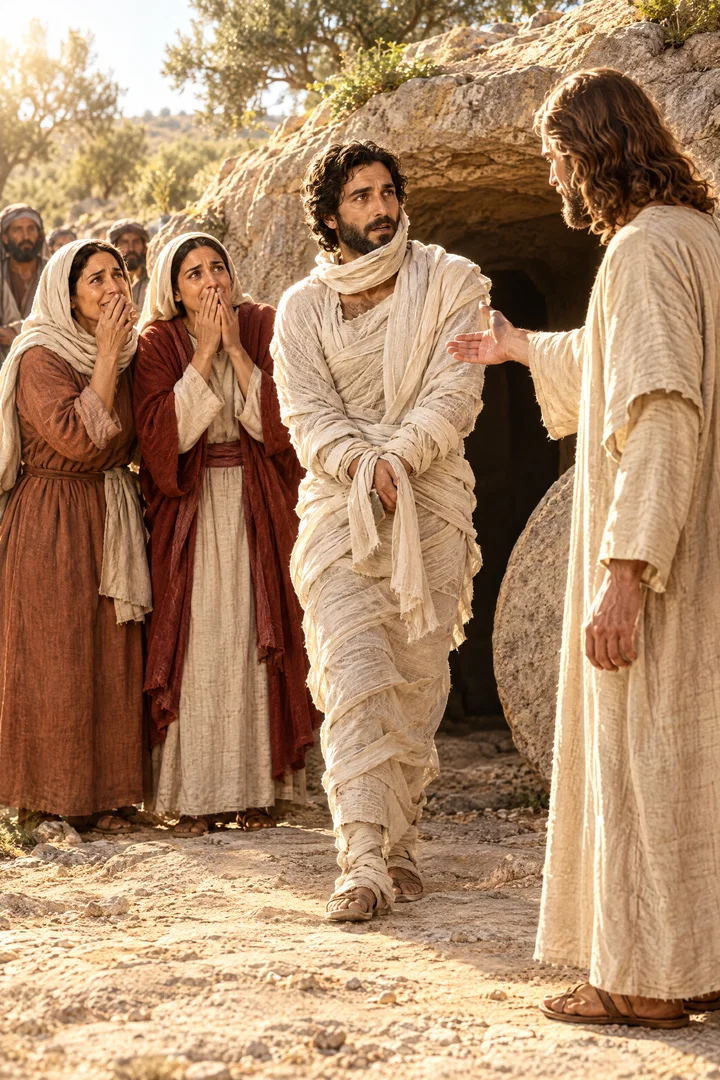
Jesus prayed with uplifted eyes after the stone was removed and the decayed body of four days was exposed, then with a loud command called Lazarus to life and health before many witnesses in daylight.3RED 106.221MR 110.7–111.23RED 108.24RED 106.1–2COS 86.2–87.2 He already knew the Father always heard Him, and He spoke aloud not from doubt or to persuade the Father but for the sake of the bystanders, so they would believe the Father had sent Him and recognize the miracle as proof of His divine mission.3RED 106.2DA 5242SP 365.1–3Ms 115, 1902, par. 9–10DA 524.1 The raising was His last and crowning miracle, permitted after death and burial to display God's majesty and power and to give clear public proof that He is the Son of God, united with the Father.3RED 108.2RH Nov 13, 1900COL 264.2–265.1Ms 18, 1898, par. 5–7Ms 47, 1897, par. 9–10 Many who saw it believed and glorified God, yet those determined to resist truth were only hardened by it, with the rulers refusing to confess though convinced, opposing Him more bitterly and even seeking to kill Lazarus.21MR 110.7–111.23RED 108.2RH Nov 13, 1900Ms 19, 1892, par. 18–21Ms 128, 1899, par. 15 As the mighty Lifegiver He restores the dead by His word, His intercession is always heard so that all who come to Him are saved completely, and He still waits for people in faith to do what they can, as removing the stone and unbinding Lazarus, before He does what only He can do.Ms 115, 1902, par. 9–1016MR 324.2–326.3Lt 2a, 1878, par. 19–21Lt 2, 1878, par. 11–14RH Dec 16, 1902
Setting at the Tomb
With eyes lifted up, the prayer was offered after the stone had been taken away and the decayed body laid open to view, while friends pressed around in curiosity and awe.3RED 106.2 It was spoken at the tomb in the midst of the raising of Lazarus, with people gathered close and standing by.DA 524COS 92.4–93.32SP 373.1–374.1 In it thanks was given for being heard, with the assurance of being always heard, declared aloud not for personal need but so the bystanders might believe in the sending by the Father.3RED 106.2 A hush followed the prayer until it was broken by the loud call for Lazarus to come out, which at once gave life to the form that decay had changed.3RED 106.2
Lazarus had lain dead four days and his body had begun to decay, yet by a word he was called from the grave to life and health.4RED 106.1–2COS 86.2–87.2RH Feb 13, 1900Ms 127, 1899, par. 5–9 The miracle had been planned by God to occur after death and burial had taken place.21MR 110.7–111.2 It was performed in daylight before many witnesses.3RED 108.2
Meaning of the Prayer
Jesus knew with certainty that the Father always heard Him.2SP 365.1–3DA 524.1DA 524.2–3DA 535.5–6ST Apr 13, 1882 That constant hearing underlies His confidence that His intercession prevails.Ms 115, 1902, par. 9–10
He spoke the prayer aloud not for His own sake, not from any doubt, and not because He needed to establish or persuade the Father to hear Him.3RED 106.22SP 365.1–3DA 524.1DA 524.2–3ST Apr 13, 1882 He said it aloud for the sake of the people standing by, gathered near the tomb, so that those present would believe that the Father had sent Him.3RED 106.2DA 5242SP 365.1–3DA 524.1DA 524.2–3 His open thanksgiving that the Father had heard Him declared that unbroken communion before the bystanders.3RED 106.2
He was always careful to make His dependence evident, co-operating with the Father in all He did and never working independently, but working His miracles by faith and prayer.ST Nov 10, 1909 His words at the grave made clear His relationship with God and showed that His claim to be God's Son was not a deception.DA 535.5–6ST Nov 10, 1909 Spoken for the bystanders, the aloud prayer prepared them to recognize the raising of Lazarus as evidence of His divine mission and as a sign of that mission.2SP 365.1–3ST Apr 13, 1882
Evidence of Divine Mission
The raising of Lazarus was Christ's last and crowning miracle and the crowning evidence of His divinity.RH Nov 13, 1900COL 264.2–265.1Ms 18, 1898, par. 5–7Ms 6, 1899, par. 15–21Ms 128, 1899, par. 1 It was given to the Jewish people and nation as wonderful light and wonderful evidence of God's majesty, power and truth, with Lazarus dead four days yet raised and bearing his testimony before them.RH Nov 13, 1900Ms 18, 1898, par. 5–7Ms 6, 1899, par. 15–21 The miracle had a powerful effect on people's minds and drew a large, enthusiastic multitude to see Jesus.Ms 128, 1899, par. 1 Lazarus' death was permitted so that his resurrection would provide the Jews with this crowning evidence that Jesus was the Son of God.Ms 18, 1898, par. 5–7
It was performed in daylight before many witnesses, displaying divine power and giving clear, public proof that Jesus was the Son of God.3RED 108.2Ms 47, 1897, par. 9–10 Jesus spoke aloud so the people standing nearby would believe that the Father had sent Him, and His words together with the miracle were meant to lead those present to believe in His divine mission.3RED 108.216MR 324.2–326.3Ms 47, 1897, par. 9–10 This work reveals the Father through Christ and gives convincing evidence that the Father and the Son are united.Ms 41, 1897, par. 14–20
Lazarus coming forth from the tomb testified to the mighty power of Jesus of Nazareth.RH Nov 13, 1900 The evidence was great enough to banish all prejudice even in the most unbelieving, able to convince a mind guided by reason and conscience.3RED 108.2RH Nov 13, 1900 The mighty work served as undeniable evidence of Jesus' Messiahship to Nicodemus, and the raising after four days in the grave was evidence of Christ's Messiahship and authority through a deed that those present witnessed, though the religious leaders did not accept it.4RED 18.1Ms 127, 1899, par. 5–9
Responses to the Evidence
The prayer was answered in the very purpose for which it was spoken aloud, for many who stood by were led to believe in Jesus and God was glorified.21MR 110.7–111.2Ms 19, 1892, par. 18–21 To the sisters the raising brought unspeakable joy as Christ's power over death was displayed before them.Ms 1, 1867, par. 44–47 The crowning miracle made a powerful impression on minds and drew a large, enthusiastic multitude to see Jesus.Ms 128, 1899, par. 1
Yet those who had repeatedly rejected truth and earlier light remained hardened in unbelief despite evidence able to convince a mind guided by reason and conscience.21MR 110.7–111.23RED 108.2Ms 19, 1892, par. 18–21 Instead of yielding, they responded with greater hatred and bitterest opposition.3RED 108.2RH Nov 13, 1900 They stirred up Jesus' enemies against Him.21MR 110.7–111.2 Their resistance went so far that they even sought to kill Lazarus, the living witness who had returned from the dead and bore his testimony before them.COL 264.2–265.1Ms 6, 1899, par. 15–21
The priests, rulers and Jewish leaders had witnessed clear proof of divine power, majesty and truth in a man dead four days called forth in daylight before many witnesses.RH Nov 13, 1900Ms 45, 1897, par. 3–4RH Feb 13, 1900 Some among the rulers were already convinced of the Saviour's divinity, and the deed was great enough to banish all prejudice even in the most unbelieving.RH Nov 13, 1900 They nevertheless would not humble themselves to confess they were in error, but filled their hearts with opposition, maddened because Christ had done something they could not refute.RH Nov 13, 1900 In stubbornness, self-exaltation and proud boasting they rejected Him despite this evidence of His power, salvation, Messiahship and authority, sought to mislead the people, and did not recognize God in Christ.RH Nov 13, 1900Ms 128, 1899, par. 15Ms 45, 1897, par. 3–4RH Feb 13, 1900Ms 127, 1899, par. 5–9
The public testimony to Christ's divine power and identity as the Son of God thus became a final test for the Jewish nation.20MR 147.3–5 Their refusal illustrates how the first step in resistance to light leads to the second and third, until no light however strong and no evidence however plain has any effect.RH Nov 13, 1900 The same truth that softens the contrite heart only hardens the heart determined to resist.RH Nov 13, 1900 In this their course vindicated the declaration that if men hear not Moses and the prophets, neither will they be persuaded though one rose from the dead.Ms 6, 1899, par. 15–21 The law and the prophets are God's appointed agencies for salvation, and piling evidence upon evidence, even the testimony of a witness raised from the dead, will not convince or lead to repentance those who refuse to listen to the voice of God in His Word.Ms 6, 1899, par. 15–21
Christ the Lifegiver
Jesus stands at the grave as the mighty Lifegiver whose command gives life to the dead.16MR 324.2–326.3Lt 2a, 1878, par. 19–21Lt 2, 1878, par. 11–14 He breaks the slumbers of the dead, ever touched by human woe.3RED 112.2 There His character as Saviour and Lifegiver was demonstrated.Ms 128, 1899, par. 15
His tears at the tomb reveal sympathy for mourners, and the raising reveals His power to restore the dead.ST Mar 23, 1882 He remains a compassionate helper to mothers in their distress.ST Mar 23, 1882
The raising of Lazarus was a raising back to mortal life, not to immortality.Ms 115, 1897, par. 17–20 Like the son of the widow of Nain and Jairus' daughter raised during His ministry, Lazarus after being raised continued subject to death and decay.ST Feb 3, 1914Ms 115, 1897, par. 17–20 This is different from those who came forth from the grave at Christ's own resurrection, who were raised to everlasting life never more to see death or sorrow.Ms 115, 1897, par. 17–20
Raising the dead was His fulfilling His mission as the Pattern Man.Lt 1, 1880, par. 5–6 He did so just as certainly as when He toiled as a carpenter hiding the great secret of His divine mission, as when He trod the foaming white-capped billows on the Sea of Galilee, and as when He died as man's sacrifice on the cross to lift the whole race to a new and perfect life.Lt 1, 1880, par. 5–6
Intercession and Human Cooperation
The Father always hears Christ, and His intercession for Peter when Peter was in danger of falling was heard.Ms 115, 1902, par. 9–10RH Dec 16, 1902 He is mighty to save, and He saves completely all who come to Him.Ms 115, 1902, par. 9–10RH Dec 16, 1902 This assures believers that their prayers are joined with Christ's intercession, whose voice the Father hears.ST Feb 28, 1906 Christ is the great Intercessor, foreshadowed by Moses, whose earnest plea for God's presence in his work was heard and granted.Ms 13, 1906, par. 42–43
Christ's words and miracle at the raising of Lazarus were meant to lead those present to believe in His divine mission, while as the mighty Lifegiver His power raised Lazarus and human faith and obedience prepared the way for His work.16MR 324.2–326.3 In that miracle Jesus performed His life-giving work after people removed the stone and later unwrapped Lazarus, showing that He calls for human faith and action as people prepare the way while His command gives life to the dead.Lt 2a, 1878, par. 19–21 His divine power works alongside human cooperation, for people must act in faith by removing the stone and later unbinding Lazarus, while Christ gives life by His command.Lt 2, 1878, par. 11–14 Christ may require people to do what they can before He does what only He can do.Lt 2, 1878, par. 11–14
Jesus stood ready to bring Lazarus back to life but waited for the people to roll away the stone.16MR 326.4 His life-giving power was ready to act, while human unbelief and resistance hindered the work.16MR 326.4 The people had to remove the stone before He performed the miracle.16MR 326.4
Sources
Pioneers and periodicals
114 sources
At the opened tomb Jesus lifted His eyes and gave thanks before calling Lazarus forth to life.RH Nov 21, 1912ST Mar 29, 1905ST He already knew the Father always heard Him because His will was wholly submitted to the Father's will, so He spoke not from doubt or need to persuade.ST Aug 23, 1899ST Mar 15, 1899ST Mar 18, 1897 He prayed aloud for the sake of the people standing around, that they would have clear evidence of His union with the Father and believe the Father had sent Him.ST Aug 23, 1899ST Dec 23, 1897 That word restored one dead four days and already corrupt, showing power without limit of time because resurrection is re-creation by the One who first created.ST Oct 9, 1879ST Jun 7, 1899ST Feb 1, 1899 Because the Father always hears the Son, the feeble prayers of believers presented through Jesus as High Priest and Advocate always prevail and are accepted.ST Feb 28, 1906ST Jun 14, 1905RH Jul 15, 1862
Setting at Lazarus Tomb
John 11:42 belongs to the raising of Lazarus from the dead at Bethany, in which Jesus proves that He is the resurrection and the life by breaking the power of death and restoring the dead to life.ST Aug 20, 1896ST Mar 6, 1901 The raising was real, for corruption had already begun and Lazarus afterward sat at table and served.ST Aug 20, 1896 The prayer was spoken at the tomb of Lazarus after the stone was rolled away, with Jesus lifting up His eyes to the Father, before the loud call for Lazarus to come forth.RH Nov 21, 1912ST Mar 29, 1905ST It was prayed in the presence of the people who had gathered there, between thanksgiving for being heard and the call that brought the miracle, leading many beholders to believe on Him.ST Mar 29, 1905ST
Bethany was the home of Mary and Martha and Lazarus, two miles from Jerusalem over the Mount of Olives, where many witnesses from Jerusalem had come to comfort the sisters.ST Nov 17, 1898 Men hostile to Him were watching for an opportunity to trap Him, even hostile scribes and Pharisees watching to catch blasphemy. Beside the grave He groaned in spirit because death's shadow had fallen on one He loved whose warm sympathy had often dispelled the sorrows of His way.RH Dec 15, 1859 While the weeping sisters urged that the dwelling of decay be left unbarred, He lifted His eyes in a moment of prayer and then with a God-like summons called the dead to come forth from the grave.RH Dec 15, 1859
At the grave of Lazarus He wept in sympathy for mourning hearts while He dried the tears of the sisters by restoring their dead brother to their joyful embrace, breaking the chain that bound him in the prison of death.ST Mar 23, 1882ST Nov 17, 1898RH Jun 13, 1871 He prayed aloud before a large company in a tone that commanded silence, so that even the hostile watchers heard. His tears and the raising reveal His sympathy for mourners and His power to restore the dead, and He remains a compassionate helper to mothers in their distress.ST Mar 23, 1882 The work was not done in secret or in a corner but openly before witnesses, so that its purpose would be clear to those standing nearby.RH Jul 1, 1873ST May 8, 1907
It was a mighty public wonder displaying His power, standing with the feeding of the five thousand, the stilling of the storm-tossed waves on Galilee, and His own resurrection as miracles witnessed by the disciples, and John himself witnessed the raising and so had firsthand knowledge of Christ's power over death.ST Sep 5, 1911RH Aug 17, 1916 Its reality was incontestable as the crowning sign among His miracles.ST Apr 20, 1882 The miracle stirred public excitement and prompted the leaders to fear political upheaval, leading them to discuss how to deal with Jesus, and more than any other it stirred the Pharisees to put Jesus to death.ST Nov 17, 1898ST Apr 20, 1882 Performed about five months before the triumphal entry into Jerusalem in the last week of Christ's life on earth, it greatly increased the general desire among all classes to see Jesus through the rest of His ministry and during the days from His triumphal entry until His crucifixion.ST Oct 17, 1895ST Apr 14, 1898
Father Always Hears Son
Jesus knew that the Father always heard Him and lived in complete confidence and abiding faith in that hearing, not only when He prayed in the synagogue but at the tomb.ST Aug 23, 1899ST Mar 15, 1899ST Mar 15, 1899ST Jan 14, 1897 He spoke aloud not because He doubted or needed to persuade the Father to hear Him or needed to be heard.ST Aug 23, 1899ST Mar 15, 1899ST Mar 15, 1899ST Apr 10, 1901 The Father always heard Christ's petitions because Christ's will was wholly submitted to God's will.ST Mar 18, 1897 Jesus had already prayed about the matter and knew the Father's will, and His audible prayer at the tomb was not for His own assurance.ST Jun 14, 1905ST Mar 15, 1899
His thanks before calling Lazarus forth and before asking anything showed implicit faith that God had heard Him, thanking the Father for being heard before any request was spoken.ST Jun 14, 1905ST Nov 21, 1906ST Mar 29, 1905 Such faith never asks in vain because it is always guided by the Spirit in what to ask.ST Mar 29, 1905 His prayer was earnest, yet He knew He was never denied.ST Aug 1, 1916 His calm repose and self-possession amid serious trial reflected faith in the heavenly Father and loving confidence in God's promises.ST Aug 1, 1916ST Jul 29, 1886
The Father always hears Jesus and answers Him, so that Christ's authority in heaven as on earth means the Father does not refuse His requests.RH Jun 3, 1858 Christ co-operated with His Father in all He did, never working independently but working His miracles by faith and prayer, and always careful to make that dependence evident.ST Nov 10, 1909 His work was begun with prayer and carried forward by prayer, and He resorted to prayer on every important occasion, as at the resurrection of Lazarus.ST Nov 10, 1909RH Nov 14, 1912 The prayer belongs to His whole life of believing and prevailing prayer near the end of His ministry, when His need was greater and He spent still more time in prayer.RH Nov 14, 1912
That life was continuous and incessant communion with God, by which He received grace, stayed above the sin around Him, lived in the atmosphere of heaven, and replenished His supply of grace and power for teaching and healing.RH Nov 14, 1912 The public prayer at the grave is one of several public prayers on record, prominent among them along with the prayer for His disciples just before betrayal and crucifixion.ST Feb 24, 1887 It is distinct from the Lord's prayer, which is the brief petition given as a model for all prayers, while His many whole-night prayers are unrecorded.ST Feb 24, 1887 In the raising, human grief and divine power reveal Him as both true man and true God in one person, with the infinite dwelling in and acting through the finite and the divine controlling the human.RH Jul 6, 1916RH Jul 6, 1916
His groaning in spirit and weeping are truly human, and His word bringing Lazarus to life is truly divine.RH Jul 6, 1916 Christ prayed with complete certainty that Lazarus would live again because His omniscient eye already saw Lazarus coming forth at His command, laying aside the garments of the grave and rejoicing in new life and the strength of young manhood.ST Nov 11, 1897 His tears beside the tomb were not grief for Lazarus or doubt about those four days of slumber, but the burden of the world's sorrow, seeing the countless graves and remembering that death must come to all because all have sinned, with grief for human sinfulness and tender pity for its awful consequences and havoc.ST Nov 11, 1897
Spoken So They Believe
Jesus spoke the prayer aloud for the sake of the people and multitude standing by and around, not because He needed to be heard, for He already knew the Father always heard Him.ST Aug 23, 1899ST May 17, 1905RH Jun 3, 1862 Hearing Him, they were to have clear evidence of His connection with the Father and to believe that the Father had sent Him.ST Aug 23, 1899ST May 17, 1905RH Jun 3, 1862 The event was tied to belief from the surrounding verses onward, as what happened at the tomb would lead the disciples to believe.ST Aug 23, 1899 His speaking aloud at His mighty works was to bring that belief, for those works showed how great the light He brought was, a light greater than all previous experience.ST Dec 23, 1897 That great light upon eyes accustomed to darkness blinded those who loved darkness and persisted in walking in it, so that the greater the work He did the more they hated Him and His teaching.ST Dec 23, 1897 The same word rebukes those who stand around the gospel, hearing one day each week for years about what is most important yet never accepting it as a gift, a conduct as foolish and self-contradictory as loafing about a shop for an hour and a half one day a week for twenty years without ever buying anything.ST May 17, 1905 His confidence before the Father at the tomb belonged with His concern on the mountain that His disciples who had believed would not be overcome.RH Jun 3, 1862
The raising was a public manifestation of God's glory and a public sign and witness of His divine mission.ST Apr 13, 1882RH Mar 4, 1902 He prayed and acted so that those present could believe God had sent Him, directing their minds toward heaven and preparing them to recognize the miracle as a sign.ST Apr 13, 1882RH Mar 4, 1902 Belief in Him was shown to be essential to receiving the salvation He alone could give. The same divine power is at work when the sick are restored to health, showing God's ministry of life, in which faith may see God's glory in restoration.RH Mar 4, 1902
The miracle gave the Jews further proof that Jesus was the Messiah and king of Israel, when He raised Lazarus who had been dead four days.ST Nov 8, 1883 It became crowning evidence of His Messiahship and divine mission, the greatest evidence of His power over death, yet the chief priests rejected that evidence and sought to kill Jesus and Lazarus, and even so great a work did not lead everyone who witnessed it to believe.RH Sep 25, 1913ST Mar 5, 1902 It was a public miracle displaying divine power and giving unquestionable proof that He was the Son of God, described as incontestable in reality and as the crowning sign among His miracles.ST Jul 15, 1886ST Apr 20, 1882 It demonstrated His power to give life and confirmed Him as Messiah.ST Jan 3, 1911 It stirred public excitement and prompted the leaders to fear political upheaval, leading them to discuss how to deal with Him.ST Apr 20, 1882
The prayer served as evidence that He was the divine Son of God sent into the world to save sinners.ST Jun 8, 1915ST Jun 8, 1915 The raising demonstrated His power to bring the dead back to life and made the hope of resurrection real to His followers and to a doubting world.RH Apr 28, 1910 It was a divine sign confirming His Sonship for His followers and honest-hearted hearers, not a display for the curious or scoffers.RH Jun 6, 1865 It led many people to support Him and made the rulers fear the public consequences of condemning Him.ST May 6, 1889 The One who prayed and raised Lazarus is the very same Jesus who taught from Peter's boat, stopped the funeral to restore the widow of Nain's son, gave the water of life to the woman at the well in Samaria, fed the multitudes with barley loaves and fishes, went to heal the stranger mother's demoniac daughter, sweat great drops of blood in Gethsemane, was nailed to the tree and died and was buried and rose triumphant over death and the grave, and who is coming again.ST Apr 15, 1897 He works these miracles on human bodies by divine creative power, the same word of power by which He brought the world into existence and upholds all things, a creative act displaying heavenly power and directing minds to Jehovah as the great first cause beyond physical things.ST Dec 3, 1894ST May 6, 1913 Even at the grave His mission as the One sent by God was doubted, and unbelief plotted to kill both the Life-giver and Lazarus who had been given life.ST May 15, 1907ST Sep 26, 1895
Power Over Four-Day Death
Lazarus had been dead four days when corruption had begun and his body had started to decay and decompose, yet Jesus called him back to life and health by a word.ST Oct 9, 1879ST Jun 7, 1899ST Feb 1, 1899ST Mar 11, 1889 That raising brought joy to the afflicted and showed God-given power even where those He came to save rejected Him.ST Feb 1, 1899ST Mar 11, 1889 It demonstrated power to raise the dead without limit of time after death, for resurrection is re-creation, and Christ who was active in humanity's original creation can re-create.ST Jun 7, 1899
His resurrection took place through the power of the Son of God's sacrifice, though that sacrifice had not yet happened and was already established in God's purpose.ST Oct 12, 1876 The familiar voice of Jesus awakened him to new life, and he afterward sat at table and served, confirming that the raising was real and making him a witness to miraculous power.ST Aug 20, 1896ST May 18, 1915 It was literal, bodily, material history resting on the Bible as an infallible inspired book, in a form to be recognized by friends.ST Aug 9, 1905ST Mar 13, 1907ST Oct 6, 1909 It was not a merely spiritual resurrection, not a trance restored by magnetic power, and not a story told only to convey a moral lesson.RH Sep 8, 1853ST Mar 13, 1907ST Oct 6, 1909ST Jul 21, 1909
He was truly dead and truly raised as Life-giver by prayerful faith before Jesus Himself had died and risen in the fiercest struggle with death.ST Jan 11, 1905 He was made victor over the power of death by virtue of Jesus' death and resurrection already determined in His character, and first-fruits means first in pre-eminence not first in time, so that title still belongs to Christ.ST Jan 11, 1905 Unlike those raised at Christ's resurrection, he was not made immortal but remained subject to death.ST Feb 3, 1914 His case stands as an exception to the general rule that the dead are raised at the future resurrection, restored to life by Christ's power.ST Feb 3, 1914ST Jan 28, 1889
The raising literally accomplished the promise that the dead shall hear the voice of the Son of God and they that hear shall live.RH Dec 11, 1855RH Oct 19, 1869 The Son has power to bestow life on those who hear because the Father who has life in Himself has given the Son to have life in Himself, and has given Him authority to execute judgment.RH Oct 19, 1869 It is wonderful in itself but is only the foreshadowing of the greater manifestation when all in the graves shall hear His voice and come forth, they that have done good unto the resurrection of life to eternal life and they that have done evil unto the resurrection of judgment.RH Oct 19, 1869 Christ's coming to Lazarus meant life, and so His coming will bring life to those who sleep in Jesus.ST Feb 7, 1906ST May 30, 1895 Together with the widow's son, the little maid, and a multitude later, it proves true His promise that everyone who sees the Son and believes may have everlasting life and He will raise him up at the last day, and the same power that restored the sick and raised the dead then makes whole physically and keeps whole today in every land and in unnumbered homes.ST Jan 26, 1915
The raising was a restoration from natural death back to earthly life before Christ died, of the same kind as the widow's son raised by the prophet, the widow of Nain's son, and the daughter of Jairus.RH Feb 25, 1873 It proves that first begotten of the dead, firstfruits of them that slept, and first that should rise from the dead cannot mean first to be restored from natural death, because Lazarus and the others came before Christ in that sense.RH Feb 25, 1873 Those who so hold teach that it means being first to arise out from among the dead who had left the earth and were living in the hadesian regions of the spirit world, whose real ascension and resurrection is ascent out of that prison house where Christ went after His death to preach to the departed spirits, and from which at the trump those who did good will come forth to the resurrection of life and the evil to the resurrection of condemnation.RH Feb 25, 1873
Dead Asleep Awaiting Resurrection
The raising after a four-day sleep proves that the dead are not alive while dead but shall live again, confirming that he who believes though dead shall yet live and that the dead shall rise in the resurrection at the last day, with power to ransom from the power of the grave.ST Dec 19, 1916 Lazarus, the brother of Mary and Martha, was dead, not living in heaven, and Jesus called his death sleep, said He would awake him, and called him from the tomb back to life, speaking His prayer aloud for the people standing by so they would believe that the Father had sent Him.ST Jan 24, 1884RH Dec 28, 1911 He was a good man dead four days, and the righteous and the wicked both remain in their graves awaiting their resurrection.RH Dec 28, 1911
He gave no account of seeing heaven and was silent about any conscious experience, showing the dead do not go to heaven at death, gain no knowledge in an intermediate spirit world, or bring back information about earth.RH Dec 28, 1911RH Aug 24, 1905ST Feb 17, 1881ST Nov 4, 1880 His silence disproves the teaching that man has an immortal soul that leaves the body at death and lives and speaks consciously apart from it, against the claim that departed saints watch what goes on all over the world.ST Feb 17, 1881ST Nov 4, 1880 Those restored to life after death had no conscious experience to report and no revelation to make of things seen, felt, and enjoyed in Paradise.RH Aug 24, 1905ST Nov 4, 1880
The account presents the raising as a return to life and renewed life through resurrection, addressing the dead man in the tomb and calling him to come forth after he had lain in the grave four days.ST May 5, 1881ST Mar 18, 1886 It is the restoring of a dead person to life rather than the recall of a conscious soul from heaven or the releasing of an already living soul from the body, for the future life taught by Scripture is renewed life through resurrection, not continuous life.ST May 5, 1881ST Mar 18, 1886 Lazarus stands as an example of one Christ called back to life.ST Dec 30, 1903
The account is used as a powerful defense of the resurrection of the dead, preached to a crowd amid widespread skepticism about that doctrine.RH Jun 8, 1916 Treating it as an impossible tale or fable undermines trust in God's promises, while theories explaining Christ's works through psychotherapy do not account for Lazarus.ST Aug 22, 1916RH Mar 18, 1909 Because every prayer He offered on earth was pleasant to God and heard, His prayers for believers after He went to heaven as great High Priest standing before God's throne are surely heard.ST Apr 22, 1897 Through His merits He makes Christians' prayers acceptable and fragrant to God, not because believers offer them but because He makes them acceptable, so they can come boldly to the throne of grace to obtain mercy and find grace to help in time of need, and should pray much and often with petitions inspired by His love.ST Apr 22, 1897
The Father always hears the Son's petitions, and this gives believers encouragement to come boldly to the throne of grace when they need help.ST Jun 14, 1905 Jesus takes believers' feeble and unworthy prayers, presents them Himself to the Father, and pleads for His sake that the poor sinner be blessed and the request granted, and because the Father always hears Him His prayers for sinners always prevail, so even a trembling, mourning sinner has a Friend at court and can pray with full persuasion.RH Jul 15, 1862 Their prayers are joined with Christ's intercession, whose voice the Father hears, and the merits of His perfect obedience mingle with their sincere, humble prayers.ST Feb 28, 1906 As High Priest and Advocate His intercession is effective, and those who come to God through Him are accepted, regarded as united with Christ in His death and resurrection and in obedience pleasing to God, and complete in Him.ST Dec 10, 1902 His prayer for Peter when in danger of falling was heard, showing Christ saves completely those who come to Him.RH Dec 16, 1902
Many Believed Yet Rulers Hardened
Jesus spoke aloud between thanksgiving for being heard and the loud command for Lazarus to come forth, and many beholders believed on Him, including many Jews and many who had resisted all previous evidence that He was the Christ.ST Mar 29, 1905ST Mar 29, 1905ST Nov 14, 1900 His going about doing good and healing, casting bread upon the waters in raising Lazarus dead four days, caused multitudes who saw His great power and influence to believe, and their belief was the bread returning to Him. Lazarus coming forth from the tomb testified to the mighty power of Jesus of Nazareth, convincing many present that He is the Shiloh and awakening faith in thousands more.RH Nov 13, 1900ST Jan 26, 1915
The miracle was crowning evidence of His Messiahship, divinity, and divine mission, great enough to banish all prejudice even in the most unbelieving, and it should have led the rulers already convinced of His divinity to believe and confess Him.RH Nov 13, 1900RH Sep 25, 1913 Instead the chief priests rejected that evidence and sought to kill Jesus and Lazarus, plotting murder even while many others believed because of the miracle.RH Sep 25, 1913RH Nov 6, 1866 The Jewish rulers had witnessed this display of power and authority, yet they did not recognize God in Christ.RH Feb 13, 1900
The leaders filled their hearts with bitterest opposition, maddened because Christ had done what they could not refute, and in stubbornness, self-exaltation and proud boasting would not humble themselves to confess they were in error.RH Nov 13, 1900 Their refusal shows how the first step in resistance of light leads to the second and third until no light however strong and no evidence however plain has any effect.RH Nov 13, 1900 Truth softens the contrite heart but only hardens the heart determined to resist, so that those who hardened themselves against this crowning proof could not be freed from unbelief by any power.RH Nov 13, 1900ST Jul 15, 1886
He spoke aloud at His mighty works so bystanders might believe the Father sent Him, yet the greater the work He did the more the people hated Him and His teaching.ST Dec 23, 1897 That light was greater than their previous experience, blinding eyes accustomed to darkness, made worse because they had loved darkness and persisted in walking in it.ST Dec 23, 1897 Though the raising after four days was done openly before witnesses in tenderness and weeping to produce faith in His divine mission, after such testimony only a handful of disciples followed while the masses heard and rejected Him, showing the gospel is life to a few and death to the many.RH Jul 1, 1873
He knew the Father always heard Him and prayed aloud not from need but for the multitude standing around, so they might believe the Father sent Him.ST May 17, 1905 That standing around rebukes people who spend one day each week for years hearing the gospel yet never accepting it as a gift, proving their conduct foolish and self-contradictory.ST May 17, 1905 It is like loafing about a shop for an hour and a half one day a week for twenty years without ever buying anything.ST May 17, 1905
Pattern for Prayer and Life
The prayer at the tomb is the model for public prayer, expressing faith aloud for the sake of the hearers so they may believe, and it is brief and concise with no repetitions, occupying only a few seconds, yet effectual to bring results even to raising the dead.RH Nov 21, 1912ST Mar 26, 1894 It exemplifies thanksgiving, unwavering confidence that the Father always hears, and brevity in public prayer.RH Nov 21, 1912ST Mar 26, 1894 He spoke aloud not because He needed to persuade the Father but because He already had perfect, abiding faith that He was heard.RH Nov 21, 1912ST Mar 26, 1894
That confidence encourages prayer with full assurance that God hears, with childlike faith that trusts His promises, and such faith brings God's miracle power into life.ST Aug 25, 1887ST Apr 4, 1911 Such faith thanks before any request is spoken, never asks in vain because it is always guided by the Spirit in what to ask, and it is the faith those who stand at Christ's coming must have.ST Aug 25, 1887ST Apr 4, 1911ST Mar 29, 1905 Human hands still must do what they can while trusting God to answer, as they rolled away the stone before the call and removed the wrappings afterward.RH Nov 11, 1902ST Jun 27, 1900ST Jan 27, 1909 Their service supports the work but does not perform the miracle, for Christ alone calls back to life.RH Nov 11, 1902ST Jun 27, 1900
The raising was a public manifestation of God's glory so those present could believe, and the same divine power is at work when the sick are restored, where faith may see God's glory in restoration.RH Mar 4, 1902ST Mar 11, 1889 That power can raise one whose body had begun to decompose, and it can change human nature, help overcome evil habits, and ultimately give life to mortal bodies.RH Mar 4, 1902ST Mar 11, 1889 Healing and restoration to life are wrought immediately by divine power without the employment of natural agencies or means.RH Mar 4, 1902ST Mar 11, 1889ST Mar 31, 1898 Giving new life to one dead until putrefaction had set in exemplified ability to take away sin by taking away its consequences, to heal the sin-stricken soul and preserve it from further affliction.ST Dec 1, 1898ST Nov 29, 1905 The call that Lazarus heard illustrates the greater miracle of calling a sinner from spiritual death into light and life, so those who heed become new creatures seeing God's glory in creation and fellow beings in a new light.ST Dec 1, 1898ST Nov 29, 1905
His tears at the tomb and the raising reveal sympathy for mourners and power to restore, and He remains a compassionate helper to mothers in distress and a comfort to mourners.ST Mar 23, 1882ST Jan 16, 1896 His work of true greatness was not to lay waste by war but to feed hungry multitudes, alleviate suffering, comfort the sad and lonely, open blind eyes and unstop deaf ears, in noble self-sacrificing deeds and impartial love that seekers of His kingdom must copy by putting away selfishness and practicing love and meekness in active interest for others' welfare.ST Aug 27, 1885RH Mar 2, 1869 His voice of love at Bethany's tomb is the same now, and His Spirit is near to the meek, lowly and penitent.ST Jan 31, 1911ST Aug 27, 1885 His raising of Lazarus was among His acts of going about doing good and helping and healing, casting bread upon the waters, and the belief of the multitudes who saw His power and influence was the bread returning to Him.ST Jan 31, 1911RH Mar 2, 1869 His care for the suffering and sympathy with the afflicted belonged to the work He did for others.RH Mar 2, 1869
His prayer on the mountain also included concern that His disciples who had believed would not be overcome.RH Jun 3, 1862 The scene at the tomb serves as proof of His mission and guarantee of the truth of His teaching, shows His benevolent character, and represents the spiritual cures His gospel can perform.RH Jun 3, 1862RH Sep 4, 1855
Sources