John 21:5
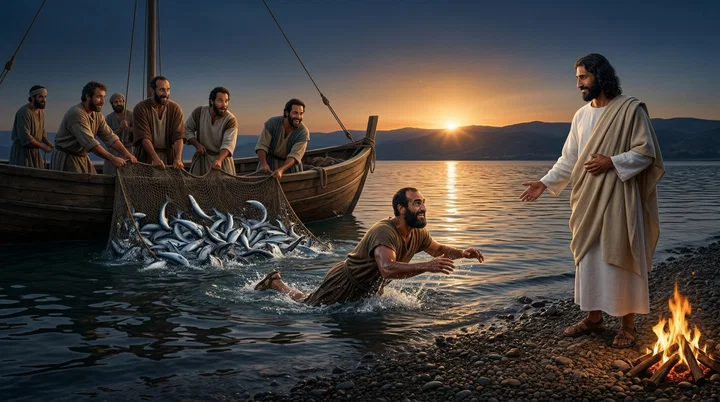
Then Jesus saith unto them, Children, have ye any meat? They answered him, No.
Translations
Then Jesus says to them, Children, have you any meat? They answered him, No.
King James Version, KJV Cambridge Paragraph Bible
Then Jesus saith unto them, Children, have ye any meat? They answered him, No.
Then Jesus saith to them, Children, have ye any victuals? They answered him, No.
Revised Version, American Standard Version
Jesus therefore saith unto them, Children, have ye aught to eat? They answered him, No.
Jesus, therefore, saith to them, 'Lads, have ye any meat?'
Jesus therefore says to them, Children, have ye anything to eat? They answered him, No.
Jesus, therefore, saith unto them—Children! perhaps ye have nothing to eat? They answered him—No.
Berean Standard Bible, Majority Standard Bible
So He called out to them, “ Children, do you have any fish?”“ No,” they answered.
Jesus therefore said to them, “ Children, have you anything to eat?”They answered him, “ No.”
So Jesus said to them, Children, have you taken any fish? They made answer, No.
Iesus then said vnto them, Syrs, haue ye any meate? They answered him, No.
Douay-Rheims (Challoner revision)
Jesus therefore said to them: Children, have you any meat? They answered him: No.
Pictures
Cross-references
- Luke 5:1-11
And it came to pass, that, as the people pressed upon him to hear the word of God, he stood by the lake of Gennesaret,
An earlier miraculous catch is recalled as a parallel to the catch after Jesus’ resurrection.
- John 21:15-17
So when they had dined, Jesus saith to Simon Peter, Simon, son of Jonas, lovest thou me more than these? He saith unto him, Yea, Lord; thou knowest that I love thee. He saith unto him, Feed my lambs.
After the meal, Jesus restores Peter and charges him to care for his followers.
- John 6:1-14
After these things Jesus went over the sea of Galilee, which is the sea of Tiberias.
The meal Jesus provides after the catch recalls his feeding of the five thousand.
- Luke 5:6
And when they had this done, they inclosed a great multitude of fishes: and their net brake.
An earlier miraculous catch of fish is repeated at Galilee.
- Matthew 14:19-21
And he commanded the multitude to sit down on the grass, and took the five loaves, and the two fishes, and looking up to heaven, he blessed, and brake, and gave the loaves to his disciples, and the disciples to the multitude.
The bread and fish recall Jesus’ feeding of the five thousand.
- Luke 24:40-43
And when he had thus spoken, he shewed them his hands and his feet.
Jesus eats in the disciples’ presence.
- John 21:13
Jesus then cometh, and taketh bread, and giveth them, and fish likewise.
The risen Jesus serves food to the disciples.
- John 21:9
As soon then as they were come to land, they saw a fire of coals there, and fish laid thereon, and bread.
The disciples find a fire and food on shore.
- Matthew 26:32
But after I am risen again, I will go before you into Galilee.
promise fulfilled in John 21
- Matthew 4:18-22
And Jesus, walking by the sea of Galilee, saw two brethren, Simon called Peter, and Andrew his brother, casting a net into the sea: for they were fishers.
Fishermen called by Jesus on the shore later meet the risen Jesus there.
- Mark 16:7
But go your way, tell his disciples and Peter that he goeth before you into Galilee: there shall ye see him, as he said unto you.
promise fulfilled in John 21
- Mark 14:28
But after that I am risen, I will go before you into Galilee.
promise fulfilled in John 21
- John 21:14
This is now the third time that Jesus shewed himself to his disciples, after that he was risen from the dead.
Identifies the lakeside encounter as Jesus’ third appearance to the disciples after rising from the dead.
- Acts 10:41
Not to all the people, but unto witnesses chosen before of God, even to us, who did eat and drink with him after he rose from the dead.
Witnesses ate and drank with Jesus after his resurrection.
Commentary
Each commentary is drawn from primary sources: the writings of Ellen G. White and Adventist pioneers and periodicals. Each commentary is separate. Its own words are not a quotation; follow the references to read the source passages.
Ellen G. White
15 sources
After his resurrection the disciples met Jesus in Galilee at the Sea of Tiberias, where after toiling through the whole night fishing they had caught nothing, and at dawn Jesus stood on the shore unrecognized as a stranger and called to them as children asking whether they had any food or fish, and they answered in weariness that they had nothing.DA 809.1Ms 43, 1897, par. 13–14Ms 155, 1904, par. 51–54RH Feb 6, 19136RED 65.2 He had watched over them unseen through their fruitless toil and let himself be seen in the morning as one who cared for their needs and would provide for them as they continued his work.Ms 155, 1904, par. 51–54RH Feb 6, 1913ST Oct 3, 18786RED 46.1–2 Their empty labor shows that work without Christ is hard and fruitless and human effort alone fails, while effort succeeds when his divine power works together with human labor in connection with him.Ms 43, 1897, par. 13–14ST Oct 3, 1878ST Oct 3, 1878 His question opens the way for his direction to cast the net again, the abundant miraculous catch, and the meal he had prepared, leading into Peter's threefold confession of love and the charge to care for his followers.RH Feb 6, 1913ST Oct 3, 1878ST Oct 3, 1878 The miraculous catch to which the question belongs renewed Christ's commission to the disciples, showing that his death had not ended their duty to carry on the work he had given them.6RED 47.1ST Oct 3, 1878
Setting and Exchange
The exchange belongs to the meeting in Galilee after Passover, when the disciples had gone to meet Jesus as he had directed them, at the Sea of Galilee, which is the Sea of Tiberias, after his resurrection.DA 809.1RH Feb 6, 1913 They had gathered in a secluded place where they were not likely to be disturbed, yet they were surrounded by reminders of Jesus and his mighty works from the years when much of his ministry had been passed beside that sea.DA 809.3 On that very sea, when their hearts were filled with terror and the fierce storm was hurrying them to destruction, he had walked upon the billows to their rescue, and there the tempest had been hushed by his word.DA 809.3 Within sight was the beach where above ten thousand persons had been fed from a few small loaves and fishes, and not far distant was Capernaum, the scene of so many miracles, so that as they looked upon the scene their minds were full of the words and deeds of their Saviour.DA 809.3
Peter proposed going out upon the sea to cast their nets from his old love for boats and fishing, and all joined him because they were in need of food and clothing which the proceeds of a successful catch would supply.DA 810.1 After Jesus' ascension they had returned to this work, and though they toiled through the whole night they caught nothing.Ms 43, 1897, par. 13–14Ms 155, 1904, par. 51–54RH Feb 6, 19136RED 65.2 Through the weary hours they talked of their absent Lord and recalled the wonderful events they had witnessed in his ministry beside the sea, while they questioned as to their own future and grew sad at the prospect before them.DA 810.1 Their reply to what followed was given in that weariness and discouragement.Ms 43, 1897, par. 13–14
In the morning, when the boat was only a little way from land, Jesus stood alone on the shore as a watcher over the disciples, following them with his eyes unseen through their long, unsuccessful night of fruitless toil.6RED 65.2 Then at dawn he let himself be seen, yet still unrecognized, speaking to them as a stranger.6RED 65.23SP 227.2–228.1 He called to them as children and asked whether they had any meat or food or fish to eat, and they, not knowing it was Jesus, answered that they had nothing, that they had caught nothing at all.RH Feb 6, 19136RED 65.2ST Oct 3, 18786RED 45.2–33SP 227.2–228.1
Lessons and Application
The honest “No” after a night of empty toil prepares for what comes next: the command to cast the net again, the abundant miraculous draught, and the breakfast already prepared on shore, which opens the way to Peter’s threefold avowal of love and the charge to feed and care for Christ’s followers.RH Feb 6, 1913ST Oct 3, 1878ST Oct 3, 1878 The failure exposes the hardness and fruitlessness of work attempted without Christ, for human labor by itself cannot succeed.Ms 43, 1897, par. 13–14ST Oct 3, 1878 Success comes only when divine power unites with human effort, when labor is carried on in connection with Christ.ST Oct 3, 1878ST Oct 3, 1878
The question and answer reveal the risen Lord’s watchful care for the temporal needs of His workers and His purpose to provide for them as they labor for Him and carry forward His work.ST Oct 3, 18786RED 46.1–2 The repeated miracle belongs inseparably to the renewal of the commission, declaring that His death had not cancelled their duty to continue the work He had committed to them.6RED 47.1ST Oct 3, 1878
In the search for a school site the empty nets become a figure for prospects that look uncertain and for the difficulty of discerning any advantage in a place that at first appears forbidding.8MR 136.2Lt 82, 1894, par. 13 The lesson is the need for strengthened faith before passing judgment, to view apparently discouraging circumstances from the side of faith.8MR 136.2Lt 82, 1894, par. 13 Such faith learns to recognize the advantages hidden in the place and to trust that the right course, once taken, will bring success.8MR 136.2Lt 82, 1894, par. 13
Sources
Pioneers and periodicals
74 sources
On a morning after His resurrection by the Sea of Galilee, the risen Jesus stood unrecognized on the shore and tenderly called to the seven disciples who had toiled all night in the boat and caught nothing, and they answered that they had no food or catch.ST May 30, 1895RH May 28, 1872ST Dec 13, 1883ST Oct 17, 1878ST May 11, 1915 Their empty nets exposed the fruitlessness of turning back to their own wisdom and self-service after being called to be fishers of men, and His question gently reproved confidence in their own ability.ST May 30, 1895ST May 30, 1895ST Jan 7, 1897 Their speaking and answering with Him there showed He was truly alive, in what is counted His third meeting with the disciples after His resurrection and His seventh showing Himself alive after His suffering.ST May 30, 1895ST May 11, 1915ST Nov 8, 1910RH Oct 7, 1862RH Apr 12, 1860 He who knew their weariness and poverty directed them to the great catch and gave them a morning meal on shore, teaching that labor at His word succeeds and that He watches over and provides for those who do His work.ST Nov 4, 1886ST Oct 3, 1878ST Apr 21, 1914ST Jun 17, 1897 The fishing occasion was a common working day and gives no authority for first-day observance, for His meeting with them and blessing their work on that day did not make it holy or replace the seventh-day Sabbath.RH Sep 10, 1857RH Sep 10, 1857RH Nov 26, 1872ST Mar 23, 1882RH Sep 2, 1851
Setting by the Sea
The meeting takes place in the morning, several days after the resurrection, on the northern shore of the Sea of Galilee, called the Sea of Tiberias, near Capernaum where the disciples had often fished.ST May 30, 1895ST Apr 2, 1896RH Sep 2, 1851 It lies in the district where Jesus had walked more than any other part of the sea or of Palestine, had done most of His mighty works, had crossed and recrossed the sea followed by multitudes numbering thousands, and had called the fishermen to be His disciples.ST Jul 7, 1898 The lake setting is the vicinity of Capernaum at the north end of the lake, the scene of their former labor.ST May 30, 1895ST Jul 7, 1898
Seven disciples are in the boat: Simon Peter, Thomas called Didymus, Nathanael of Cana in Galilee, the sons of Zebedee, and two others.ST Apr 2, 1896ST Jun 2, 1898 Among them are the ardent, impetuous Peter and the loving John.RH Dec 15, 1874 Peter leads out in proposing to go a-fishing, and the others join him, so that Peter with six other apostles spends the night in fishing.ST May 30, 1895ST Apr 2, 1896ST May 1, 1901 Weary after working through the night, several disciples are refreshed there in the early morning, and seven are provided a morning meal by the lake.ST Nov 11, 1908ST Nov 11, 1886
They had gone to Galilee to meet Jesus by His appointment.ST May 30, 1895 Surrounded by the scenes of their former labor and discouraged by disappointment over the temporal kingdom they supposed He came to set up, with their hopes dashed by His death and by His crucifixion and burial, old desires returned.ST May 30, 1895ST Oct 1, 1894 In that disappointment they turned back to their former work of fishing, returning to old ways after His death and resurrection.ST May 30, 1895ST Jul 31, 1901ST Oct 1, 1894
They toiled all night in their own way and by their own wisdom and caught nothing, their night's work standing empty.ST May 30, 1895RH May 28, 1872 Jesus stood on the shore in the morning beside a small fire, unrecognized by them, at the opening of His meeting with them by the sea.ST Oct 3, 1878ST Apr 2, 1896ST Oct 17, 1878 His question to them about having food or catch to eat, and their answer No, marks that empty night's work and their lack, and sets up His direction to cast the net on the other side and the abundant, miraculous catch that follows.ST Oct 3, 1878ST May 30, 1895RH May 28, 1872
Question and Empty Nets
In the morning after a night of fruitless toil Jesus stood on the shore and called out to the men in the boat in familiar, tender address, asking whether they had any meat or food or catch to eat.ST Dec 13, 1883ST Oct 17, 1878ST Apr 12, 1883 They answered Him plainly, No, owning that they had caught nothing through the night and had no food, thereby acknowledging their immediate need.ST Dec 13, 1883ST Oct 17, 1878ST May 11, 1915ST Apr 12, 1883ST Apr 21, 1914 Their failure after working all night without success had left them discouraged and weary, and His question met them in that known condition to cheer them by His help.ST Apr 21, 1914
The question gently confronted them for having turned to work for themselves after being called to the work of the gospel ministry, bringing them to confess that their self-directed labor had yielded nothing.ST May 30, 1895ST May 30, 1895 It kindly reproved their confidence in their own ability, as shown by empty nets after a night of fishing in Galilee.ST May 30, 1895ST May 30, 1895ST Jan 7, 1897 In that reproof Christian, moral, and personal work, including overcoming sin, is shown unable to succeed apart from Christ, since resolutions and vows made in human strength cannot purge weakness or sin.ST Jan 7, 1897
Their confessed lack sets the scene for what follows, for Jesus then directed them to cast the net on the other side, on the right side, and provided for their need.ST Nov 4, 1886RH May 28, 1872 That direction led to a great, abundant and miraculous catch, teaching that human effort joined with His divine power succeeds in His work.ST Nov 4, 1886ST Oct 3, 1878RH May 28, 1872 The same exchange leads on to the meal He had prepared on shore, showing the risen Lord watching over poor disciples who needed food and clothing and ready to supply them as they did His work, and onward to Peter's threefold confession of love and the charge to care for His followers.ST Nov 4, 1886RH Feb 6, 1913ST Oct 3, 1878
The verse does not say their fishing was wrongdoing, nor does it record that Jesus rebuked them for fishing.ST Dec 13, 1883ST Sep 16, 1875 He directed them where to cast their nets and obtain a good catch without telling them that fishing was wrong, even if the day were Sunday.ST Dec 13, 1883ST Sep 16, 1875
Witness to Resurrection
The meeting by the lake fulfills the repeated promise that the disciples would see Him in Galilee after His resurrection, and the repeated stress laid on that promise makes it a confirmation of the resurrection.RH Sep 10, 1857 The brief exchange in which the risen Jesus speaks from the shore and they answer Him is one of the many proofs that He was truly alive, that the disciples saw and talked with Him after His resurrection.ST Nov 8, 1910RH Oct 7, 1862 It belongs to His showing of Himself to those who had known Him before His death, establishing that the same Jesus was seen alive by His followers at the Sea of Galilee and at the Lake of Tiberias.ST Nov 8, 1910RH Nov 24, 1868ST Aug 3, 1882
The meeting is counted as His third appearance and third meeting with the disciples after His resurrection.ST May 11, 1915ST Jul 19, 1883ST Apr 15, 1889RH Mar 31, 1874 It came after the appearance with Thomas present and before the later meeting on the mountain in Galilee, and after the appearance eight days after the resurrection when they were out fishing.ST Jul 19, 1883ST Nov 24, 1898RH May 12, 1874 It is also counted as His seventh meeting and the seventh time He showed Himself alive after His suffering, by the sea.ST May 30, 1895RH Apr 12, 1860
The appearances occurred at intervals during the forty days between resurrection and ascension, as separate manifestations and not as one continuous presence with them.RH Aug 31, 1869ST Apr 8, 1889 They were not confined to one day, for He was seen by His disciples for forty days, and the exact order and total number of appearances during that time is uncertain and what other appearances occurred is unknown.ST Apr 8, 1889ST Nov 24, 1898 This appearance while fishing is distinguished from the appearance on the day of His resurrection.RH Jan 23, 1866 The account of the appearance at the Lake of Tiberias is a supplementary Gospel memoir, abrupt and fragmentary and incomplete in form, illustrating that the Gospels preserve original records by different writers rather than narratives edited into a uniform history.RH Apr 11, 1871
The encounter leads on into dining with Him on the shore and into the brief but comprehensive test of love, Peter's threefold confession and practical test rather than mere profession, with the charge to feed lambs and sheep that still comes to each listener today.RH Feb 6, 1913RH Dec 15, 1874ST May 1, 1901ST May 1, 1901 It shows where and on what occasion Jesus spoke with Peter about love and feeding His sheep, after the morning following the night of fishing by Peter and six other apostles.ST May 1, 1901ST May 1, 1901 It is an example of His personal work with the disciples on the seashore, standing on shore before they recognized Him, directing the abundant catch and preparing the meal, then drawing Peter into confession of love and care for His followers.RH Feb 6, 1913RH Aug 26, 1902
No Sunday Sacredness Proved
The record of the meeting by the sea does not state what day of the week it occurred, and the day is unknown.ST Apr 13, 1882RH Nov 26, 1872ST Mar 23, 1882RH Jun 19, 1856ST Apr 13, 1882 The question is raised whether it happened on the first day of the week, but the account itself does not identify the day.ST Apr 22, 1897RH Jun 19, 1856 If it was the first day, the circumstances must be weighed as they stand; if it was another day, it shows manifestation to the disciples on another day.ST Apr 13, 1882ST Apr 13, 1882
Careful reading of the chapter shows the timing and proves meeting with the disciples on another day besides the first day.RH Sep 10, 1857 The meeting while fishing was not on the Sabbath, and the fact of meeting does not make that day holy.RH Oct 20, 1859 Though counted as the third meeting with the risen one by the Sea of Galilee, it may have occurred on a Sunday, but it was not on the Sabbath.
The meeting may have occurred on the first day of the week, but the record does not name the day.ST Apr 22, 1897ST Dec 11, 1901 The setting places the meeting in a fishing occasion, not a religious meeting, and it was not thereby shown to be holy.ST Nov 11, 1889 It was a common fishing occasion after the appearance eight days after the resurrection, when they were out fishing, not a religious celebration of the first day.RH May 12, 1874 The disciples were engaged in ordinary work, and the account does not name the day or describe a religious meeting, so there is no example of first-day observance in it.RH Aug 1, 1854 Nor does the third meeting establish that the disciples gathered to honor Sunday as a sacred day, though it might have occurred on Sunday.ST Apr 15, 1889
If the meeting was on Sunday, the disciples were fishing then and direction was given where to cast the net.ST May 11, 1915 If it was the first day, the circumstances show no treating of it as a day set apart from ordinary work.ST Apr 13, 1882ST Apr 13, 1882 Their fishing work shows they did not regard that day as sacred or holy, and the meeting itself gives no sacredness to the first day.ST Aug 4, 1898 The incident took place on a fishing day, when work had gone through the night, not as evidence of a recurring Sunday meeting or of Sunday sacredness.ST Feb 20, 1879 To use the account to establish Sunday as a day of worship would also allow the claim that fishing on Sunday was taught.RH Dec 31, 1857
Meeting with the disciples does not change a day's character or make it holy; otherwise it would be an unidentifiable holy day of the week.RH Nov 26, 1872 The interview did not give that day a sacred character.ST Mar 23, 1882 Meeting does not make that day a rest day.RH Jun 19, 1856 Appearance on a fishing day did not make it a Sabbath, just as appearance on another day did not establish that day as the Sabbath.ST Aug 13, 1874 That reasoning would also make other working days sacred.RH Feb 25, 1862 The same holds for the meeting eight days after the resurrection and for the final meeting at the ascension from the Mount of Olives on Thursday, which did not make those days Sabbaths.RH May 12, 1874
There is no proof it happened on the first day of the week, since fishing is ordinary work permitted on the working days of the fourth commandment, so the chapter gives no authority for first-day observance.RH Sep 10, 1857 Meeting on that day is not evidence that the first day was observed as a Sabbath.RH Sep 2, 1851 If meeting made that day a Sabbath, then fishing would be right on the Sabbath, and encouragement and direction in the work rather than rebuke therefore gives no sanction for observing the first day.RH May 16, 1854 The meeting is one of several appearances after the resurrection and is not evidence that Sunday replaced the seventh-day Sabbath.RH Dec 17, 1857 The appearance while engaged in ordinary work gives no example of first-day observance.RH Aug 1, 1854 Nor is there proof that appearances were only on the first day, since careful reading proves meeting on another day besides the first day.RH Sep 10, 1857
Christ could manifest himself to the disciples on another day besides the first, and a day does not become sacred merely because of such meeting.ST Apr 13, 1882ST Apr 13, 1882 The extended conversation by the sea does not make the time holy or show meeting to honor a sacred day, but presents evidence of resurrection, not institution of a weekly day of worship.RH Nov 24, 1868 There was no stated reason for choosing that time except that it seemed good to him, which proves the right to meet on any day of the week chosen without telling why, and gives no proof of meeting for public or social worship or that the day was the Sabbath.RH Nov 29, 1853
Christ Cares and Provides
The risen Lord watched over poor disciples who needed food and clothing, asked after their night without success whether they had any food to eat, and showed Himself ready to provide for them as they did His work.ST Nov 4, 1886ST Oct 3, 1878 When they answered that they had none, His direction to cast the net on the right side brought a great catch, teaching that human effort succeeds when joined with His divine power.ST Nov 4, 1886ST Oct 3, 1878ST Jun 17, 1897 The same care appears in His oversight of the work of gathering souls, where obedience to His direction makes labor fruitful while work apart from it may yield nothing, and in the morning meal He provided by the lake for the seven weary after working through the night.ST Sep 28, 1904ST Nov 11, 1886
He knew their condition after failure had left them discouraged and weary, came to them early in the morning, and cheered their hearts by His help, showing His willingness to encourage discouraged followers.ST Apr 21, 1914ST Apr 21, 1914 Weary people are therefore taught to trust and obey His direction, assured that He stands near through hardship and is able to protect and reward them when they follow it.ST May 27, 1889
The miraculous catch renewed their commission, teaching that His death had not ended their obligation to continue the work He had assigned them and that their own labor fails while success comes through working in connection with Him.ST Oct 3, 1878ST Jun 17, 1897 After they had returned to their former work and old ways, He recalled them to their mission, paralleling those followers who turned back after the disappointment of 1844.ST Jul 31, 1901
Work Only With Christ
The disciples had left their duty to wait in Galilee for the Saviour and had gone a-fishing in their own wisdom, going back from the exalted mission of being fishers of men to fishers of fish, from the service of Christ to the service of self, and the service of self is always fruitless.ST May 30, 1895ST May 30, 1895ST Apr 2, 1896 Jesus gently confronted and kindly reproved them as they worked for themselves after being called to the work of the gospel ministry, and His question whether they had caught anything brought them to acknowledge that their self-directed labor had yielded nothing and to recognize its fruitlessness, preparing them to follow His direction.ST May 30, 1895ST May 30, 1895 Discouraged, they had turned from their appointed work to work for themselves and had accomplished nothing through the night without His direction.ST May 30, 1895
Their empty nets and their answer that they had no food expose the emptiness of human effort apart from Christ, even when it is sustained and organized in their own wisdom and strength.ST Apr 2, 1896 When Peter led out and the others joined him apart from divine direction on a purely human plan, their night of catching nothing proved that human plans, methods, organizations, wisdom and toil accomplish nothing for God.ST Apr 2, 1896ST Apr 2, 1896 Human wisdom, human effort, human expedients, human organizations, human might, even when joined to former successful experience, will accomplish nothing for God, and without Christ all such work is hollow, vain and empty despite human praise and admiration.ST Apr 2, 1896ST Jan 7, 1897 His question the next morning kindly reproved confidence in their own ability, showing that apart from Christ man can do nothing.ST Apr 2, 1896ST Jan 7, 1897
The same sea and boat and place that yielded nothing to fishing for themselves yielded a full net and a meal on shore at the command of Christ.RH Jul 6, 1916ST Apr 2, 1896 Following His command always brings success even when it seems unreasonable, and implicit faith in His word always meets with success.ST Apr 2, 1896ST Oct 1, 1894 When Christ appeared and directed them their boat was soon filled, teaching that without Him nothing can be done but with obedience to His word success is sure.RH Jul 6, 1916ST Apr 2, 1896 By giving success through obedience to His word, Jesus taught them to catch men, for souls are gathered only by Christ's word and never by human schemes and devices or by compromises and perversions of truth.ST Oct 1, 1894
Those who work to bring people to Christ must let Him guide their efforts, for teaching independently of Him leads to false witness.ST Aug 14, 1893ST Sep 28, 1904 Faithful labor for souls may appear fruitless, yet work done at the Master's word will not be in vain, for Christ oversees the gathering and His followers' labor is fruitful when they obey His direction while work apart from it may yield nothing.ST Aug 14, 1893ST May 25, 1904ST Sep 28, 1904 Efforts to share the message may seem to yield nothing even when it is spoken clearly, yet Jesus is near and His word gives reason to try again.ST May 25, 1904ST Oct 1, 1894RH Jan 18, 1912 God's servants toiling in their own strength and wisdom for souls in seemingly barren fields must do His service in His way by simple faith in His word to reap the sure harvest.ST Apr 2, 1896ST Oct 1, 1894
When God's servants become discouraged, lose sight of Christ, forget His commands, directions and equipment, and organize and labor in their own ways through days and nights and years, their work is empty and they have nothing to show when the Master asks whether they have food.ST Apr 2, 1896 The same empty nets illustrate that Christian, moral, and personal work — including overcoming sin — cannot succeed apart from Jesus Christ, for resolutions and vows made in human strength cannot purge weakness or sin.ST Jan 7, 1897 His gentle approach after the fruitless night recalls Peter's earlier call after a fruitless night of fishing, preparing the disciples to recognize the Master and remember their calling.ST Oct 3, 1878ST Oct 1, 1894 The repeated catch renewed Christ's commission, showing that His death did not end their duty to carry on His work, repeating the earlier miracle of the fishes to teach them to catch men, and this time the lesson became permanent.ST Oct 3, 1878ST Oct 1, 1894
The small company of Galilean fishermen, counted as the eleven fishermen of Galilee, illustrates divine strength working through human weakness, with a minority standing secure when God is on its side.ST Jul 14, 1887 The Saviour's question whether they have food is a daily call to examine whether the soul has been fed and strengthened.ST Oct 9, 1884 Such nourishment should be sought at the beginning of each day before temptations arise, because delay risks spiritual weakness, while daily watching and prayer help prevent falling into temptation, and steady gradual growth leads toward the full stature of life in Christ.ST Oct 9, 1884
Sources