Matthew 4:18
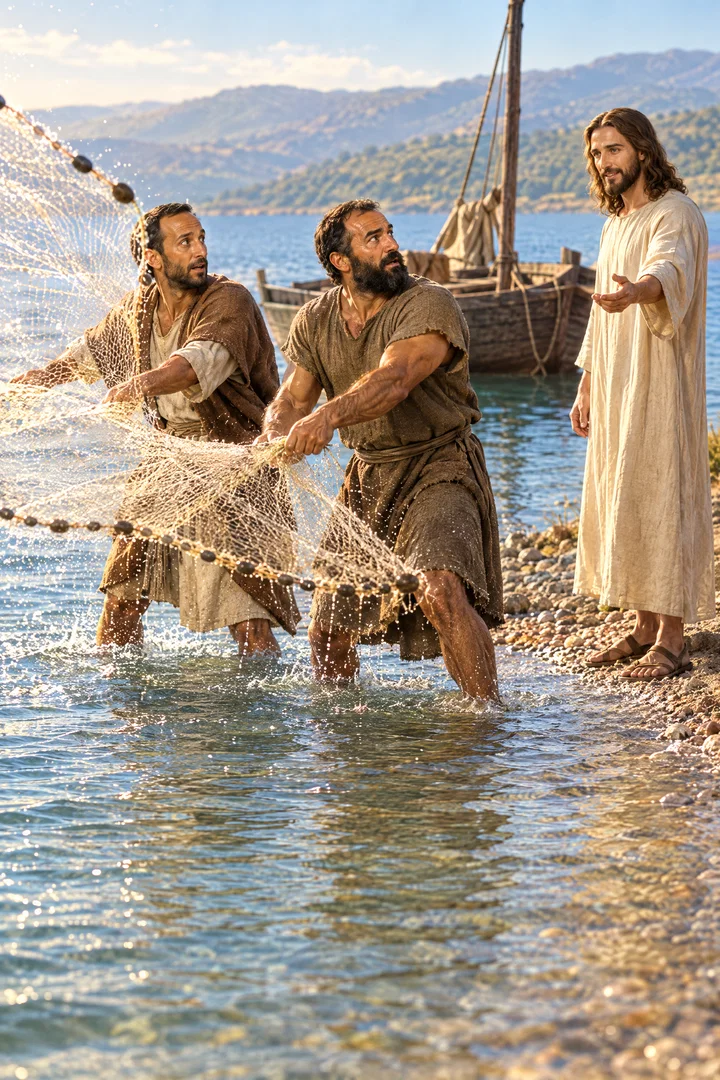
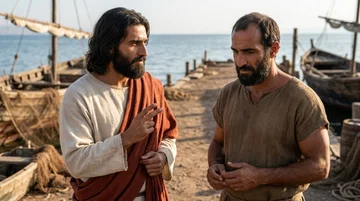
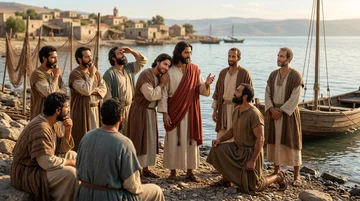
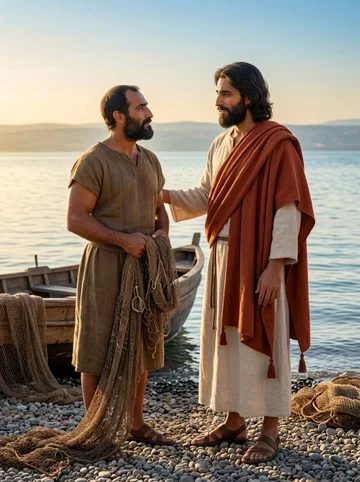
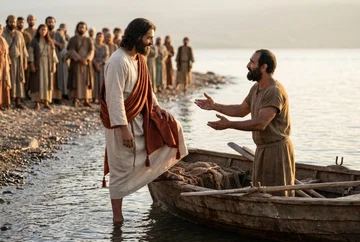
And Jesus, walking by the sea of Galilee, saw two brethren, Simon called Peter, and Andrew his brother, casting a net into the sea: for they were fishers.
Translations
And Jesus, walking by the sea of Galilee, saw two brothers, Simon called Peter, and Andrew his brother, casting a net into the sea: for they were fishers.
King James Version, KJV Cambridge Paragraph Bible, Webster Bible
And Jesus, walking by the sea of Galilee, saw two brethren, Simon called Peter, and Andrew his brother, casting a net into the sea: for they were fishers.
Revised Version, American Standard Version
And walking by the sea of Galilee, he saw two brethren, Simon who is called Peter, and Andrew his brother, casting a net into the sea; for they were fishers.
And Jesus, walking by the sea of Galilee, saw two brothers, Simon named Peter and Andrew his brother, casting a drag into the sea — for they were fishers —
And walking by the sea of Galilee, he saw two brothers, Simon called Peter, and Andrew his brother, casting a net into the sea, for they were fishers;
And, walking round beside the sea of Galilee, he saw two brethren—Simon who is called Peter, and Andrew his brother,—casting a large fishing-net into the sea, for they were fishers;
Berean Standard Bible, Majority Standard Bible
As Jesus was walking beside the Sea of Galilee, He saw two brothers, Simon called Peter and his brother Andrew. They were casting a net into the sea, for they were fishermen.
Walking by the sea of Galilee, he saw two brothers: Simon, who is called Peter, and Andrew, his brother, casting a net into the sea; for they were fishermen.
And when he was walking by the sea of Galilee, he saw two brothers, Simon, whose other name was Peter, and Andrew, his brother, who were putting a net into the sea; for they were fishermen.
And Iesus walking by the sea of Galile, sawe two brethren, Simon, which was called Peter, and Andrew his brother, casting a net into the sea (for they were fishers.)
Douay-Rheims (Challoner revision)
And Jesus walking by the sea of Galilee, saw two brethren, Simon who is called Peter, and Andrew his brother, casting a net into the sea ( for they were fishers).
Pictures

Cross-references
- Luke 5:10-11
And so was also James, and John, the sons of Zebedee, which were partners with Simon. And Jesus said unto Simon, Fear not; from henceforth thou shalt catch men.
Jesus calls Simon and his companions from fishing to follow him and catch people.
- Mark 1:16-18
Now as he walked by the sea of Galilee, he saw Simon and Andrew his brother casting a net into the sea: for they were fishers.
Parallel account of Jesus calling Simon and Andrew from their nets to follow him.
- Matthew 9:9
And as Jesus passed forth from thence, he saw a man, named Matthew, sitting at the receipt of custom: and he saith unto him, Follow me. And he arose, and followed him.
Matthew leaves his work and immediately follows Jesus’ call.
- 1 Kings 19:19
So he departed thence, and found Elisha the son of Shaphat, who was plowing with twelve yoke of oxen before him, and he with the twelfth: and Elijah passed by him, and cast his mantle upon him.
Both are called while occupied with everyday work.
- John 1:40-42
One of the two which heard John speak, and followed him, was Andrew, Simon Peter’s brother.
Andrew brings Simon to Jesus before their later call while fishing.
- Isaiah 9:1-2
Nevertheless the dimness shall not be such as was in her vexation, when at the first he lightly afflicted the land of Zebulun and the land of Naphtali, and afterward did more grievously afflict her by the way of the sea, beyond Jordan, in Galilee of the nations.
Isaiah’s prophecy of light dawning in Galilee is fulfilled in Christ’s ministry there.
- Acts 4:13
Now when they saw the boldness of Peter and John, and perceived that they were unlearned and ignorant men, they marvelled; and they took knowledge of them, that they had been with Jesus.
Peter and Andrew were ordinary fishermen who became apostles and were recognized as having been with Jesus.
- John 21:1-14
After these things Jesus shewed himself again to the disciples at the sea of Tiberias; and on this wise shewed he himself.
Recounts the post-resurrection catch that recalls the first one.
- Matthew 19:27-28
Then answered Peter and said unto him, Behold, we have forsaken all, and followed thee; what shall we have therefore?
Peter followed Jesus’ call, and Jesus promises his followers thrones of judgment.
- Luke 5:2-4
And saw two ships standing by the lake: but the fishermen were gone out of them, and were washing their nets.
The later fishing episode revisits Peter’s call to follow Jesus.
- Luke 5:5
And Simon answering said unto him, Master, we have toiled all the night, and have taken nothing: nevertheless at thy word I will let down the net.
Peter lets down the net at Christ’s word after a fruitless night.
- Matthew 4:22
And they immediately left the ship and their father, and followed him.
The brothers immediately leave their work and follow Jesus.
- Luke 5:1
And it came to pass, that, as the people pressed upon him to hear the word of God, he stood by the lake of Gennesaret,
gives same lakeside setting
- Luke 5:11
And when they had brought their ships to land, they forsook all, and followed him.
shows they forsook all to follow
- Luke 5:8
When Simon Peter saw it, he fell down at Jesus’ knees, saying, Depart from me; for I am a sinful man, O Lord.
Peter confesses his sinfulness before Jesus’ divine power.
- John 1:43-44
The day following Jesus would go forth into Galilee, and findeth Philip, and saith unto him, Follow me.
Both describe Jesus calling disciples in Galilee, with Andrew and Peter named.
- Mark 4:39
And he arose, and rebuked the wind, and said unto the sea, Peace, be still. And the wind ceased, and there was a great calm.
Jesus commands the sea where he called Peter and Andrew.
- Acts 2:41
Then they that gladly received his word were baptized: and the same day there were added unto them about three thousand souls.
Peter’s preaching later gathers multitudes into the church.
- Luke 9:61
And another also said, Lord, I will follow thee; but let me first go bid them farewell, which are at home at my house.
A delayed farewell contrasts with the immediate following of Jesus.
Commentary
Each commentary is drawn from primary sources: the writings of Ellen G. White and Adventist pioneers and periodicals. Each commentary is separate. Its own words are not a quotation; follow the references to read the source passages.
Ellen G. White
91 sources
Jesus walking by the Sea of Galilee saw the two brothers Simon called Peter and Andrew his brother casting a net into the sea because they were fishers.ST Jul 19, 1905Ms 66, 1910, par. 10–11Lt 8, 1910, par. 4–8 He found them at their ordinary daily work earning their living as fishermen, and that work became the setting for His call to follow Him.1RED 63.1Lt 53, 1905, par. 6–7Ms 55, 1901, par. 18–20 These humble, poor working fishermen were His first disciples, and their call marks the very commencement of laying the foundation of the Christian church.CH 321.1–2CH 347.1–2SSP 38.2–4 He passed by the learned rabbis, lawyers, scribes and dignitaries who felt self-sufficient and would not follow Him, and chose instead men of humble, teachable, obedient spirits who were open to instruction and willing to be shaped.Ms 36, 1898, par. 5CT 511.3–512.2 He called them directly to leave nets, boats and occupation and follow Him to become fishers of men, and they straightway left their nets and followed Him promptly without question or hesitation though He promised no gain, wealth or worldly honor.GW 24.1–2ST Jul 19, 19051RED 63.1Lt 53, 1905, par. 6–7Lt 8, 1910, par. 4–8
Setting by the Sea
Jesus walking beside the Sea of Galilee saw two brothers, Simon called Peter and Andrew his brother, casting a net into the sea because they were fishers.ST Jul 19, 1905Ms 66, 1910, par. 10–11Lt 8, 1910, par. 4–8Ms 145, 1907, par. 6–9RH Dec 15, 1910 They were brothers and fishermen at work on the water when He saw them and called them to follow Him and become fishers of people.Ms 66, 1910, par. 10–11Lt 8, 1910, par. 4–8Ms 145, 1907, par. 6–9Ms 27, 1910, par. 8–10RH Dec 15, 1910 He took them directly from that work to learn beside Him as He taught the crowds and gave them further explanation afterward.Ms 145, 1907, par. 6–9
He found them at their ordinary daily work where they earned their living as fishermen, and that work became the setting for His call to follow Him.1RED 63.1Lt 53, 1905, par. 6–7Ms 55, 1901, par. 18–20LC1 63.1RH Jan 17, 1907 He met Simon Peter and Andrew while they were casting a net into the sea and called these working fishermen directly to follow Him and serve in the salvation of souls.1RED 63.1Lt 53, 1905, par. 6–7Ms 55, 1901, par. 18–20RH Jan 17, 1907Lt 8, 1909, par. 4–7 Their ordinary occupation sets the scene for His call to give their work a new purpose in helping bring people to salvation, and their immediate response shows faithful obedience even when it means leaving occupation.Ms 55, 1901, par. 18–20LC1 63.1Lt 8, 1909, par. 4–7
The scene came after a night of unsuccessful fishing when the disciples returned discouraged by failure.DA 244.14RED 35.3–37.3 They were grieving John's death and troubled by doubt, fear and unbelief, and after witnessing His miracles and hearing His teaching they had still gone back for a time to fishing for brief diversion from anxiety.4RED 35.3–37.3ST Mar 3, 1881 Jesus used Peter's boat to teach the gathered crowd about salvation and the mysteries of the kingdom, with lake, mountains, fields and sunlight illustrating His teaching and bringing eternal life to hearers.DA 244.1DA 244.24RED 35.3–37.3 He then proved His divine power by a miraculous draught that filled and broke the net and nearly sank the laden boats, convicting Peter of sinful unbelief so that he fell at Jesus' feet.4RED 35.3–37.3
These humble, sturdy, poor working fishermen were His first disciples, chosen as ordinary working men at the Sea of Galilee.CH 321.1–2CH 347.1–2SSP 38.2–4STB 813.2–4Lt 129, 1903, par. 8 Their call marks the very commencement of laying the foundation of the Christian church.SSP 38.2–4 Following Him meant sharing His self-denial and sacrifices rather than receiving a promised payment, certain sum, or fixed wage for service.CH 321.1–2CH 347.1–2SSP 38.2–4STB 813.2–4RH Jul 23, 1914
The later abundant catch after His resurrection renewed the meaning of that first scene.6RED 46.1–2 Though they would no longer have His visible companionship or rely on fishing for livelihood, the risen Jesus would care for them as they carried out His work.DA 810.56RED 46.1–2 Their labor would succeed when joined with Christ's power, and their commission remained after His death as divine power joined human effort and provided for their needs.DA 810.56RED 46.1–2
Peter's former occupation as a fisherman evokes the simple early Christian assemblies in which he presided, marked not by formal display but by the Spirit's power.GC 255.2
Why Humble Fishermen Chosen
Choosing these humble, uneducated fishermen did not show a preference for ignorance, contempt for education, or opposition to learning.CT 511.3–512.2FE 47.1–44RED 38.22SP 186.1CE 203.3–204.1 The highest culture, when sanctified by the love and fear of God, receives His approbation.4RED 38.22SP 186.1 Learning in Christ's school could give an education higher and more far-reaching than the school of the prophets, and no course in rabbinic schools or halls of philosophy could equal that schooling in value.CE 203.3–204.1 He joined the fishermen to Himself so He could educate them and prepare them to carry on His work after He left, and His knowledge and teaching qualified them for their high commission so that their words and works had world-changing, far-reaching results.CT 511.3–512.2FE 47.1–4 Their simple lives, familiarity with hardship, and freedom from love of riches and worldly honor made them receptive to truth and able to develop love for mercy, righteousness, justice, and holiness, while the selection reflected the corruption of religious knowledge by human teachings and worldly ambition among the learned of that time.LC1 64.3
He passed by the learned rabbis and chose instead of learned lawyers, scribes and elders, dignitaries, and the rich, talented, great and educated.Ms 36, 1898, par. 54RED 38.22SP 186.1Ms 168, 1902, par. 22 Exalted by worldly wisdom and self-righteousness, intellectual superiority and trust in learning, position and human wisdom, they felt all-sufficient in themselves with no special need of a Redeemer.4RED 38.22SP 186.1CE 203.3–204.1 With fixed characters and schooled in false traditions and erroneous customs, they would not follow Him and receive His teachings.4RED 38.22SP 186.1 Those qualified and learned people who believed Him lacked the courage to confess Him and serve despite opposition at risk to standing, and men of learning are not easily reached by practical truth nor easily made humble learners in the school of Christ.CT 511.3–512.2FE 47.1–4CE 203.3–204.1 Jesus could work with the humble fishermen and train them for the highest work given to mortals.Ms 36, 1898, par. 5
The fishermen were men of native ability and good natural ability with humble, teachable, obedient and faithful spirits.FE 47.1–4CE 203.3–204.1GW92 385.1–2 They were candid, fair, compassionate, kind and sympathetic, open to instruction and willing to be taught and shaped.1RED 68.1LC1 68.1 Free from worldly customs and the religious leaders' bigotry, praise, flattery and self-sufficiency, and unschooled in the traditions and erroneous customs of their time, they rejoiced to be connected with Him and become co-laborers with Him.1RED 68.14RED 38.2LC1 68.12SP 186.1 He saw each person's possibilities and infinite possibilities in them, so that in His hands they would become precious jewels to shine brightly in the kingdom of God, and personal contact and association were how He trained them.ED 231.2–232.1Ms 168, 1902, par. 22 When they came forth from His training they were no longer ignorant and uncultured but had become like Him in mind and character, so that others recognized they had been with Jesus.
Trained by hard work and hardship in poverty, obscurity and common duties, clothed with coarse raiment and regarded as of little value, their low social standing did not keep them from serving Him.MH 197.2–3LC1 64.3ED 85.1–2Ms 168, 1902, par. 22 Their humble occupation as working fishermen of Galilee did not prevent them from becoming workers whose influence would endure with lasting value through eternity.ST May 4, 1882 Though unschooled in rabbinic learning and customs, they had ability and a teachable spirit, and He chose people beyond the bounds of rank, wealth, and learning.MH 197.2–3ED 85.1–2 Their call from the lower ranks of life in the humble walks of life kept the simplicity of habit He had preserved from His life at Nazareth working at the carpenter's trade through His public work proclaiming the gospel of the kingdom to its close.Ms 20, 1902, par. 8
Yet their understanding of His kingdom and mission was limited because they had absorbed false teachings and the mixed and objectionable sayings of the scribes and Pharisees.RH Jul 3, 1900Ms 45, 1898, par. 21 They could not yet receive all that He wanted to teach about divine truth, which put a restraint on what He could disclose to them.RH Jul 3, 1900Ms 45, 1898, par. 21 He had to make room for the new wine of His kingdom in hearts ready to receive His truth.13MR 53.2–55.1Lt 83, 1890, par. 13–18
Call to Become Fishers
Jesus spoke directly to the fishermen at their nets and called them to follow Him, leaving nets, boats, regular occupation and worldly possessions to serve in the salvation of souls.ST Jul 19, 19051RED 63.1Ms 145, 1907, par. 6–94RED 35.3–37.3Ms 187, 1905, par. 9–12 He did not send them to prepare under Jewish teachers, rabbis, or the school of the prophets, but took them straight from their work to be trained by Himself.1RED 63.1Lt 53, 1905, par. 6–7Ms 145, 1907, par. 6–9Ms 187, 1905, par. 9–12 His word, Follow Me, carried an impelling influence and drawing power that implied all He meant for them, so no long explanation was needed.ST Jul 19, 1905Lt 53, 1905, par. 6–7Ms 145, 1907, par. 6–9
With Him they would become fishers of men, turning the work of catching fish into the mission of gathering people.GW 24.1–2Lt 8, 1910, par. 4–8RH Jan 17, 1907Ms 103, 1906, par. 20–22 That meant leading souls out of Satan's service into God's service, to gather and warn the world.GW 24.1–2SBAWP 16.1DA 810.5 They would work in faith to save souls by sharing the truth as human channels, while divine power joined their human effort to make the work effective.GW 24.1–2RH Jan 17, 1907DA 810.5
He took them to walk and work with Him and to practice His virtues, learning beside Him as He taught the crowds, healed the sick, and traveled from place to place ministering to needs, with further explanation given afterward.GW 24.1–2LC1 63.1RH Jan 17, 1907Ms 145, 1907, par. 6–9 They were chosen to witness His miracles, words and works, that they might testify to what they had seen and heard.GW 24.1–2LC1 63.1RH Jan 17, 1907 His meeting them at their labor shows His varied ways of gaining attention in order to proclaim the gospel, and personal contact and association was the method by which He trained them.GW 24.1–2RH Jan 17, 1907Ms 103, 1906, par. 20–22ED 231.2–232.1
They were joined to Himself as first pupils from the common people and were subject to His refining influence for three years under Him as the most perfect educator the world has ever known.FE 47.1–44RED 38.22SP 186.1CE 203.3–204.1 No course in rabbinic schools or halls of philosophy could have equaled that schooling in Christ in value.CT 511.3–512.2CE 203.3–204.1 That training qualified them for their high commission, making the ignorant and uncultured like Him in mind and character, so that others took knowledge of them that they had been with Jesus.CT 511.3–512.2FE 47.1–4 Their testimony was freed from tradition and bigotry, and their words and works had world-changing, far-reaching results, with recorded lessons that carry weight until the end of time.CT 511.3–512.2FE 47.1–44RED 38.2
The call proves that Christ Himself is the only authorized leader of His people, who personally calls His followers.LS 402.3Lt 53, 1905, par. 8 He gathered these helpers at the very beginning of His ministry, laying the foundation of the Christian church.LS 402.3Lt 53, 1905, par. 8
Immediate Obedience and Sacrifice
Their minds were under Christ's influence, so at His call they came right to His side and straightway left their nets and followed Him.ST Jul 19, 1905Ms 115, 1909, par. 43–46Lt 128, 1909, par. 7–11Ms 95, 1908, par. 10–12Lt 8, 1909, par. 4–7 They obeyed promptly, immediately and without delay, without one question, without hesitation, and without dwelling on reasons not to obey.ST Jul 19, 1905Ms 115, 1909, par. 43–46Ms 55, 1901, par. 18–20Lt 128, 1909, par. 7–11SSP 3.1–3 Their response illustrates how those influenced by Christ answer His call, showing faithful obedience to His summons to serve.Ms 115, 1909, par. 43–46Lt 128, 1909, par. 7–11Lt 8, 1909, par. 4–7 That obedience takes precedence over binding commitments to human beings, even when it means leaving occupation and father to enter right relation and cooperation with Jesus.Ms 115, 1909, par. 43–46Ms 95, 1908, par. 10–12Lt 8, 1909, par. 4–7
He did not promise them a certain sum, a fixed payment, or a salary equal to their former occupation.CH 321.1–2CH 347.1–2SSP 38.2–4STB 813.2–4Lt 129, 1903, par. 5–7 He offered no flattering prospects in this life and no promise of gain, wealth, or worldly honor.SSP 38.2–4RH Jul 23, 1914SSP 3.1–3GW 113.2–3 Following Him meant sharing with Him His self-denial, sacrifices and sufferings, and giving up self-seeking.CH 321.1–2CH 347.1–2SSP 38.2–4STB 813.2–4RH Jul 23, 1914
They immediately left boats and nets without stipulation, without demand, and without waiting to ask how they would live and sustain family, friends and dependents, though some had friends dependent on them for support.STB 778.1–2SSP 3.1–3MH 480.1GW 113.2–3 It was enough for them to be with the Saviour, to hear His words and to unite with Him in His work, content in trust in His care.SSP 3.1–3GW 113.2–3 That trust was afterward vindicated, for when they were sent without purse, scrip, shoes or provisions they could answer that they had lacked nothing.STB 778.1–2SSP 3.1–3MH 480.1GW 113.2–3
The same call comes today to all whose hearts are touched by His love, including men and women.Lt 118, 1906, par. 5MH 480.2SSP 3.1–3GW 114.1 Faithful, humble workers put God's honor and glory first, and hearts touched by His love put compensation aside.Lt 118, 1906, par. 5MH 480.2STB 778.3SSP 3.1–3 They rejoice to be co-workers with Christ and trust His care without fear.MH 480.2STB 778.3SSP 3.1–3GW 114.1 By making God their strength they gain clear perception of duty, unselfish aims and noble purpose above selfish, sordid motives, and entire consecration brings with it the mighty influence of God's power.Ms 95, 1908, par. 10–12MH 480.2STB 778.3SSP 3.1–3GW 114.1
Pattern for Gospel Workers
The calling of the two brothers casting their net is the example of how to work that all are to follow.SSP 38.2–4 The Lord Himself still calls men and women in the same direct way, from fishing and farming, from the plow and from other common, humble walks of life.PMMEP 27.49T 170.3 He raises up common people without great education, not judging fitness by grammar or business ability but by knowledge of God and willingness to learn and follow, to give the last warning to perishing souls and carry truth to many places.Ms 114, 1909, par. 22SBAWP 16.1 As John was called from his fishing boat, so workers are called from ordinary work for the closing work.Lt 210, 1903, par. 6–7
Those so called are not to bind themselves in advance to serve for a term of years under the direction of one group of men, under one branch, or under one human teacher.STB 434.4PMMEP 27.49T 170.3 The Lord Himself must be given opportunity to show duty and to work upon minds.PMMEP 27.49T 170.3 He Himself instructs regarding field of labor and the methods to follow, and as the great Teacher He opens the understanding to see wondrous things in His word.CH 425.3PMMEP 27.49T 170.3 There are many ways to work, including unworked highways and byways, entered with wonderful blessing.PMMEP 27.4Lt 169a, 1903, par. 3–5
Leaving nets and fishing vocation to join the great Teacher, learn His methods and plans, and work for the salvation of souls is the pattern for today.STB 364.1MWISDAP 21.1Ms 122, 1905, par. 8 Men and women will leave their vocations to proclaim the gospel so that multitudes are gathered into the fold.Lt 103, 1903, par. 12 By these eleventh-hour comers the broken ranks left by those who corrupted their way and departed from the faith are filled.Lt 103, 1903, par. 12 Entering thus into right relation with God and cooperation with Jesus, they give up self-seeking and follow in self-denial and sacrifice to win souls.Ms 122, 1909, par. 13–14Ms 62, 1905, par. 22
Christ trained those He gathered at the very beginning by drawing them into practical work beside Himself as He traveled from place to place teaching the people and ministering to their needs.RH Sep 7, 19059T 173.3–174.2Ms 39, 1909, par. 5–6 He gathered them about Him while sitting on a rock or some elevated place and gave them instruction, while hundreds would soon listen to His words.9T 173.3–174.2 This is the model for preparing young people, city workers, and gospel medical missionary evangelists through supervised hands-on labor under experienced leaders, with a place to return for prayer and shared accounts of experience.RH Sep 7, 19059T 173.3–174.2Lt 137, 1905, par. 2–6 Such living connection with Christ and following in His footsteps is the highest education, making men laborers together with God, and it teaches ministers to look for and train helpers rather than trying to do everything alone.Lt 53, 1905, par. 89T 173.3–174.2Ms 39, 1909, par. 5–6
Called from their nets without college education, they linked themselves with the Great Teacher and learned precious lessons from the Saviour and knowledge from the Scriptures that qualified them to speak to others of Christ.MC 10.1–26T 318.1RH Jan 8, 1901 Only by daily consecration to God can workers be made soul-winners, for humility to receive instruction from above rather than wisdom in one's own estimation, with the renewing power of the Holy Spirit, gives practical, saving energy and true wisdom.MC 10.1–26T 318.1RH Jan 8, 1901 Those too poor to pay for schooling and destitute of school knowledge can do the same work where they are for those around them when as sons and daughters of God they consecrate themselves and God works through them.6T 318.1RH Jan 8, 1901Ms 38, 1900, par. 21–23 The learning of the most learned remains foolishness for that work unless learned in Christ's school.MC 10.1–2
They were sturdy, humble, working fishermen of Galilee, chosen to labor with Him in the work of salvation in keeping with the simplicity of habit He preserved from the carpenter's trade at Nazareth with His parents through His public work to its close.ST Nov 12, 1885CTBH 98.3–99.1ST May 4, 1882Ms 20, 1902, par. 8 Their patient labor in humble occupation, acting with faith and hope and bearing responsibility, shows that religion belongs in daily business and honors faithful work with influence lasting through eternity.ST Nov 12, 1885CTBH 98.3–99.1Ms 58, 1890, par. 17 That simplicity teaches children and youth, and warns against straining to reach a wonderful height of learning, since desire for knowledge has destroyed many youths before their education was completed.Ms 95, 1908, par. 17
God accepts the humble, and He selected poor fishermen as companions and scholars because He could not educate the talented and great, schooled as they were in other ways.Ms 41, 1886, par. 173MR 80.1–2 He chose these humble and unlearned first disciples to train and educate as architects of His church, who in turn were to educate other workers and send them out with the gospel message.Ms 75, 1903, par. 11–12 The church is thus built on Christ as the true foundation and not on any human foundation, by going constantly from place to place proclaiming salvation through Christ to fill God's house, gathering those who received Jesus as Messiah and were expelled from the synagogues, rather than building fine churches and settling down over them as pastors.Ms 75, 1903, par. 11–12 The lessons of instruction given them are recorded and will have weight until the end of time, and they must be let to have sanctifying influence on the heart, bring the natural disposition under discipline into practice, and be stood firmly upon when assailed, lest truth be betrayed.Ms 41, 1886, par. 173MR 80.1–2
Sources
Pioneers and periodicals
83 sources
Jesus walking by the Sea of Galilee saw the two brothers Simon called Peter and Andrew his brother casting a net into the sea, for they were fishers by trade.ST Jul 19, 1905RH Jun 2, 1904RH Dec 9, 1873 This was a formal, definite call to leave their occupation for discipleship, not their first acquaintance with Him, for they had known Him, witnessed His teaching and miracles, and returned to fishing until He called them to forsake all.ST Apr 26, 1905RH May 12, 1868ST Aug 20, 1896 They left their nets, boats and livelihood straightway and followed at once with simple faith, without question about support, conditions or consequences.ST Jul 19, 1905RH Oct 21, 1858 He chose lowly, unlearned, poor working fishermen rather than the nation's dignitaries, Sanhedrin, scribes, Pharisees and learned men, because the learned rested in self-sufficiency and could not be used while the humble were teachable and willing to learn.ST Jun 7, 1905RH Aug 21, 1913ST Mar 24, 1881RH Dec 14, 1916 He called them while busy at their daily work to a greater service as fishers of men, first training them with Himself for three and a half years before enduing them with power from on high, and He still calls busy workers today to put Him before work and possessions and follow without delay.STRH Dec 9, 1873RH Oct 21, 1858ST Apr 23, 1885
Time Place and Setting
Jesus was walking by the Sea of Galilee when He saw the two brothers, Simon called Peter and Andrew his brother, casting a net into the sea because they were fishers.ST Jul 19, 1905RH Dec 15, 1910RH Jun 2, 1904RH Dec 9, 1873 He found them busy at their daily work as fishermen beside the sea, and their trade sets the scene for His call to follow Him and become fishers of people.ST Jul 19, 1905RH Dec 15, 1910RH Jun 2, 1904RH Dec 9, 1873 He saw them at their work on the seashore near Capernaum, and the verse begins the calling of four disciples at that time.ST Mar 10, 1898ST Mar 29, 1899
The meeting was on the shore near Capernaum at the north end of the lake, about eight miles north of Magdala, on the strand at Bethsaida where boats were drawn up and nets were spread.ST Mar 29, 1899RH Jan 8, 1867ST Jul 7, 1898RH May 14, 1872 Bethsaida was the city of Andrew and Peter, and also of James and John, and the shore near the northwest corner of the lake was a likely place for their fishing and for the miraculous catch of fish.RH Jan 8, 1867RH May 14, 1872 That shore was ground Jesus walked more than any other part of the sea or of Palestine, where He did most of His mighty works, where He crossed and recrossed the sea, and where multitudes numbering thousands followed Him.ST Jul 7, 1898
The call belongs at the beginning of the ministry of Jesus, following His baptism and after John the Baptist was imprisoned.ST Mar 10, 1898ST Sep 16, 1886RH May 12, 1868 It came during the second year of His public ministry, when He traveled around Galilee and trained His disciples for their work.ST Oct 1, 1894 It was part of the same opening work in which He preached repentance because the kingdom of heaven is at hand, taught in the synagogues concerning the kingdom, healed the diseases of all who came to Him, and drew great multitudes to hear the gospel as great light to people sitting in darkness.ST Mar 10, 1898 After John's death, grief, doubt and fear for a time drew the disciples back to fishing, which gave them a brief diversion from their anxiety.ST Mar 3, 1881
The scene marks the very commencement of laying the foundation of the Christian church, when Jesus Himself begins gathering His followers.LS 402.3RH Dec 1, 1874 It proves He is the only authorized leader who personally calls His people.LS 402.3 This was a formal, definite call to leave their occupation for discipleship, not their first acquaintance with Him.ST Apr 26, 1905RH May 12, 1868ST Aug 20, 1896 Andrew had been with John and afterward told Peter about Christ, and Peter had earlier come at Andrew's invitation without intending to leave fishing, having witnessed His miracles and heard His teaching, but they went back to fishing in their own district until Jesus came there and definitely called them to forsake all and follow Him.ST Mar 3, 1881ST Apr 26, 1905RH May 12, 1868ST Aug 20, 1896
The verse begins the calling of four disciples at that time, together with James and John.ST Mar 10, 1898ST Mar 29, 1899 The same vicinity later saw His appearance to those disciples after His resurrection, when He gave them a miraculous draught of fishes and prepared a meal for them on the shore.ST Jul 7, 1898
Brothers and Their Trade
Simon called Peter and Andrew his brother were brothers working together as fishermen, casting a net into the Sea of Galilee when Jesus saw them and called them to follow him.RH Jun 2, 1904 In response to that call to follow him they left their nets, boat, catch and familiar life by the sea to become fishers of people, showing that God's call is a call to serve.RH Jun 2, 1904 Their boat and nets represented their livelihood and employment, so following meant giving up all they had and leaving security behind.STRH Sep 15, 1904 Jesus sought and found them where they were at their daily work, busy casting a net into the sea because they were fishermen.STRH Sep 15, 1904
Their familiar, demanding trade had trained them through toil, danger, waiting and disappointment, and they were strong and successful men, experienced even in managing boats.ST They were sturdy, humble laborers whose faithful labor with Christ in salvation would have influence lasting through eternity.ST Nov 12, 1885ST Their poverty as working fishermen stands in contrast with the rich young man, for they would gladly follow the Saviour's call rather than cling to wealth.ST Jul 7, 1887 Peter earned his living by manual labor as a fisherman by trade, like Jesus as a carpenter and Paul as a tent-maker, and he was a fisherman, not an admiral.RH Nov 5, 1903RH Feb 13, 1879
Call and Prompt Response
Jesus sought them out where they were, finding Simon called Peter and Andrew his brother at their daily work by the Sea of Galilee, casting a net into the sea because they were fishermen, and there He called them to follow Him and become fishers of men.RH Dec 15, 1910STRH Dec 9, 1873RH Aug 17, 1916 Their familiar trade had trained them through toil, danger, waiting and disappointment, making them strong and successful men, experienced even in managing boats, and that ordinary work was where He met them and prepared them for a greater work.ST His word to follow Him carried an impelling influence and drawing power that implied all He meant for them, with no long explanation and no promise of wages.ST Jul 19, 1905 They were called as His first disciples to share His self-denial and sacrifices, and His call and promise to make them fishers of men assured them of His care for their daily needs.RH Jul 23, 1914RH Sep 15, 1904
They left their nets, boats, catch and familiar life by the sea straightway and followed at once with simple faith.ST Jul 19, 1905RH Dec 9, 1873 It was prompt obedience without one question, without first turning back to bid farewell to those in the house, without first asking how they or their families would be supported, and without first asking about conditions or consequences, for knowing they were called was enough to go.ST Jul 19, 1905STRH Apr 14, 1904 In joyful wholehearted consecration they left nets and boats behind forever, desiring no one beside Jesus and pressing forward without looking back, showing that being with Him and joining His work mattered more than worldly gain or security.STRH Apr 14, 1904 Together with their response, this illustrates that the first disciples promptly put Christ before work, possessions and closest earthly ties and followed without delay, leaving other concerns to begin serving Christ at once.RH Oct 21, 1858
Their call followed His demonstration that He is worthy, for after an unsuccessful night Peter obeyed His direction to cast the nets again, witnessed an abundant catch, recognized his own sinfulness, and heard Him say not to fear but that he would catch people. Forsaking work and its catch to follow Him involved a struggle, yet they did so at once. Their immediate acceptance of the Word, even with joy, was right and does not by itself prove they were stony-ground hearers who would later fall away.ST Oct 9, 1901 Wisdom led them to obey, leave their occupations and follow despite His rejection by the visible church of their day.RH May 9, 1865
Their response illustrates how people influenced by Christ answer His call and how God uses those who give themselves wholly to Christ to do good work, coming at once to His side and following Him.RH Jan 21, 1909 Jesus called Peter and John to work together, and their contrasting temperaments of boldness and gentleness became complementary strengths in gospel work.RH Mar 31, 1863 Their deserting nets and boats so that what they had might be employed in the Master's service stands with the widow giving her two mites, the citizen of Arimathea giving his means, and multitudes selling possessions and laying the proceeds at the apostles' feet, proving that rich and poor, learned and unlearned have always been required to do as much in proclaiming the word as conditions in their time demand.RH Feb 6, 1879
Why Humble Fishermen Chosen
Jesus passed by the nation's dignitaries, the Sanhedrin, Jewish religious leaders, scribes, Pharisees and learned men, and chose lowly, unlearned, poor simple workingmen and ignorant fishermen to be His co-laborers.ST Jun 7, 1905ST Mar 24, 1881RH Mar 31, 1863RH May 16, 1854 When He began to sow the gospel seed, point the way to heaven, heal the sick and raise the dead, He did not give that work to the great ones of the earth or the proud of purse or pen, but to chosen humble men like Simon Peter and Andrew casting their net as fishers.ST Mar 24, 1881RH Mar 31, 1863ST Mar 17, 1887 The first proclaimers of the gospel were thus gathered from Galilee's fishing boats rather than from the learned, coming from an ordinary, socially unimpressive class and from humble walks of life.RH May 16, 1854ST Mar 17, 1887
They were chosen because they had not been schooled in the traditions and erroneous customs of their time, were not spoiled by praise or flattery nor filled with self-sufficiency, but were men of native ability who were humble, teachable and willing to follow and learn.ST Mar 3, 1881ST Jun 7, 1905 Their humble daily work and ordinary background did not prevent God from calling them to important service, and men whose experience had been limited to fishing boats were entrusted with leading the church.RH Jan 7, 1902ST Feb 28, 1884ST Jul 29, 1886 Men in the common walks of life patiently doing daily toil possess dormant powers that the touch of a skilful hand can arouse to raise them to equality with the world's most honored men, and encouraging such zeal can raise up many workers.RH Jan 7, 1902 He gave them the advantage of association with Himself, a teacher such as the world's great men never had, so that when they came forth they were no longer ignorant and uncultured but had become like Him in mind and character, and others recognized they had been with Jesus.ST Mar 3, 1881
Their calling does not teach that ignorance is preferable nor that inability is preferred, but came from necessity.RH Aug 21, 1913RH Dec 14, 1916 The learned Pharisees and scribes rested in their position as teachers in Israel and their attainments, encased in self-righteousness, self-sufficiency and independence of God, far from God and unusable because God cannot coerce the human will.RH Aug 21, 1913RH Dec 14, 1916 Christ would have used educated and honorable people if they had been willing to follow Him and had possessed courage to confess Him, but He chose obedient and faithful men, using humble instruments to the exclusion of those who might do a greater work but will not be used.RH Aug 21, 1913RH Dec 14, 1916 Knowledge is not religion, for religion comes not from knowing more of the Bible or of exegesis or homiletics but from a life of unselfish devotion, so that ministers learn more religion from humble members of the congregation than from all the books of the theological seminary.RH Jul 2, 1908ST Sep 13, 1899 Their later testimony carried authority because Jesus had taught them and given them knowledge free from tradition and bigotry.RH Jul 2, 1908ST Sep 13, 1899
Recalling Jesus calling the fishermen of Palestine presents Christianity as lowly and suited to the humble, forsaken and defeated rather than as a luxury or ornament of the rich and powerful.RH Jun 25, 1867RH Jun 13, 1854 Because its first teachers were twelve lowly men and not among the wise, mighty and noble of this world, popular opinion turned against it, and persecution and contempt became their portion.RH Jun 25, 1867RH Jun 13, 1854 Only those willing to face a frowning world for the sweet smiles of a Saviour's love and to rise above all fear of man united with them.RH Jun 13, 1854 The first ministers were ordinary working men, not renowned speakers or religious scholars, who left their fishing tools and gear to proclaim the gospel, and He was not afterward ashamed of such pupils but sent them forth to the whole world.ST Jun 14, 1899RH Apr 2, 1861 Their success showed that the power belonged to God, not to human skill or status, and with the truths they taught and the methods they learned from Him they shook the very foundations of the civilized world.ST Jun 14, 1899RH Apr 2, 1861
He did not entrust them with the gospel work when He called them, but first gave them three and a half years of practical lessons in laboring for souls under the greatest Teacher ever on earth, and even then they were still not fitted to go forth until they had been endued with power from on high, afterward continuing to meet together to counsel and relate experience.ST Apr 23, 1885 The verse therefore proves that God requires thorough preparation and education for gospel workers, and no less preparation in the closing work of carrying the most solemn message the world has ever heard.ST Apr 23, 1885 He saw in them natural qualities adapted to ministry, calling Peter from the fishing-nets to the higher calling of preaching because He saw a gift that would make him a revival preacher, and He calls different people in different ways according to individual character and gifts.ST Jan 22, 1885ST Mar 15, 1910ST Dec 16, 1908 Their success in ministry came because God endowed them and they submitted to Him, and Christ values cleanness over strength, as one with a clean net though worn and weak, so that more pains should be spent to be a clean church than to get a strong machine.ST Mar 15, 1910ST Feb 25, 1897
The call to leave secular work on the ground of discerned fitness, followed by special education to fit for the work, gives the pattern for selecting young men whose birth, education and native gifts shown in the prayer-meeting and Sunday-school show adaptation to ministry and counseling them to leave the clerkship, the store, the shop and the farm to give themselves to preaching.ST Jan 22, 1885 Likewise He gave the fishermen of Galilee their own places and work in His service just as He gave Paul the scholar of his time his place and work, so that His ambassadors need not all be great able men, and men of smaller ability and qualification labor where ability fits, such as rural districts rather than large cities.ST Jan 22, 1885ST Oct 30, 1879 God chooses poor people outside the institutions of learning and calls them to leave secular jobs to go out boldly and fearlessly in defense of truth, and Sabbath-keeping Adventists raised up in the latter days to prepare the world for its final doom follow the same pattern, being unlearned in schools yet presenting Bible truths in a clearer, more systematic, beautiful and perfect light by reading it in its plain, obvious and largely literal sense and comparing scripture with scripture.RH Sep 26, 1854 As fishermen were taken from their nets for preaching, so carpenters and other tradesmen may be taken from their trades for preaching and may go in His name to distant fields, following Jesus Himself, who was a carpenter and a carpenter's son.RH Sep 26, 1854ST Dec 14, 1904
Their calling shows that Jesus can use people today even if they have not had what is regarded as high education, and that God can use ordinary working people to carry His message to the world.RH Jun 27, 1912RH Nov 25, 1909RH Jul 9, 1901 Those who follow Him and humbly study Scripture in prayer can be prepared to serve Him, and people from ordinary walks of life, including those regarded as uneducated, may be called to share the Scriptures and win others to Christ.RH Jun 27, 1912RH Nov 25, 1909 The needed qualification is consecration, which each person must give, through daily consecration and labor where they are.RH Nov 25, 1909RH Jul 9, 1901 He chose humble men and worked through these plain, unlettered men, training them in ideas, truths and principles of God's law for service in a work of reform that would help shape His great work.RH Jun 6, 1907RH Jun 18, 1872
Training for Greater Mission
God's call in this verse is a call to serve, lifting Peter and Andrew from casting a net into the Sea of Galilee as fishermen brothers to follow Him and become fishers of people.RH Jun 2, 1904ST Aug 8, 1900 That humble beginning led to great honor and lasting service as they were called to share His mission, with promise of places on twelve thrones judging the twelve tribes of redeemed Israel, fulfilling a far greater purpose than they could have imagined.ST Aug 8, 1900 They became His first disciples, called to share His self-denial and sacrifices and to work with Him as sturdy, humble laborers in the work of salvation.RH Jul 23, 1914ST Nov 12, 1885 Their faithful labor carries honor and enduring value with influence lasting through eternity.ST Nov 12, 1885ST May 4, 1882
Their fishing provides the image for winning people to the gospel, for successful fishers of people follow Jesus, whose own ministry was prepared through obedience, humility, diligence, study, and prayer.ST Oct 31, 1916 He gave them the advantage of association with Himself, a teacher such as the world's great men never had, linking them with the Great Teacher to learn precious lessons.RH Jan 8, 1901 When they came forth from His training they were no longer ignorant and uncultured but had become like Him in mind and character, so that others recognized they had been with Jesus. The same renewing power of the Holy Spirit gives practical, saving energy to make soul-winners of workers who consecrate themselves daily, labor where they are, gain knowledge from the Scriptures to speak of Christ, and are not too wise in their own estimation to receive instruction from above.RH Jan 8, 1901 He trained them by taking them with Him from place to place and drawing them into practical work, and their contact with people and varied circumstances prepared them to meet and deal with people of every kind, providing a model for preparing young people through supervised, hands-on labor for service in cities.RH Sep 7, 1905
He chose Simon Peter and Andrew as part of the foundation of His church, though their understanding of His kingdom and mission was limited because they had absorbed false teachings from the scribes and Pharisees and could not yet receive all He wanted to teach them.RH Jul 3, 1900 As comparatively plain and isolated Galileans, their gospel testimony records the character of Jesus they had seen in a living person, which they did not invent without an original to observe.ST Sep 14, 1882 The sea stands here as a place where Jesus showed grace through teaching and called His followers to service in preaching.ST Oct 10, 1906 He who called the fishermen is Himself the Pearl of great price of priceless value, while the hundreds in fishing-boats seeking pearls by looking downward are themselves greater pearls because a human soul has great value.ST May 5, 1909 Those who know Him and know a soul's value will no longer squander lives for sea-born treasures but will look up instead of down, search after Him and find Him, and receive boundless and enduring satisfaction and wealth.ST May 5, 1909
Call to Workers Today
Jesus found Peter and Andrew busy casting a net into the sea, and He calls a worker already at work when He needs men for His service, never going to the lazy or idle but calling a busy man when He wants a great servant.RH Jan 28, 1902ST Oct 18, 1877 He chose His disciples while they were busy at their ordinary fishing work, in contrast with Satan who selects his disciples when they are idle.ST Feb 5, 1885 God calls people to His work while they are actively engaged in useful occupations and faithfully attending to everyday duties, rather than waiting idly for a call.RH Jan 28, 1902ST Oct 18, 1877
God leads by a secular incentive to the place where a blessing of an entirely different nature waits, so the commonplaces of life are where God is met and faithful everyday vocations hold the richest spiritual blessings.RH Apr 8, 1909 Christ may call people away from their occupations to warn the world, as He called Simon Peter and Andrew from their work as fishermen to follow Him and serve in His work.ST Sep 4, 1879RH Jun 2, 1904 They left their nets and daily work to answer, and leaving ordinary work to serve people finds its reward in the satisfaction of service rather than salary, position, or worldly influence.ST Sep 4, 1879RH Aug 24, 1916 Poor people outside the institutions of learning are still called to leave secular jobs to go out boldly and fearlessly in defense of truth, presenting the Bible in a clearer, more systematic, beautiful and perfect light by reading it in its plain, obvious and largely literal sense and comparing scripture with scripture.RH Sep 26, 1854
Their leaving fishing to follow when called shows the personal call to give up worldly pleasures and former lives, to leave other concerns, and to begin serving Christ without delay. The first disciples promptly put Christ before work, possessions, and closest earthly ties and followed Him without delay.RH Oct 21, 1858 Their boat and nets represented their livelihood, so following Jesus meant giving up employment and all they had, and their response shows faith as obedience to God's call even when obedience requires leaving security behind, with His promise to make them fishers of men assuring them of His care for daily needs.RH Sep 15, 1904
Christ's varied ways of reaching people teach His followers to bring the gospel to others, for He met the brothers at their ordinary work beside the sea and called them to become fishers of people.RH Jan 17, 1907 When He began to sow the gospel seed, point the way to heaven, heal the sick and raise the dead, He did not give that work to the great ones of the earth or the proud of purse or pen, but to chosen ones of humble birth, poor simple workingmen like Simon casting his net.ST Mar 24, 1881 His going among ordinary working people, including fishers by the sea, as part of His work for people from every walk of life teaches His followers to go among others and do what they can for them.ST Jul 9, 1894 That call continues as He invites imperfect and sinful people into partnership with Him under His instruction to do God's work, and His power can work through human weakness just as it did through the first disciples.RH Jan 11, 1912 Though they were employees rather than employers, their calling does not support labor unions or confederacies that exclude other workers but reflects the broad, inclusive character of His life.ST Dec 1, 1898
Sources