Matthew 14:19
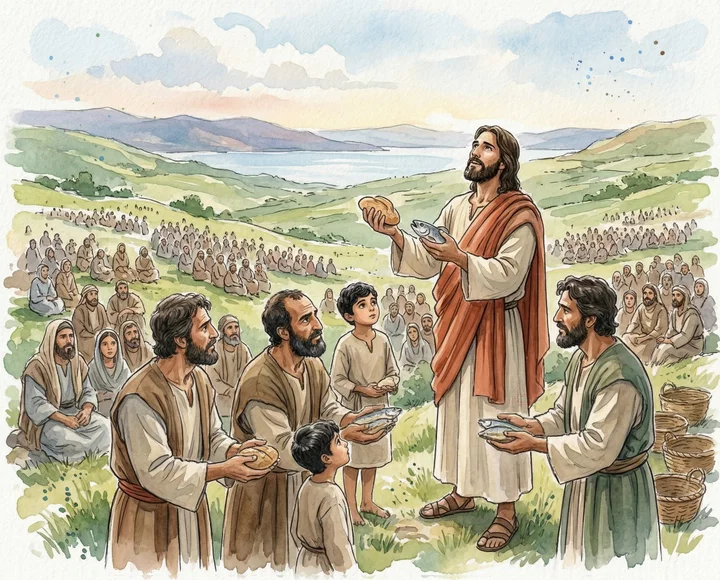
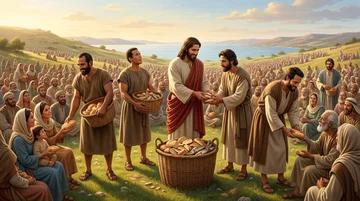
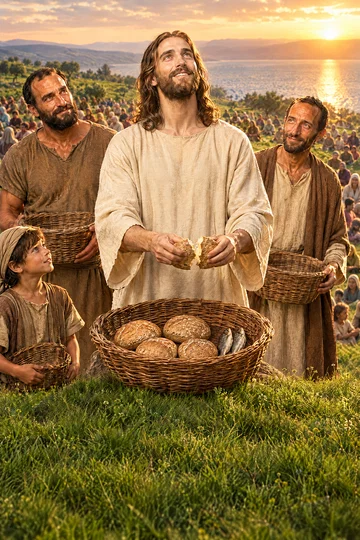
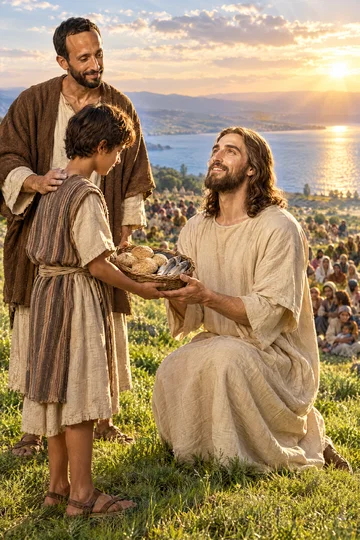
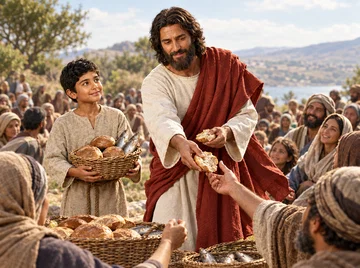
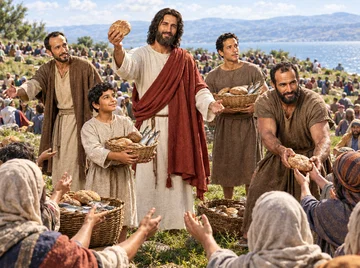
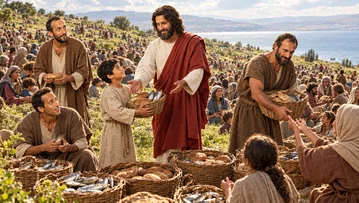
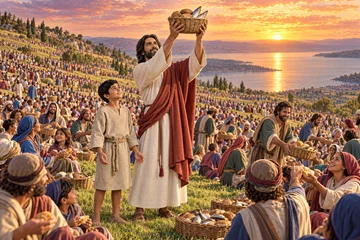
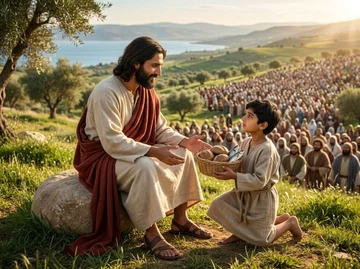
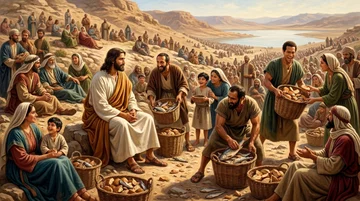
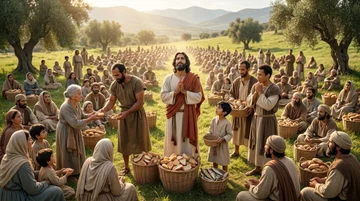
And he commanded the multitude to sit down on the grass, and took the five loaves, and the two fishes, and looking up to heaven, he blessed, and brake, and gave the loaves to his disciples, and the disciples to the multitude.
Translations
American King James Version, Webster Bible
And he commanded the multitude to sit down on the grass, and took the five loaves, and the two fishes, and looking up to heaven, he blessed, and broke, and gave the loaves to his disciples, and the disciples to the multitude.
King James Version, KJV Cambridge Paragraph Bible
And he commanded the multitude to sit down on the grass, and took the five loaves, and the two fishes, and looking up to heaven, he blessed, and brake, and gave the loaves to his disciples, and the disciples to the multitude.
Revised Version, American Standard Version
And he commanded the multitudes to sit down on the grass; and he took the five loaves, and the two fishes, and looking up to heaven, he blessed, and brake and gave the loaves to the disciples, and the disciples to the multitudes.
And having commanded the multitudes to recline upon the grass, and having taken the five loaves and the two fishes, having looked up to the heaven, he did bless, and having broken, he gave the loaves to the disciples, and the disciples to the multitudes,
And having commanded the crowds to recline upon the grass, having taken the five loaves and the two fishes, he looked up to heaven, and blessed: and having broken the loaves, he gave [ them] to the disciples, and the disciples [ gave them] to the crowds.
And, giving orders that the multitudes should recline upon the grass,—taking the five loaves and the two fishes,—looking up into the heaven, he blessed; and, breaking, gave, the disciples, the loaves, and the disciples unto the multitude.
Berean Standard Bible, Majority Standard Bible
And He directed the crowds to sit down on the grass. Taking the five loaves and the two fish and looking up to heaven, He spoke a blessing. Then He broke the loaves and gave them to the disciples, and the disciples gave them to the people.
He commanded the multitudes to sit down on the grass; and he took the five loaves and the two fish, and looking up to heaven, he blessed, broke and gave the loaves to the disciples; and the disciples gave to the multitudes.
And he gave orders for the people to be seated on the grass; and he took the five cakes of bread and the two fishes and, looking up to heaven, he said words of blessing, and made division of the food, and gave it to the disciples, and the disciples gave it to the people.
And hee commanded the multitude to sit downe on the grasse, and tooke the fiue loaues and the two fishes, and looked vp to heauen and blessed, and brake, and gaue the loaues to his disciples, and the disciples to the multitude.
Douay-Rheims (Challoner revision)
And when he had commanded the multitudes to sit down upon the grass, he took the five loaves and the two fishes, and looking up to heaven, he blessed, and brake, and gave the loaves to his disciples, and the disciples to the multitudes.
Pictures
Cross-references 20 of 31
- John 6:11-13
And Jesus took the loaves; and when he had given thanks, he distributed to the disciples, and the disciples to them that were set down; and likewise of the fishes as much as they would.
Jesus feeds the multitude with loaves and fishes, with twelve baskets left over.
- Mark 6:39-44
And he commanded them to make all sit down by companies upon the green grass.
Jesus blesses and distributes loaves and fishes to feed the multitude.
- Luke 9:16
Then he took the five loaves and the two fishes, and looking up to heaven, he blessed them, and brake, and gave to the disciples to set before the multitude.
Jesus blesses and distributes the loaves and fishes to feed the multitude.
- John 6:35
And Jesus said unto them, I am the bread of life: he that cometh to me shall never hunger; and he that believeth on me shall never thirst.
Christ gives spiritual food to those united to Him.
- Matthew 15:32-38
Then Jesus called his disciples unto him, and said, I have compassion on the multitude, because they continue with me now three days, and have nothing to eat: and I will not send them away fasting, lest they faint in the way.
Jesus again feeds a multitude with a few loaves and fishes.
- John 6:9
There is a lad here, which hath five barley loaves, and two small fishes: but what are they among so many?
Andrew identifies the five loaves and two fish available to feed the multitude.
- 2 Kings 4:42-44
And there came a man from Baal-shalisha, and brought the man of God bread of the firstfruits, twenty loaves of barley, and full ears of corn in the husk thereof. And he said, Give unto the people, that they may eat.
A small supply feeds many by God’s word, with food left over.
- John 6:11
And Jesus took the loaves; and when he had given thanks, he distributed to the disciples, and the disciples to them that were set down; and likewise of the fishes as much as they would.
Jesus blesses the food and distributes it to the crowd.
- Mark 6:42-43
And they did all eat, and were filled.
All ate their fill, and twelve baskets of food remained.
- Exodus 16:4
Then said the LORD unto Moses, Behold, I will rain bread from heaven for you; and the people shall go out and gather a certain rate every day, that I may prove them, whether they will walk in my law, or no.
Jesus’ feeding recalls God’s provision of manna from heaven in the wilderness.
- 1 Kings 17:12-15
And she said, As the LORD thy God liveth, I have not a cake, but an handful of meal in a barrel, and a little oil in a cruse: and, behold, I am gathering two sticks, that I may go in and dress it for me and my son, that we may eat it, and die.
The widow shares her scarce food with Elijah and receives provision.
- Mark 6:37
He answered and said unto them, Give ye them to eat. And they say unto him, Shall we go and buy two hundred pennyworth of bread, and give them to eat?
Jesus tells the disciples to feed the crowd.
- John 6:5
When Jesus then lifted up his eyes, and saw a great company come unto him, he saith unto Philip, Whence shall we buy bread, that these may eat?
Jesus asks where bread can be obtained for the crowd.
- Mark 8:1-9
In those days the multitude being very great, and having nothing to eat, Jesus called his disciples unto him, and saith unto them,
Jesus feeds the multitude with loaves and fishes.
- Exodus 16:14-15
And when the dew that lay was gone up, behold, upon the face of the wilderness there lay a small round thing, as small as the hoar frost on the ground.
Both describe miraculous bread provided to the people.
- Mark 6:52
For they considered not the miracle of the loaves: for their heart was hardened.
The disciples did not understand the miracle of the loaves because their hearts were hardened.
- Psalms 78:19
Yea, they spake against God; they said, Can God furnish a table in the wilderness?
God provides a table in the wilderness.
- Luke 9:13
But he said unto them, Give ye them to eat. And they said, We have no more but five loaves and two fishes; except we should go and buy meat for all this people.
Both accounts give the command to feed the multitude.
- Mark 6:40
And they sat down in ranks, by hundreds, and by fifties.
shares seating in fifties and hundreds
- John 6:48-51
I am that bread of life.
Records Jesus’ teaching about himself as the bread of life after the feeding.
Commentary
Each commentary is drawn from primary sources: the writings of Ellen G. White and Adventist pioneers and periodicals. Each commentary is separate. Its own words are not a quotation; follow the references to read the source passages.
Ellen G. White
82 sources
He ordered the great crowd to sit in orderly groups on the grass, then took the only food at hand, five small barley loaves and two small fishes, looked up to His Father in heaven, gave thanks, broke it into pieces and gave it to His disciples to carry to the people.ST Aug 15, 191619MR 360.1–3Ms 197, 1907, par. 1–4MH 47.2MH 45.1–4 The little store did not run out but grew in His hands and in the disciples' hands as they shared, so all of the more than ten thousand hungry people ate and were filled and twelve baskets of fragments were gathered.19MR 360.1–3Lt 275, 1903, par. 14–19DA 364.1MH 45.1–4MH 48.2–3 The act shows His divine power and tender care, meeting real bodily need as well as spiritual need in full reliance on God rather than offering luxury.ST Aug 15, 1916Ms 128, 1905, par. 9–13MH 47.3STST Dec 15, 1909 He supplies need through appointed human helpers, so those united to Him receive the bread of life from Him and keep receiving only as they keep giving to others.Ms 47, 1894, par. 1–22SP 261.2–262.2ST Aug 15, 1916MH 49.2–4ST Jan 22, 1902 The simple meal and the saving of what remained teach gratitude, simplicity, and careful economy, while the daily growth of harvest shows the same providing power still at work.ST Aug 15, 1916Ms 197, 1907, par. 1–4MH 47.2ST May 10, 1883ED 107.3
Setting and Course of Miracle
The gathering numbered five thousand men besides women and children, more than ten thousand people in all, near the time of Passover in a wilderness, out-of-the-way place away from the villages, on a grass plot on the shore of Galilee near Capernaum where much of Christ's ministry was spent.Lt 318, 1908, par. 7–11DA 364.13SP 226.1–2 They had followed eagerly without invitation and listened all day until evening drew on and night was near, hungry and faint far from home, and He would not send them home fasting.MH 48.2–3ST Aug 19, 1897ST Jan 22, 1902 He led them to rest and slowly opened truth in a simple way whose circumstances were given to be understood after His crucifixion and resurrection.Lt 318, 1908, par. 7–11 The available food was only five small barley loaves and two small fishes, the humble ordinary fare of Galilean fisher folk, with no apparent means to provide in the wilderness.ST Aug 15, 1916MH 47.2MH 47.1MH 45.1–4DA 365.3–366.1
He commanded the multitude to sit down on the grass or ground in orderly groups, in companies of fifty and one hundred, so they could rest comfortably and in order and all could witness what He would do.Ms 128, 1905, par. 9–13Lt 275, 1903, par. 14–19ST May 10, 1883ST May 20, 1886DA 365.3–366.1 A hymn was sung before the distribution.Ms 197, 1907, par. 1–4 Looking up to heaven to the Father in full reliance upon God, He blessed or gave thanks over the bread and fish, broke it into small pieces, and gave the loaves to the disciples and through them to the multitude, the people then sharing with one another.Ms 197, 1907, par. 1–4ST May 20, 1886ST Jan 22, 1902 The small supply did not diminish as it was passed out but fresh supply was furnished as often as the disciples returned for more, multiplying in His hands and in their hands.ST May 10, 1883ST May 20, 1886ST May 10, 1883ST Jan 22, 1902
All ate and were filled and satisfied from the small store, and twelve baskets of fragments remained, twelve baskets in this feeding and seven in the other feeding.19MR 360.1–3Lt 275, 1903, par. 14–19MH 45.1–4ST May 10, 1883ST Mar 7, 1906 The fragments were gathered so nothing would be lost.Ms 197, 1907, par. 1–4ST May 10, 18833RED 55.2 Afterward Christ and His disciples ate of the heaven-supplied food.ST Jan 22, 1902 The open landscape and beautiful natural scenery made the occasion vivid and memorable, connecting sacred lessons with God's works in creation so the people could recall the truths when they later saw the landscape.RH May 30, 18712T 579.2–580.2
The teachings and manner of work in Matthew 13 and 14 were faithfully reported by believing disciples to leave a lasting impression on human minds to the end of time.Ms 197, 1907, par. 1–4Lt 28, 1909, par. 11–12 Those who believe the truth for the last days are to follow, study, and bring into their ministry of the Word the instructions He recognized as essential, for they hold the principles underlying true higher education.Lt 28, 1909, par. 11–12 Every such action was to make truth remain with those healed and witnessing the miracle.Ms 197, 1907, par. 1–4ST Dec 15, 1909
Christ's Power and Compassion
The feeding was striking evidence of divinity, for no human power could have supplied so much food from so little, and as the small supply of five loaves and a few small fishes was blessed with thanks, broken, and passed from hand to hand through the disciples to the multitude, it multiplied until there was enough for all.STST Dec 15, 19092SP 262.3–263.1RH Jan 7, 1909ST Mar 18, 1913 The crowd was seated in orderly groups on the grass so all could rest and witness what was done, and when more than five thousand men besides women and children ate and were filled with twelve baskets of fragments remaining, the miracle strengthened their growing conviction that He was the Messiah, the promised Deliverer and the world's Redeemer revealing the Father.ST2SP 262.3–263.1RH Jan 7, 1909ST Mar 18, 1913ST Aug 12, 1897
He met genuine bodily need as well as spiritual need, with thoughtful and selfless care for people who were weary, hungry and faint after following eagerly without invitation and listening all day far from home until evening and night drew near, and He would not send them home fasting or unrefreshed lest they faint by the way.Ms 128, 1905, par. 9–13MH 48.2–3ST Aug 19, 1897ST May 10, 1883DA 365.3–366.1 Having them sit in order to rest comfortably, He took the five small barley loaves and two fishes, the humble ordinary fare and daily food of Galilean fisher folk and not a rich repast, and looking to heaven He blessed and broke and gave the food to the disciples to distribute, making the simple meal an assurance of His power and tender care in the ordinary needs of life.Ms 128, 1905, par. 9–13MH 47.3MH 47.2ST May 10, 1883DA 365.3–366.1 That care expresses His love and mission of practical service to the poor, needy, suffering, afflicted and oppressed rather than pursuit of riches, honor, comfort, popularity or worldly advantage, teaching His disciples to care compassionately for those seeking salvation by giving them opportunity to hear the word of life, finding practical ways to help, removing what makes the way burdensome or discouraging, and not leaving them hungry, weary or discouraged.2RED 39.1–41.2Ms 1, 1909, par. 5–6ST Aug 12, 1897
God's providence had placed Him there in the wilderness where food was not readily available and there was no apparent means to provide, and He received the food from the Father and depended on His heavenly Father to supply what was needed, looking up to heaven to the Father in full reliance upon God.ST Aug 15, 1916MH 48.2–3ST Aug 19, 1897ST Aug 15, 1916ST Jan 22, 1902 The miracle therefore teaches dependence on God in every emergency and difficulty, for when His workers face the need of thousands with little in hand as night approaches, they are to seek His help with confidence from His infinite resources rather than give up or rely on their own plans, since He already knows how to provide even after testing their faith.ST Aug 15, 1916MH 48.2–3ST Aug 19, 1897ST May 10, 1883DA 368.2–3
By this miracle of mercy for suffering humanity He proved He had power to satisfy His own hunger in the wilderness, for feeding five thousand at once with five loaves and two small fishes showed He could have worked a miracle on His own account.RH Aug 4, 1874LC1 143.1–145.12RED 39.1–41.2RP 26.5–6ST Jun 25, 1874 He would not exert that miraculous power in His own behalf to take Himself out of the hands of His heavenly Father, for doing so would not have been in accordance with the plan of salvation and His mission to save others and to bring blessing, hope and life to the afflicted and oppressed.RH Aug 4, 1874LC1 143.1–145.12RED 39.1–41.2RP 26.5–6ST Jun 25, 1874 The same divine power was present while He did daily work as a carpenter to support His family, yet He did not use it to lessen His burdens or lighten His toil, and His example shows that useful labor is honorable and that people should be industrious.RH Aug 4, 1874RP 26.5–6RH Oct 3, 1912
He is the great Provider whose command to give the people food is backed by the same power that supplied the crowd's needs, so the small amount in the disciples' hands is no reason to withhold what they have when He directs them to serve others.7T 61.2DA 369.1Ms 115, 1906, par. 21–2217MR 252.3Ms 14, 1902, par. 4 That same Jesus can still bless His people's work and give it fruit today, and His benevolent care is not limited to that occasion, for He can give knowledge, tact, skill and understanding to those who seek Him wholeheartedly and come into line with Him to help provide food and help for others.7T 61.2DA 369.117MR 252.3Ms 14, 1902, par. 4Lt 25, 1902, par. 31–32
He does not draw people by offering luxury, and His provision did not promise luxury, for the plain and scanty fare taught simplicity rather than luxury and the gratification of appetite, showing that God's natural provisions had been turned from their proper purpose by indulgence and that food for luxury would not have conveyed the same lesson.ST Aug 15, 1916MH 47.3MH 47.2DA 365.3–366.1DA 367.1–2 His followers may live in poverty with plain or scanty food, yet their needs will be supplied and they will have the better gift of His abiding presence.MH 47.3MH 47.2DA 367.1–2 Though He had left the royal courts and lived in the inconveniences of poverty so He could discern the needs of the poor, He still supplied their need, and His work to minister to the suffering and needy and to help and lift up mankind proves that true higher education is not gaining popularity, securing worldly advantages, having all temporal wants abundantly supplied, or being honored by the titled and wealthy of earth.MH 47.3DA 367.1–2Ms 1, 1909, par. 5–6
Sharing Through Appointed Agencies
He did not walk among the hungry himself to put food into their hands, but after having the crowd seated in orderly groups on the grass He took the five loaves and two fishes, gave thanks, broke them, and placed them in the disciples' hands to distribute to the multitude.Ms 47, 1894, par. 1–22SP 261.2–262.26T 263.1Ms 186, 1907, par. 8–9 In this He supplies human need through appointed human agencies who minister for Him and cooperate with Him, including ministers, evangelists, teachers, friends, companions, and all believers as workers together with God.Ms 47, 1894, par. 1–2 What people receive through them they receive as if from His own hand, and their grateful response is accepted by Him as given to Himself.Ms 47, 1894, par. 1–2 The small supply became enough to satisfy the people as the disciples kept returning to Him for more, and only after the multitude was fed did the disciples eat with Him of the heaven-supplied food.2SP 261.2–262.2MH 49.2–46T 263.1 His command to give the people food is backed by the same power that supplied the crowd, so the small amount in their hands is no reason to withhold what they have when He directs them to serve.DA 369.1
The disciples were the channel of communication between Christ the great Center and Source of all strength and the people, taking the loaves from Him and distributing them to the waiting multitude, while the people then shared with one another.ST Aug 15, 1916ST Jan 22, 1902ST Jan 22, 1902 Their hands reaching out to Him in service were continually supplied and never empty, for the food multiplied in His hands and in their hands and the gift increased in the distribution.MH 49.2–4ST Jan 22, 1902ST Jan 22, 190216MR 70.1–2 Those softened and subdued and sanctified by the Holy Spirit who dedicate themselves to God are to study how to work His very works, and He will give them of His Spirit so they can communicate to those in necessity.Ms 186, 1907, par. 8–9 Those who labor with God in this way use their influence to lift up, encourage, and restore others.16MR 70.1–2
All who are united to Christ receive from Him the bread of life, the heavenly food, and impart it to others.ST Aug 15, 1916ST Jan 22, 1902ST Jan 22, 1902 None can supply anything for the needs of the soul of themselves, but can impart only as they receive and can receive only as they impart; as they continue to impart they continue to receive, and the more they impart the more they receive.ST Jan 22, 1902ST Jan 22, 1902 Because they will often feel helpless before those hungry for spiritual food, they must receive from God what they pass on, including giving the word of life to hungry souls who in turn share it with others.DA 370.1 Those who receive the blessed bread are to give to others the bread that comes down from heaven to satisfy hunger of soul, repeating what they have learned of His wonderful things, so that nothing is lost.ST Dec 15, 1909
He ordered the disciples themselves to feed the crowd and had them bring all the little they had, not first inviting them to eat but telling them to serve the people before eating themselves.MH 49.2–4 Christians must use the means, time, and ability they have, bring their barley loaves to Jesus, and give what they have even when it looks enough only for one, sharing food, help, truth, and publications whose truth multiplies as shared.MH 49.2–4RH Nov 5, 1914Ms 180, 1907, par. 27–28 What is too little for many becomes enough for many in His hands, what is wisely used in His service increases as shared, and honest simple reliance is rewarded, turning a meager supply into a rich feast and sustaining givers even in difficult circumstances.MH 49.2–4ST Aug 15, 1916 Those who give in this way are also blessed, for the food increases as it is distributed and Christ supplies what is lacking.6T 263.16T 345.1–3ST Aug 15, 1916
The feeding teaches trust: God's children should not worry and fret over things they cannot help but should learn to go on from strength to strength.ST Mar 7, 1906 They are to act in faith rather than judge a gift only by its apparent size, for He can make gifts that seem too small more than sufficient for His people's needs.Ms 66a, 1900, par. 24–27Lt 121, 1904, par. 14–16 What appears meager in His hands can become abundant, satisfying receivers and leaving something to give others, with twelve baskets full gathered in this feeding and seven in the other, and this calls for greater faith in Him to minister, teach, and help in every trial.Lt 121, 1904, par. 14–16Ms 123, 1909, par. 32–34Ms 123, 1909, par. 29–31 The miracle at Bethsaida should have taught the disciples to trust His power to provide, but they failed to rely on it before a later Gentile crowd, with Jewish prejudice contributing to their doubt.DA 404.1–405.2
Gifts offered with thanksgiving and prayer for gospel and soul-saving work are blessed and multiplied by the Lord as the loaves were, so limited resources used in trust can reach many with the bread of life.6T 467.1STB 148.2–3Ms 66a, 1900, par. 30–31STB 119.3–4 If the best use is made of available means, God can do great things even when resources seem far too small, making scant provision more than sufficient by divine power and grace.6T 465.4Ms 66a, 1900, par. 30–31Ms 114, 1899, par. 1–3
Simplicity Economy and Daily Provision
The humble meal itself was the lesson, for five small barley loaves and two small fishes were the ordinary fare of Galilean fisher folk, not a rich repast, and in choosing them He taught simplicity rather than luxury and assured hungry people of His tender care in their common needs.ST Aug 15, 1916MH 47.2DA 365.3–366.1 Natural provisions of God had been turned from their proper purpose by indulgence of appetite, and food for luxury would not have conveyed the same lesson, so His provision teaches gratitude to the Creator and restraint from indulgences that harm body and mind.MH 47.2DA 365.3–366.1ST Aug 12, 1897 Simple living in harmony with nature's laws is thus joined to abundant provision, while selfishness and indulgence bring both excess and want.MH 47.2
After all had eaten their fill from a supply that did not diminish as it was passed out, He directed that the remaining broken pieces be gathered so that nothing would be lost, and they filled twelve baskets.Ms 197, 1907, par. 1–4ST May 10, 18833RED 55.2 That command means more than saving leftover food, for it teaches carefulness, saving, and economy in the use of all gifts of life, means, health, food, and air, wasting in temporal as in spiritual things no opportunity, no advantage, and nothing that would benefit a human being or relieve the necessities of the hungry.Ms 197, 1907, par. 1–4STB 772.1–2ST Dec 15, 1909 What God gives is to be freely imparted to supply the needy and not wasted or gotten by gambling and robbing others, and those who receive the blessed bread are to give to others the bread that comes down from heaven to satisfy hunger of soul, repeating what they have learned of His wonderful things so that nothing is lost.ST Dec 15, 1909Ms 64, 1910, par. 10–11Ms 182, 1907, par. 21–23 The lesson applies especially in difficult times to those responsible for institutions, calling for thrift and economy, for plain and simple yet ample sanitarium buildings with room to care for and impress visitors and without extravagance, and for food work conducted economically without selfish private interests obstructing its progress.Ms 197, 1907, par. 1–4STB 772.1–2Lt 302, 1906, par. 5
The same divine power that multiplied the loaves works daily through rain, sunshine, seed growth, and harvest to supply food for countless people, and God feeds millions through the earth's harvest while people cooperate in tending grain and making bread.ED 107.3ST Aug 12, 1897 This continual miracle is often overlooked when people credit human effort or natural processes and fail to give God the glory, whereas the feeding reveals the divine agency behind daily food and shows that His gifts are meant as blessings, not turned to selfish use.ED 107.3ST Aug 12, 1897
When people live in obedience to Him and food is used for His glory, His blessing can make a small supply go far and satisfy them with less than they expect to need, even providing food in a barren place where food seems impossible to raise.CH 539.2CH 527.2 His works, including works done through a message or helpful service, are therefore to be valued.Ms 64, 1910, par. 10–11
The feeding of the five thousand, and also of the four thousand, gives instruction in preparing the best, suitable, wholesome, palatable, inexpensive foods for different times, needs, and occasions, and the health-food work is one of His means of supplying necessities under the heavenly Provider's guidance.Lt 302, 1906, par. 57T 114.3CH 599.1–2GW 362.2–363.1 Yet miraculous provision and miraculous healing do not teach idleness or abolish human agencies, for although He could furnish food miraculously He used the miracle to impart spiritual truths vital to salvation, and people must still put forth effort to provide the necessities of life.Lt 93, 1892, par. 4–5 God will not always work miracles to keep people alive, so the sick are to be placed where they can have the benefit of hygienic living and treatment, and these agencies must not be despised.Lt 93, 1892, par. 4–5
The same divine power shown in feeding the multitude was present while He did daily work as a carpenter to support His family, but He did not use it to lessen His burdens or lighten His toil, and His example shows that useful labor is honorable and that people should be industrious.RP 26.5–6RH Oct 3, 1912 His feeding of the hungry was part of His work of doing good, and it teaches His disciples to care compassionately for people seeking salvation, giving them opportunity to hear the word of life and not leaving them hungry, weary, or discouraged.ST Aug 12, 1897Ms 55, 1901, par. 22–23 Christians have a duty to find practical ways to help and to remove whatever makes the way to Christ burdensome or discouraging.ST Aug 12, 1897
Sources
Pioneers and periodicals
123 sources
Jesus seated the hungry multitude in orderly companies on the grass, then took the five barley loaves and two small fishes, looked up to heaven to the Father, blessed and gave thanks, broke them and gave them to his disciples, and they gave them to the people.STST May 10, 1883ST Jul 26, 1905ST Oct 12, 1904RH Jan 6, 1859 The scanty supply did not lessen as it was shared but multiplied by direct creative power in his hands and in the disciples' hands until about five thousand men besides women and children ate and were filled and twelve baskets of fragments remained.ST May 10, 1883RH Mar 16, 1905ST Jul 26, 1905ST Oct 12, 1904 The act was a mighty miracle proving him the divine Provider and Creator, the Messiah, the Son of God and Redeemer, with humanity and divinity united in him.STST Dec 15, 1909ST Jul 26, 1905RH May 20, 1909 It shows he knows every need and is not limited by outward supply, so that a little blessed by him becomes more than enough and his people can trust him in every emergency rather than worry.ST Mar 16, 1904STST Oct 22, 1902ST Sep 18, 1893RH Nov 1, 1906 He gives through his disciples as channels, who receive from him and impart to others and receive more as they impart, teaching that what is placed in his hands and shared increases instead of diminishing.ST Aug 15, 1916ST Apr 11, 1906ST May 13, 1880RH Dec 22, 1859
Setting and Background
The feeding took place after crossing from Capernaum with the disciples to a desert place beyond the sea to rest awhile.ST Dec 22, 1887 People searching for him saw the boat depart and watched it recede, spread the news from city to city, flocked on foot to the landing place while others followed over the water in boats, so that when he landed a pressing multitude met him on every side.ST Dec 22, 1887
The place was on the northern bank of the Sea of Galilee, on a neighboring hill and hillside by the sea near Bethsaida.ST Sep 18, 1893ST May 13, 1880STRH May 27, 1858ST Jul 7, 1898 It was on a beach on the shores of Galilee within sight of where the disciples later gathered, not far from Capernaum, in the region of much of his ministry where many of his most wonderful miracles were performed.ST Oct 3, 1878 The word desert, eremos, does not mean a dry, barren place destitute of water or vegetation, but a solitary, uninhabited region.ST Jun 7, 1883ST May 13, 1880ST May 20, 1880 The desert place had grass growing on it, and a desert location can still provide grass and sufficient standing water for immersion.ST Jun 7, 1883ST May 13, 1880ST Dec 22, 1887
The multitude had listened all day while he taught and healed until they forgot hunger and felt as if in heaven.ST Aug 19, 1897ST Jan 22, 1902ST The sun was sinking and night approached, and they were hungry and faint, far from home in the wilderness with no apparent food or means at hand, many unable to buy food.ST Aug 19, 1897ST Jan 22, 1902STST Nov 15, 1899 He was pale from weariness and hunger from laboring without food or rest, yet he would not send them away hungry but declared they had no need to go away and must be fed on the spot.ST Jan 22, 1902ST Nov 15, 1899
The feeding happened between two different evenings of the same day. The first evening had already come when the disciples asked him to send the multitude away, beginning much earlier, about three o'clock. After the people ate and were filled and he sent them away, a second evening came when he was alone on the mountain to pray. That second evening is the true evening which always begins at sunset and marks the beginning of the next day.
The feeding follows the beheading of John the Baptist and comes before his walking on the water.ST Jan 20, 1909 It comes before his sending the people away and directing the disciples to cross the lake, and belongs to the feeding near Bethsaida after which he sent them away and went up into the mountain to pray.ST Dec 29, 1887ST Jul 7, 1898 It happened after the disciples rubbed the ears of corn and before a Passover, the Passover before the last Passover, placing it near a Passover and showing his public work lasted more than three years.RH Apr 2, 1908 Its importance is shown by its being recorded in all four Gospels.
Food and Arrangement
The food was the humble, frugal, ordinary fare of Galilean fisher folk, five barley loaves and two small fishes carried as a boy's small basket of provisions.ST Aug 15, 1916ST It was a slender store scarcely sufficient for twenty people, yet plain and substantial like the manna in the wilderness and the same food he and his disciples themselves ate.STST Dec 22, 1887 It was the food the people were accustomed to and desired, frugal even as his own food, and made from living creatures.ST Aug 15, 1916ST Jun 6, 1906ST Nov 1, 1910
About five thousand men besides women and children were fed, described as above ten thousand persons and as twelve thousand.ST Mar 7, 1906RH Mar 16, 1905ST Jul 26, 1905 All ate and were filled, each taking as much as they wanted, including the children, with none sent away hungry.ST Jul 26, 1905ST Oct 12, 1904RH Jul 28, 1903 Twelve baskets full of fragments remained afterward, more taken up afterward than there was at first.ST Mar 7, 1906RH Mar 16, 1905ST Jul 26, 1905ST Oct 12, 1904ST Oct 22, 1902
He commanded the multitude to sit down on the grass where there was much grass, seating them in orderly groups in companies of fifty and one hundred, in ranks by hundreds and by fifties.ST May 10, 1883ST May 20, 1886ST May 10, 1883STST Dec 22, 1887 This was to preserve order and to let all witness the miracle, and to show methodical, orderly work.ST May 10, 1883ST May 20, 1886ST Dec 22, 1887 The people were seated quietly and in order as he looked to heaven, and witnessing its distribution filled the disciples with amazement and awe, with Jazer himself eating the bread and fish.ST May 10, 1883ST May 10, 1883RH Jan 6, 1859
Manner of the Miracle
Seated in his presence on the grass, the multitude watched him take the five loaves and the two fishes into his own hands, showing personal care in the act.STST Jul 26, 1905ST Oct 12, 1904 He had them sit down in orderly companies of fifty and one hundred to preserve order and let all witness what followed.ST May 20, 1886ST Dec 22, 1887 Looking up to heaven to the Father in full reliance upon God, he blessed the food and gave thanks, then broke the loaves and divided the two fishes among them all.STST May 20, 1886ST Jan 22, 1902ST Oct 12, 1904 Having broken it, he gave it to the disciples and through them to the multitude to meet their hunger rather than sending them away.ST May 20, 1886ST Jul 26, 1905ST Mar 11, 1908
He received the food from the Father and imparted it to the disciples, and they imparted it to the multitude and the people to one another.ST Aug 15, 1916ST Jan 22, 1902STRH Nov 17, 1910 The disciples were the means through whom he gave it to the people, appointed as the channel of communication between him as the great center and source of strength and the people.ST Aug 15, 1916ST Jan 22, 1902ST Jan 22, 1902 Their hands reaching out to him in service were never empty but were continually supplied, so that the small amount brought became enough for all.ST Aug 15, 1916ST Jan 22, 1902STST Jan 22, 1902
The slender store, scarcely sufficient for twenty people, did not diminish as it was passed out but multiplied by creative power as it was broken, shared, distributed, and eaten.ST May 10, 1883ST May 20, 1886ST Jul 26, 1905ST Dec 22, 1887 Fresh supply was furnished as often as the disciples returned to him, in quantities sufficient to satisfy appetite until all ate and were filled.ST May 20, 1886RH Apr 8, 1909ST Dec 22, 1887 It multiplied in his hands and continued to multiply in the disciples' hands through his own power, not angelic power, until thousands of loaves were produced in an instant, beyond known natural laws.ST May 10, 1883ST Jul 26, 1905
Divine Power and Identity
The act was a mighty miracle of God, done by direct miraculous creative power when only five barley loaves and two small fishes stood before thousands of hungry people and the available supply was wholly inadequate.ST Jul 26, 1905 Seated in orderly groups on the grass, the multitude watched the food blessed with thanksgiving and then broken and given through the disciples, multiplying as it passed from hand to hand and as it was eaten until more than five thousand, counting women and children, ate and were filled and twelve baskets of fragments remained.STRH Jan 7, 1909ST Mar 18, 1913ST Jul 26, 1905 It was an uncommon immediate form of divine work that reveals the divine provider, the Creator of the bread and Master of the sea, and one of the works by which the Father was revealed.RH Jan 7, 1909ST Jul 26, 1905 It strengthened conviction and led witnesses to recognize him as the coming prophet, the Messiah, the Son of God, and the world's Redeemer.STST Mar 18, 1913ST Jul 26, 1905
The feeding is striking evidence of divinity and bears witness that its author is divine.ST Dec 15, 1909ST Dec 17, 1885 It stands with the water made wine, the angry sea made calm, the blind and deaf and lame and leprous healed, devils cast out, the dead raised, and the chief crowning miracle of the resurrection.ST Dec 17, 1885 It shows humanity and divinity united in him, his divinity veiled in humanity, his hands doing blessing to mankind without evil as one harmless, sinless and spotless.RH May 20, 1909RH Jan 9, 1900RH Dec 20, 1906 His divine power was used to bless others rather than to exalt or deliver himself, and the same Jesus who fed the multitudes is expected to appear again.RH Dec 20, 1906RH Mar 21, 1912
Feeding five thousand is no more contrary to experience than the yearly growth that turns seed into food, since both depend on creative power beyond human explanation.RH May 20, 1858 It is the same divine work that produces grain over months through sunshine, rain, planting, and harvest, displayed in uncommon immediate form in the loaves and in common gradual form in the crops, with the ordinary growth no less dependent on divine power than the sudden multiplication.RH Feb 8, 1906RH Apr 9, 1901ST Mar 31, 1898 God's daily provision through rain, sunshine, seed, and harvest to supply countless people is itself a miracle, able to make a little go far and a small amount sufficient.ST Aug 26, 1880ST Apr 6, 1888 The miracle is not a greater display of power than ordinary processes but a different one, witnessed by particular people as a direct personal message calling for attention, while people often overlook the continual miracle and credit human effort.ST Aug 26, 1880RH Apr 9, 1901
Though owning all things and having power to work a miracle to satisfy his own hunger, he would not exert miraculous power in his own behalf to take himself out of his Father's hands, since that would not accord with the plan of salvation.RH Aug 4, 1874ST Jun 25, 1874 The same power shown in feeding five thousand at once with five loaves and two small fishes for suffering humanity was present when he worked as a carpenter and in daily work, yet he did not use it to lessen his own burdens or toil.RH Aug 4, 1874RH Oct 3, 1912 He nourished the crowd with bread while providing no meal for himself, using power to meet others' needs and not his own in self-denying love, waiting for God's care even when near death from hunger and thirst, though he himself knew hunger.ST Nov 15, 1905ST Jan 21, 1913
The feeding was a literal bodily event and a real miracle of God's power, not merely a symbol of feeding the soul with the bread of life.ST Jul 25, 1911 It is no less possible than other miracles recorded in the Bible, beyond ordinary explanation with no natural parallel, even if a skeptic might think seeing it would make belief possible.ST May 13, 1897ST Mar 1, 1899 His word could provide food for the multitude, and alongside walking on the waves this displays power that prepares the question of whether he also has authority over death.ST May 24, 1905ST May 24, 1905 His personal presence in feeding from nothing, healing, quieting waves, raising the dead, teaching, and enabling devils to be cast out attached the disciples to him, with the Holy Spirit as his representative succeeding him to be to each believer all he had been to them.ST May 24, 1905
Provision and Trust
Matthew 14:19 shows Jesus providing food for the multitude in a desert place, illustrating that he can provide for his people in every circumstance because he knows their needs and calls them to trust him and obey his word, which also supplies their spiritual needs.ST Mar 16, 1904STRH Nov 19, 1908 He demonstrated power to feed the hungry, proving the Lord is not limited in resources nor in ways and means for sustaining his people, for with only five loaves and two fishes he fed five thousand and more was taken up afterward than there was at first.ST Oct 22, 1902RH Nov 21, 1907 He himself is living bread, so where he is there can be no lack, and his spoken word can when necessary take material form and become nourishing substance for the body.ST Jun 28, 1899 He is able and willing to supply every need with authority over nature, and does not depend on ordinary supplies or outward conditions such as a wheat crop.ST Oct 22, 1902RH Nov 21, 1907ST Jun 28, 1899
With only five loaves and two little fishes for about five thousand men besides women and children in a desert place with nothing to eat, his blessing on that little store made it more than enough, showing that small resources multiplied by his blessing meet great need in hard times.ST Sep 18, 1893ST Apr 6, 1888RH Jun 9, 1903 A small amount with God's blessing can provide abundantly, for God can make a little go far and make a small provision sufficient for many.RH Nov 1, 1906ST Apr 6, 1888RH Aug 11, 1910 Dependence on divine increase is to be valued more highly than visible material abundance, since humble provisions are made abundant through miraculous power.RH Nov 1, 1906RH Jun 9, 1903 The Lord can bring great results from little beginnings, for tiny, feeble means can accomplish a great design because there is no restraint to save by few or many.RH Aug 11, 1910RH Mar 31, 1874 When believers readily take up works that are great to them, make large ventures, and trust God for great things, God justifies that faith by making their ability equal to their works and showing them a way to feed thousands.ST Sep 18, 1893RH Mar 31, 1874
The simple meal of fish and barley loaves, the humble food of Galilean fisher folk, assured the hungry people of his power and tender care in their ordinary needs and teaches dependence upon God to supply need.ST Aug 15, 1916ST Aug 19, 1897ST Knowing the people would be hungry and faint after listening all day, far from home as night approached with many unable to buy food and no apparent food or means at hand, he relied on his heavenly Father to supply what was needed, and his followers are to depend on God when they face difficulties and in emergencies and difficult circumstances.ST Aug 19, 1897ST God's children should not worry and fret over things they cannot help but should learn trust and go on from strength to strength.ST Mar 7, 1906 Though he had power to provide food in abundance without it, he chose to use the small amount offered to him, teaching hope and trust, so people should bring what they have for him to use, with honest reliance rewarded.ST Mar 16, 1904RH Apr 10, 1900
That provision should have taught the disciples to trust him to provide food and to understand that his warning to beware of the leaven of the Pharisees and Sadducees was not spoken concerning literal bread but concerning their teaching.ST Jun 28, 1899ST Sep 22, 1881 The five loaves feeding five thousand, and the seven loaves feeding four thousand, showed they need not fear being without bread when he was with them, for the small amount of food they had with them did not matter when he was present.ST Sep 22, 1881ST Sep 22, 1881 Yet they later reasoned that they had taken no bread and failed to consider what they had witnessed because their hearts were hardened.ST Jun 28, 1899ST Feb 11, 1886 Contact with surrounding influences can harden people so they forget what they have experienced of his goodness, in contrast to faith that would have believed from witnessing it.ST Feb 11, 1886ST Sep 5, 1911
Channels of Blessing
He gave the blessed loaves to his disciples and they gave to the multitude, and the people shared with one another, which is the gospel way by which those united to him receive the bread of life and heavenly food from him and pass it on to others.ST Aug 15, 1916ST Jan 22, 1902STST Apr 11, 1906 The disciples were appointed as the means and channel of communication between him as the great center and source of all strength and the people, receiving from the Father through him and imparting to the multitude.ST Aug 15, 1916ST Jan 22, 1902ST Their hands reaching out to him in service were never empty but were continually supplied, and the small store became sufficient for all, so that afterward they ate with him from food supplied from heaven.ST Aug 15, 1916ST Jan 22, 1902ST None can supply anything for the needs of the soul of themselves, but can impart only as they receive and can receive only as they impart, so that as they continue to impart they continue to receive and the more they impart the more they receive.ST Jan 22, 1902 Their part was to pass on what they had received and return to him for more as needed, sharing the bread of life with hungry souls and giving faithfully what God has placed in their hands in trust that he will provide.RH Mar 27, 1900
His charge to give them to eat carried in itself the power to fulfill it, so that if obeyed the food would be supplied through them and the needed supply would be ready at the demand of faith.ST Mar 11, 1908 He graciously made the disciples co-workers in his work, while he performed the all-important part of the miracle and theirs was to distribute the food and gather the fragments, giving them no ground to claim the credit that belonged to the Lord.ST Jan 9, 1907RH May 18, 1911 When his followers receive even a little from him and carry it to those in need, he can make the supply of spiritual and temporal food grow until the multitude is fed, with everyone including the children satisfied and none sent away.RH Jul 28, 1903ST Mar 22, 1899 That same charge to still famine's craving and give the bread of life in discreet love covers all hunger for life's food at home and abroad, on lonely road or crowded street, and among the feeble and dying multitudes in distant lands beyond the seas, because time is fleet.ST Nov 15, 1899
He who would distribute to the multitude must first get bread from his hands, for the church cannot give to the world what it does not possess, and general spiritual failure comes from spiritual poverty.RH Jan 1, 1914 Because workers would often feel helpless before the needs of those hungry for spiritual food, they had to receive from God what they would pass on to others as his representatives giving the bread of life to the people.ST Mar 16, 1915 Having passion requires coming close in consecration, and transmitting power requires tarrying as in the upper room, beginning not by rising to work or going out into the highways but by falling on the knees in repentance, contrition, and real agony of soul.RH Jan 1, 1914
The few loaves and fishes represent the limited means people can bring to him, and his touch makes them sufficient for sharing the good news of his love with hungry, suffering people and trusting him to make humble efforts fruitful.ST Mar 26, 1912 A small gift put into his care multiplies to meet great need, as a lad's five loaves and fishes fed the multitude on the hills of Galilee, and in the same way small pennies given to him can grow into dollars to help homeless children who have no parents or home, supplying their many needs and showing them the heavenly way so they do not go astray.RH Feb 6, 1908 With God's blessing upon what his people have and what they do they can carry this bread of life to all the world, and a small amount with God's blessing can provide abundantly to feed souls.RH Jul 11, 1912RH Nov 1, 1906 The loaves and fishes were placed in the Saviour's hands before he fed the people, so his people must yield all their money and possessions to him that his work may be completed through them, for in mission work money and human effort alone accomplish little unless gifts are placed in God's hands and sanctified by his blessing, with prayer shaping the work.RH Jan 14, 1904RH Mar 6, 1913
A treasure from God is meant to be given rather than selfishly hoarded, for the bread multiplied as it was shared on the hillside of Galilee.ST May 13, 1880 God's blessings increase as they are shared, the loaves and fishes becoming more abundant the farther they were distributed, unlike selfish efforts which diminish as they are used for personal gain.ST Aug 2, 1899 He divided to multiply, and this is the divine pattern that to keep anything, give it away, while people can co-operate with God in multiplying loaves.ST May 13, 1880ST Aug 2, 1899 The same lesson applies to preaching, that ministers should share the word as they are enabled, trusting God to make it fruitful and provide enough and to spare, and to humble imperfect words that like broken bread become a blessing.RH Dec 22, 1859 The food multiplied as it passed from him through the disciples to the people, so publications whose truth is distributed will likewise multiply as shared, and his word received in faith and made part of life multiplies through regenerated people who share it until others are nourished by it and live.RH Nov 5, 1914 Prayerful, cheerful gifts blessed by God can be multiplied to bless many people, including through small self-denials.ST Mar 26, 1912
Meaning and Daily Practice
After teaching the multitude, he fed their bodies with loaves and fishes just as he had fed minds and hearts with the word, the pure bread of life.RH Jul 28, 1903ST May 27, 1897 He cared for bodily need as well as spiritual benefit, meeting temporal need to serve spiritual welfare and salvation while giving glory to the Father who sent him.RH May 30, 1871RH Dec 4, 1860 His kindness reached all without rejecting any for ignorance, slowness, social contempt, or sin, and after they received spiritual bread he met physical need through faith.RH Dec 4, 1860ST May 27, 1897 Those who would bring others to hear the word of life must not leave them hungry, weary, or discouraged, but find practical ways to help and remove what makes the way burdensome.ST Aug 12, 1897
The humble food of fisher folk, fish and barley loaves, taught simplicity rather than luxury and assured hungry people of power and tender care in ordinary needs.ST Aug 15, 1916 Simple food satisfies hunger, so temperance does not mean starvation, and forced changes in diet bring no lasting benefit, since reform grows from conviction and education using what people have and multiplying it to satisfy them.RH Dec 21, 1905 The bounties of Providence are not to be squandered or used wastefully nor perverted to gratify appetite, for the same divine power that multiplied the loaves works daily through rain, sunshine, seed, and harvest to feed countless people.ST Dec 15, 1909ST Aug 12, 1897 That continual provision is to be received with gratitude to the Creator and restraint from indulgences that harm body and mind, instead of overlooking the miracle and crediting human effort.ST Aug 12, 1897
Even the fragments were to be gathered so nothing would be lost, teaching care not to waste food, whether plain food or costly luxuries.RH Mar 16, 1905ST Jan 11, 1877 The gathering teaches carefulness, saving, and economy in all gifts of life, means, health, food, and air, saving in order to give and wasting in temporal as in spiritual things no opportunity, no advantage, and nothing that would benefit a human being or relieve the hungry.ST Dec 15, 1909 Those who receive the blessed bread give to others the bread from heaven to satisfy hunger of soul, repeating what they have learned of wonderful things so nothing is lost.ST Dec 15, 1909 The hungry multitude must be fed first and distributors take afterward, seeking others' welfare before self and giving away all good truth and every ray of light, with basketfuls left over afterward, far more for personal use than at first, the plain substantial food like manna and the same food he and his disciples ate.RH May 29, 1900
Though owning all things, he never broke bread without lifting eyes and hands to heaven in thanks to the Father and asking blessing on the food.ST Dec 12, 1878 Every meal, home, and safety is a gift to be acknowledged with grateful praise, entreating blessing and teaching children morning and evening by family prayer their dependence on God, rebuking those who enjoy loaded bounties yet despise the Giver and rise and lie down without thanks.ST Dec 12, 1878 The people seated quietly and in order as he looked to heaven gives the example of orderly conduct in asking blessing on food.RH May 13, 1862 The detailed record — sitting down, taking, blessing, breaking, giving through the disciples — shows methodical work as a pattern for disciples, and the open landscape made teaching vivid, connecting sacred lessons with creation for later recall.RH May 30, 1871RH Aug 10, 1916
He brought heaven's spirit to earth by going about doing good and turning away no appealing case, delighting to minister to the wants of the poor and needy and magnifying a few loaves to feed thousands in the wilderness in infinite benevolence.ST Nov 14, 1906RH Mar 10, 1863 He fed the hungry without first asking whether they were worthy or would thank him, and his bountiful meal was given to all present, not alone to the faithful and true, without limit of Gentile or Jew, good or fallen.ST Apr 29, 1908ST Nov 20, 1901 Giving therefore does not scan frailties or ask the cause of want, but feeds the heart-stricken wanderer, the sick wife, and unfed children.ST Nov 20, 1901 His personal care, rather than leaving need to others, includes deeds of kindness and care for vulnerable children, with practical help accompanying the gospel that saves body, soul, and spirit.RH Jun 22, 1905RH Sep 3, 1908
The loaves that fed so many had been made by a woman who did not know they would serve on a larger scale, showing how a small unnoticed act becomes useful far beyond itself.ST May 29, 1884 A moment in a servant's life can become blessing to many, and an ordinary act of care like giving bread is made one of his works.RH Sep 2, 1902 Plenty with loaves and fishes contrasted with wilderness hunger and temptation shows both plenty and suffering as circumstances God allows for those who trust him.RH Apr 5, 1860 The wilderness scene where all ate enough pictures heaven's abundant provision.RH Oct 28, 1915 Those he fed, the poor who heard his word, the broken-hearted healed of every wound, and those to whose arms he restored the dead, gathered round the cross where he was slain for foes and salvation was won.RH Aug 21, 1860
Judas Iscariot of Kerioth worked furiously that day supplying the people from what his Master gave to disciples and through them to five thousand men besides women and children.ST Oct 25, 1910 Afterward he counted how many shekels the food would have brought if sold, argued that power to create food could sustain an army against the Romans, and headed the turbulent crowd that sought to crown him king.ST Oct 25, 1910
Bread and fish are food from living creatures, showing Scripture does not forbid taking life for food.ST Jun 6, 1906 Eating flesh is not inherently sinful, since he did so without sin.RH Sep 24, 1901 Humanity and divinity united in him call for faith that lays hold on him in self-denial and self-sacrifice to live and serve in union with him, which is the faith his followers will have, seen in feeding thousands from a few loaves.RH May 20, 1909ST May 5, 1914 Following his steps does not require literally repeating his identical acts — feeding five thousand, raising the dead, being crucified and rising, or a forty-day fast — for he is example in moral decision, submission to the Father's will, obedience, and overcoming appetite and sin, and mighty Helper by faith laying hold of him.ST Jun 23, 1909
Sources