John 3:11
Verily, verily, I say unto thee, We speak that we do know, and testify that we have seen; and ye receive not our witness.
Translations
Truly, truly, I say to you, We speak that we do know, and testify that we have seen; and you receive not our witness.
King James Version, KJV Cambridge Paragraph Bible
Verily, verily, I say unto thee, We speak that we do know, and testify that we have seen; and ye receive not our witness.
Verily, verily, I say to thee, We speak what we know, and testify what we have seen; and ye receive not our testimony.
Verily, verily, I say unto thee, We speak that we do know, and bear witness of that we have seen; and ye receive not our witness.
Verily, verily, I say unto thee, We speak that which we know, and bear witness of that which we have seen; and ye receive not our witness.
'Verily, verily, I say to thee — What we have known we speak, and what we have seen we testify, and our testimony ye do not receive;
Verily, verily, I say unto thee, We speak that which we know, and we bear witness of that which we have seen, and ye receive not our witness.
Verily, verily, I say unto thee: What we know, we speak, and, of what we have seen, we bear witness, and, our witness, ye receive not.
Berean Standard Bible, Majority Standard Bible
Truly, truly, I tell you, we speak of what we know, and we testify to what we have seen, and yet you people do not accept our testimony.
Most certainly I tell you, we speak that which we know and testify of that which we have seen, and you don’ t receive our witness.
Truly, I say to you, We say that of which we have knowledge; we give witness of what we have seen; and you do not take our witness to be true.
Verely, verely I say vnto thee, wee speake that we know, and testifie that we haue seene: but yee receiue not our witnesse.
Douay-Rheims (Challoner revision)
Amen, amen I say to thee, that we speak what we know, and we testify what we have seen, and you receive not our testimony.
Pictures
Cross-references
- John 3:3
Jesus answered and said unto him, Verily, verily, I say unto thee, Except a man be born again, he can not see the kingdom of God.
Jesus’ testimony continues the teaching that new birth is needed to see God’s kingdom.
- John 3:32
And what he hath seen and heard, that he testifieth; and no man receiveth his testimony.
Jesus testifies to what he has seen and heard, and his testimony is not received.
- John 1:18
No man hath seen God at any time; the only begotten Son, which is in the bosom of the Father, he hath declared him.
The Son testifies from firsthand knowledge of the unseen Father.
- John 3:19-21
And this is the condemnation, that light is come into the world, and men loved darkness rather than light, because their deeds were evil.
Rejection of Christ’s witness reflects love of darkness and evil deeds.
- John 8:26
I have many things to say and to judge of you: but he that sent me is true; and I speak to the world those things which I have heard of him.
Christ speaks to the world what He has heard.
- John 18:37
Pilate therefore said unto him, Art thou a king then? Jesus answered, Thou sayest that I am a king. To this end was I born, and for this cause came I into the world, that I should bear witness unto the truth. Every one that is of the truth heareth my voice.
Jesus bears witness to the truth, though his hearers do not receive his testimony.
- John 12:49
For I have not spoken of myself; but the Father which sent me, he gave me a commandment, what I should say, and what I should speak.
Jesus says his words come from the Father who sent him.
- John 3:1-2
There was a man of the Pharisees, named Nicodemus, a ruler of the Jews:
Nicodemus comes to Jesus by night for personal contact.
- 1 John 1:3
That which we have seen and heard declare we unto you, that ye also may have fellowship with us: and truly our fellowship is with the Father, and with his Son Jesus Christ.
Both speak of testifying to what was seen and heard.
- John 5:24
Verily, verily, I say unto you, He that heareth my word, and believeth on him that sent me, hath everlasting life, and shall not come into condemnation; but is passed from death unto life.
names passing from death to life
- John 8:28
Then said Jesus unto them, When ye have lifted up the Son of man, then shall ye know that I am he, and that I do nothing of myself; but as my Father hath taught me, I speak these things.
Jesus speaks what the Father taught him.
- John 1:14
And the Word was made flesh, and dwelt among us, ( and we beheld his glory, the glory as of the only begotten of the Father,) full of grace and truth.
Christ, the Word made flesh, speaks with firsthand knowledge.
- Acts 1:8
But ye shall receive power, after that the Holy Ghost is come upon you: and ye shall be witnesses unto me both in Jerusalem, and in all Judæa, and in Samaria, and unto the uttermost part of the earth.
Christ’s followers witness by the Spirit’s power.
- John 3:5
Jesus answered, Verily, verily, I say unto thee, Except a man be born of water and of the Spirit, he can not enter into the kingdom of God.
Entry into God’s kingdom requires birth of water and Spirit.
- John 3:16-18
For God so loved the world, that he gave his only begotten Son, that whosoever believeth in him should not perish, but have everlasting life.
Christ teaches Nicodemus that God offers salvation through belief in his Son.
- John 3:36
He that believeth on the Son hath everlasting life: and he that believeth not the Son shall not see life; but the wrath of God abideth on him.
Both contrast believing the Son with receiving life.
- Acts 4:13
Now when they saw the boldness of Peter and John, and perceived that they were unlearned and ignorant men, they marvelled; and they took knowledge of them, that they had been with Jesus.
The hearers recognized that the disciples had been with Jesus.
- John 15:15
Henceforth I call you not servants; for the servant knoweth not what his lord doeth: but I have called you friends; for all things that I have heard of my Father I have made known unto you.
Jesus says he has made known what he heard from the Father.
Commentary
Each commentary is drawn from primary sources: the writings of Ellen G. White and Adventist pioneers and periodicals. Each commentary is separate. Its own words are not a quotation; follow the references to read the source passages.
Ellen G. White
41 sources
It was spoken to Nicodemus, a ruler and teacher in Israel who came to Jesus by night to learn of His mission and the way of salvation.ST Apr 15, 1886Ms 53, 1905, par. 15–16Lt 55, 1895, par. 51–55SPBC 186.4DA 176.2–177.1 Jesus declares that He speaks from direct, firsthand knowledge and sight of heavenly truth, having come from the Father and being one with God.DA 167.1Ms 3, 1909, par. 6–8Ms 10, 1891CE 88.1Ms 67, 1898, par. 20–21 The we joins Him with all who bear His testimony from what they themselves know and have seen, yet Nicodemus and others addressed did not receive that witness.DA 167.1Ms 82, 1905, par. 1–2Ms 3, 1909, par. 6–8Lt 54, 1895, par. 45–49 What He so certainly testifies is that a person must be born again of water and of the Spirit to see and enter the kingdom of God, a change no learning, religious office, or outwardly correct life can replace.Ms 3, 1909, par. 6–8Ms 53, 1905, par. 15–16Lt 54, 1895, par. 45–49Lt 55, 1895, par. 51–55Ms 53, 1905, par. 13–14 Mere knowledge about His mission cannot save without faith, a new heart, and renouncing self-righteousness to depend wholly on Christ, for refusing His witness to these earthly things leaves people unable to believe heavenly things.Ms 82, 1905, par. 1–2Ms 53, 1905, par. 15–16Lt 54, 1895, par. 45–49Lt 223, 1905, par. 21–255T 219.1–3
Night Conversation Setting
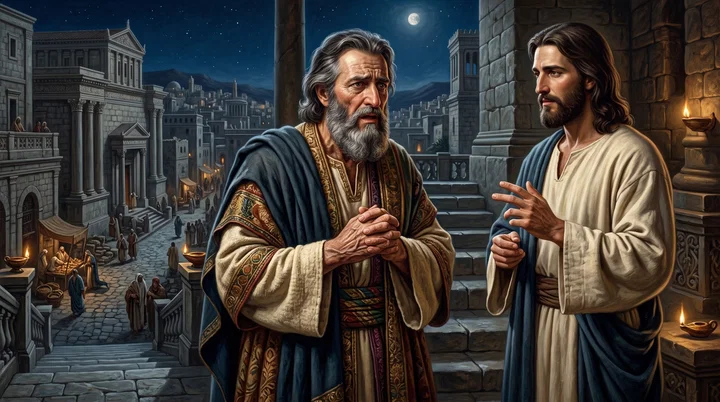
John 3:11 was spoken in Jesus' private, nighttime conversation with Nicodemus.ST Apr 15, 1886DA 176.2–177.1ED 231.2–232.12SP 135.2–136.1ST Jan 13, 1881 It belongs to a secret interview in which He explained His mission and the plan of salvation and taught vital truths about the way of life that remain important.DA 176.2–177.12SP 135.2–136.1ST Jan 13, 1881 The setting shows precious instruction given through personal contact to an individual recognized as receptive.ED 231.2–232.1
Nicodemus was a ruler of the Jews who came to Jesus by night.Ms 53, 1905, par. 15–16 He was a master and teacher in Israel, an honored rabbi entrusted with the religious interests of the people.Ms 53, 1905, par. 15–16Lt 55, 1895, par. 51–55SPBC 186.4ED 231.2–232.1
He sought Jesus after seeing His works and searching the prophecies that pointed to Him as the Messiah.ST Apr 15, 1886 He recognized Jesus as sent by God and was convinced He was the promised One, so that His warnings carried divine authority.DA 167.2–168.1 His desire to learn was stirred by truths he had heard from Jesus but had not yet fully accepted.DA 167.1
The leaders of Israel did not welcome the light Jesus revealed in that conversation and rejected His warnings, risking repetition of their fathers' rejection of God's messengers.DA 167.2–168.1DA 176.2–177.1 Nicodemus by contrast kept the teaching in his heart and received the lesson.DA 176.2–177.1STMW9 27.1 He later came to recognize Jesus as the world's Redeemer and became a true believer, speaking against the effort to condemn Jesus by asking that a person be heard before being judged.DA 176.2–177.1STMW9 27.1
Certain Knowledge Witness
Jesus speaks what He knows and testifies what He has seen from direct, firsthand knowledge and sight, answering Nicodemus about how a man can be born again.DA 167.1Ms 3, 1909, par. 6–8Ms 10, 1891Ms 53, 1905, par. 15–16 His declaration is certain knowledge and firsthand testimony about being born of water and of the Spirit in order to see and enter the kingdom of God.Ms 53, 1905, par. 15–16 That witness is grounded in what He knows and has seen, yet those addressed do not receive it, even though Nicodemus is a learned teacher in Israel whose failure shows learning alone does not ensure belief.Ms 10, 1891Ms 148, 1899, par. 9–11 His words are true because He comes from God and reveals heavenly truth.CE 88.1
The “we” joins Jesus with those who bear His testimony, who likewise speak from what they know and have seen from certain knowledge and firsthand experience.Ms 82, 1905, par. 1–2Lt 54, 1895, par. 45–49Lt 4, 1895, par. 13–15STMW9 26.2 His witness is true and trustworthy because He came from the Father to reveal Him, is one with God and speaks from divine knowledge, and as the greatest Teacher can reveal heavenly knowledge beyond every human discovery.CE 88.1Ms 67, 1898, par. 20–21Ms 40, 1891, par. 75–76FE 190.1 He gave this witness with solemn dignity and earnest love in look and tone, so that Nicodemus realizes his humiliating position without being offended.Lt 55, 1895, par. 51–55SPBC 186.4 His teaching was direct, sympathetic, practical and suited to hearers, reaching them in ordinary circumstances to meet needs and hopes and form character.Ms 67, 1898, par. 20–21ST Jun 9, 1914
His speaking what He knows was part of deliberately working to reach the rich as well as the poor, seeking the acquaintance of the wealthy and cultured Pharisee in order to gain access to his heart and reveal imperishable riches.MH 24.2 For this work He accepts invitations, attends feasts, and makes Himself familiar with the interests and occupations of the rich, including the Jewish nobleman and the Roman ruler.MH 24.2 Nicodemus and others do not receive that witness, and the verse rebukes that refusal and charges them with not receiving it.DA 167.1Ms 82, 1905, par. 1–2Ms 3, 1909, par. 6–8Lt 54, 1895, par. 45–49
New Birth Teaching
Jesus answers the question how a person can be born again with certain knowledge and firsthand testimony about being born of water and of the Spirit in order to see and enter the kingdom of God, charging failure to receive that witness.Ms 3, 1909, par. 6–8Ms 53, 1905, par. 15–16 A person must be born again and converted to see and discern the kingdom of heaven, for without this conversion the kingdom cannot be discerned.Ms 53, 1905, par. 15–16Ms 53, 1905, par. 13–14 If His testimony to these earthly things about the new birth is not believed, His testimony about heavenly things will not be believed.Ms 53, 1905, par. 15–16
The whole passage from John 3:1-16 definitely points out the way to heaven, what conversion is, and what must be done to be saved.Ms 1, 1889, par. 2–5 It strikes directly at surface religion and against the idea that a person can become a child of God without any particular or decided change.Ms 1, 1889, par. 2–5 Where the truth of God has found a place in the heart it works a decided change, with sanctifying power upon life and character, producing fruits of righteousness and a course of action that testifies of having learned of Christ.Ms 1, 1889, par. 2–5 That same teaching told beforehand that He would be lifted up on the cross as the hope of Israel, which could not be understood until after the resurrection, when hope and faith were resurrected and those who had learned in His school the living connection of the soul with God went forth with great boldness speaking of the Lord of life and glory taken by wicked hands and crucified and risen, with living faith laying hold upon the merits of the blood of the crucified and risen Saviour as righteousness.Ms 1, 1889, par. 2–5
Knowing facts about His divine mission is not enough when the heart remains unchanged, for the needed response is faith and a new heart.Ms 82, 1905, par. 1–2 What is needed is not learning nor controversy but truth and a new heart.Ms 82, 1905, par. 1–2Lt 223, 1905, par. 21–25 Until the heart is changed, reasoning upon points of difference produces no saving results but strengthens the spirit of resistance.Lt 223, 1905, par. 21–25
Even a learned teacher and master in Israel, a ruler entrusted with the religious interests of the people who should not be ignorant of the condition of entrance into the kingdom, may fail to understand the new birth and remain spiritually ignorant.Lt 54, 1895, par. 45–49Lt 55, 1895, par. 51–55Ms 148, 1899, par. 9–11ST Mar 6, 1907Lt 4, 1895, par. 13–15 Education and religious responsibility cannot replace receiving the truth, and learning alone does not ensure belief in His testimony.Lt 54, 1895, par. 45–49Ms 148, 1899, par. 9–11 Outwardly correct moral character likewise cannot replace humbling self before God and receiving plain truth about the need for a new heart.Lt 55, 1895, par. 51–55 That plain exposure of humiliating lack calls for a humble opinion of self rather than irritation, irony, offense, or rejection, for difficulty understanding the work of grace in the heart leaves a person unable to grasp heavenly things.Lt 55, 1895, par. 51–55Lt 4, 1895, par. 13–15DA 173.2–174.1
Rejecting His witness to earthly things about the new birth and God’s kingdom leaves people unable to believe what He teaches about heavenly things.Ms 53, 1905, par. 15–16Lt 54, 1895, par. 45–49CE 88.1 The lesson was not fully grasped at first, but later events made its mystery plain.Ms 71, 1898, par. 5 His words are true because He comes from God and reveals heavenly truth, yet they are rejected.CE 88.1
The verse belongs to definite instruction on the nature of true higher education, which together with the first chapter of John defines the only education that is of saving value.Lt 28, 1909, par. 17–20 That instruction is only feebly comprehended, no one can understand its full import until he is born again, and it can only be received through sanctification of the Spirit of God.Lt 28, 1909, par. 17–20
Links to Other Testimony
The testimony given to Nicodemus corresponds to the Baptist's declaration that He who comes from above is above all and testifies what He has seen and heard, yet His testimony is not received.2SP 137.3–138.2ST Jan 13, 1881 The two utterances are almost the counterpart of each other, the one spoken in the secret interview and the other proclaiming Christ as come from heaven.2SP 137.3–138.2ST Jan 13, 1881 Both bear witness to the truth about Christ from direct knowledge and sight, and both meet with rejection.2SP 137.3–138.2ST Jan 13, 1881 They agree together because the same Spirit that actuated Jesus controlled John.ST Jan 13, 1881
The vital truths taught to Nicodemus about the way of life remain important.2SP 135.2–136.1 What began as a secret nighttime conversation was afterward put by Nicodemus himself into John's Gospel for the instruction of many.2SP 135.2–136.1 In that same surrounding teaching Christ told Nicodemus beforehand that He would be lifted up on the cross as the hope of Israel.Ms 1, 1889, par. 2–5 The disciples could not understand this until after the resurrection, when their hope and faith were resurrected.Ms 1, 1889, par. 2–5 Then they went forth with great boldness speaking the words of life about the Lord of life and glory taken by wicked hands and crucified and risen, because they had learned in His school the living connection of the soul with God and the living faith essential for salvation that lays hold upon the merits of the blood of the crucified and risen Saviour as righteousness.Ms 1, 1889, par. 2–5
Call and Application
The chapter to which this testimony belongs is to be read carefully by all who have not been born again, and then they are to humble themselves under God.Lt 180, 1902, par. 33–35 Those who have light are to walk in the light, as Christ does.Lt 180, 1902, par. 33–35 The lesson given to Nicodemus lays out the terms of salvation and serves as a guide to the soul.SPBC 187.4 Those who counsel others or deal with human minds need its truth as a light and must diligently search God's Word for knowledge.SPBC 187.4
When Nicodemus asked how these things could be, he was met with the rebuke that a master of Israel did not know these things, and with firm affirmative testimony to what was known and had been seen, though men did not receive the witness.Lt 223, 1905, par. 21–25 That example gives the pattern for God's workers to hold truth and testify positively rather than to debate.Lt 223, 1905, par. 21–25 What is needed is not learning nor controversy but truth and a new heart, for until the heart is changed, reasoning upon points of difference produces no saving results but strengthens the spirit of resistance.Lt 223, 1905, par. 21–25 Wisdom is shown by not going away from the great questions involved and not allowing opponents to lead into controversy on false theories, but by presenting new light and practical points that bring contact with all light, in the work in Los Angeles and in other places afterward.Lt 223, 1905, par. 21–25
Nicodemus was of outwardly correct moral character and believed his life and character were upright, yet this did not remove his need to humble himself before God.5T 219.1–3SC 28.3–29.1RH Nov 18, 1909 Like him, everyone, even one who considers himself morally upright, must enter life by renouncing personal righteousness and depending wholly on Christ for imputed righteousness, strength, and salvation.5T 219.1–3RH Nov 18, 1909 The light of Christ reveals the impurity, selfish motives, and opposition to God hidden in the human heart, showing that self-righteousness cannot cleanse sin.SC 28.3–29.1 The blood of Christ alone can cleanse and renew the heart, and salvation comes through divine grace, not personal merit.SC 28.3–29.1RH Nov 18, 1909
A witness speaks with assurance what is known and has been personally experienced and seen, rather than merely repeating what has been heard, even when hearers do not accept it.5T 40.2CTBH 261.2–262.1Lt 37, 1879, par. 11–13 That principle grounds firsthand testimony about a grievous offense among professedly Christian young people, namely treating their early vows of consecration to God with levity or contempt.5T 40.2 It likewise grounds testimony about accusations as asserted from direct knowledge, in the words, I testify the things I do know.Lt 37, 1879, par. 11–13 It also marks a warning spoken from the Lord God of heaven as knowledge, not worldly policy or false methods.Ms 26, 1899, par. 18
Sources
Pioneers and periodicals
63 sources
Jesus speaks with sure firsthand knowledge of what He has seen and experienced, not by hearsay, yet His hearers refuse to accept His witness.ST Jan 18, 1905ST Aug 27, 1894ST Aug 27, 1894 He said this in a secret night interview with Nicodemus, a proud yet timid ruler of the Jews, to lead him step by step into God's love and the plan of salvation.ST Apr 15, 1886RH Mar 25, 1902ST Mar 11, 1913 His certainty rests on dwelling in the Father's presence and coming from heaven, knowing heavenly things more fully than prophets who saw in visions or dreams.ST Apr 16, 1896ST Oct 23, 1901 What He testifies is that no one can see or enter God's spiritual kingdom in mere flesh and blood without being born from above by the unseen power of the Spirit through faith.ST Sep 17, 1894ST Mar 8, 1899RH Jan 22, 1857 That same firsthand certainty is the pattern for faithful witness, to speak only what is known and seen in life and truth and leave it to make its own force even when rejected.ST May 3, 1899ST Oct 3, 1895
Nighttime Talk with Nicodemus
John 3:11 belongs to Jesus' nighttime, secret interview with Nicodemus, a Pharisee and ruler of the Jews who visited Him secretly by night.ST Apr 15, 1886RH Mar 25, 1902ST Mar 11, 1913 It was an evening and midnight conversation with a proud and autocratic yet timid listener who came afraid to be recognized.ST Mar 11, 1913RH Jun 11, 1872ST Oct 15, 1902 In it Jesus revealed God's unutterable love and unfolded the plan of salvation step by step to one who had sought Him after seeing His works and searching the prophecies pointing to Him as Messiah.ST Apr 15, 1886RH Jun 11, 1872 His testimony there is almost the counterpart of John the Baptist's declaration that He who comes from above testifies what He has seen and heard, the two corresponding because the same Spirit actuated both, and in that midnight meeting Jesus kept His true manliness and pure speech rather than lowering Himself through coarse conduct.ST Jan 13, 1881ST Oct 15, 1902
Nicodemus came feeling sure Jesus had been sent by God to teach deep truths vital to the soul, recognizing the divine source of His power from the Scriptures.ST Apr 15, 1886ST Mar 11, 1913 He sought clear answers as an inquirer about the way to be saved, answers God still speaks through the written Bible.RH Mar 16, 1916 Yet he thought of Jesus as a mere man, as did the young ruler, trusting his own upright life and moral character and supposing he did not need to humble himself before God.ST Jul 14, 1887RH Nov 18, 1909 Christ loved him despite his faults and religious errors, while still speaking from what He knew and had seen though His hearers did not accept it.RH Jun 2, 1904 The setting therefore teaches that religious knowledge and outward correctness cannot take the place of conversion, and that to enter life a person must be born of the Spirit, let self die, renounce own righteousness, and depend wholly on Christ for righteousness and strength, since salvation comes through divine grace and not personal merit.ST Jul 14, 1887RH Nov 18, 1909
The talk was a personal conversation with one soul in Jerusalem rather than a crowd, instructing him about his soul and about regeneration one person at a time.RH Nov 19, 1908RH Feb 9, 1911ST May 16, 1878 Some of Jesus' greatest sermons were preached to one soul alone, including this sermon to Nicodemus by night, which stands among the most prominent sermons in the Gospel of John to audiences of one.RH Oct 5, 1905 It is one of two preserved popular discourses excluded from the reckoning that the great body of His instruction was given to individuals and His little band of disciples.RH Oct 5, 1905 The Gospel of John is largely made up of such individual sermons, revealing Him as the discoverer of the individual who lavished love wherever need was found and did God's great work by personal effort with individuals, working practically alone under direct leadership from above, and showing that speaking to one person is significant work because that person may go on to reach many others and because personal effort can help win someone to Christ.RH Feb 9, 1911RH Oct 5, 1905ST Mar 30, 1882
Certain Firsthand Testimony
Jesus speaks what He knows and testifies what He has seen, with certainty resting on direct knowledge and firsthand sight and experience rather than hearsay or report, yet those He addresses do not accept His witness.ST Jan 18, 1905ST Aug 27, 1894ST Aug 27, 1894ST Jan 18, 1905ST Mar 15, 1905 His testimony is given with authority because it affirms what is known and seen, and its rejection does not alter its certain foundation.ST Jan 18, 1905ST Aug 27, 1894ST Jan 18, 1905ST Mar 15, 1905ST Jan 11, 1899
His teaching carries divine authority because it comes from the Father who sent Him and was received from God rather than gained from experience with evil, being God's Word and truth He knew and not merely human teaching.ST Feb 17, 1904ST Jan 13, 1898ST Oct 8, 1894 He taught God's Word clearly and positively, using God's works and the things around Him as tangible object lessons, without anything superfluous or incoherent, in contrast to teaching human wisdom and traditions that undermine truth about God's kingdom and can keep both teacher and pupils from entering it.ST Feb 17, 1904ST Apr 9, 1902ST Oct 8, 1894 In Him the human and the divine are so closely united as to be imperceptible.
He spoke what He knew from ages of experience in heaven and testified to what He had personally seen there, as no other man or being ever spoke and testified, for He alone ascended to learn the things of God and came back to reveal them to the world.ST Apr 16, 1896 He dwelt in the Father's presence even more fully than Moses, who spoke with God directly, while other prophets received messages through visions or dreams and sometimes prophesied beyond their own understanding. His prophetic word is sure because He knows the future as fully as the past and the present, and human opposition cannot annul it, for its purpose will be fulfilled and God's foreknowledge ultimately established beyond dispute.ST Oct 23, 1901
The plural "we" shows Jesus speaking together with His fellow witnesses and those who bear witness to Him, who also speak from knowledge and what they have seen, while their witness is rejected by unbelief.RH Nov 7, 1907 In answering doubt about the new birth He affirms that this testimony rests on what He and His fellow witnesses know and have seen, and knowing God's power by its work in one's own life makes being born from above, born of the Spirit, understandable.RH Nov 7, 1907
He used earthly things to explain heavenly things, treating the material creation as a fitting illustration of spiritual truth rather than as something discredited or unreal.ST Oct 6, 1909 He challenged that if testimony about the new birth as an earthly matter was not believed, testimony about heavenly things could not be believed.ST Aug 12, 1889ST Jan 14, 1913 Read with verse 13 this proves that no man except Jesus entered heaven and came back to teach such truths, for He alone came from heaven to do that teaching work.ST May 12, 1909ST Apr 16, 1896 His declaration is almost the counterpart of John the Baptist's declaration that He who comes from above testifies what He has seen and heard and no man receives His testimony, and the two correspond because the same Spirit actuated both.ST Jan 13, 1881
Rejection Through Unbelief
The verse is a rebuke to Nicodemus and to the teachers of Israel for refusing testimony about the new birth and the kingdom of God even when it is given from direct knowledge and firsthand sight.ST Mar 6, 1907RH Nov 7, 1907 It confronts a teacher of Israel with the failure of religious understanding to receive such witness, while the people generally share in that refusal through unbelief.ST Mar 6, 1907RH Nov 7, 1907 Nicodemus himself is a Pharisee whom Christ still loved despite his faults and religious errors, yet his hearers do not accept the testimony spoken from what is known and seen.ST Mar 6, 1907RH Jun 2, 1904 People can see the effects of the Spirit without understanding how the Spirit works, and still reject those who bear witness from knowledge and sight.RH Nov 7, 1907RH Jun 2, 1904
The lesson that seeing God's kingdom requires being born again cannot be learned by human reason nor achieved by human power, but must be learned through simple faith in the power of God's word.ST Sep 17, 1894 Lack of faith in God's word brings spiritual blindness, and reliance on burdensome works as a means of salvation takes the place of faith.ST Jul 8, 1913 Divine truths may be difficult to comprehend, just as some simple things in nature cannot be explained, and understanding God's words begins with believing that God speaks, which prepares the mind to receive understanding.ST Sep 17, 1894RH Sep 13, 1906
Jesus speaks from direct knowledge and firsthand sight of heavenly things, and His witness together with the visions given to the prophets makes the joys of heaven and the final destinies of the godly and ungodly knowable.RH Feb 7, 1865 Rejecting that witness leaves no way to know that heaven and its immortal joys exist and leaves no basis for receiving the message He brings.RH Feb 7, 1865ST Aug 12, 1889 Nicodemus did not accept testimony about the new birth as an earthly matter, and the challenge stands that if earthly things are not believed, testimony about heavenly things will not be believed when told.ST Aug 12, 1889ST Jan 14, 1913 His words convey truth from God about the need to be born from above, yet His hearers do not accept the testimony of what He knows and has seen.RH Feb 7, 1865ST Jan 14, 1913
New Birth and Kingdom
To see God's kingdom and to become a subject of it requires being born again, born from above, born of the Spirit.ST Sep 17, 1894ST Mar 8, 1899RH Jan 22, 1857 The kingdom of God is a spiritual kingdom which flesh and blood in the present mortal state cannot enter or inherit.ST Mar 8, 1899RH Jan 22, 1857 Spiritual life cannot be produced by natural generation, for that which is born of the flesh is flesh and cannot by any fleshly power gain any other nature, and the lesson cannot be learned by human reason or achieved by human power but must be learned through simple faith in the power of God's word.ST Sep 17, 1894ST Mar 8, 1899 This birth is the great change that makes people fit for the kingdom, ultimately through receiving incorruptible bodies at the resurrection or an equivalent change, in which anyone in Christ becomes a new creature.ST Mar 8, 1899RH Jan 22, 1857 It is not merely conversion or a change that makes people members of a spiritual kingdom already established at Christ's first advent.RH Jan 22, 1857
New life comes through God's work, not through a change visible to the natural eye.ST Jun 22, 1904 The change is effected by unseen divine power, like the wind, and is received by faith through the Son who came in human flesh to reach and purify fallen people, so that whoever believes in Him may receive everlasting life.ST Jun 22, 1904 By the regeneration of His Spirit through His Word Christ as Prince of life purifies and cleanses a chosen people who call upon His name in truth, delivering them from the bondage of corruption and destroying the works of the devil, to make them heirs of eternal life and present them at last blameless and holy before the Father's glory as triumphant overcomers over all temptation and power of the enemy.ST Feb 24, 1898 The mystery of redemption through the union of divinity with humanity, and the gift of eternal life, cannot be explained so as to be fully understood, but can be experienced and known and enjoyed by faith through being born of the Holy Ghost.ST Apr 23, 1912RH May 22, 1913 Those born again can testify from personal experience to the life received, as Christ testified to what He knew and had seen.ST Apr 23, 1912
Knowing God's power by its work in one's own life makes being born from above, born of the Spirit, understandable, while without that knowledge Nicodemus questioned the fact of the new birth. A sinner relying only on natural forces cannot change his life from sin to righteousness, hope does not lie in human effort or evolutionary development, and yet man must change and be born anew or be eternally lost, for His witness is clear, emphatic, certain truth.ST Dec 15, 1909 Religious knowledge and outward correctness, upright life and moral character, cannot take the place of conversion, for a person must be born of the Spirit, let self die, and depend on Christ's righteousness rather than their own to enter life.ST Jul 14, 1887 The encounter opened Nicodemus's eyes to his own heart, his Pharisaic shortcomings, and how far he was from the light, showing his need for true conversion.RH Jul 1, 1902 Like him, people must enter life by renouncing their own righteousness and depending wholly on Christ for righteousness and strength, since salvation comes through divine grace, not personal merit.ST Jul 14, 1887RH Nov 18, 1909
A heart out of order must first be taken to God to be set right, as a broken watch is taken to a skillful mechanic, for the defect may be radical with the mainspring out of order, and God must put the heart into good running order with a good regular motion before it can be kept with all diligence by grace and help.RH Aug 30, 1870 The chapter must not be separated from practical Christian service, for love and philanthropy need the renewal that comes through fellowship with God in Christ, and doctrine cannot be discarded in favor of practice alone.RH Jun 2, 1903 The chapter is counted among the Scriptures showing the ten precepts as the law of Christ set forth by Christ Himself and His apostles.RH Dec 30, 1873 The ten commandments are not left behind as a Jewish code under the old obligation to do and live with the Levitical priesthood, but remain binding as a rule of life for Gentiles both before and after faith.RH Dec 30, 1873
Pattern for Faithful Witness
Christ's declaration that He speaks what He knows and testifies what He has seen shows His witness to the Father was true, and His life expressed the Father's love for fallen humanity and perfect character.ST May 3, 1899 It gives the pattern for faithful Christian witness to tell the truth through words and life and to leave the testimony to make its own force rather than relying on heated arguments.ST May 3, 1899 Positive testimony grounded in real experience of Christianity is strengthened by a consistent daily life and helps win people to Christ. True witness rests on personal knowing and seeing, not on intellect, for a person of great mind who talks about what he does not know is ignorant on that thing, while a person of feeble mind who really knows a thing knows it as surely as anyone can know it.ST Oct 3, 1895 Knowing the life of the Lord gives certainty and boldness, so no one who knows it will be afraid to tell it.ST Oct 3, 1895
Jesus and those who speak for God bear witness to heavenly things from firsthand knowledge and experience, and to testify faithfully about these things and teach them to others one must know them through being born from above.ST Jun 21, 1899 Witnessing for Jesus is limited to personal experience, so testimony speaks only what is known and has been seen and cannot go beyond those bounds.RH Jun 2, 1874 Those ministering in His name are to speak only what they know from the Scriptures, the things taught in Christ's Word.ST Jun 26, 1901 The seventh-day Sabbath and the nearness of the Lord's coming are things they can speak with knowledge because they are stated in the Lord's Word.ST Jun 26, 1901
A true witness speaks from what he knows with firm confidence, and effective witnessing requires an actual message to know and proclaim.RH Feb 22, 1912 With that message and power from Christ, His followers can bring the gospel to people in cities.RH Feb 22, 1912 A witness testifies to what is known and seen, though those who hear may reject the testimony.ST Jun 17, 1897
The discourse with Nicodemus serves as a model for Christian witness whose aim is to awaken a person's conscience to guilt before God and the need for a Saviour.RH May 18, 1911 Jesus spoke from firsthand knowledge and testified to what He had seen, and His teaching was direct, sympathetic, and suited to His hearers.ST Jun 9, 1914 It reached people in their ordinary circumstances and addressed their needs and hopes.ST Jun 9, 1914
The same firsthand principle holds for those who were present when the Lord revealed light to His people in open vision, who speak what they know and bear witness to what they saw, testifying from firsthand knowledge that facts about sinful lives were known only by what God revealed and that the revelation was given under the influence of the Spirit of God.RH May 8, 1913 Their witness is light from heaven to be accepted and advanced in, continued by surviving witnesses after most who received it have died in hope.RH May 8, 1913 Testimony grounded in what one knows and has personally seen is also the witness borne by Christian homes, where people can observe the character Christians display in daily family life and public conduct, and that witness can affect God's honor and the salvation of others.ST Jan 23, 1879 Speaking what is known and testifying what has been seen from real lived experience gives weight to firsthand witness about the harm of idle tales and useless reading, known through painful experience suffered personally and observed in others, and backs the call to break off such habits at once and use reading to gain help for a better and more useful life in the Lord's service.RH Mar 28, 1871 Confident testimony based on what the speaker knows and has seen supports the assurance that a person can overcome tobacco by firmly resolving to stop, exercising free will, and relying on God.ST Mar 4, 1875 Testimony given from what the speaker knows and has seen applies also to speaking from firsthand experience of gospel work in the East and West, and the same words witness to the truth of national moral corruption where public and private life, including churches and benevolent societies, is diseased by selfish ambition and wrongdoing.RH Feb 16, 1864RH May 7, 1857
Sources