Translations
(For his disciples were gone away to the city to buy meat.)
( For his disciples were gone away unto the city to buy meat.)
(For his disciples were gone away unto the city to buy meat.)
(For his disciples had gone to the city to buy provisions.)
Revised Version, American Standard Version
For his disciples were gone away into the city to buy food.
for his disciples were gone away to the city, that they may buy victuals;
( for his disciples had gone away into the city that they might buy provisions).
for, his disciples, had gone away into the city, that, food, they might buy.
Berean Standard Bible, Majority Standard Bible
( His disciples had gone into the town to buy food.)
For his disciples had gone away into the city to buy food.
For his disciples had gone to the town to get food.
For his disciples were gone away into the citie, to buy meate.
Douay-Rheims (Challoner revision)
For his disciples were gone into the city to buy meats.
Pictures
Cross-references
- John 4:28-29
The woman then left her waterpot, and went her way into the city, and saith to the men,
The woman tells her townspeople about Jesus and invites them to come see him.
- John 4:27
And upon this came his disciples, and marvelled that he talked with the woman: yet no man said, What seekest thou? or, Why talkest thou with her?
The disciples are surprised to find Jesus speaking with the Samaritan woman.
- John 4:32-34
But he said unto them, I have meat to eat that ye know not of.
Jesus speaks of food the disciples do not know about.
- Genesis 33:18-20
And Jacob came to Shalem, a city of Shechem, which is in the land of Canaan, when he came from Padan-aram; and pitched his tent before the city.
The passage places Jacob near Shechem, where the well was located.
- John 4:39-42
And many of the Samaritans of that city believed on him for the saying of the woman, which testified, He told me all that ever I did.
A speedy harvest of belief followed while the disciples were away.
Commentary
Each commentary is drawn from primary sources: the writings of Ellen G. White and Adventist pioneers and periodicals. Each commentary is separate. Its own words are not a quotation; follow the references to read the source passages.
Ellen G. White
29 sources
The disciples had gone away into the city to buy food, leaving Jesus alone at Jacob's well with the Samaritan woman.DA 183.1–3Ms 18, 1895, par. 4–5Lt 48, 1897, par. 3–10 Weary from travel, hungry and thirsty and without anything to draw water with, He rested there in the ordinary needs and limitations of human life.GW 195.1–3ST Apr 22, 1897DA 194.3–195.1 Thirsty Himself, He asked her for a drink in order to open the way to offer something of far greater value, the living water that gives everlasting life.MH 27.1ST Apr 22, 1897Ms 79a, 1910, par. 28–32 In doing so He set aside the prejudices and customs that separated Jews from Samaritans, mingling with a despised people and accepting their hospitality, showing that His love and the gospel are not limited by race or nation.6MR 323.3Ms 87, 1907, par. 32MR 109.1 The despised woman believed without seeing a miracle, forgot her errand, left her water-pot and brought her townspeople to Him, so that He sowed with one hearer and speedily reaped a harvest the disciples had overlooked.MH 28.1GW 195.1–3ST Aug 11, 1914ST Apr 22, 1897Ms 2, 1890, par. 4–5
Setting at Jacob's Well
The parenthetical note explains that the disciples had gone away into the city to buy food, leaving Jesus alone at the well with the Samaritan woman.DA 183.1–3Ms 18, 1895, par. 4–5ST Aug 11, 1914ST Apr 22, 18972SP 140.1 Their absence sets the scene for His conversation with her about living water, with the ordinary circumstance of her coming to draw water becoming His opening to teach.Ms 18, 1895, par. 4–5Lt 48, 1897, par. 3–10GW 195.1–3 While they were away she brought her townspeople to hear Him, and His talk with her reached one person who then brought others to Him.GW 195.1–3ST Aug 11, 1914 Their going to buy food took place at Jacob's well near Sychar, where Jesus was left without their help.ST Apr 22, 1897DA 194.3–195.12SP 140.1
Their buying was permitted by Jewish custom as necessary trade with Samaritans, but they did not go beyond that custom to seek social contact or to offer kindness.DA 183.1–3 Left without them, Jesus rested at Jacob's well near Sychar, weary from travel and from rejection in Judea where priests, rabbis, and professed disciples had rejected Him.ST Apr 22, 1897DA 194.3–195.12SP 140.1 He was there hungry and thirsty, without anything to draw water with, showing that He had accepted the ordinary needs and limitations of human life.GW 195.1–3ST Apr 22, 1897ST Apr 22, 1897 Thirsty and needing help, He asked the Samaritan woman who came to draw water to give Him to drink, and His thirst and request were real.ST Apr 22, 1897
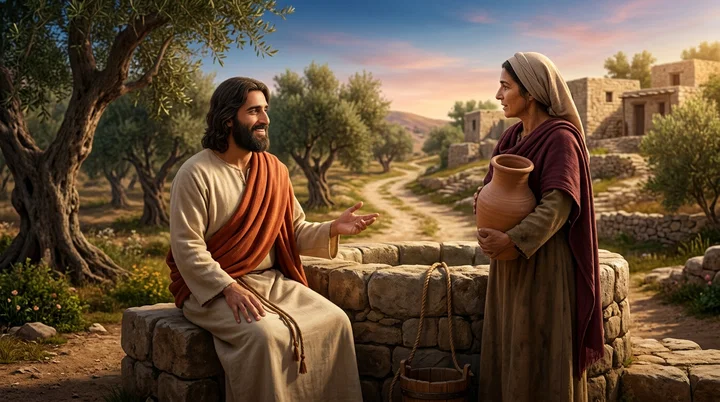
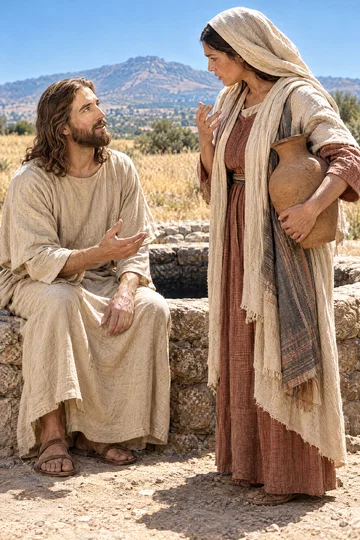
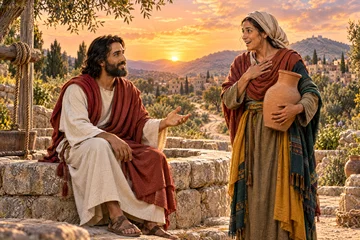
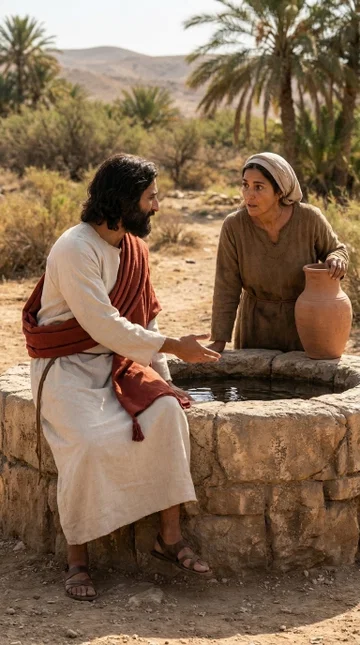
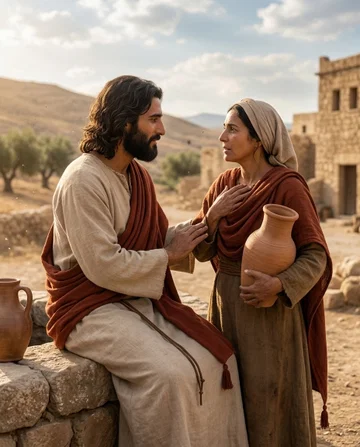
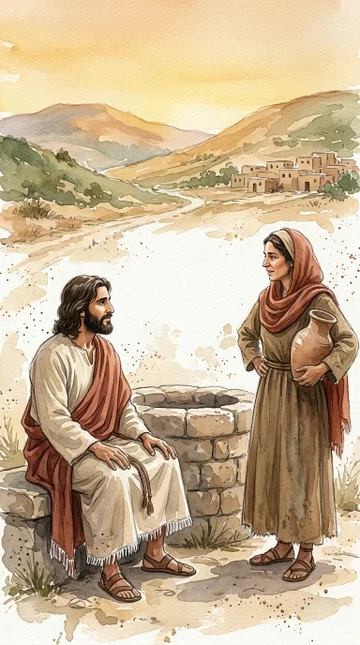
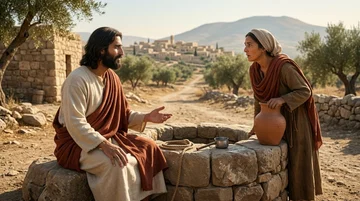
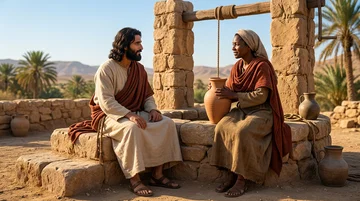
The meeting place was Jacob's well, and also called the well of Sychar, where Jesus sat and asked a Samaritan woman who had come to draw water to give Him a drink.MH 27.1Ms 61, 1896, par. 5–7DA 195 It was reached down a rocky, sparsely vegetated hillside along a stone path and terrace, where robed Samaritan women came carrying large upright water jars to draw water.DA 195 His wanting water for His own thirst opened the way to offer something of far greater value.MH 27.1
The disciples saw nothing in Samaria to indicate an encouraging field and did not see the harvest to be gathered right around them.ST Aug 11, 1914DA 194.3–195.1SW 83.1 They thought it a small matter for Jesus to spend His time on one Samaritan woman, a stranger and alien from Israel living in open sin whom they despised, with their thoughts fixed on a great future work.DA 194.3–195.1 While they were away purchasing food Jesus sowed the seed of truth with her, so that when He told them the harvest was ready the harvest speedily followed through her going back and bringing others to believe.ST Aug 11, 1914SW 83.1
Christ's Gift and Grace
Thirsty Himself and left at the well without anything to draw with, Jesus made a real request for a drink from the Samaritan woman who came to draw water, and His need and asking opened the way to offer her living water that gives everlasting life.MH 27.1ST Apr 22, 1897 What He offered was something of far greater value than the well itself, the fountain of living waters, the fountain of living water.MH 27.1Ms 79a, 1910, par. 28–32Ms 79, 1910, par. 43–44 He did not reprove her for drawing water from Jacob's well.Ms 79, 1910, par. 43–44
He showed great interest in the one despised woman at Sychar's well and spoke earnest and eloquent words to her.MH 28.1ED 231.2–232.1 He was ready to instruct wherever hearts are open to receive truth, and discerning her receptive heart and mind He gave precious instruction privately to an individual.MH 28.2ED 231.2–232.1 In speaking personally with one person He taught her truths that could reach many others.GW92 337.2
In that conversation He revealed the Father and the service acceptable to Him who reads the heart, using no parables and plainly declaring that He is the Messiah.MH 28.2 While His disciples were away He mingled with this despised people despite Jewish prejudice, setting aside His nation's prejudices and customs that separated Jews from Samaritans.6MR 323.3Ms 87, 1907, par. 32MR 109.1 He accepted Samaritan hospitality and ate food prepared by them, treating them with kindness and courtesy.6MR 323.3Ms 87, 1907, par. 32MR 109.1 His ministry at Sychar freely crossed Jewish barriers and showed that His love and the gospel are not limited by race or nation, bringing the message of salvation to people often treated as unworthy.AA 19.2–20.1DA 402.2 Through human sympathy that drew their hearts and divine grace He brought them life, awakened hope for a new life, and brought them the salvation the Jews rejected.6MR 323.3Ms 87, 1907, par. 32MR 109.1
His work at Jacob's well in offering the water of life to the woman of Samaria fulfills the promise in Eden that the Seed of the woman should bruise the serpent's head, and He continues that same work until every soul has been tested and tried.ST Apr 22, 1897 The Samaritan visit showed that His love for the Samaritans remained unchanged, and it prepared His disciples to later carry the gospel to them.DA 488.4–6
From One Hearer to Harvest
The woman believed His word without seeing a miracle, welcomed the light, and shared it with her neighbors who received it.Ms 2, 1890, par. 4–5 She became so astonished and eager to hear about living water that she forgot the thirst of the stranger and His request for a drink, and forgot her own errand to draw water.ST Apr 22, 1897 Moved by earnest words offering living water, she left her water-pot and went into the city to call her friends to come see Christ.MH 28.1
While the disciples were away in the city to buy food, the woman brought her townspeople to hear Jesus.ST Aug 11, 1914 His conversation reached one person who then brought others to Him.GW 195.1–3 Her report brought many Samaritans to hear Him and believe.3T 217.3–4 She proved a more effective missionary than the disciples themselves and brought a whole city to hear Jesus, while they had overlooked the nearby opportunity to gather a harvest.ST Aug 11, 1914DA 194.3–195.1 Many Samaritans of that city believed on Him, with an influence for the saving of souls that has continued through the years since then.MH 28.1 The contrast shows that miracles alone do not overcome prejudice or make people recognize truth.Ms 2, 1890, par. 4–5
The ordinary circumstance of her coming to draw water became an opening to teach the water of life, and she carried what she learned to others.Lt 48, 1897, par. 3–10 During the absence of the disciples buying food, Christ shared the gospel with a humble Samaritan woman, who received the message and became a giver of living water to others.Lt 55, 1897, par. 12–15 He sowed the seed of truth with her, and when He told the disciples the harvest was ready the harvest speedily followed through her going back into Samaria and bringing others to believe.SW 83.1 Christ reasons earnestly with one hearer, and everyone who drinks the living water becomes a fountain of life and a missionary.DA 194.3–195.1
Sources
Pioneers and periodicals
75 sources
The disciples had gone into the city to buy food, leaving Jesus alone at Jacob's well when the Samaritan woman came to draw water about noon.ST Mar 3, 1914ST Feb 7, 1900ST Sep 17, 1894ST Mar 8, 1899 He sat there wearied from the journey, hungry and thirsty with nothing to draw with, truly sharing human need and limitation.ST Apr 22, 1897ST Mar 8, 1899ST Jul 1, 1889ST Dec 22, 1887 His request for a drink became the opening to offer her freely the living water of salvation and eternal life.ST Mar 8, 1899ST Jul 1, 1889RH Nov 28, 1912RH Sep 30, 1902ST Jun 22, 1904 In doing so he set aside Jewish custom that kept Jews and Samaritans apart, reaching in love across hostility and religious difference to an outcast sinner.ST Jan 17, 1900ST May 24, 1910RH Oct 28, 1915ST Sep 3, 1902ST Feb 7, 1900 That brief conversation while the disciples were away was a sermon to an audience of one, showing that earnest personal work for a single soul is not small, for one soul won may bring many others to believe.RH Nov 28, 1912RH Nov 11, 1873RH May 13, 1873RH Oct 11, 1870RH Sep 16, 1902
Setting at the Well
The parenthetical explanation is that the disciples had gone away into the city to buy food, leaving Jesus alone at the well while he remained there and spoke with the Samaritan woman who came to draw water.ST Mar 3, 1914ST Feb 7, 1900ST Jan 11, 1899ST Jan 11, 1899 He was left at Jacob's well when she arrived, and their absence set the scene for his conversation with her.ST Sep 17, 1894ST Mar 8, 1899ST Feb 7, 1900ST Jul 14, 1887 His request to her for a drink was made while he was alone with her in that circumstance, and that personal encounter during their brief absence is counted as part of his personal work with individuals.ST Sep 17, 1894ST Jul 1, 1889ST Jul 14, 1887RH Nov 19, 1908
The meeting was at Jacob's well near Sychar when Jesus, wearied with his journey, sat there and asked the Samaritan woman for drink about the sixth hour.ST Jul 17, 1901ST Jul 2, 1885 The well stood near the town of Shechem, thirty-four miles north of Jerusalem, in the valley between Mount Gerizim and Mount Ebal, where Jesus rested at noon.ST Sep 8, 1898ST Jul 17, 1901ST Jul 2, 1885 That place is also called Sychar, now Nablous, lying between the mountains where Abraham and Jacob had been before, and the wondrous words spoken there revealed God to Samaria and to the world.ST Sep 8, 1898ST Feb 14, 1884 The scene belongs at Jacob's well at noon, where the truth he shared led her to call people from the city to hear him.ST Jul 17, 1901ST Feb 14, 1884RH Nov 11, 1873
The well was deep with no bucket at hand, so he could not draw its cool water for himself, and being tired and hungry and thirsty from traveling he sat down by its side to rest, which led to his asking the woman who came to fill her jug for a drink.RH Aug 25, 1868 The twelve who traveled on foot with him had gone to a village a little way off to buy food, leaving him alone there about noon.RH Aug 25, 1868 The well itself lies in a vaulted chamber beneath the surface of the ground amid ruins, with a circular mouth cut in a large slab of stone, a ledge where he rested, and grooves worn in the stone by ropes drawing up water pots.ST May 22, 1884
The going into the city to buy food shows that money was sometimes used to provide food and other necessities for Jesus and themselves.RH Jun 25, 1901 The word buy in that errand stands in contrast with the gifts of God and the living water Jesus freely offers. The verse belongs to the account in John 4:6-26 whose central illustration is the water of life, with the conversation at the well presenting that subject.ST Sep 8, 1898ST Oct 18, 1905ST Jul 16, 1885 That conversation while the disciples were away became the starting point for his two-day stay with the Samaritans.ST Oct 18, 1905ST Jan 18, 1899
Human Need of Jesus
Jesus was left alone at Jacob's well near Sychar, also called Shechem, about thirty-four miles north of Jerusalem, because his disciples had gone away into the city to buy food.ST Mar 8, 1899ST Jul 2, 1885 Wearied with his journey he sat there about the sixth hour at midday to rest while the woman of Samaria came from the city to draw water.ST Jul 17, 1901ST Jul 2, 1885 He was tired and hungry and thirsty from traveling on foot with his twelve followers, who had gone to a village a little way off for provisions, and he sat down by the side of the well to rest.ST Mar 8, 1899ST Jul 1, 1889RH Aug 25, 1868 The well was deep with no bucket at hand so he could not draw its cool water for himself, and his aloneness led to his asking the Samaritan woman who came to fill her jug for a drink.ST Jul 1, 1889RH Aug 25, 1868
He rested there hungry and thirsty without their help, showing that he had accepted the ordinary needs and limitations of human life.ST Apr 22, 1897ST Dec 22, 1887 Left at the well without anything to draw water with, thirsty and needing help, he asked the woman who came to draw water to give him to drink.ST Apr 22, 1897ST Apr 22, 1897 His thirst and his request were real, and he waited at the well for a drink.ST Apr 22, 1897ST Dec 22, 1887 She afterward became so astonished and eager to hear his words about living water that she forgot the thirst of the stranger and his request, and forgot her own errand to draw water.ST Apr 22, 1897
In being hungry and weary and needing help he shared ordinary bodily needs, including eating and drinking.ST Apr 22, 1897ST Dec 2, 1889ST Dec 22, 1887 His life shared the bodily realities of human life, without separating him from humanity.ST Apr 22, 1897ST Dec 22, 1887 He put ministry to the woman ahead of the ordinary comfort of a meal, giving focused attention and teaching to one woman despite national prejudice.ST May 12, 1914 He forgot his own sore thirst in offering living drink to one who had it not, for personal needs shrink into nothing when giving good to those in need, and filling a neighbor's life with love brings relief from burning care, pain and anxious doubt.
The mystery of ministry is that who gives most blessing gains the greatest bliss. His words awakened the Samaritan woman's conscience and led her to drink the water of life, and seeing her receive it satisfied his spiritual hunger and thirst and brought him joy.ST May 12, 1914RH Dec 17, 1914 He found spiritual nourishment in that ministry because many would come to believe through her.ST May 12, 1914RH Dec 17, 1914 Weary and faint, he met a poor sinner at the well and refreshed her by revealing the fountain of living water, and that scene identifies the coming Christ as the same personal Jesus who lived and ministered on earth.ST Oct 19, 1888
Gift of Living Water
His tactful request for a drink became the opening to speak with her about God's grace, salvation, and the living water he gives, made while resting weary and thirsty at the well because the disciples had gone into the village and city to buy food, leaving him alone with the Samaritan woman who came to draw.ST Jan 27, 1881ST Jul 1, 1889RH Nov 28, 1912ST Jan 17, 1900 That ordinary request was aimed to bring her to seek salvation from him and to reach her heart, leading to her conversion and afterward to the conversion of many of her associates.RH Nov 28, 1912RH Sep 30, 1902ST Jan 17, 1900 In using it he disregarded the hostile custom that kept Jews and Samaritans apart in order to begin a personal conversation about the gift of living water and divine grace.ST Jan 27, 1881ST Jan 17, 1900
The encounter teaches that salvation comes through Jesus, that God's truth should be received from whatever source he sends it through, and that acceptable worship is in spirit and truth, learned while he remained at Jacob's well with the woman after the disciples had gone to buy food.ST Sep 17, 1894 He used even his weariness and the situation at the well to bring the gospel to a thirsty sinner, lingering for a drink where he drew a soul into the gospel.ST Mar 8, 1899ST Oct 31, 1916 There he offered living water that gives eternal life to a thirsty sinner, inviting all who thirst to receive the water of life freely, and she received it and told others.ST Jun 22, 1904 He stopped to help the lone woman and share profound truths that meet the soul's hunger rather than mere temporal things, teaching her personally the way of life and giving instruction to one person by pointing to the water of life, so that she went on to bring others to him.ST Jun 19, 1907ST Sep 10, 1896
That work of offering the water of life at Jacob's well fulfills the promise in Eden that the Seed of the woman should bruise the serpent's head, and Christ continues that same work until every soul has been tested and tried.ST Apr 22, 1897 The encounter first showed her herself as a sinner before God, leaving her without rest, and then showed her himself, so that she went joyfully to the city to invite others to come and see him.RH Sep 30, 1873 Left without anything to draw with, thirsty and needing help, he had asked her to give him to drink with a real thirst and a real request, yet she became so astonished and eager to hear his words about living water that she forgot the stranger's thirst and his request and forgot her own errand to draw water.ST Apr 22, 1897
Mission Across Barriers
Jesus opened the conversation with the ordinary request for water while his disciples were away in the city buying food, reaching her heart in a setting where Jews and Samaritans had no social intercourse.ST Jan 17, 1900ST Feb 7, 1900 In doing so he disregarded the hostile custom that kept Jews and Samaritans apart, where giving and receiving water could signify a friendly compact of hospitality.ST Jan 17, 1900ST Feb 7, 1900
He freely associated with Samaritans in Samaria at the well, teaching the woman and offering salvation without regard to the boundary between Jews and Samaritans.ST May 24, 1910 That speaking with a Samaritan woman was an act his opponents condemned because she was a Samaritan.ST Aug 16, 1910
His conversation with her while they were gone to buy food shows his concern for people beyond the Jewish people.ST Oct 29, 1885 His visit to Samaria was a beginning of the work that would extend among the Gentile nations.RH Dec 7, 1905 He brought the gospel to Samaritans as well as to Jews before it was carried more fully to other nations, mingling with people of every class and seeking their salvation without distinction.RH Jan 8, 1914ST May 1, 1907 Yet his earlier willingness to go there stands as an example given when his disciples were not yet ready for a mission among Samaritans.ST Aug 4, 1881
His dealings with the Samaritan are an example of loving someone despite religious difference and seeing the good in a person.RH Jun 2, 1904 Though he was a Jew and she may have been prejudiced against him, he addressed her with a friendly spirit, showing that meeting people warmly even when they do not welcome us can help overcome prejudice and gain their respect and confidence for spiritual work.RH Oct 28, 1915 Asking a Samaritan woman for water while his disciples were away buying food, he disregarded social and religious barriers, and meeting her personally is the way to win her to the truth and bring restoration.ST Sep 3, 1902 That ministering at the well shows his loving compassion toward a woman regarded as an outcast and his freedom from the prejudices that divided people, going among people of different backgrounds and reaching them with care.RH Mar 24, 1910ST Jul 9, 1894
His meeting with the woman of Samaria shows how gently he dealt with the erring.ST Mar 10, 1909 Though he knew her unsavory record, he was not harsh and denunciatory in private dealing but kind, with the object to win her.ST Mar 10, 1909 His teaching won her and convinced her that he was Christ, and at once she began to bring others to the Saviour.ST Mar 10, 1909
That speaking at the well shows Christ doing God's will and giving himself for another, even someone regarded as fallen and outside his natural circle of care. His example calls for self-denying service and love that looks beyond a person's outward circumstances to their soul.
Pattern for Personal Work
The meeting at the well took place during the brief time the disciples had gone into the city to buy food, leaving Jesus alone with the Samaritan woman as his sole listener, a poor despised woman at Jacob's well.RH May 13, 1873RH Oct 11, 1870RH Sep 16, 1902ST Nov 9, 1915 That quiet conversation that opened the way for his work in Samaria was a sermon to an audience of one, a famous discourse given to a single soul because one soul was worth his personal attention.RH Feb 26, 1914ST Jul 8, 1886ST Nov 9, 1915 It shows that Jesus gave earnest, far-reaching, chaste attention to one person rather than only to crowds, and that personal witness can have great influence even when only one person hears.RH Sep 16, 1902ST Jan 20, 1914 The private setting while the disciples were away allowed the conversation to take place and gave him time to speak with her and share the good news of salvation.ST Apr 10, 1907ST Nov 9, 1915RH Jul 4, 1907
That personal labor was not a small work, for one soul won for Christ may in turn reach many others.RH Feb 9, 1911 The best work described in the New Testament is work done for individuals, for hand-picked fruit gathered one by one is better than fruit shaken from the tree in mass.ST Mar 30, 1882 True faith values each soul and individualizes people rather than grouping them in masses, bringing the gospel into contact with each heart, seeking renewal of that heart by the Holy Spirit, and making salvation a personal concern.RH Jun 12, 1856 The Gospel of John is largely made up of such personal efforts with individuals, in which Jesus lavished his love wherever he found need while working practically alone, since his small following were students receiving instruction rather than co-laborers.RH Oct 5, 1905 Power for ministry grows with direct labor for those outside Christ, in proportion to the directness of personal labor.RH Jun 12, 1856
His constant habit of personal work teaches constant personal work now, for his sermons often were developments of private interviews.RH Aug 26, 1902 Those preparing for ministry are to learn to meet people at their homes with systematic personal effort.RH Aug 26, 1902 Each member of the church who is quickened by the Holy Spirit should make a personal assault of love upon unconverted friends to win them to Christ.ST Mar 30, 1882 He kindly spoke to one straying woman on a toilsome way on a sultry day as if she alone of all the world had the deepest need, with no thought but to reclaim his sheep, and his seeking of that one lost sheep shows what he means when he says to those who love him, feed my sheep.ST Apr 9, 1894 He enlisted her interest by asking her to do something for him in asking for a drink, a strange request for a separated Jew to make of an outcast Samaritan, and that tactful request for water became the opening to a personal conversation that led to her conversion.RH Nov 28, 1912ST Jul 17, 1901
That one conversion led to the conversion of many of her associates, for her testimony brought many neighbors to believe he was the Christ, the Saviour of the world.RH Nov 28, 1912 She called people from the city to hear him at noon at Jacob's well, brought her townspeople to him, and stirred Samaria toward him, and through John's Gospel those truths enlightened the world.RH Nov 11, 1873ST Jan 20, 1914RH Apr 16, 1914RH Jul 4, 1907 While the disciples were away buying food they overlooked the nearby opportunity to gather a harvest, but the woman carried the light to her countrymen at once and brought the people of Samaria to hear him.ST Aug 11, 1914 Their absence contrasts with her zeal to share the good news, while they are described as forgetting the needs of souls.RH Jan 23, 1913
The ordinary errand of going into the city to buy food brought people to a place of spiritual blessing where everyday settings become places of receiving blessing, for lingering at the well in Samaria for a drink he drew a soul into the gospel and there the woman found the Saviour.ST Oct 31, 1916RH Apr 8, 1909 This experience is compared with caring for needy travelers while seeking their salvation.ST Feb 15, 1905 His solitary meeting with the woman was a blessed privilege for her, a meeting alone with Christ, and it proves that being alone does not cut believers off from religious privilege, spiritual life and usefulness, so lonely and isolated believers should not be uneasy but take courage from her example.RH Mar 25, 1902 Sitting by the well of Samaria is one of the remembered scenes of his earthly ministry to which believing souls look when seeking peace and joy in believing, yet that earthly view alone leaves Christians incomplete unless they lift the eye from the cross and earthly scenes to the throne where the same Jesus is now at the right hand of God, the same Saviour yesterday, today, and forever.RH Aug 1, 1854
Sources