Joshua 22:21
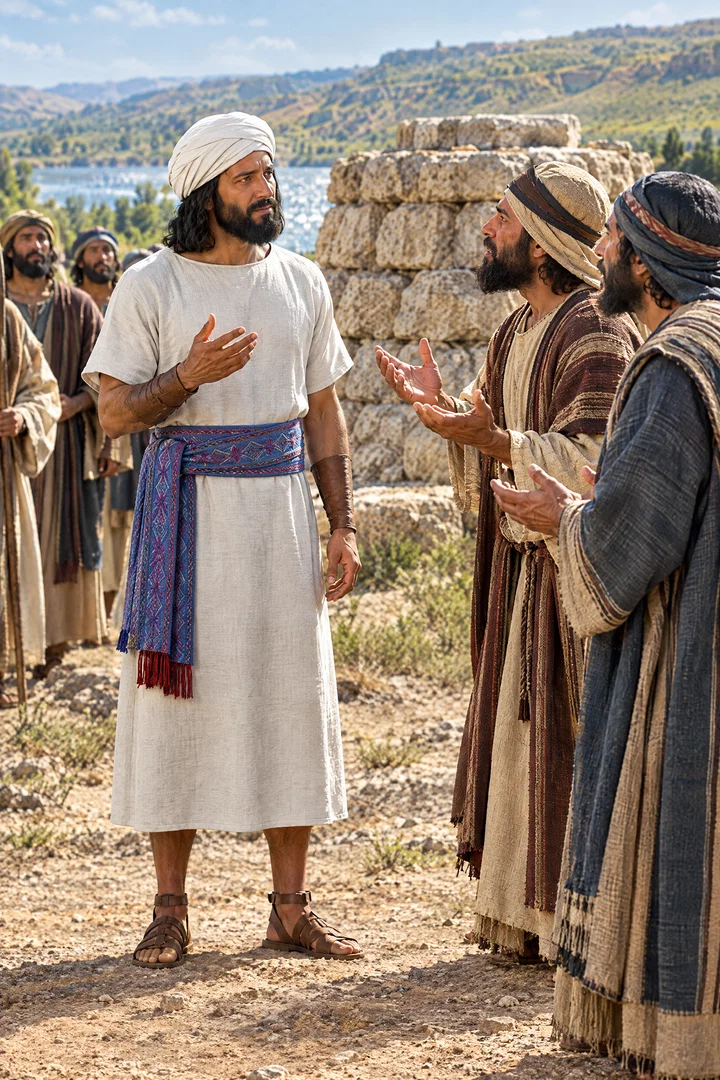
Then the children of Reuben and the children of Gad and the half tribe of Manasseh answered, and said unto the heads of the thousands of Israel,
Translations
Then the children of Reuben and the children of Gad and the half tribe of Manasseh answered, and said to the heads of the thousands of Israel,
King James Version, KJV Cambridge Paragraph Bible
Then the children of Reuben and the children of Gad and the half tribe of Manasseh answered, and said unto the heads of the thousands of Israel,
Then the children of Reuben, and the children of Gad, and the half-tribe of Manasseh answered, and said to the heads of the thousands of Israel,
Then the children of Reuben and the children of Gad and the half tribe of Manasseh answered, and spake unto the heads of the thousands of Israel,
Then the children of Reuben and the children of Gad and the half-tribe of Manasseh answered, and spake unto the heads of the thousands of Israel,
And the sons of Reuben, and the sons of Gad, and the half of the tribe of Manasseh, answer and speak with the heads of the thousands of Israel:
And the children of Reuben and the children of Gad and the half tribe of Manasseh answered and said to the heads of the thousands of Israel,
Then responded the sons of Reuben and the sons of Gad and the half tribe of Manasseh,—and spake unto the heads of the thousands of Israel:
Berean Standard Bible, Majority Standard Bible
Then the Reubenites, the Gadites, and the half-tribe of Manasseh answered the leaders of the clans of Israel:
Then the children of Reuben and the children of Gad and the half-tribe of Manasseh answered, and spoke to the heads of the thousands of Israel,
Then the children of Reuben and the children of Gad and the half-tribe of Manasseh said in answer to the heads of the families of Israel,
Then the children of Reuben and the children of Gad, and halfe the tribe of Manasseh answered, and saide vnto the heads ouer the thousands of Israel,
Douay-Rheims (Challoner revision)
And the children of Ruben, and of Gad, and of the half tribe of Manasses answered the princes of the embassage of Israel:
Pictures
Cross-references
- Joshua 4:12
And the children of Reuben, and the children of Gad, and half the tribe of Manasseh, passed over armed before the children of Israel, as Moses spake unto them:
Their earlier pledge to fight was fulfilled.
- Exodus 20:4-6
Thou shalt not make unto thee any graven image, or any likeness of any thing that is in heaven above, or that is in the earth beneath, or that is in the water under the earth:
The altar is considered in relation to the command against making images for worship.
Commentary
Each commentary is drawn from primary sources: the writings of Ellen G. White and Adventist pioneers and periodicals. Each commentary is separate. Its own words are not a quotation; follow the references to read the source passages.
Ellen G. White
4 sources
The verse is the opening of the reply made by the children of Reuben and the children of Gad and the half tribe of Manasseh, through their representatives, to the heads of the thousands of Israel, that is to Phinehas and the princes sent to them.PP 517.4–518.1ST May 12, 1881 Those who answer are the two and a half tribes who had received their inheritance on the east before crossing the Jordan, having chosen the wide upland plains and rich forests of Gilead and Bashan as grazing land for their flocks and herds, for they were a pastoral people.PP 517.4–518.1 They had pledged a proportion of their armed men to cross the Jordan with their brethren and share their battles until the rest also entered their inheritance, so forty thousand prepared for war passed over to the plains of Jericho and fought bravely beside their brethren for years.PP 517.4–518.1 They then returned with much riches, with very much cattle and with silver and gold and brass and iron and very much clothing, to share with those who had remained behind with the families and flocks, to dwell at a distance from the sanctuary where isolation and a wandering life brought strong temptation to fall into the customs of the heathen tribes on their borders.PP 517.4–518.1
Their reply comes in the midst of a serious misunderstanding in which the other tribes, remembering the divine rebuke over Achan's sin and acting from zeal to guard Israel from sin and to defend true worship, suspected them of abandoning the worship of Israel and sharply censured them without first courteously asking what had happened.ST May 12, 1881ST May 12, 1881 In answering, they courteously allowed Phinehas to finish his discourse before defending themselves, showed no anger or resentment at ungrounded suspicion and sharp rebuke, and in a sincere and solemn manner declared their innocence, appealing to the Lord who knew their hearts to testify against them if at fault and admitting that their lives would justly be forfeited if guilty of the sin charged against them.ST May 12, 1881 They then explained their motive, that they feared their children in future years might be excluded from the tabernacle as having no part in Israel, so the altar they had built after the pattern of the altar of the Lord at Shiloh would stand as a witness that its builders were also worshipers of the living God.ST May 12, 1881
Their candid explanation and measured conduct convinced the ambassadors that their hearts were still true to the God of Jacob, so all thoughts of war were dismissed and Israel was united in rejoicing and praise to God, thereby preventing a conflict that could have cost many lives.ST May 12, 1881ST May 12, 1881 The episode thus makes the verse a lesson in Christian forbearance, teaching that one unjustly suspected or censured should answer with meekness and forbearance rather than with anger or retaliation.ST May 12, 1881ST May 12, 1881 Its setting likewise teaches that zeal to defend true religion and to oppose sin must be joined with care to learn the facts, since mistaken suspicion can lead to grave harm, and believers must avoid both laxness toward sin and harsh, groundless judgment.ST May 12, 1881ST May 12, 1881
Sources
Pioneers and periodicals
7 sources
The book holding this verse is the first of the twelve historical books, which record the history of the chosen people from their first occupation of the land of Canaan as a nation to the return from the captivity, and it is named for its leading character Joshua.RH Mar 2, 1916 The verse stands in the section from chapters 13 to 22 inclusive, which gives the account of the distribution of the land of Canaan among the tribes and is based upon written documents in which the property was accurately described.RH Mar 2, 1916 It comes after the account of Achan's sin in the part dealing with the conquering of the Canaanites and the division of the land, just before the solemn charge in the last two chapters to serve God and Him alone.ST Mar 17, 1909
The verse begins the answer of the children of Reuben and Gad and the half tribe of Manasseh to Phinehas and the princes, the heads of the thousands of Israel, after those two and one-half tribes had returned to their inheritance east of the Jordan once all Israel had received its inheritance.ST May 12, 1881 The reply concerns the altar the eastern tribes built after the pattern of the altar of the Lord at Shiloh.ST May 12, 1881ST May 18, 1904 It was intended as a witness that its builders were also worshipers of the living God, not as an object of worship or rival worship, from fear that in future years their children might be excluded from the tabernacle as having no part in Israel.ST May 12, 1881ST May 18, 1904
The altar was erected with a truly devotional purpose yet was construed as wrongdoing and an attempt at complete apostasy from God.ST May 12, 1881ST May 18, 1904ST May 25, 1904 When its true purpose was learned and the candid explanation convinced the ambassadors that the builders' hearts were still true to the God of Jacob, all thoughts of war were dismissed and Israel united in rejoicing and praise to God.ST May 12, 1881 The episode shows that making an image or likeness is not a transgression when it is not made for worship.ST May 18, 1904
The answer is a lesson in Christian forbearance: the accused courteously let the rebuke finish before defending themselves, expressed no anger or resentment at ungrounded suspicion and sharp rebuke, and in a sincere and solemn manner declared their innocence.ST May 12, 1881 They appealed to the Lord who knew their hearts to testify against them if at fault and admitted their lives would justly be forfeited if guilty of the sin charged against them.ST May 12, 1881 The verse gives an impressive lesson on the manner in which unjust suspicions are circulated and how easy it is to misconstrue the actions of brethren.ST May 25, 1904
The other Israelites, remembering God's rebuke over Achan's sin, acted zealously to guard Israel from sin but went too far by suspecting and censuring their brethren before courteously asking what had happened.ST May 12, 1881 The setting teaches that zeal against sin should be joined with care to learn the facts, avoiding both laxness and harsh, groundless judgment.ST May 12, 1881 Zeal to defend true religion can lead to grave harm when suspicion is mistaken, even to a conflict that could have cost many lives, but the measured conduct and willingness of the accused to explain prevented it.ST May 12, 1881ST May 12, 1881 Their example teaches that one unjustly suspected or censured should answer with meekness and forbearance rather than anger or retaliation.ST May 12, 1881ST May 12, 1881
Sources