Exodus 20:4
Thou shalt not make unto thee any graven image, or any likeness of any thing that is in heaven above, or that is in the earth beneath, or that is in the water under the earth:
Translations
You shall not make to you any graven image, or any likeness of any thing that is in heaven above, or that is in the earth beneath, or that is in the water under the earth.
King James Version, KJV Cambridge Paragraph Bible
Thou shalt not make unto thee any graven image, or any likeness of any thing that is in heaven above, or that is in the earth beneath, or that is in the water under the earth:
Thou shalt not make to thee any graven image, or any likeness of any thing that is in heaven above, or that is in the earth beneath, or that is in the water under the earth:
Thou shalt not make unto thee a graven image, nor the likeness of any form that is in heaven above, or that is in the earth beneath, or that is in the water under the earth:
Thou shalt not make unto thee a graven image, nor any likeness of any thing that is in heaven above, or that is in the earth beneath, or that is in the water under the earth:
'Thou dost not make to thyself a graven image, or any likeness which [is] in the heavens above, or which [is] in the earth beneath, or which [is] in the waters under the earth.
Thou shalt not make thyself any graven image, or any form of what is in the heavens above, or what is in the earth beneath, or what is in the waters under the earth:
Thou shalt not make to thee an image, or any form, that is in the heavens above,—or that is in the earth beneath,—or that is in the waters beneath the earth:
Berean Standard Bible, Majority Standard Bible
You shall not make for yourself an idol in the form of anything in the heavens above, on the earth below, or in the waters beneath.
“ You shall not make for yourselves an idol, nor any image of anything that is in the heavens above, or that is on the earth beneath, or that is in the water under the earth:
You are not to make an image or picture of anything in heaven or on the earth or in the waters under the earth:
Thou shalt make thee no grauen image, neither any similitude of things that are in heauen aboue, neither that are in the earth beneath, nor that are in the waters vnder the earth.
Douay-Rheims (Challoner revision)
Thou shalt not make to thyself a graven thing, nor the likeness of any thing that is in heaven above, or in the earth beneath, nor of those things that are in the waters under the earth.
Pictures
Cross-references 20 of 124
- Deuteronomy 5:22
These words the LORD spake unto all your assembly in the mount out of the midst of the fire, of the cloud, and of the thick darkness, with a great voice: and he added no more. And he wrote them in two tables of stone, and delivered them unto me.
God spoke the commandments to the assembly and wrote them on stone tablets.
- Deuteronomy 4:12-16
And the LORD spake unto you out of the midst of the fire: ye heard the voice of the words, but saw no similitude; only ye heard a voice.
God spoke the Ten Commandments without showing a likeness, warning Israel against making an image.
- Exodus 32:4
And he received them at their hand, and fashioned it with a graving tool, after he had made it a molten calf: and they said, These be thy gods, O Israel, which brought thee up out of the land of Egypt.
Aaron fashions a graven image, and Israel worships the golden calf.
- Revelation 14:9-12
And the third angel followed them, saying with a loud voice, If any man worship the beast and his image, and receive his mark in his forehead, or in his hand,
The warning against worshiping the beast and its image contrasts with keeping God’s commandments.
- Exodus 19
In the third month, when the children of Israel were gone forth out of the land of Egypt, the same day came they into the wilderness of Sinai.
Gives the setting for the law proclaimed in Exodus 20.
- Deuteronomy 5:8-10
Thou shalt not make thee any graven image, or any likeness of any thing that is in heaven above, or that is in the earth beneath, or that is in the waters beneath the earth:
Moses repeats the prohibition of images, with its warning and promise.
- Matthew 5:17-19
Think not that I am come to destroy the law, or the prophets: I am not come to destroy, but to fulfil.
Christ affirms the law’s continuing authority and warns against breaking its commandments.
- Daniel 3:16-18
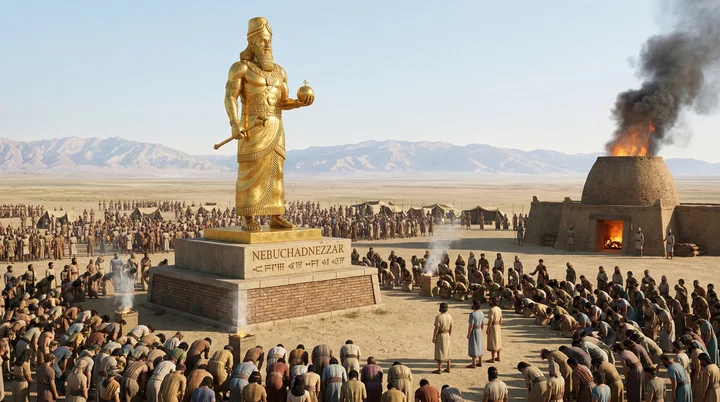
Shadrach, Meshach, and Abed-nego, answered and said to the king, O Nebuchadnezzar, we are not careful to answer thee in this matter.
The three Hebrews refuse to worship the golden image despite the king’s threat.
- Deuteronomy 4:15-19
Take ye therefore good heed unto yourselves; for ye saw no manner of similitude on the day that the LORD spake unto you in Horeb out of the midst of the fire:
Forbids making images and worshiping the sun, moon, and stars.
- Genesis 35:2-4
Then Jacob said unto his household, and to all that were with him, Put away the strange gods that are among you, and be clean, and change your garments:
Jacob tells his household to put away their strange gods before worshiping God.
- Romans 1:23
And changed the glory of the uncorruptible God into an image made like to corruptible man, and to birds, and fourfooted beasts, and creeping things.
God’s glory is exchanged for images of created things.
- Exodus 25:18-20
And thou shalt make two cherubims of gold, of beaten work shalt thou make them, in the two ends of the mercy seat.
God commands cherubim images for the ark, not as objects of worship.
- Acts 15:20
But that we write unto them, that they abstain from pollutions of idols, and from fornication, and from things strangled, and from blood.
The council instructs Gentile believers to abstain from idols, upholding the commandment against idolatry.
- Genesis 31:19
And Laban went to shear his sheep: and Rachel had stolen the images that were her father’s.
Rachel steals Laban’s household images, showing image worship before Sinai.
- Isaiah 40:18-20
To whom then will ye liken God? or what likeness will ye compare unto him?
Contrasts human-made images with the incomparable Creator.
- Acts 17:29
Forasmuch then as we are the offspring of God, we ought not to think that the Godhead is like unto gold, or silver, or stone, graven by art and man’s device.
Paul rejects images made by human craft and points to God as the Creator.
- Deuteronomy 10:4
And he wrote on the tables, according to the first writing, the ten commandments, which the LORD spake unto you in the mount out of the midst of the fire in the day of the assembly: and the LORD gave them unto me.
God wrote the Ten Commandments, including the prohibition on graven images, on the stone tablets.
- Leviticus 26:1
Ye shall make you no idols nor graven image, neither rear you up a standing image, neither shall ye set up any image of stone in your land, to bow down unto it: for I am the LORD your God.
Both forbid making images for worship and bowing down to them.
- Revelation 13:14-15
And deceiveth them that dwell on the earth by the means of those miracles which he had power to do in the sight of the beast; saying to them that dwell on the earth, that they should make an image to the beast, which had the wound by a sword, and did live.
beast-image worship violates this command
- Colossians 3:5
Mortify therefore your members which are upon the earth; fornication, uncleanness, inordinate affection, evil concupiscence, and covetousness, which is idolatry:
Covetousness is called idolatry, extending the commandment beyond graven images.
Commentary part 1 of 5
Each commentary is drawn from primary sources: the writings of Ellen G. White and Adventist pioneers and periodicals. Each commentary is separate. Its own words are not a quotation; follow the references to read the source passages.
Ellen G. White
227 sources
The second commandment forbids making any carved image or likeness of anything in heaven above, on earth beneath, or in the water under the earth to represent God or to bow down to and serve in His place.SG3 265.31SP 235.2–236.8ST May 6, 1880Ms 146, 1906, par. 3–9PK 100.1
It forbids image-worship and irreverence toward God, not every picture or likeness, for a picture becomes an idol only when it is worshiped, loved and trusted in place of God.Ms 146, 1906, par. 3–9PK 100.2HSFM 211.5–212.48MR 78.1–79.1Lt 9, 1892, par. 48–57
Its principle reaches beyond wood and stone, for anything that divides the affections, takes away supreme love, or absorbs the attention due to God becomes an idol.4T 632.1–2Ms 126, 1901, par. 31–341T 289.1CT 329.2RP 10.4
It was spoken by God Himself with an audible voice to all Israel at Mount Sinai amid awful grandeur, and written with His own finger on tables of stone.Ms 2, 1904, par. 6–19Ms 93, 1908, par. 11–15CH 388.2ST Jan 24, 1911ST Jun 10, 1880
It stands as part of the plain, perfect and unchangeable transcript of God's character and government, binding on all people and remaining the standard of righteousness and judgment under the gospel.Ms 2, 1904, par. 6–19Ms 117, 1908, par. 17–18Lt 202, 1907, par. 8–12Ms 131, 1907, par. 13–14
Words and Prohibition
The second commandment forbids making any carved or graven image or any likeness of anything in heaven above, on earth beneath, or in the waters under the earth, and in that same idolatrous setting forbids bowing down to such images or serving them.SG3 265.31SP 235.2–236.8ST May 6, 1880Ms 17, 1906, par. 29–40Ms 2, 1904, par. 6–19 It stands with the first commandment as a guard against idolatry, since idolatry leads to rebellion, grave sin and even human sacrifice.1SP 235.2–236.8ST May 6, 1880 It belongs to the first four commandments that define duty to God, requiring that God alone be placed above everything as sovereign Ruler of the universe, exalted as omnipotent.Ms 17, 1906, par. 29–40Ms 2, 1904, par. 6–19 Obedience means keeping His written requirements without altering His word, turning from sin and bringing mind and heart under His discipline.Ms 84, 1910, par. 9–11Ms 2, 1904, par. 6–19 The law so given is plain and clear, an expression of the character of the Sovereign of the universe, covering the whole duty of man.Ms 17, 1906, par. 29–40Ms 2, 1904, par. 6–19
No image may be made to represent God or to be worshiped in God's place.Ms 146, 1906, par. 3–9PK 100.1PK 100.2PP 305.3–4 Calling an image a mere figure or symbol of the true God does not make its worship acceptable.PP 305.3–4PP 305.5–306.4 The ban covers representation of God by graven image, by beast, or by reptile.PP 305.3–4PP 334.4 Such material representations lower the mind's conception of God, turning it from the Creator toward created things, dishonoring the infinite God by reducing Him to no greater than human handiwork, blinding minds to His power, majesty and glory, degrading the worshiper, abandoning the truth that humanity was made in His image, and opening the way to unrestrained evil passions and Satan's influence.PP 305.3–4PP 305.5–306.4PP 334.4 Jeroboam broke this rule by making two golden calves as visible symbols of the invisible presence and placing them at Israel's worship centers, echoing heathen representations familiar from Egypt and inviting bowing and strange worship.PK 100.1PK 100.2
The prohibition is against image-worship and irreverence toward God, not against every picture or likeness.HSFM 211.5–212.48MR 78.1–79.1Lt 9, 1892, par. 48–57 God Himself used pictures and symbols to teach the prophets, appealing to sight so people could understand, and prophetic history was shown to Daniel and John in symbols to be set out plainly.HSFM 211.5–212.4 A picture becomes an idol only when it is worshiped, or loved and trusted in place of God.8MR 78.1–79.1 Anything earthly that is desired and trusted for help or benefit becomes an idol when it draws from God, divides affections, takes away supreme love, or prevents complete confidence and trust in Him.8MR 78.1–79.1 The command does not require destroying every image, and personal judgments about pictures should not be made a test to burden consciences, though pictures can be misused, excessive spending on them can divert means from God's work, and the line between picture-making and sin can be difficult to determine.HSFM 211.5–212.4
The ban also forbids making images or pictures to represent heavenly or spiritual things.15MR 114.2–115.1Lt 137, 1899, par. 3–4 This applies to pictures of Christ, angels and other spiritual things, and to photographs and other pictures when attachment to them becomes idolatry.15MR 114.2–115.121MR 408.5–6 Such false images misrepresent heavenly beings, mingle the sacred with the common, and cannot match the pictures God Himself can impress on the mind.15MR 114.2–115.1Lt 137, 1899, par. 3–4 Producing them in multitudinous numbers draws attention away from God, misuses money that could serve missionary work, and teaches children to prize perishing things, so desire for them should be restrained.15MR 114.2–115.121MR 408.5–6 Christ Himself, not any human-made representation, displays the character of God, in whom the attributes of the Infinite are seen and by looking to whom people are changed into His image, as revealed in the ten moral precepts.ST Aug 29, 1895
By forbidding false gods the command implies that the true God alone is to be worshiped.PP 305.3–4PP 305.5–306.4Ms 126, 1901, par. 31–34 It declares the Lord to be the only true God, who demands obedience to His Word and must be kept by those standing for truth and righteousness.Lt 168, 1909, par. 16–17 Its pledge is given to every living soul on earth, addressing people accustomed to having many gods.Ms 125, 1909, par. 22–25 God's bond with His people is as by marriage, so idolatry is spiritual adultery and His opposition to it is called jealousy.PP 305.5–306.4Ms 126, 1901, par. 31–34 True worship is in spirit and truth by living faith rather than imagination, with the sacred kept distinct from the common and no strange god allowed.Ms 126, 1901, par. 31–34 Had these commandments been obeyed with heart and mind, the wickedness now seen would never have existed.HMW 20.4–5
Giving at Sinai
Thou shalt not make any graven image was spoken by God Himself with an audible voice to all Israel encamped before Mount Sinai in the third month after leaving Egypt.Ms 2, 1904, par. 6–19Ms 93, 1908, par. 11–15SG3 298.1–299.2 This came after deliverance from bondage, the dividing of the Red Sea, and proving in the wilderness.SG3 298.1–299.2 It was proclaimed in awful grandeur with trumpet waxing louder, thunder, lightning, cloud, tempest, thick darkness, smoke, flame, earthquake, glory as devouring fire, and angels surrounding Him enshrouded in glory.CH 388.2SG3 298.1–299.2ST Mar 3, 1881 That power and glory made known His majesty and authority as Ruler of the world, to impress the people with the sacredness of His law and the importance of obeying it, so all mankind might clearly understand the requirements of God.Ms 2, 1904, par. 6–19CH 388.2STB 7.1–2 It belongs to the faith once delivered to the saints and to the law of His kingdom, plain and clear, covering the whole duty of man.Ms 2, 1904, par. 6–19CH 388.2
The Teacher on the mount was Christ Jesus Himself.Lt 160, 1906, par. 3–9 Father and Son were both upon Sinai's holy mount when it was spoken.Ms 176, 1903, par. 3 The law had been first given in Eden and was repeated by the Lord when He came down on Sinai, and later recapitulated by Moses in the hearing of all the people.Ms 176, 1903, par. 3ST Mar 3, 1881Ms 160, 1899, par. 1–2 It was the same clear ringing voice later heard in the cleansing of the temple, made by Christ who knew every phase of the law.ST Mar 7, 1878 Spoken by Christ from Sinai, its four precepts on the first table sum up supreme love to God and declare a governing principle requiring implicit obedience.ST Mar 7, 1878
God wrote it with His own holy finger upon tables of stone, unlike the rest of the Bible expressed in men's words.ST Jan 24, 1911ST Jun 10, 1880SG3 298.1–299.2 He spoke audibly to all Israel and wrote directly to prevent misunderstanding and to remove all possibility of mingling human tradition or practices of men with His holy precepts.ST Jan 24, 1911ST Jun 10, 1880SG3 298.1–299.2ST May 6, 1886 The two tables were kept in the ark and chest in the most holy place in heaven, where Jesus entered in 1844 after shutting the door of the holy place.EW 35.2Ms 41, 1886, par. 9 Opposition to this present truth tries to open what Jesus shut and to shut people away from the ark and its law.EW 35.2
The moral law was not new at Sinai but already the foundation of God's government over angels and from the beginning.ST Jan 24, 1911ST May 6, 1886ST Apr 8, 1875 It was made known to Adam and Eve in Eden, given after the fall, preserved by Noah, observed by Abraham, and deposited with him.SG3 298.1–299.2CH 388.1Ms 160, 1899, par. 1–2 Israel was entrusted with it as depositaries and a peculiar treasure and holy nation to make it known to all peoples and to every nation, kindred, and tongue, for it was not given only for Israel.ST Apr 8, 1875Ms 160, 1899, par. 1–26T 9.2–3 Long bondage in Egypt amid idolatry had confused ideas, blinded minds, and made them prone to forget and to mix its precepts with heathen customs and human practices, making necessary its proclamation from Sinai and engraving on stone to preserve from total apostasy.1SP 263.1–265.1SG3 298.1–299.2ST Oct 15, 1896
Before hearing it Israel was commanded to wash clothes and prepare, for its sacredness calls for cleanliness and order.HTL6 58.3–59.1 God separated His people and led them where bare rocks and lofty mountains showed their nothingness and left nothing to attract the senses or divert the mind, so His word would ever be clear and distinct.6T 9.2–3 Proclaimed with terrible majesty, as God's great mirror and rule of right it revealed as never before the offensive character of sin and personal guilt before a pure and holy God and overwhelmed the soul with terror.ST Mar 3, 1881ST Jan 24, 1911ST May 6, 1886 The people stood afar off and begged Moses to speak with them lest they die if God spoke directly.ST Mar 3, 1881ST May 6, 1886 Those who had worshiped graven images in transgression were forbidden to approach when God descended in glory to write the law again, lest they be consumed by the glory of His presence, for the law cannot pardon and the people needed Christ as Mediator.ST Jun 10, 1880
Minds impaired by slavery and association with idolaters did not fully appreciate its far-reaching principles and were not ready to grasp them.RH Aug 16, 1906ST Oct 15, 1896 Therefore additional judgments, statutes, and minute directions were given privately through Moses as God bade him and written in a book.Lt 160, 1906, par. 3–9SG3 298.1–299.2 Those precepts illustrate, apply, and enforce obligations, guard the sacredness of the moral law man is prone to transgress, and draw erring man to obedience.SG3 298.1–299.2RH Aug 16, 1906 They guard against doing injustice, guide dealings with one another, call for contention to cease and for love as brethren, and simplify duty to God, to one another, and to the stranger, with particular attention to the Sabbath and to avoiding intermarriage with other nations.Lt 160, 1906, par. 3–9ST Oct 15, 1896
Nature of Divine Law
The prohibition is part of the law written by God on stone, which perfectly reveals His will and the principles of His kingdom for all peoples, plain and clear as an expression of the character of the Sovereign of the universe, proclaimed with awful solemnity from Sinai in the third month after Israel left Egypt when Israel was encamped before the mount.Ms 2, 1904, par. 6–19Ms 61, 1910, par. 9 It is the transcript of His character and the divine requirements He makes of His people, definitely made known as the laws of His kingdom and the principles of His government to be afterward revealed to people of all nations and tongues, so that none need make any mistake.Ms 2, 1904, par. 6–19Ms 117, 1908, par. 17–18 It is holy, and its commandments are important to keep, with their purpose expressed in love for God with the whole heart and love for neighbor as oneself.Lt 80, 1898, par. 16–18 It means just as it reads and must be believed and done as the Lord directed, to be searched with earnest desire to know truth, with prayer for opened understanding and a mind willing to grasp every ray of light even when opposed to past belief.Lt 131, 1903, par. 6–9 It is perfect and converts the soul, engraved by His own finger on stone, and Christ's life and death teach that obedience to all its commandments brings safety and a healthy spiritual experience.Ms 61, 1910, par. 9 Blessed are they that do His commandments, that they may have right to the tree of life and may enter in through the gates into the city.Lt 131, 1903, par. 6–9
That law spoken at Mount Sinai is immutable and endures throughout eternity, serving as an unchangeable standard of right conduct presenting eternal truth, and Christ's death did not abolish it.Lt 202, 1907, par. 8–12Ms 131, 1907, par. 13–14 It was proclaimed to the children of Israel with God's own voice in awful grandeur with power and glory that made known His majesty and authority as Ruler of the world, to impress the people with the sacredness of His law and the importance of obeying it, belonging to the faith once delivered to the saints by Christ the Redeemer speaking from Sinai.CH 388.2 Its ten precepts are not limited to the Jews but bind all people for as long as human life and society continue, and no precept can be revoked or changed to spare the transgressor.ST Jan 19, 1882 Spoken by Christ from Sinai and written on the first table of stone with the three other precepts showing duty to man to God and summing up love to God supremely, it declares a governing principle for mankind requiring implicit obedience, remaining in force with the rest of the moral code while heaven and earth remain, as the origin of all enlightened law and the foundation of God's government in heaven and on earth.ST Mar 7, 1878 Satan sought to make people believe it ended with Christ's death, but Christ's death did not abolish it; it magnified and honored it and confirms that its precepts remain binding.SG1 109.2
All ten are linked like a chain and cannot be set aside apart from the rest, for to violate this one precept makes a person a breaker of the whole law, making the whole law binding against the offender.ST Jan 19, 1882ST Mar 7, 1878 Those who acknowledge the commandments and keep the fourth must live by the principles of all ten.2T 449.2 It belongs to the whole law whose commandments are connected, the first four revealing duty to God, so that breaking one makes a person guilty of breaking the law and partial obedience cannot secure eternal life, for the whole law is holy, just, and good.ST Jul 16, 1894 Truly keeping the Sabbath means obeying every precept of the law, not disregarding any of them.ST Mar 31, 1898
It remains the standard of righteousness by which people will be judged, with obedience a prerequisite of salvation and its principles determining a sentence of life or death. It must be studied by everyone who professes to keep the commandments of God and obeyed in truth and righteousness together with every other command, for its principles will stand to witness against the world in the day of judgment and will decide the destiny of every soul.Ms 77, 1899, par. 11–12 Hidden until the day when the judgment shall set and the books shall be opened and every man shall be judged according to the things written in the books, the tables of stone will be presented before the world to show that the terms of salvation is obedience to the perfect law of God, leaving none with excuse for sin.Ms 117, 1908, par. 17–18 It is Heaven's great standard of right with which lives and characters are to be compared, pointing out sin and declaring guilt, not to be trampled underfoot nor turned from when character stands revealed in moral deformity.ST Jan 24, 1911 It expresses God's righteousness and serves as the rule of judgment by which people could see their faults and repent, but those who reject its requirements are condemned by it.GC88 639.1–2 Even when men close their eyes to it and trample it underfoot it remains the standard by which God will bring every work into judgment, with every secret thing whether good or evil, in the last day, covering the whole duty of man to fear God and keep His law.ST Mar 14, 1911 Its conviction calls for repentance toward God and faith toward the Lord Jesus Christ, for being doers of the Word and not hearers only, for transformation of the heart, the seat of the affections, and renewal of the moral nature by grace, with peace for the weary, sin-sick soul who has violated it coming only from its Originator.ST Jan 24, 1911
Like every Thou shalt not it contains or implies a promise, with obedience bringing blessing while disobedience brings danger and unhappiness.HL 17.4–5 As part of the law it reflects God's character, carries supreme importance, and means life for the obedient and death for the disobedient.Ms 119, 1903, par. 19 Israel's prosperity depended on obedience to these precepts framed by God rather than by any human mind or by Moses and proclaimed at Sinai amid scenes of great grandeur.Ms 4, 1904, par. 19 Disobedience carries a definite penalty annexed to the law, punishment is sure to follow transgression, God's retributive justice never fails, and the plain cases recorded in Scripture prove that penalty and stand as warning against disobedience.4T 11.3 Its sacredness and authority must be acknowledged, for its precepts reveal God's supreme authority above earthly rulers and call people to obey Him, and persistent refusal and disobedience are met with judgments intended, mercifully, to awaken transgressors to their sin and peril.LSEGW 407.2–409.2RH Jul 5, 1906
The ten-commandment law is as old as the world and remains binding in this dispensation in spirit and letter, with violating God's law being sin even when carried on under the cloak of Christianity, and obedience necessary for health, truth, and happiness.LC1 181.1ST Feb 25, 1875 Its divine precepts remain obligatory and provide a standard for condemning the guilty and justifying the obedient, and they must not be treated as restraints to be discarded, for setting aside God's law opens the way to sin and lawlessness.ST Jul 4, 1905 Christ gave statutes and precepts to guard and explain the Ten Commandments, and these were not temporary types but remain binding in every age, distinct from temporary types that ceased when type met antitype.ST Apr 15, 1875 The commandment forbidding making and worshiping graven images remains in force, and claims that God's law has been abolished wrongly relieve the consciences of those who practice image worship.Ms 23, 1885, par. 12 It is counted faultless even by many who accept nine commandments but stumble over the fourth.ST Mar 7, 1878
True Worship Versus Idols
Material images made to represent God or to be worshiped through are forbidden, even when they are called mere figures or symbols of the true God, for the Eternal One cannot be likened to anything He has made.PP 305.3–4PP 305.5–306.4Ms 126, 1901, par. 15–16 Such material representations lower the mind's conception of God, turning it from the Creator toward created things, and they dishonor Him by belittling Him and associating Him with common things as no greater than human handiwork.PP 305.3–4PP 305.5–306.4Ms 126, 1901, par. 31–34Ms 126, 1901, par. 15–16 This blinds people to His power, majesty and glory, abandons the truth that humanity was made in the Creator's image, and degrades those who worship such objects.PP 305.5–306.4PP 334.4 That degradation corrupts and debases the mind, opening the way to unrestrained evil passions, sensuality, other sins and Satan's influence.Ms 126, 1901, par. 31–34PP 334.4 By forbidding false gods the commandment implies that the true God alone is to be worshiped and served, and true worship is in spirit and truth by living faith rather than imagination, with keeping the Sabbath preserving the world from idolatry.PP 305.5–306.4Ms 126, 1901, par. 31–34CET 85.1–3
Its principle reaches beyond carved images, for anything that divides the affections or takes away supreme love to God becomes an idol.1T 289.18MR 78.1–79.1 Nothing may share the place of supreme delight that belongs to God, and those who worship the true God must put away every idol and anything that separates them from Him.CT 329.2RP 10.4 Even things of apparently little consequence are forbidden to attract the mind and eye and absorb the attention that should be given to God, including in sacred responsibility where selfishness is woven into sacred things and common fire is used in place of sacred fire of God's own kindling.Lt 145, 1899, par. 7 A picture itself is not prohibited, but a picture becomes an idol when it is worshiped or loved and trusted in place of God, and anything earthly desired and trusted to help or benefit draws from God when it divides affections, diminishes supreme love or prevents complete confidence and trust in Him.8MR 78.1–79.1 Spiritual worship therefore requires undivided love and obedience, separation from worldly influences, and refusal to run the risk of displeasing God.1T 289.1Lt 145, 1899, par. 7
The prohibition equally forbids fashioning an idol of wood or stone and making an idol of false doctrines and theories.ST Jul 17, 1907 To conceive of God in a false character, as having attributes He does not possess, is to enthrone a philosophical idol in the place of Jehovah.ST Jul 17, 1907 The true God as revealed in His word, in Christ and in the works of creation is worshiped by but few, while thousands deify nature and deny the God of nature.ST Jul 17, 1907 In a different form idolatry breaks this commandment in the Christian world today as verily as among ancient Israel in the days of Elijah, and the god of many professedly wise men, philosophers, poets, politicians, journalists, polished fashionable circles, many colleges and universities, and even some theological institutions is little better than Baal, the sun-god of Phenicia.ST Jul 17, 1907
Making objects from precious and valuable materials and worshiping them as gods, while putting the Creator aside and glorying in human handiwork instead of honoring Him or thanking Him for what He provided, violates the commandment.ST Feb 27, 1879SG3 62.1 That violation was taught to children, who were taught to do the same and to bow to graven images.ST Feb 27, 1879SG3 62.1PP 90.3–91.1 It misused things God had placed on earth for human benefit, adored nature instead of its Creator, turned gifts and works of hands into objects of pride and worship, and set idols in groves and beneath trees and fruit trees and in splendid buildings and beautifully arranged gardens, turning places associated with worship of the true God into sites of idolatry.ST Feb 27, 1879SG3 62.1PP 90.3–91.1 There altars were erected in groves and consecrated to idols, with even human sacrifices offered upon them as abominations and horrible idolatrous sacrifices which God detests.1SP 74.1 The living God, Maker of heaven and earth, answers such worship with wrath, tearing down idol altars and destroying the works of idolaters' hands by lightning from heaven and scattering their ruins, making them tremble before His power and know that their abominations called for their destruction.1SP 74.1
God declares Himself jealous, and He does not promise His blessing to parents and children who transgress His requirements and hate Him.Ms 84, 1910, par. 9–11PP 305.5–306.4RH Jul 29, 1873 False worship is spiritual adultery against the sacred bond as by marriage between God and His people, and God's opposition to it is called jealousy.PP 305.5–306.4Ms 126, 1901, par. 31–34 He shows mercy to thousands of generations of those who love Him and keep His commandments, calling for obedience to His written requirements without altering His word and for turning from sin to bring mind and heart under His discipline.Ms 84, 1910, par. 9–11PP 305.5–306.4 Children may suffer the consequences of their parents' wrongdoing through inheritance and example, but they are not punished for their parents' guilt unless they share in their sins.PP 305.5–306.4
Israel's Idolatry in History
The ban on images became necessary at Sinai because Abraham's descendants broke the covenant pledged by circumcision to be separate and perfect, and went into idolatry and bondage in Egypt.SG3 298.1–299.2 The moral law was not new there, for it had been given to Adam after his fall, preserved in the ark by Noah, deposited with Abraham and observed by him, but was largely lost to Israel through long bondage.SG3 298.1–299.2ST Dec 15, 1881 Having witnessed so much idolatry in Egypt, they had confused ideas of the law and were prone to forget and mingle human tradition and heathen practice with holy precepts, so God Himself spoke it with an audible voice in the hearing of all the people when He came down upon Sinai enshrouded in glory and surrounded by angels after delivering them and dividing the Red Sea and proving them in the wilderness, and wrote it with His own holy finger upon tables of stone to remove all possibility of such mingling.SG3 298.1–299.2ST Dec 15, 1881 The prohibition was given because the nations were given to idolatry, to preserve mankind from total apostasy, and God's mighty power in bringing Israel out and establishing them in Canaan served to maintain that preservation.ST Dec 15, 1881 It guards against even the least approach to idolatry because idolatry leads to rebellion, grave sin and even human sacrifice.ST May 6, 18801SP 236.9–237.1
It is guarded by the judgments and laws Moses was required to write as God bade him in the mount, giving minute directions and principles simplified in definite detail about duty to one another and to the stranger, to draw erring man to obedience to the moral law he is prone to transgress and to keep men from erring.SG3 298.1–299.2 Israel's worship was clearly defined, and its rites and ceremonies helped keep the commandments in remembrance and guard against their violation and against adopting the ways of surrounding nations.ST Apr 15, 1875 The statutes also helped preserve God's people from idolatry.ST Apr 15, 1875
Israel had heard the Ten directly from the lips of God Himself from Mount Sinai amid thunderings and lightnings and earthquakes, and had solemnly promised obedience and entered solemn covenant to obey His voice only weeks before, yet while Moses was away forty days they demanded gods to lead them.3T 296.1–3RH Jul 29, 18733T 340.1 Aaron broke the command when he yielded to the people instead of standing firmly for God's law and reminding them of their covenant, having their ornaments brought and fashioning a golden calf in imitation of Egypt's gods.RH Jul 29, 1873ST May 13, 18803T 298.3 He presented it as the god that had brought them out of Egypt, built an altar to it, proclaimed a feast, and the people offered burnt offerings and sacrifices to it and ate and drank and rose up to play in shameful rioting and drunkenness.SG3 275.1RH Jul 29, 1873 This was idolatry and direct transgression of the first and second commandments recently proclaimed and expressly forbidden.SG3 275.1ST May 13, 1880 The continued manna and the cloud and fire showed God remained present and had not abandoned them while Moses was away, so making other gods was rejection of His presence and provision.3T 340.1
Jeroboam violated the same ban by making two golden calves as visible symbols of the presence of the invisible God and placing them at Israel's worship centers.PK 100.1 His calves presented an idolatrous symbol of the Deity, echoing the heathen representations familiar to Israel from their time in Egypt and inviting the people to bow before the images and adopt strange forms of worship.PK 100.2
Israel broke the ban in the very sight of Sinai when the people clamored for gods to lead them back to Egypt and Aaron failed to stand firm, and broke it again after entering Canaan by gradually going into idolatry.RH Apr 23, 1901 Continued breaking despite messages, warnings, reproofs and judgments brought loss of God's protection, defeat by enemies and scattering as captives, though God still offered pardon and healing if they would return.RH Apr 23, 1901 Obedience had been meant to make Israel an example to other nations of true righteousness and of the benefits of living by the principles that govern heaven, with the ten precepts forming the foundation of national law and the laws given through Moses illustrating them and setting with them the condition for fulfillment of God's promises.Ms 98a, 1905, par. 8–9PP 311.3 The Ten hedged Israel about and distinguished it from every other nation. The recorded history of that idolatry and its punishment warns God's people against disobedience and shows that the law's penalty is sure.ST May 31, 1910
Rome's Change and Prophecy
Adoration of images and relics was gradually introduced into Christian worship as a substitute for idol worship to promote nominal acceptance by converts from heathenism, and was finally established as a system of idolatry by decree of a general council, the Second Council of Nice in A.D. 787.GC 51.4GC88 51.4 To complete that introduction Rome expunged the second commandment forbidding image worship from the law and divided the tenth commandment in order to preserve the number ten.GC 51.4GC88 51.4 Catholic catechisms and devotional books omit it as not obligatory, on the plea that its whole meaning is already contained in the first commandment, altering the commandments to fit existing practice.Ms 126, 1901, par. 17–19ST Nov 19, 1894ST Nov 26, 1912 The prohibition forbids making images to represent God or using images or creatures in worship of the true God, directing honor to human-made objects instead of the living God, degrading thought, and ruling even against treating a Roman ensign as an object of religious respect in the temple.Ms 126, 1901, par. 17–194SP 54.1
The second commandment forbidding image worship is distinct from the first, and the plea that the ban is unnecessary because included in the first, with the law given exactly as designed to be understood, does not stand.GC 445.2–446.2GC88 446.1–24SP 279.1–2 Its omission is not the intentional, deliberate change of times and law foretold for the little horn to think to change.GC 445.2–446.2GC88 446.1–24SP 279.1–2 The exact fulfillment is the change in the fourth commandment alone, authorizing observance of the first day instead of the seventh day as the Sabbath, claimed on church authority alone.GC 445.2–446.2GC88 446.1–2Ms 91, 1894, par. 17 By that change the papal power openly sets itself above God, avowing and boasting of it unlike the disclaimed intention in omitting the second, while tampering with divine authority in either form is apostasy that finite people cannot amend.RH Jun 4, 1901ST Nov 14, 1895ST Nov 26, 1912Ms 91, 1894, par. 17
Breaking God's commandments is the special characteristic of the beast and therefore of his image, so keeping God's law versus violating it makes the distinction between worshipers of God and worshipers of the beast.GC 445.2–446.2GC88 446.1–2 Understanding obedience to the law as thus changed gives supreme honor to that power and is a mark of allegiance to the pope in place of God.GC 445.2–446.2GC88 446.1–2 Such trampling upon God's commandments is sin, since sin is transgression of the law, and proves the Roman Church to be the mystery of lawlessness.ST Nov 19, 1894ST Nov 26, 1912Ms 91, 1894, par. 17
Merely changing the objects of worship from pagan gods to Christian figures does not remove idolatry.SG1 103.1EW 176.1GC88 43.1GC 42.2–43.1 Making and adoring images of Jesus, and even of Mary his mother and the saints, with relics, burning candles before images and offering prayers to them, still breaks the command forbidding making images of anything in heaven or on earth for worship and requiring worship of God alone.SG1 103.1EW 176.1GC88 43.1GC 57.1 Such worship is absurd and superstitious, showing minds controlled by superstition until reason loses sway, marking growing spiritual darkness especially when priests and bishops are pleasure-loving, sensual and corrupt and leave the people sunken in ignorance and vice.GC 57.1 When professed converts kept idolatry under Christian names and the church united with them instead of refusing compromise, the foul leaven corrupted faith and worship with unsound doctrines, superstitious rites and idolatrous ceremonies, and the church lost her purity and power.EW 176.1GC88 43.1GC 42.2–43.1
Keeping this command belongs with keeping the true Sabbath, denying the supremacy of Rome, and resisting her corruptions, whose image worship shows her to be the apostate Babylon of the Apocalypse.GC88 65.1 Through ages of darkness and apostasy faithful Waldenses held fast this rejection as part of holding the truth unadulterated and standing for God's Word and His honor, even under hatred, persecution and death.GC88 65.14SP 70.1ST Jun 25, 1885 In the Netherlands under Charles V and Philip II, refusing to bow to an image was faithfulness punishable by death by the stake, placed alongside reading the Bible, hearing or preaching it or speaking concerning it, praying to God in secret, worshiping Him at home rather than attending mass, and singing a psalm.GC 239.3–240.3GC88 239.2 Thousands perished for such obedience, holding firm through torture and burning, with wives comforting husbands at the stake and maidens going to burial alive, the scaffold and the fire with courage, kneeling at home to pray for enlightenment of mind, pardon of sins, and for the sovereign and magistrates.GC 239.3–240.3GC88 239.2
Christ Lawgiver and Gospel
Christ Himself as Creator proclaimed this commandment at Sinai, and He knew its meaning and full reach.FE 237.1ST Nov 14, 1895Ms 16, 1890, par. 82–84 His teaching restored its true light and claims which human traditions, superstitions, customs, maxims, rabbis, scribes and Pharisees had obscured, and those human teachings must not be made all-essential above the ten words or allowed to set them aside.Lt 60a, 1896, par. 1–3FE 237.1ST May 14, 1902 The law belongs to the writings of Moses preserved through Ezra who earnestly sought its true significance, and to the principles of righteousness meant as the rule of action which those entrusted with the sacred oracles had almost lost sight of.RH Jan 30, 1908RH Sep 13, 1906 It is not a cold rigid code but glorious and enduring as heaven and earth, unchanged and unaltered.ST Nov 14, 1895 Christ kept the commandments and thereby showed obedience is possible for those who accept Him as Saviour and partake of the divine nature, and He vindicated His right to pardon by sinless endurance of Adam's test over the ground where Adam stumbled and fell.ST May 14, 1902ST Jul 18, 1878
The law condemns every unrighteous act as the rule for conduct, and Christ perfectly fulfilled its precepts.FE 135.2 Through faith in Him His perfection covers the transgression of the repentant obedient soul, His sacrifice atones for sin and enables believers to obey, and grace never permits transgression.FE 135.2Ms 16, 1890, par. 82–84
It was given in great love to order conduct, restrict men to what increases real happiness in this life and the happiness of fellow creatures, protect from the results of sin, and bring joy through obedience.ST Jul 18, 1878 Its principles carried out ennoble and sanctify heart and mind and give moral fitness through Jesus Christ for the society of holy angels, and received in Christ they become the believer's thought, for the law expresses God's thought.ST Jul 18, 1878 Proclaimed at Sinai it revealed God's holiness and by contrast human sinfulness, and applied to the heart by the Holy Spirit it convicts of sin, reveals need for a Saviour, and continues to lead to Christ whose cleansing blood and justifying righteousness are received by faith. To teach that no man ever kept or can keep it misrepresents the Father and leads men to disregard and trample it as arbitrary, and such teachers will meet the great Lawgiver over His broken law.ST Jul 18, 1878 Whoever breaks one of the least commandments and teaches men so will be called least and have no place in the kingdom, while whoever does and teaches them will be called great, and every penitent soul turning to the Saviour will surely be saved because Christ died for men, while the unrepentant transgressor must surely die.ST Jul 18, 1878 True righteousness includes not only the letter specifying how to walk to please God but also its spirit pointing to Jesus as atoning sacrifice through whose merits the sinner can fulfill its requirements, so there is perfect harmony between law and gospel.ST Jul 18, 1878
Obedience is required from the heart through love and not mere theory or outward observance, for the law is to be written on each heart and its principles honored in practical life.STM2 9.16MR 396.2–3 Keeping it means being pure, loving God supremely and neighbor as self, and where this inward obedience is lacking truth loses its vitalizing power, sin strengthens, the life is a lie, and there is no strength for efficient work for God.STM2 9.1 It is a plain principle of heaven and the will of heaven carrying weight under which every soul must bow in humility and contrition, and departing from it is sin that must be called by its right name.STB 369.2MWISDAP 26.2 Claiming to do the will of heaven while disobeying puts feet on the very brink of ruin, and cleansing from all sin and every glossed-over iniquity and opening of blinded eyes comes only through the blood of Jesus Christ who gave His life.STB 369.2MWISDAP 26.2 Each person is free to choose obedience or transgression, transgression defies divine authority and brings punishment, keeping is delight to those who love Him while the natural heart resists its holy claims and may refuse light for selfish gratification or worldly gain.ST Jan 10, 1911ST Apr 15, 1886
To profess belief in Christ while violating it is transgression and sin.6T 60.1Ms 19, 1900, par. 17Lt 209, 1899, par. 25 It still binds as Christ Himself proclaimed it from Sinai, given in Eden at creation, written with the finger of God on two tables of stone, and kept in the ark of His testament in the temple in heaven as the symbol of His presence.6T 60.1Lt 20, 1900, par. 14–18 It must be proclaimed with power and certain sound as part of the third angel's message, not in tame voiceless indefinite manner, but lifting the voice like a trumpet to show that sin to God's people and the world, with the Sabbath question as the great test for this time.6T 60.1Lt 209, 1899, par. 25 The commandments joined to the faith of Jesus are the basis of the third angel's message embracing the first and second messages as present truth to be proclaimed everywhere with distinctness and power.Lt 20, 1900, par. 14–18 Keeping them distinguishes sincere worshipers from opposers and transgressors, marking the obedient as commandment-keepers who wear the God-given seal and receive eternal life, while transgressors face the judgments symbolized by lightnings and voices and thunderings and earthquake.Lt 20, 1900, par. 14–18
Love to God and Neighbor
The second commandment belongs to the first four commandments written on the first table of stone, which define duty to the Maker and sum up supreme love to God with all heart, soul, strength and mind.Ms 17, 1906, par. 29–40Ms 198, 1899, par. 34–36Lt 80, 1898, par. 16–18Ms 103, 1908, par. 27ST Mar 7, 1878 God alone is to be placed above everything as sovereign Ruler of the universe and exalted as omnipotent, allowing no separated affections.Ms 17, 1906, par. 29–409T 211.4 These first four are joined to the last six, which define duty to other people, and faithfulness to God is what makes a person true to his neighbor and able to love his neighbor as himself.9T 211.4Ms 198, 1899, par. 34–36Lt 80, 1898, par. 16–18Ms 103, 1908, par. 27 Being false to God in this duty makes true faithfulness to neighbors impossible, while loving God supremely produces loving the neighbor as self.9T 211.4Ms 103, 1908, par. 27 The commandment stands against pride and vanity lifting itself up until a person makes a god of himself, which the gospel sanctifies the soul by expelling, and against the idol erected in the shape of a false sabbath, which is cast down by lifting the standard of God's law higher and still higher with care and wisdom by grace and power.9T 211.4Ms 103, 1908, par. 27
The Pharisees treated these first four pointing out duty to God as more important than the last six concerning duties to other people, and this emphasis left them deficient in practical godliness and in conduct toward others.3SP 51.1–2 Christ later defined the law's principles for practical life.ST Dec 11, 1879 The lawyer had kept neither the first four nor the last six and was convicted of guilt under Christ's searching test, yet instead of confessing sin he tried to excuse it and to show the commandment too difficult to fulfill in order to parry conviction and vindicate himself before the people.HMW 30.5 His conviction that he had neglected those commandments included his failure to love and serve God supremely as the law requires.Ms 45, 1900, par. 4–6
Obedience to the first great principle enjoining supreme love to God, the principle most disregarded, is necessary in order to obey the second great principle of loving one's neighbor as oneself.18MR 1.5–6 Keeping the first four makes people one with Christ and co-workers with God, consecrating the obedient soul to be a missionary laborer together with God for everyone for whom Christ died.9MR 381.22MR 36.1Lt 31, 1894, par. 39Ms 87, 1894, par. 8–10 It makes manifest duty to fellow men in tender, pitying love, with wisdom from God that is pure, peaceable, gentle, easy to be entreated, full of mercy and good fruits, without partiality and without hypocrisy, sowing the fruit of righteousness in peace.2MR 36.1Lt 31, 1894, par. 39 All who thus obey have the Spirit of Christ and as missionaries derive zeal and energy from the chief Missionary.2MR 36.1Lt 31, 1894, par. 39 The Ten Commandments are to be obeyed in spirit and in daily life and not merely professed, for neglecting true benevolence and loving one's neighbor as oneself misrepresents the commandments.4T 58.1
Its principles must govern business dealings and be practiced in every part of work, giving rules for guidance in dealings with one another to be taught to children and followed without swerving.STMW9 17.1RCOC 40.1–2Lt 75, 1895, par. 5 A profession of reverence for the law is empty when injustice or wrongdoing is concealed, and conduct must not distort God's law, dishonor Him, or place stumbling blocks before others.ST Apr 21, 1881RCOC 40.1–2 Disregarding them and treating falsehood as truth misrepresents God's character, for God will never be in league with dishonest practices.STMW9 17.1
Obedience to it is in harmony with the laws of health and does not conflict with them, for the precepts of the Decalogue are as truly divine as the laws governing the human body written on nerve, muscle and fiber.CH 673.2ED 196.3–197.1 Violating God's laws, whether physical or moral, is sin against the Creator, and those who disregard God's laws for the body are also prone to violate His moral law.CH 38.2–39.1ED 196.3–197.1CH 24.3–25.1 Had men always obeyed it together with the rest of the ten, living out its principles in temperance and self-restraint, the curse of disease that now floods the world would not exist, and health, truth and happiness cannot be advanced apart from full obedience to that law and faith in Jesus Christ.CH 673.22RED 77.2–3LC1 181.2–3
Sabbath and Related Duties
The prohibition of graven images stands together with the command to remember the Sabbath day to keep it holy, with the seventh day as the Sabbath of the Lord on which no work is done, because in six days the Lord made heaven and earth and rested the seventh day and blessed and hallowed it, and that blessing has not been removed.Ms 93, 1908, par. 11–15Lt 198, 1908, par. 5–11 It is to be taught to children that they may honor God and serve Him.Ms 93, 1908, par. 11–15 Keeping the Sabbath commandment preserves the world from idolatry.CET 85.1–3 Setting aside the Sabbath command could lead people to forget the Creator and worship other gods.PK 180.2
Pointing people to this law lifts up the standard and casts down the idol erected in the shape of a false Sabbath.9T 211.4Ms 103, 1908, par. 27 Faithfulness to God in this duty to the Maker makes true faithfulness to neighbors possible, for loving God supremely produces loving the neighbor as self, while pride lifting itself up unto vanity breaks the commandment by leading a person to make a god of himself.9T 211.4Ms 103, 1908, par. 27 The Sabbath question must be presented with great care and wisdom and the standard lifted up higher and still higher until by grace and power that idol is cast down.9T 211.4
To set aside any one of these commandments proclaimed from Sinai and present in its place the observance of a day or law that bears no sanctity, the Sunday sabbath set forth to be observed as the Lord's Sabbath, is to usurp an authority that infringes upon His divine prerogatives and will be dealt with by Jehovah.Lt 154, 1906, par. 26–2821MR 88.2 Treating Sunday as sacred and reverencing it elevates a human institution and is a form of idolatry.Ms 23, 1889, par. 15–20 To obey a human law that conflicts with God's law compels men to transgress the laws of Jehovah, and human enactments that conflict with the laws of God do not bear the stamp of divine approval.Lt 154, 1906, par. 26–2821MR 88.21T 360.3–361.2 When the requirements of rulers conflict with the laws of God the only question is whether to obey God or man, and God's people must obey God rather than men, refusing to violate conscience even under pressure to engage in what is opposed to every principle of their faith.1T 360.3–361.2
Its ban on idols applies to Sunday, which is an idol to be dealt with cautiously where prejudice is strong, without needlessly arousing opposition by working on Sunday.Ms 22c, 1895 [Copy 3], par. 15–20 Refraining from work on Sunday where it advances the work is not receiving the mark of the beast, and Sunday can be used for genuine missionary work.Ms 22c, 1895 [Copy 3], par. 15–20 But when efforts compel transgression believers must stand firm and not violate God's holy day, for the final issue of the Sabbath question has not yet come.Ms 22c, 1895 [Copy 3], par. 15–20 Israel's worship was clearly defined, and its rites and ceremonies helped keep the commandments in remembrance and guard against their violation.ST Apr 15, 1875 The statutes also helped preserve God's people from idolatry and from adopting the ways of surrounding nations.ST Apr 15, 18755T 666.3–667.1 Israel was so prone to forget God and His claims that added ceremonies and ordinances were given to keep God in remembrance and to stir up minds to realize obligations to obey and honor the Creator, and had they been obedient and loved to keep God's commandments the multitude of ceremonies and ordinances would not have been required.5T 666.3–667.1
Sources