Joshua 4:9
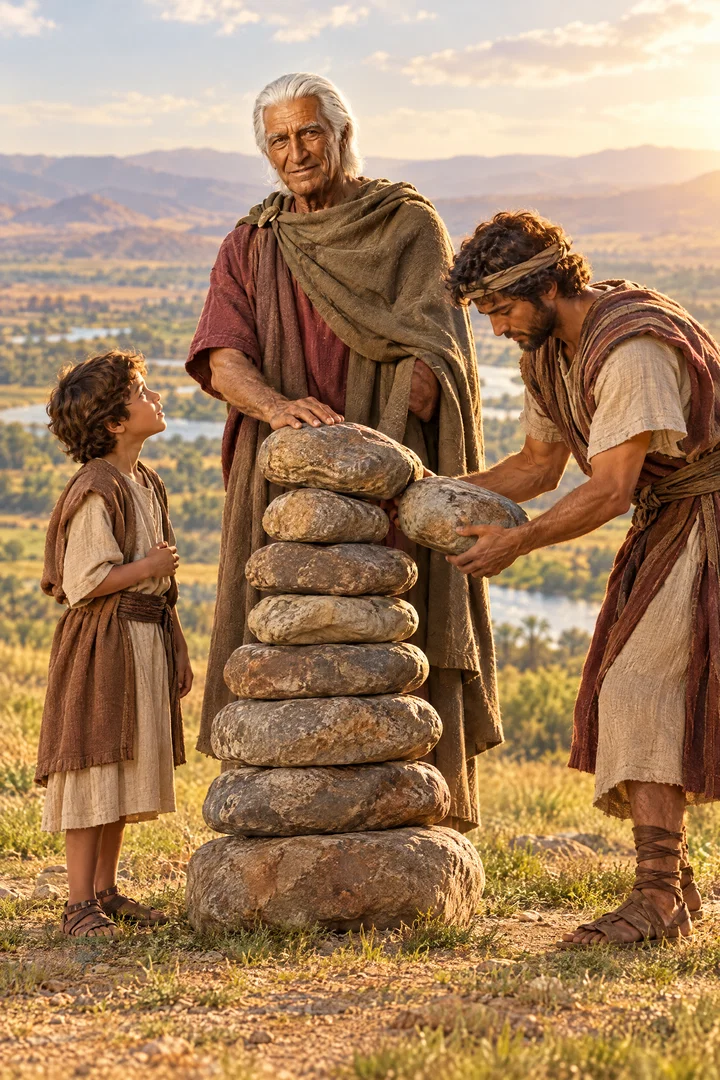
And Joshua set up twelve stones in the midst of Jordan, in the place where the feet of the priests which bare the ark of the covenant stood: and they are there unto this day.
Translations
And Joshua set up twelve stones in the middle of Jordan, in the place where the feet of the priests which bore the ark of the covenant stood: and they are there to this day.
King James Version, KJV Cambridge Paragraph Bible
And Joshua set up twelve stones in the midst of Jordan, in the place where the feet of the priests which bare the ark of the covenant stood: and they are there unto this day.
And Joshua set up twelve stones in the midst of Jordan, in the place where the feet of the priests who bore the ark of the covenant stood: and they are there to this day.
And Joshua set up twelve stones in the midst of Jordan, in the place where the feet of the priests which bare the ark of the covenant stood: and they are there, unto this day.
And Joshua set up twelve stones in the midst of the Jordan, in the place where the feet of the priests that bare the ark of the covenant stood: and they are there unto this day.
even the twelve stones hath Joshua raised up out of the midst of the Jordan, the place of the standing of the feet of the priests bearing the ark of the covenant, and they are there unto this day.
And twelve stones did Joshua set up in the midst of the Jordan, in the place where the feet of the priests who bore the ark of the covenant had stood firm; and they are there to this day.
Twelve stones also, did Joshua set up in the midst of the Jordan, in the place where stood the feet of the priests who were bearing the ark of the covenant,—and they have remained there until this day.
Berean Standard Bible, Majority Standard Bible
Joshua also set up twelve stones in the middle of the Jordan, in the place where the priests who carried the ark of the covenant stood. And the stones are there to this day.
Joshua set up twelve stones in the middle of the Jordan, in the place where the feet of the priests who bore the ark of the covenant stood; and they are there to this day.
And Joshua put up twelve stones in the middle of Jordan, where the feet of the priests who took up the ark of the agreement had been placed: and there they are to this day.
And Ioshua set vp twelue stones in the middes of Iorden, in the place where the feete of the Priests, which bare the Arke of the couenant stood, and there haue they continued vnto this day.
Douay-Rheims (Challoner revision)
And Josue put other twelve stones in the midst of the channel of the Jordan, where the priests stood that carried the ark of the covenant: and they are there until this present day.
Pictures
Cross-references
- Joshua 3:17
And the priests that bare the ark of the covenant of the LORD stood firm on dry ground in the midst of Jordan, and all the Israelites passed over on dry ground, until all the people were passed clean over Jordan.
The priests stand in the Jordan as Israel crosses on dry ground, the crossing the stones memorialize.
- Joshua 4:21-24
And he spake unto the children of Israel, saying, When your children shall ask their fathers in time to come, saying, What mean these stones?
The stones prompt future generations to remember God’s mighty hand in the Jordan crossing.
- Joshua 3:13
And it shall come to pass, as soon as the soles of the feet of the priests that bear the ark of the LORD, the Lord of all the earth, shall rest in the waters of Jordan, that the waters of Jordan shall be cut off from the waters that come down from above; and they shall stand upon an heap.
God promised to stop the Jordan when the priests carrying the ark entered it.
- Joshua 3:3
And they commanded the people, saying, When ye see the ark of the covenant of the LORD your God, and the priests the Levites bearing it, then ye shall remove from your place, and go after it.
The people follow the ark as Israel approaches the river.
- Psalms 114:3
The sea saw it, and fled: Jordan was driven back.
Jordan’s retreat recalls Israel’s departure from Egypt.
- 1 Kings 18:31
And Elijah took twelve stones, according to the number of the tribes of the sons of Jacob, unto whom the word of the LORD came, saying, Israel shall be thy name:
Twelve stones represent the tribes of Israel.
- Exodus 14:21-22
And Moses stretched out his hand over the sea; and the LORD caused the sea to go back by a strong east wind all that night, and made the sea dry land, and the waters were divided.
Contrasts the parting of the Jordan with the parting of the Red Sea.
- 1 Samuel 7:12
Then Samuel took a stone, and set it between Mizpeh and Shen, and called the name of it Eben-ezer, saying, Hitherto hath the LORD helped us.
Samuel’s stone marked Israel’s deliverance.
- Genesis 28:18
And Jacob rose up early in the morning, and took the stone that he had put for his pillows, and set it up for a pillar, and poured oil upon the top of it.
Both Joshua and Jacob set up a stone to mark a memorable experience.
Commentary
Each commentary is drawn from primary sources: the writings of Ellen G. White and Adventist pioneers and periodicals. Each commentary is separate. Its own words are not a quotation; follow the references to read the source passages.
Ellen G. White
7 sources
Joshua set up twelve stones in the midst of the Jordan, taken from the riverbed, in the very place where the feet of the priests bearing the ark of the covenant stood while the people crossed over.4T 158.2PP 484.3SG4 59.2–3PK 151.1–2 The twelve-stone memorial is also recalled as set up at Gilgal to commemorate the crossing.ST Jul 27, 1882PP 613.3–614.2 The twelve stones stand for Israel's twelve tribes, one stone for each tribe.RH Sep 25, 1913PK 151.1–2
The setting is Israel's miraculous passage through the Jordan on dry ground into the promised land.4T 158.2PP 484.3SG4 59.2–3RH Sep 25, 1913ST Jul 27, 1882 The memorial was set up by divine direction.PP 613.3–614.2 The stones remained there as a lasting memorial and witness to the miracle, as expressed by the phrase unto this day.4T 158.2SG4 59.2–3
The stones mark the covenant the Lord made with Israel as they crossed the Jordan into the promised land.RH Sep 25, 1913PK 151.1–2 The stones were meant to preserve the memory of God's deliverance and mighty power, prompting the people to tell the history to their children and grandchildren through successive generations, so that all peoples might know His power and Israel would revere Him always.4T 158.2PP 484.3 Gilgal, associated with the memorial, was Israel's first encampment in the promised land and a place marked by important events in the nation's history.PP 613.3–614.2 Elijah's rebuilding of the altar with twelve stones was a reminder of and showed respect for Israel's covenant with God recalled by the Jordan stones.RH Sep 25, 1913PK 151.1–2
Sources
Pioneers and periodicals
13 sources
Joshua 4:9 records a second memorial of the crossing, set up in the Jordan itself in the place where the priests bearing the ark stood while God held back the river.RH Sep 25, 1913ST Jul 21, 1909ST Feb 3, 1904 Twelve men took twelve stones, one for each tribe, from the dry bed in the midst of the stream opposite Jericho, where the flood stood as a wall while the whole host passed over in trust and exact obedience.RH Sep 25, 1913ST Jul 21, 1909 The stones were set by faith amid the rushing waters and held there by the power of God alone, to stay as a constant witness from generation to generation to His power.RH Nov 23, 1905RH Dec 26, 1907ST Mar 2, 1915 Like the Passover, the feast of Tabernacles, baptism and the Lord's Supper, this memorial was instituted together with the event it marked, proving the Sabbath commemorating Creation was instituted at Creation and not in the wilderness of Sin.RH Feb 3, 1852ST Mar 11, 1880 The crossing pictures Jesus bringing His people out of the wilderness of sin, through the judgment, and into the heavenly Canaan, and its record was given not for wonder but that people may experience the living God's power in daily life.ST Mar 15, 1910RH Dec 9, 1902
Jordan Crossing Remembered
The verse belongs to the account of Israel's impressive passage through the Jordan and reconsecration to God.ST Mar 25, 1913 That account covers the preparation for passing over Jordan and the crossing at full flood near the beginning of the book in about 1451 B.C., the same year Moses died, in a book written at the close of Joshua's life about 1427 B.C.ST Mar 25, 1913 Joshua was Moses' lieutenant whose name signifies the same as Jesus in Greek, Saviour, and in leading Israel he was a type of the Lord.ST Mar 25, 1913 At about eighty years old he began his greatest work of leading the people through the Jordan to divide the land to them and set them to conquer all foes and find the promised rest, with the Captain of Jehovah's hosts with him in victory.ST Mar 21, 1911ST Mar 25, 1913
Twelve men took twelve stones, one for each tribe, from the dry bed in the midst of the stream where the priests bearing the ark of the covenant with its mercy-seat stood firm opposite Jericho.RH Sep 25, 1913ST Jul 21, 1909 There the flood drew asunder and stood as a firm wall while the vast host of men, women, and children passed over to liberty, home, and conquest in trust, submission, fearlessness, and exact obedience.ST Jul 21, 1909 The stones mark the covenant the Lord made with Israel there.RH Sep 25, 1913
The verse records a second memorial of the crossing, set in the Jordan in the place where the priests stood with the ark, marking where God held back the river while the people crossed.ST Feb 3, 1904 It is also recalled as the setting up of twelve stones at Gilgal to commemorate the miraculous crossing of the Jordan into the promised land.ST Jul 27, 1882
Memorial Witness and Teaching
The twelve stones in the midst of the Jordan are a memorial that began with the event they commemorate, the standing of the priests bearing the ark in the river at the crossing.RH Feb 3, 1852ST Mar 11, 1880 They were set up at the time of the passage through the river, and did not come later than the event.RH Feb 3, 1852ST Mar 11, 1880 Like the Passover, the feast of Tabernacles, baptism, the Lord's Supper and other Bible memorials, they show that a memorial is instituted together with the event it marks.RH Feb 3, 1852ST Mar 11, 1880 Therefore the Sabbath commemorating Creation must have been instituted at Creation and not in the wilderness of Sin.RH Feb 3, 1852
God's people were directed to set up monuments marking special experiences in which He had worked for them, so they would remember His deeds and not forget Him.RH Dec 26, 1907 The stones served as such a waymark to help Israel remember God's power and past guidance.RH Nov 23, 1905RH Dec 26, 1907 The ark and its law represented God's throne and government, which no earthly power could overcome, so those who followed God's law were assured of triumph.ST Feb 3, 1904
The twelve stones were set up by faith in the middle of the bed of the Jordan and held in position amid the rushing, whirling waters by the power of God alone.ST Mar 2, 1915 They were to stay there as a constant witness from generation to generation to God's power.ST Mar 2, 1915 In the same way Israel was placed in Canaan in the highway of nations, with territory reaching to the river of Egypt on the south and to the Euphrates on the north, where armies moving east to west and north to south would sweep back and forth across their land.ST Mar 2, 1915 Israel would be kept in that possession only by that same power of God, and as the stones kept in the Jordan witnessed to God's power, Israel was to spread the knowledge of the truth and be a witness to all the conquering nations in each generation to come.ST Mar 2, 1915
The crossing pictures Jesus bringing His people out of the wilderness of sin, through the judgment, and into the heavenly Canaan.ST Mar 15, 1910 The twelve stones, one for each tribe, mark the covenant the Lord made with Israel there, and Elijah's use of twelve stones when rebuilding the altar shows respect for Israel's covenant with God.RH Sep 25, 1913 The account of crossing the Jordan was recorded not merely to inspire wonder or curiosity but to teach lessons through which people can experience the living God's power in daily life, since its events are not confined to an antiquated age.RH Dec 9, 1902
Sources