Joshua 4:21
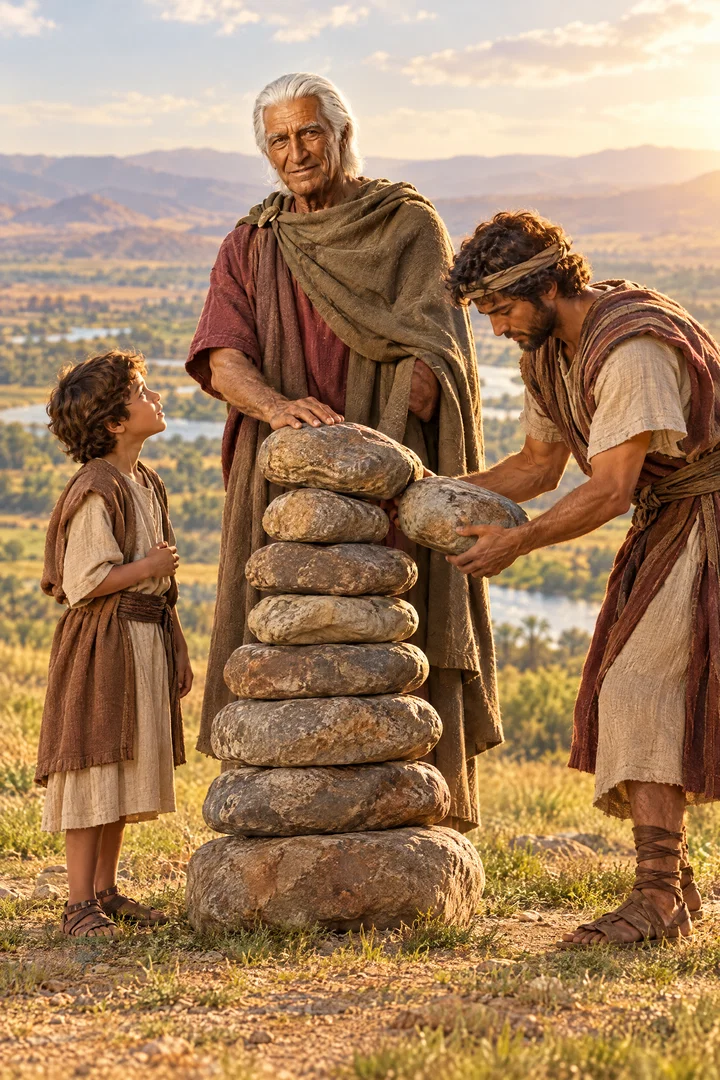
And he spake unto the children of Israel, saying, When your children shall ask their fathers in time to come, saying, What mean these stones?
Translations
American King James Version, Webster Bible
And he spoke to the children of Israel, saying, When your children shall ask their fathers in time to come, saying, What mean these stones?
King James Version, KJV Cambridge Paragraph Bible, Revised Version, American Standard Version
And he spake unto the children of Israel, saying, When your children shall ask their fathers in time to come, saying, What mean these stones?
And he speaketh unto the sons of Israel, saying, 'When your sons ask their fathers hereafter, saying, What [are] these stones?
And he spoke to the children of Israel, saying, When your children hereafter ask their fathers, saying, What [mean] these stones?
Then spake he unto the sons of Israel, saying,—When your sons shall ask, in time to come, of their fathers, saying,—What mean these stones?
Berean Standard Bible, Majority Standard Bible
Then Joshua said to the Israelites, “ In the future, when your children ask their fathers, ‘ What is the meaning of these stones?’
He spoke to the children of Israel, saying, “ When your children ask their fathers in time to come, saying, ‘ What do these stones mean?’
And he said to the children of Israel, When your children say to their fathers in time to come, What is the reason for these stones?
And he spake vnto ye childre of Israel, saying, When your children shall aske their fathers in time to come, and say, What meane these stones?
Douay-Rheims (Challoner revision)
And said to the children of Israel: When your children shall ask their fathers, tomorrow, and shall say to them: What mean these stones?
Pictures
Cross-references
- Joshua 4:6-7
That this may be a sign among you, that when your children ask their fathers in time to come, saying, What mean ye by these stones?
The stones were set up to remember the Jordan’s waters stopping before the ark.
- Exodus 14:21-22
And Moses stretched out his hand over the sea; and the LORD caused the sea to go back by a strong east wind all that night, and made the sea dry land, and the waters were divided.
The Jordan crossing recalls God drying up the Red Sea for Israel.
- Deuteronomy 6:20-23
And when thy son asketh thee in time to come, saying, What mean the testimonies, and the statutes, and the judgments, which the LORD our God hath commanded you?
Both require explaining God's acts to children.
- Joshua 3:13-17
And it shall come to pass, as soon as the soles of the feet of the priests that bear the ark of the LORD, the Lord of all the earth, shall rest in the waters of Jordan, that the waters of Jordan shall be cut off from the waters that come down from above; and they shall stand upon an heap.
The Jordan stopped while Israel crossed on dry ground.
- Exodus 12:25-27
And it shall come to pass, when ye be come to the land which the LORD will give you, according as he hath promised, that ye shall keep this service.
Both require explaining a memorial to children.
- Exodus 13:8-15
And thou shalt shew thy son in that day, saying, This is done because of that which the LORD did unto me when I came forth out of Egypt.
Both require explaining God’s deliverance to children.
- Deuteronomy 6:7
And thou shalt teach them diligently unto thy children, and shalt talk of them when thou sittest in thine house, and when thou walkest by the way, and when thou liest down, and when thou risest up.
Both call for diligent instruction of children at home.
Commentary
Each commentary is drawn from primary sources: the writings of Ellen G. White and Adventist pioneers and periodicals. Each commentary is separate. Its own words are not a quotation; follow the references to read the source passages.
Ellen G. White
3 sources
The stones set up at Gilgal after Israel crossed the Jordan were a lasting memorial.Lt 292, 1908, par. 18PP 484.34T 158.2 The memorial was designed so that in time to come children would ask what the stones meant.Lt 292, 1908, par. 18PP 484.34T 158.2 When asked, parents were to tell their children and grandchildren how God delivered Israel by bringing them across the Jordan on dry ground.Lt 292, 1908, par. 18PP 484.34T 158.2 The stones were to stand as a witness to God's mighty power.PP 484.3
Retelling the crossing was to teach future generations to fear God always.PP 484.3 The account of preparing for and crossing the Jordan preserves lessons from God's dealings with His people so later generations could remember and learn from them.Lt 292, 1908, par. 18 Repeating the account was to keep the memory of the miracle alive and impress it on the children.4T 158.2
Sources
Pioneers and periodicals
10 sources
The verse stands in the opening story of the book of Joshua in chapters 1 to 4, which record the preparation for passing over the Jordan and the crossing of the river at full flood.ST Mar 25, 1913 That opening story is dated to about 1451 before Christ, in the same year Moses died, with the book itself written near the close of Joshua's life about 1427 before Christ.ST Mar 25, 1913 Joshua began this greatest work when about eighty years of age, as one of the two of his generation who wholly followed the Lord through the forty years of temptation and wilderness.ST Mar 21, 1911 His name means saviour, the same as Jesus in Greek, and in leading Israel through the Jordan on the way to dividing the land, conquering foes and finding the promised rest he was a type of the Lord, with the victory done because the Captain of Jehovah's hosts was with him.ST Mar 21, 1911ST Mar 25, 1913
Twelve stones were taken by twelve men, one from each tribe, from the midst of the Jordan where the priests' feet stood firm after the Lord parted the waters.RH Aug 1, 1907 They were brought up and pitched by Joshua in Gilgal on the day Israel passed through the angry waters into the land of promise after forty years in the wilderness.RH Aug 1, 1907RH Feb 18, 1904 The waters stood and rose up upon a heap and were cut off before the ark of the Lord, so that all Israel passed through the bed of the river on dry ground.RH Apr 21, 1851RH Feb 20, 1866 The Lord thus dried up the Jordan as He had dried the Red Sea.RH Aug 1, 1907
The stones were set up as a lasting memorial for future generations, meant to cause children in time to come to ask their fathers what the stones mean, so they could learn their significance and remember God's power to deliver and lead His people and God's help.RH Apr 21, 1851RH Aug 1, 1907RH Jul 28, 1904RH Nov 18, 1909 They were meant to prompt that question in the home circle and in later generations, creating an occasion to recount the crossing and God's deliverance.RH Apr 12, 1906RH Feb 18, 1904 The appointed answer fathers were to give is that Israel came over Jordan on dry land because the Lord dried up its waters until they were passed over.RH Aug 1, 1907RH Feb 20, 1866 That answer was to be given that all the people of the earth might know the hand of the Lord that it is mighty and that they might fear the Lord forever.RH Aug 1, 1907 Those who passed over needed no further evidence, because to those who witness a fact the fact itself is evidence, while to all others who did not see it a memorial is the best evidence that can be given; the Sabbath is such a memorial.RH Feb 20, 1866
Explaining the significance of the stones to children in the home circle is part of diligently teaching them God's fear, God's truth and God's providence at home.RH Feb 18, 1904 As with the stones, a building such as the Washington Sanitarium was not erected by men and does not stand as a monument to the building committee, architect, superintendent, workmen, physicians or others instrumental in its completion, who were simply instruments used by the Lord, but stands as a memorial for God to glorify His name and to prompt the same question and answer.RH Aug 1, 1907 Likewise later workers can remember and tell how God helped His servants through difficulties.RH Apr 12, 1906 The account of the crossing is written for learning rather than merely to inspire wonder or curiosity, showing the acts of the living God whose power to deliver remains relevant to daily life.RH Jul 28, 1904RH Dec 9, 1902
Sources