Deuteronomy 27:12
These shall stand upon mount Gerizim to bless the people, when ye are come over Jordan; Simeon, and Levi, and Judah, and Issachar, and Joseph, and Benjamin:
Translations
These shall stand on mount Gerizim to bless the people, when you are come over Jordan; Simeon, and Levi, and Judah, and Issachar, and Joseph, and Benjamin:
These shall stand upon mount Gerizim to bless the people, when ye are come over Jordan; Simeon, and Levi, and Judah, and Issachar, and Joseph, and Benjamin:
These shall stand upon mount Gerizzim to bless the people, when ye are come over Jordan; Simeon, and Levi, and Judah, and Issachar, and Joseph, and Benjamin:
These shall stand upon mount Gerizim to bless the people, when ye have come over Jordan; Simeon, and Levi, and Judah, and Issachar, and Joseph, and Benjamin:
These shall stand upon mount Gerizim to bless the people, when ye are passed over Jordan; Simeon, and Levi, and Judah, and Issachar, and Joseph, and Benjamin:
These shall stand upon mount Gerizim to bless the people, when ye are passed over the Jordan: Simeon, and Levi, and Judah, and Issachar, and Joseph, and Benjamin.
'These do stand, to bless the people, on mount Gerizzim, in your passing over the Jordan: Simeon, and Levi, and Judah, and Issachar, and Joseph, and Benjamin.
These shall stand to bless the people upon mount Gerizim, when ye have gone over the Jordan: Simeon, and Levi, and Judah, and Issachar, and Joseph, and Benjamin.
These, shall stand to bless the people upon Mount Gerizim, when ye have passed over the Jordan,—Simeon and Levi and Judah, and Issachar and Joseph and Benjamin;
Berean Standard Bible, Majority Standard Bible
“ When you have crossed the Jordan, these tribes shall stand on Mount Gerizim to bless the people: Simeon, Levi, Judah, Issachar, Joseph, and Benjamin.
“ These shall stand on Mount Gerizim to bless the people, when you have crossed over the Jordan: Simeon, Levi, Judah, Issachar, Joseph, and Benjamin.
These are to take their places on Mount Gerizim for blessing the people when you have gone over Jordan: Simeon and Levi and Judah and Issachar and Joseph and Benjamin;
These shall stand vpon mount Gerizzim, to blesse the people when ye shall passe ouer Iorden: Simeon, and Leui, and Iudah, and Issachar, and Ioseph, and Beniamin.
Douay-Rheims (Challoner revision)
These shall stand upon mount Garizim to bless the people, when you are passed the Jordan: Simeon, Levi, Juda, Issachar, Joseph, and Benjamin.
Pictures
Cross-references
- Joshua 8:33-34
And all Israel, and their elders, and officers, and their judges, stood on this side the ark and on that side before the priests the Levites, which bare the ark of the covenant of the LORD, as well the stranger, as he that was born among them; half of them over against mount Gerizim, and half of them over against mount Ebal; as Moses the servant of the LORD had commanded before, that they should bless the people of Israel.
Israel gathers at Gerizim and Ebal, where Joshua proclaims the covenant blessings and curses.
- John 4:20
Our fathers worshipped in this mountain; and ye say, that in Jerusalem is the place where men ought to worship.
The Samaritan woman identifies Mount Gerizim as the place of worship.
- Deuteronomy 11:29
And it shall come to pass, when the LORD thy God hath brought thee in unto the land whither thou goest to possess it, that thou shalt put the blessing upon mount Gerizim, and the curse upon mount Ebal.
Mount Gerizim is designated for blessing, in contrast to Mount Ebal for cursing.
- Joshua 8:30-32
Then Joshua built an altar unto the LORD God of Israel in mount Ebal,
Joshua built an altar and wrote the law on stones after crossing the Jordan.
- Deuteronomy 28
And it shall come to pass, if thou shalt hearken diligently unto the voice of the LORD thy God, to observe and to do all his commandments which I command thee this day, that the LORD thy God will set thee on high above all nations of the earth:
Sets out blessings for obedience and curses for departing from God.
- Deuteronomy 27:2-4
And it shall be on the day when ye shall pass over Jordan unto the land which the LORD thy God giveth thee, that thou shalt set thee up great stones, and plaister them with plaister:
writing commandments on plastered stones after Jordan
- Deuteronomy 11:26-28
Behold, I set before you this day a blessing and a curse;
The blessing-and-curse rule is carried out in the Gerizim-Ebal pronouncement.
- Genesis 48:5-20
And now thy two sons, Ephraim and Manasseh, which were born unto thee in the land of Egypt before I came unto thee into Egypt, are mine; as Reuben and Simeon, they shall be mine.
Joseph’s sons receive a double blessing.
- Genesis 48:22
Moreover I have given to thee one portion above thy brethren, which I took out of the hand of the Amorite with my sword and with my bow.
Jacob gave Joseph a portion of the land.
- Genesis 49:10
The sceptre shall not depart from Judah, nor a lawgiver from between his feet, until Shiloh come; and unto him shall the gathering of the people be.
The poem identifies Judah as a king.
- Joshua 24:1
And Joshua gathered all the tribes of Israel to Shechem, and called for the elders of Israel, and for their heads, and for their judges, and for their officers; and they presented themselves before God.
Joshua gathers Israel at Shechem to renew their commitment.
Commentary
Each commentary is drawn from primary sources: the writings of Ellen G. White and Adventist pioneers and periodicals. Each commentary is separate. Its own words are not a quotation; follow the references to read the source passages.
Ellen G. White
8 sources
This instruction belongs to Moses' directions for Israel's covenant ceremony to take place after crossing the Jordan and entering the promised land, forming part of the plain statement of the blessings of obedience in Deuteronomy 26 through 28.RH Dec 25, 1900Ms 67, 1907, par. 3Ms 7, 1904, par. 126–128ST May 12, 1881 Six tribes — Simeon, Levi, Judah, Issachar, Joseph, and Benjamin — were commanded to stand upon Mount Gerizim to bless the people when Israel came over Jordan.ST May 12, 1881Ms 135, 1899, par. 7 The word spoken is the voice of Christ, Jesus enshrouded in the pillar of cloud speaking with His own voice and not the voice of man, to keep the people from forgetting.Ms 67, 1907, par. 3Ms 68, 1900, par. 3–5
Its directions express the principles of God's law, the law of God's kingdom, so that minds are not left in ignorance and uncertainty, and they make the people's continuing obligations clear.RH Dec 25, 1900Ms 68, 1900, par. 3–5 The arrangement shows God's particular care over forgetful Israel to make His law familiar and impress it on the people by teaching with repetition from two prominent positions, joined to writing the commandments on plastered stones.Lt 162, 1900, par. 16–176MR 373.3–374.1Ms 7, 1904, par. 126–128 In the ceremony the people were to repeat God's commands and hear the advantages of blessing pronounced from Mount Gerizim, appointed as the mount of blessing for the obedient, and the disadvantages of cursing pronounced from Mount Ebal for the disobedient.Lt 162, 1900, par. 16–176MR 373.3–374.1Ms 7, 1904, par. 126–128 After each declaration the congregation assented to the specifications and by accepting the conditions placed themselves under solemn responsibility to fulfill them.Lt 162, 1900, par. 16–17
It plainly states that obedience to God's commandments brings prosperity and present and future good while disobedience results in a curse.RH Dec 25, 1900Ms 68, 1900, par. 3–5Lt 162, 1900, par. 16–17 That setting of blessing and curse before the people was meant to deter from transgression and encourage in obedience, because God takes no pleasure in the death of the wicked but takes the greatest pleasure in those who turn from sin.Lt 162, 1900, par. 16–17 It lays a never-ceasing obligation on all whom God has blessed with life and health and temporal and spiritual advantages to keep and do His statutes and judgments with all the heart and soul.Ms 68, 1900, par. 3–5 When God specially favors His people they are to publicly acknowledge it so that God's name is glorified as a testimony that His Word is verity and truth, and the statement is to be read carefully.Ms 67, 1907, par. 3Ms 68, 1900, par. 3–5 Mount Gerizim and Mount Ebal later stood as witnesses to Israel's solemn vows, as Joshua rehearsed the blessings for obedience and curses for disobedience before the assembled people in the renewal at Shechem before his death.ST May 12, 1881Ms 135, 1899, par. 7
Sources
Pioneers and periodicals
29 sources
These shall stand on Mount Gerizim to pronounce blessing on the people after crossing the Jordan into the promised land were Simeon, Levi, Judah, Issachar, Joseph, and Benjamin.ST Mar 11, 1908RH Jan 4, 1912ST Jul 4, 1899 The appointment belongs to the solemn blessings from Gerizim and curses from Ebal in the covenant renewal of Deuteronomy 27-30, setting before Israel a blessing if they obeyed God's commandments and a curse if they disobeyed and turned after other gods.RH Dec 25, 1900ST Mar 11, 1908RH Feb 24, 1916ST Sep 15, 1887 The ark with priests and Levites rested in the valley between Gerizim and Ebal near Shechem, and the priests turned first toward Gerizim to speak the blessing, which the tribes answered with loud amens.ST Apr 7, 1909RH Jan 4, 1912RH Apr 29, 1875ST Feb 14, 1884ST Sep 8, 1898 The directions express the principles of God's law and the people's solemn obligation, for the curses that follow are for transgressing His commandments and are violations of the ten commandments, while blessing comes through God's presence to the obedient who heed His voice by faith with an obedient heart.RH Dec 25, 1900ST Sep 15, 1887ST Mar 8, 1910ST Aug 14, 1901ST Aug 14, 1901 Together with the tribes on Ebal, the response at the ark represents the final judgment, when choices concerning God's law have formed character and placed all among the blessed or the cursed, a picture of the daily choice between holiness and sin that fashions destiny for all hereafter.ST Apr 7, 1909ST Apr 4, 1911ST Jul 4, 1899ST Nov 29, 1899
Blessing Ceremony at Gerizim
These shall stand upon Mount Gerizim to bless the people after coming over Jordan into the promised land: Simeon, and Levi, and Judah, and Issachar, and Joseph, and Benjamin.ST May 12, 1881ST Mar 11, 1908ST Jul 4, 1899ST Feb 14, 1884RH Jul 9, 1867 The appointment belongs to the record of the solemn blessings and curses pronounced from Mount Gerizim and Mount Ebal.ST May 12, 1881ST Mar 11, 1908 The people answered the blessing with a great amen, in contrast with the curse proclaimed from Mount Ebal, with Gerizim as the mount of blessing set against Ebal as the mount of cursing.RH Jan 4, 1912ST Jul 4, 1899RH Jul 9, 1867 Resting at Shechem between the mountains followed the command concerning the blessing ceremony on Gerizim and the corresponding ceremony on Ebal.ST Feb 14, 1884
The verse belongs to the section of Deuteronomy, chapters 27 to 30, that renews the covenant.RH Feb 24, 1916 It is part of the blessings and the curses in Deuteronomy 27 and 28 showing what would come upon God's children if they were faithful to God or disobedient.ST Mar 11, 1908 It belongs to Moses' instructions for Israel's covenant ceremony, including the blessings for obedience and curses for disobedience that Joshua later rehearsed before the assembled people.ST May 12, 1881
The standing of six tribes on Gerizim where the blessings of the law were pronounced was part of Israel's first duty in the promised land, alongside the altar and law inscription on Mount Ebal. The commands about writing on stones after coming over Jordan were fulfilled when Joshua built an altar and wrote on it after Israel passed over Jordan.ST Oct 16, 1884 What is spoken of in 2 Corinthians 3 does not refer to anything commanded there, but to what took place when Moses came down from forty days and forty nights with the Lord with the two tables of stone in his hands with his face shining so the people could not look on it.ST Oct 16, 1884
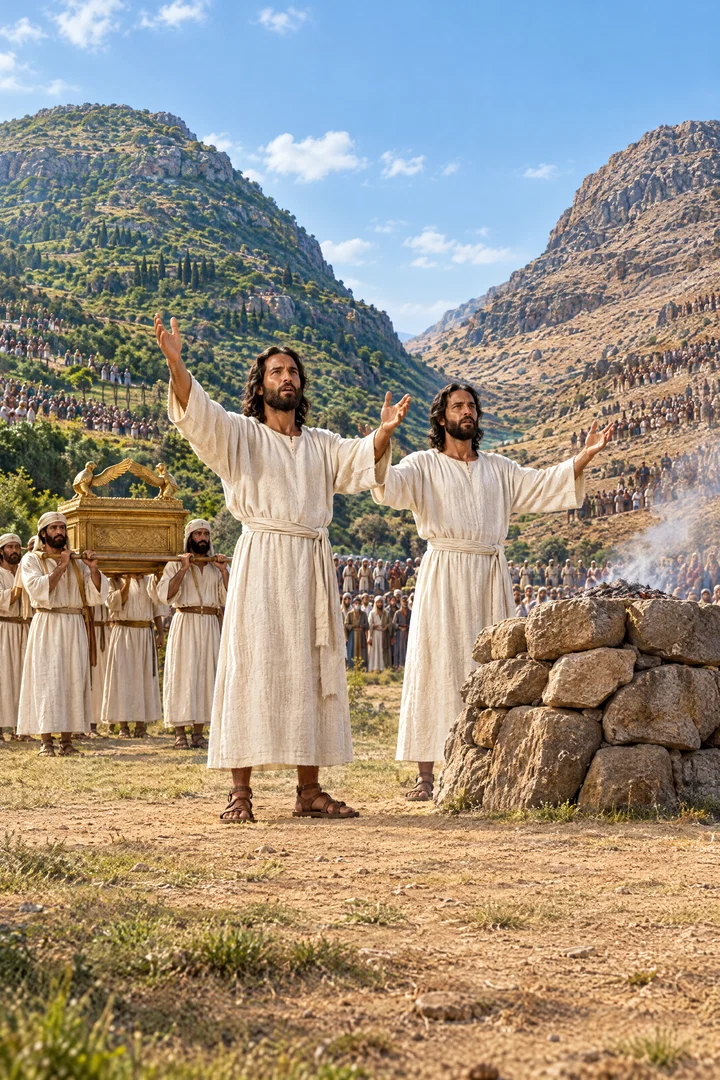
Mount Gerizim and Mount Ebal rise nearly a thousand feet above the green, watered valley of Sychar, with the hosts of Israel filling both heights as mounts of blessing and of cursing.RH Apr 29, 1875 Shechem lies between the mountains, and Gerizim and Ebal overlook the valley near Shechem.ST Feb 14, 1884ST Sep 8, 1898 The ark of the covenant with the priests and Levites rested midway in the valley between them under the Lord's Shekinah that led through the Red Sea, the desert, and Jordan, its cherubim and mercy-seat of pure gold lit by sunbeams.RH Apr 29, 1875 At the leader's command the priests recited the blessings and curses promised in Moses' law to the tribes ranged on each hand, turning first unto Gerizim to speak the blessing that blessed is the man that never makes a graven image, which the tribes on Gerizim answered with loud amens.RH Jan 4, 1912RH Apr 29, 1875 All the people gave assent with fear and awe in an imposing scene that listening children would never forget to their dying day.RH Apr 29, 1875
The tribes on Gerizim were the children of Rachel sharing its high honor together with all of Leah's sons save Zebulun and Reuben, while all the rest stood on Mount Ebal assenting to the curses.RH Apr 29, 1875 Judah stood there as kingly, Levi as serving in ministry, and Joseph's sons as receiving a double blessing.RH Jan 4, 1912 Together with the tribes on Mount Ebal, their response at the ark represents the final judgment, when all people's choices concerning God's law have formed their characters and placed them among the blessed or the cursed, and God's wisdom and justice are fully vindicated.ST Apr 7, 1909
Obedience and God's Blessing
The setting of blessing on Gerizim and cursing on Ebal carries out the setting before the people of blessing if they obey the commandments of the Lord and cursing if they disobey and turn aside to go after other gods.ST Sep 15, 1887 The chapter states plainly the blessings of obedience and the fearful curses brought by transgression, showing what would come upon God's children in faithfulness or in disobedience.RH Dec 25, 1900ST Mar 8, 1910 Its directions express the principles of God's law and make clear the people's solemn responsibilities and continuing obligations.RH Dec 25, 1900ST Sep 15, 1887ST Mar 8, 1910 The curses that follow are pronounced for transgressing His commandments, and are all violations of the ten commandments.ST Sep 15, 1887
These were conditions set before Israel, which the nation afterward refused to meet when it turned from God.ST Jul 22, 1913 The ceremony does not prove that the law failed because it could not give life or pardon, for the law was not given to pardon sinners but to define righteousness and to justify those who do its requirements.ST Feb 20, 1896 Sinful people need salvation by faith in Christ, who forgives sin and imputes His righteousness so as to bring believers into harmony with the law.ST Feb 20, 1896
Gerizim is the mount of blessing set against Ebal as the mount of cursing, yet its holiness as a place of worship came from God's blessing there and not from any power inherent in the mountain itself.ST Aug 14, 1901ST Aug 14, 1901 Blessing comes through God's presence and not through the place, and its continuance depends on harmony with Him by faith with an obedient heart.ST Aug 14, 1901ST Aug 14, 1901 God's blessings are for the obedient and continue as the people heed and obey His voice, while blessings given even to the sinful are meant to lead them to repentance.ST Aug 14, 1901ST Aug 14, 1901 Rejecting His word and persisting in disobedience turns those blessings into curses and drives away His presence.ST Aug 14, 1901ST Aug 14, 1901 The consequences of blessing from Gerizim and cursing from Ebal are needed as motives to do what is known to be right.RH Jul 9, 1867
Prophecy, Choice, and Application
Together with the tribes on Ebal, the answering response at the ark stands for the final judgment, when every person's choices about God's law have formed character and fixed place among the blessed or the cursed, and God's wisdom and justice are fully vindicated.ST Apr 7, 1909 The curses spoken from Ebal have been literally fulfilled.ST Sep 8, 1898 The blessings were read upon Mount Gerizim, the mount in Samaria claimed as the true place of worship where ancestors had worshiped for more than four hundred years before Christ.ST Sep 3, 1894ST Sep 3, 1894 That claim was set by the Samaritan woman against Jerusalem in the dispute with the Jews over the true place of worship, yet God had in fact chosen Jerusalem.ST Sep 3, 1894ST Sep 3, 1894
Gerizim is the starry mount of blessing set against cloudy Ebal as the mount of cursing, a picture of the choice between holiness and righteousness and sin.ST Apr 4, 1911ST Jul 4, 1899ST Nov 29, 1899ST Dec 16, 1903ST Jan 30, 1896 Choosing in this day fashions destiny for all hereafter, and choices made each day bring blessing or cursing even now.ST Apr 4, 1911ST Jul 4, 1899ST Nov 29, 1899ST Jan 30, 1896ST Mar 19, 1896 The dews of blessing are called down from Gerizim by choosing the righteous side where justice, truth, and freedom turn the scale and by acting justly.ST Apr 4, 1911ST Jun 25, 1912ST Jun 30, 1898 The bolts of cursing are called down from Ebal by choosing sin, letting evil triumph and robber wrong prevail, and losing freedom.ST Apr 4, 1911ST Jun 25, 1912ST Jun 30, 1898 Applied now, the choice is whether the land keeps freedom or bears church-and-state union crystallized into law, which spells ruin to the government.ST Jun 25, 1912
Gerizim as the voice of blessing standing against Ebal's voice of cursing shows that God speaks through different messengers in different ways, one threatening judgment and pointing to torment ascending forever and another promising divine love and tenderly calling sinners to turn from death to life.RH Aug 24, 1869 Gerizim is also a picture of the personal blessing found in believing in the one who leads through life's wilderness, intercedes, brings the believer to rest, encourages the tribes, and makes burdens lighter.ST Jun 23, 1898 Those who raise Jehovah's altar and answer the blessing with a great amen receive daily blessings, making the scene a picture of blessing for the new year.RH Jan 4, 1912
Sources