Joshua 8:31
As Moses the servant of the LORD commanded the children of Israel, as it is written in the book of the law of Moses, an altar of whole stones, over which no man hath lift up any iron: and they offered thereon burnt offerings unto the LORD, and sacrificed peace offerings.
Translations
As Moses the servant of the LORD commanded the children of Israel, as it is written in the book of the law of Moses, an altar of whole stones, over which no man has lift up any iron: and they offered thereon burnt offerings to the LORD, and sacrificed peace offerings.
As Moses the servant of the LORD commanded the children of Israel, as it is written in the book of the law of Moses, an altar of whole stones, over which no man hath lift up any iron: and they offered thereon burnt offerings unto the LORD, and sacrificed peace offerings.
as Moses the servant of the Lord commanded the children of Israel, as it is written in the book of the law of Moses, an altar of whole stones, over which no man hath lift up any iron: and they offered thereon burnt offerings unto the Lord, and sacrificed peace offerings.
As Moses the servant of the LORD commanded the children of Israel, as it is written in the book of the law of Moses, an altar of whole stones, over which no man hath lifted up any iron: and they offered upon it burnt-offerings to the LORD, and sacrificed peace-offerings.
as Moses the servant of the LORD commanded the children of Israel, as it is written in the book of the law of Moses, an altar of unhewn stones, upon which no man had lift up any iron: and they offered thereon burnt offerings unto the LORD, and sacrificed peace offerings.
as Moses the servant of Jehovah commanded the children of Israel, as it is written in the book of the law of Moses, an altar of unhewn stones, upon which no man had lifted up any iron: and they offered thereon burnt-offerings unto Jehovah, and sacrificed peace-offerings.
as Moses, servant of Jehovah, commanded the sons of Israel, as it is written in the book of the law of Moses — an altar of whole stones, over which he hath not waved iron — and they cause to go up upon it burnt-offerings to Jehovah, and sacrifice peace-offerings;
as Moses the servant of Jehovah had commanded the children of Israel, as it is written in the book of the law of Moses, an altar of whole stones, over which iron had not been lifted up. And they offered up burnt-offerings on it to Jehovah, and sacrificed peace-offerings.
as Moses, the servant of Yahweh, commanded the sons of Israel, as it is written in the scroll of the law of Moses, an altar of whole stones, whereon had not been wielded any tool of iron,—and they caused to go up thereon, ascending-sacrifices unto Yahweh, and sacrificed peace-offerings.
Berean Standard Bible, Majority Standard Bible
just as Moses the servant of the LORD had commanded the Israelites. He built it according to what is written in the Book of the Law of Moses: “ an altar of uncut stones on which no iron tool has been used.” And on it they offered burnt offerings to the LORD, and they sacrificed peace offerings.
as Moses the servant of the LORD commanded the children of Israel, as it is written in the book of the law of Moses: an altar of uncut stones, on which no one had lifted up any iron. They offered burnt offerings on it to the LORD and sacrificed peace offerings.
In the way ordered by Moses, the servant of the Lord, as it is recorded in the book of the law of Moses, an altar of uncut stones, untouched by any iron instrument: and on it they made burned offerings and peace-offerings to the Lord.
As Moses the seruant of the Lord had commanded the children of Israel, as it is written in the booke of the Lawe of Moses, an altar of whole stone, ouer which no man had lift an yron: and they offered thereon burnt offrings vnto the Lord, and sacrificed peace offerings.
Douay-Rheims (Challoner revision)
As Moses the servant of the Lord had commanded the children of Israel, and it is written in the book of the law of Moses: an altar of unhewn stones which iron had not touched: and he offered upon it holocausts to the Lord, and immolated victims of peace offerings.
Pictures
Cross-references
- Deuteronomy 27:5-7
And there shalt thou build an altar unto the LORD thy God, an altar of stones: thou shalt not lift up any iron tool upon them.
Moses commands an altar of whole stones and offerings, which Joshua carries out.
- Deuteronomy 27:12-13
These shall stand upon mount Gerizim to bless the people, when ye are come over Jordan; Simeon, and Levi, and Judah, and Issachar, and Joseph, and Benjamin:
Moses assigned the tribes to stand on Gerizim and Ebal for the covenant ceremony.
- Deuteronomy 11:29
And it shall come to pass, when the LORD thy God hath brought thee in unto the land whither thou goest to possess it, that thou shalt put the blessing upon mount Gerizim, and the curse upon mount Ebal.
Moses instructed Israel to proclaim blessings and curses at Gerizim and Ebal.
- 2 Corinthians 3:7
But if the ministration of death, written and engraven in stones, was glorious, so that the children of Israel could not stedfastly behold the face of Moses for the glory of his countenance; which glory was to be done away:
Both texts refer to what was written and engraved on stones.
- Deuteronomy 27:2-4
And it shall be on the day when ye shall pass over Jordan unto the land which the LORD thy God giveth thee, that thou shalt set thee up great stones, and plaister them with plaister:
explains writing on plastered stones
- Deuteronomy 27:8
And thou shalt write upon the stones all the words of this law very plainly.
Commands writing the law plainly on stones at the altar.
- Exodus 20:1-17
And God spake all these words, saying,
law Joshua repeated to Israel
- 2 Chronicles 34:14
And when they brought out the money that was brought into the house of the LORD, Hilkiah the priest found a book of the law of the LORD given by Moses.
Reports the discovery of the book of the law.
- Daniel 9:11
Yea, all Israel have transgressed thy law, even by departing, that they might not obey thy voice; therefore the curse is poured upon us, and the oath that is written in the law of Moses the servant of God, because we have sinned against him.
Refers to the law of Moses in a later biblical book.
- Hebrews 10:28
He that despised Moses’ law died without mercy under two or three witnesses:
Refers to the law of Moses in the New Testament.
- 1 Kings 2:3
And keep the charge of the LORD thy God, to walk in his ways, to keep his statutes, and his commandments, and his judgments, and his testimonies, as it is written in the law of Moses, that thou mayest prosper in all that thou doest, and whithersoever thou turnest thyself:
Refers to keeping the law of Moses.
- Revelation 15:3
And they sing the song of Moses the servant of God, and the song of the Lamb, saying, Great and marvellous are thy works, Lord God Almighty; just and true are thy ways, thou King of saints.
God’s righteous ways are recognized and vindicated in his final justice.
- 2 Kings 22:8
And Hilkiah the high priest said unto Shaphan the scribe, I have found the book of the law in the house of the LORD. And Hilkiah gave the book to Shaphan, and he read it.
Records the book of the law being found and read.
Commentary
Each commentary is drawn from primary sources: the writings of Ellen G. White and Adventist pioneers and periodicals. Each commentary is separate. Its own words are not a quotation; follow the references to read the source passages.
Ellen G. White
5 sources
The altar was erected after Achan had been punished and the second advance against Ai had ended in victory.ST May 12, 1881 It belonged to a solemn religious gathering at Shechem held before Israel took possession of its inheritance, with men, women, children and resident strangers present.PP 499.2–3 Because obedience to God was Israel's only hope, Joshua assembled all the people as Moses had commanded.ST May 12, 1881
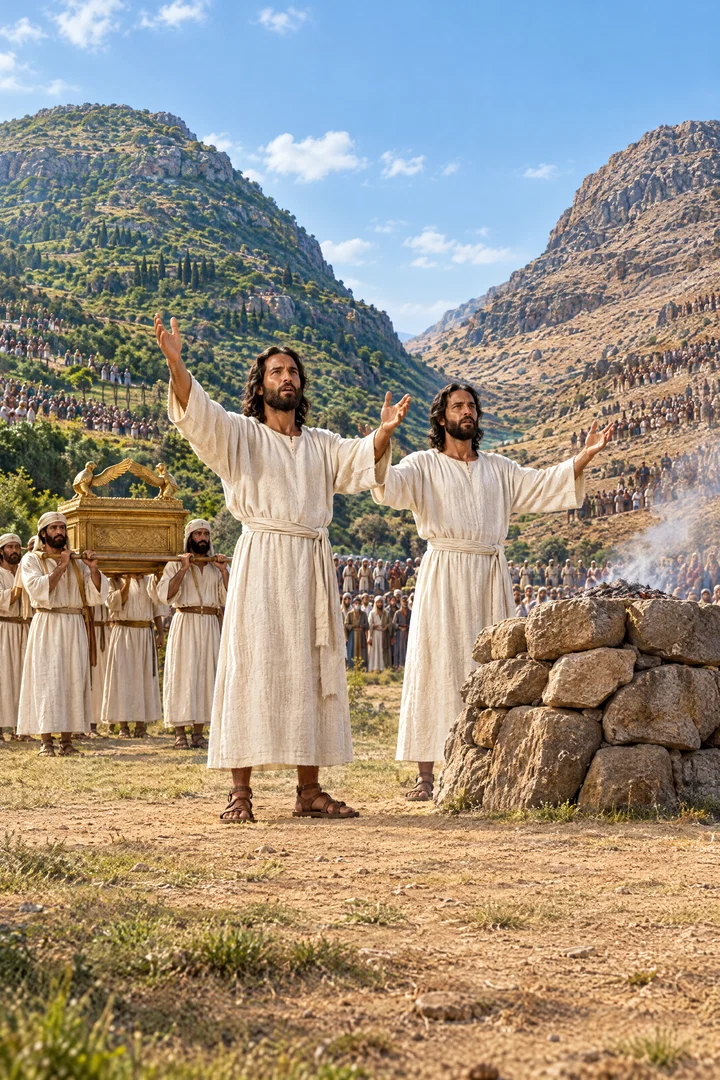
On Mount Ebal he built the altar of whole, unhewn stones over which no iron tool had been lifted, exactly as Moses had commanded, and offered burnt offerings and peace offerings to the Lord upon it.PP 500.2Ms 135, 1899, par. 7PP 522.4 At that gathering he rehearsed the blessings that would follow obedience to the law and the curses that would fall if it were disregarded, repeating the Ten Commandments and also all the statutes and precepts which Moses had recorded.ST May 12, 1881 By this public recognition of the law the people renewed their covenant loyalty to God.PP 499.2–3ST May 12, 1881
The altar stood on the mountain where the curse was pronounced, showing that Israel's transgression of God's law justly brings divine wrath.PP 500.2 The altar and its sacrifices represented the atonement of Christ, through which that judgment would be withheld.PP 500.2 Afterward Ebal and Gerizim stood as witnesses to the solemn vows the people renewed at Shechem before Joshua.PP 522.4
Sources
Pioneers and periodicals
19 sources
In obedience to the command of Moses, Israel built an altar on Mount Ebal of whole, unworked stones over which no iron tool had been lifted, and offered burnt offerings and peace offerings upon it.RH Sep 6, 1864RH Jan 29, 1861 This took place after Israel had crossed the Jordan into Canaan, after the punishment of Achan and the victory over Ai on the second advance, and before the division of the land.RH Jan 29, 1861ST Mar 17, 1909 The altar belonged to the covenant service between Ebal and Gerizim, with the ark at the center and six tribes toward Gerizim for the blessings and six toward Ebal for the curses, where all the blessings and curses of the law of Moses were recited with amens.ST Apr 7, 1909ST Sep 3, 1894ST Sep 3, 1894 The altar standing on the mountain of the curse signified that Israel had incurred the wrath of God by transgression of the law, while the burnt offerings and peace offerings represented the atonement of Christ by which that wrath would be averted. The service set obedience blessings against disobedience curses with the ark and the law at the center of worship, representing the final judgment when every choice will place each person among the blessed or the cursed and the character and justice of God will be vindicated.ST Apr 7, 1909
Altar and Covenant Ceremony
In obedience to Moses' command, Joshua built an altar on Mount Ebal of whole, unworked stones over which no iron tool had been lifted, and offered burnt offerings and peace offerings upon it.RH Sep 6, 1864RH Jan 29, 1861RH Jan 4, 1912 The law of Moses was also written upon stones connected with that altar work.RH Sep 6, 1864RH Jan 29, 1861 The ceremony joined the altar on Ebal to the tribes' gathering at Gerizim to affirm the blessings, while the curse was proclaimed from Ebal.RH Jan 4, 1912
The event took place after Moses' death at Mount Ebal, after the children of Israel had passed over Jordan and entered Canaan.RH Jan 29, 1861ST Jun 5, 1879 It came after Achan's sin and its fearful consequences, after the punishment of Achan and the second advance against Ai ended in victory, and it belonged to the conquering of the Canaanites before the division of the land.ST May 12, 1881ST Mar 17, 1909 Joshua then assembled all the people as Moses had commanded and rehearsed to them the blessings that would follow obedience and the curses that would fall for disregard of the law, repeating before them the Ten Commandments and also all the statutes and precepts Moses had recorded.ST May 12, 1881 Joshua assembled Israel at Shechem after the conquest of Canaan, with six tribes toward Gerizim for the blessings and six toward Ebal for the curses.ST Sep 8, 1898
The altar belonged to the covenant service between Ebal and Gerizim, with the ark at the center, in which the blessings described in Deuteronomy 27 were read and all the blessings and curses promised in Moses' law were recited with loud amens.ST Apr 7, 1909ST Sep 3, 1894RH Apr 29, 1875 The priests first turned toward Gerizim and solemnly pronounced blessings such as blessed is the man that never makes a graven image, then turned north to Ebal and chanted curses such as cursed is the man that makes any molten image, the amens shaking the mountain and binding the people in fear and awe before Jehovah.RH Apr 29, 1875 Blessings were read at Gerizim, the place later claimed by the Samaritans as where worship should be offered.ST Sep 3, 1894ST Sep 3, 1894
Israel after gaining the promised land gathered in the green, watered valley of Sychar between Gerizim and Ebal rising nearly a thousand feet above.RH Apr 29, 1875 The ark carried by the priests stood midway in the valley under the Lord's Shekinah that had led through the Red Sea, the desert, and Jordan's parted waters as a cloudy pillar by day and flame by night, with sunlight lighting its cherubim and mercy-seat of pure gold.RH Apr 29, 1875 The hosts filled both slopes, with Rachel's sons and all Leah's sons save Zebulun and Reuben on Gerizim as the mount of blessing and the rest on Ebal as the mount of cursing, while listening children gazed on the radiant array they would never forget to their dying day.RH Apr 29, 1875
The gathering was a short distance east of Shechem between Mount Ebal and Mount Gerizim.ST Sep 8, 1898ST Sep 8, 1898 Mount Ebal is 3,077 feet high and is barren from the base, while Mount Gerizim is 2,848 feet high and is green with verdure at the foot.ST Sep 8, 1898 From the summit of Ebal the view extends to the hills of Samaria, the Mediterranean, the site of Caesarea, Mount Carmel, the hills of Galilee, Mount Hermon, and the long range of hills east of the Jordan extending to the Dead Sea, and the view from Gerizim is nearly as extensive.ST Sep 8, 1898
The law was written on stones covered with plaster, and Joshua read the law written in the book of the law.RH Apr 30, 1857RH Jan 29, 1861 Those plaster-covered stones were distinct from the stone tablets engraved by God.RH Apr 30, 1857 The writing on the plastered stones came about forty years after Moses received the stone tablets at Sinai, and is different from the two tables Moses brought down after forty days and forty nights communing with the Lord on the mount.ST Jun 5, 1879RH Sep 6, 1864
Teaching Prophecy and Fulfillment
The altar stood on the mountain associated with the curse because Israel had incurred God's wrath through transgression of the law, and the burnt offerings and peace offerings upon whole, unworked stones over which no iron tool had been lifted represented Christ's atonement by which that wrath would be averted. The service at Ebal and Gerizim after entering Canaan placed the ark and the law at the center of worship and publicly set the blessings for obedience against the curses for breaking God's law.ST Apr 7, 1909 It represents the final judgment, when all will understand God's will and plan of salvation, when each person's choice will place him among the blessed or the cursed, and when God's character and justice will be vindicated.ST Apr 7, 1909 The tribes gathered at Mount Gerizim to affirm the blessings while the curse was proclaimed from Ebal, and those blessings are spiritual gifts for those who honor God.RH Jan 4, 1912
The account in Joshua 7 and 8 shows the awful results of even one sin and one sinner among God's people. It comes after Achan's sin and its fearful consequences and belongs to the conquering of the Canaanites before the division of the land.ST Mar 17, 1909 Israel's final triumph by faith over Ai after humiliation because of self-sufficiency means victory over sins of commission and over sins of omission, over indolence and slothfulness, over every besetment, over pride, love of the world, and selfishness, and over every wrong word and action.RH Apr 20, 1911 That victory is to be taken by faith to enter into freedom.RH Apr 20, 1911
The writing connected with the altar was on the stones, or more exactly on the plaster with which the stones were covered, not written and engraved in stones.RH Jun 18, 1901 It came about forty years after Moses received the stone tablets at Sinai, so it is distinct from the writing on those tablets and from the glory of Moses' face.RH Sep 6, 1864RH Sep 6, 1864 It is different from the decalogue in its ten precepts engraved in stones and is not the ministration written and engraved in stones meant in 2 Corinthians 3:7.RH Jun 18, 1901ST Jun 5, 1879 That text refers to the two tables of stone Moses brought down after forty days and forty nights communing with the Lord on the mount, when his face shone with glory so that the people could not look on it and he put a veil over his face while he talked with them.RH Jun 18, 1901ST Jun 5, 1879RH Sep 6, 1864
The reference to the book of the law of Moses shows the law was regarded as a book written before Joshua's time and is evidence for the antiquity of the Mosaic writings.ST May 13, 1897 The curses pronounced from Mount Ebal have been literally fulfilled, as seen in the present state of the country around Shechem, where the fertile valley opening to the east of Jacob's well is now only indifferently cultivated.ST Sep 8, 1898 Mount Gerizim is the place where the blessings were read and which the Samaritans later claimed as the place where worship should be offered.ST Sep 3, 1894
Sources