Joshua 9:3
And when the inhabitants of Gibeon heard what Joshua had done unto Jericho and to Ai,
Translations
American King James Version, Webster Bible, Darby Translation
And when the inhabitants of Gibeon heard what Joshua had done to Jericho and to Ai,
King James Version, KJV Cambridge Paragraph Bible
And when the inhabitants of Gibeon heard what Joshua had done unto Jericho and to Ai,
Revised Version, American Standard Version
But when the inhabitants of Gibeon heard what Joshua had done unto Jericho and to Ai,
And the inhabitants of Gibeon have heard that which Joshua hath done to Jericho and to Ai,
Now, the inhabitants of Gibeon, heard that which Joshua had done unto Jericho and unto Ai;
Berean Standard Bible, Majority Standard Bible
But the people of Gibeon, having heard what Joshua had done to Jericho and Ai,
But when the inhabitants of Gibeon heard what Joshua had done to Jericho and to Ai,
And the men of Gibeon, hearing what Joshua had done to Jericho and Ai,
But the inhabitants of Gibeon heard what Ioshua had done vnto Iericho, and to Ai.
Douay-Rheims (Challoner revision)
But they that dwelt in Gabaon, hearing all that Josue had done to Jericho and Hai:
Pictures
Cross-references
- 2 Samuel 21:1-2
Then there was a famine in the days of David three years, year after year; and David enquired of the LORD. And the LORD answered, It is for Saul, and for his bloody house, because he slew the Gibeonites.
Saul’s violation of Israel’s oath to the Gibeonites was followed by famine.
- Joshua 9:14
And the men took of their victuals, and asked not counsel at the mouth of the LORD.
Israel made a treaty based on appearances without asking God for counsel.
- Joshua 2:11
And as soon as we had heard these things, our hearts did melt, neither did there remain any more courage in any man, because of you: for the LORD your God, he is God in heaven above, and in earth beneath.
Rahab recognizes Israel’s God as supreme ruler of heaven and earth.
- Deuteronomy 7:2
And when the LORD thy God shall deliver them before thee; thou shalt smite them, and utterly destroy them; thou shalt make no covenant with them, nor shew mercy unto them:
God had forbidden Israel to make a covenant with the nations.
- Joshua 10:10-11
And the LORD discomfited them before Israel, and slew them with a great slaughter at Gibeon, and chased them along the way that goeth up to Beth-horon, and smote them to Azekah, and unto Makkedah.
The Lord fought for Gibeon when other nations attacked it.
- Joshua 9:12-13
This our bread we took hot for our provision out of our houses on the day we came forth to go unto you; but now, behold, it is dry, and it is mouldy:
Mouldy bread and worn supplies support the Gibeonites’ false claim.
- Joshua 6:20
So the people shouted when the priests blew with the trumpets: and it came to pass, when the people heard the sound of the trumpet, and the people shouted with a great shout, that the wall fell down flat, so that the people went up into the city, every man straight before him, and they took the city.
Jericho’s walls fell through God’s power.
- Joshua 9:16
And it came to pass at the end of three days after they had made a league with them, that they heard that they were their neighbours, and that they dwelt among them.
three days later found to be neighbors
- Joshua 7:4-5
So there went up thither of the people about three thousand men: and they fled before the men of Ai.
Israel’s failure to trust God led to defeat at Ai.
Commentary
Each commentary is drawn from primary sources: the writings of Ellen G. White and Adventist pioneers and periodicals. Each commentary is separate. Its own words are not a quotation; follow the references to read the source passages.
Ellen G. White
4 sources
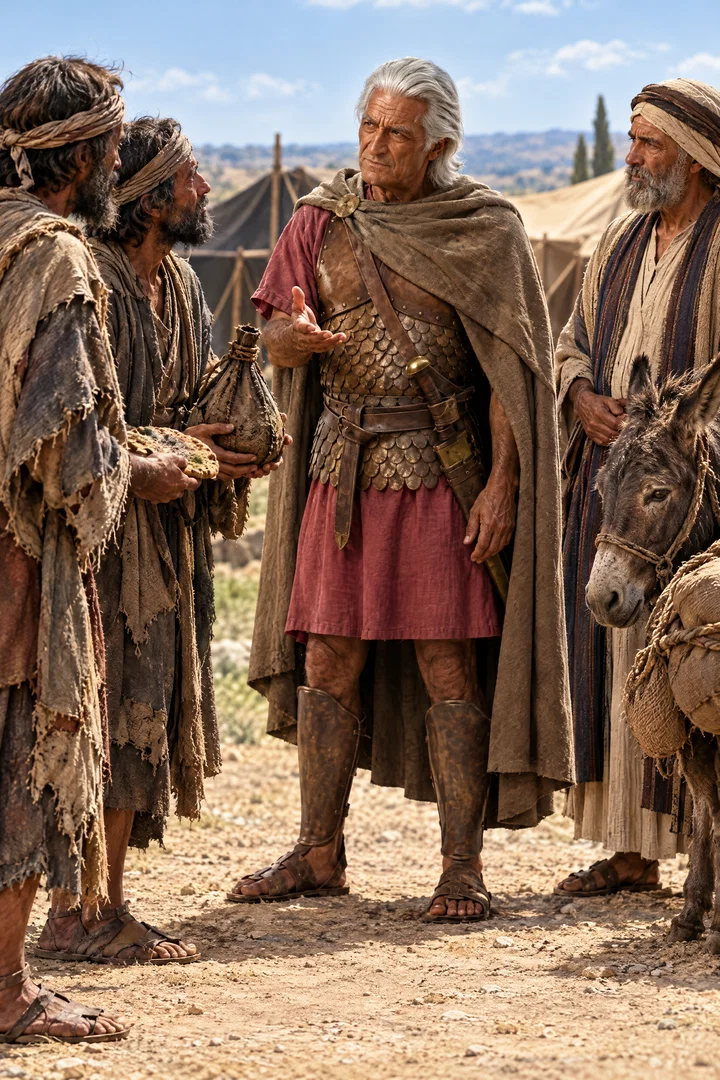
The inhabitants of Gibeon had heard what had been done at Jericho and to Ai, even the wonders God had wrought for Israel there.PP 505.1–3RH Jun 17, 1915PK 369.1–2 News of what God had done through Israel and what Joshua had done had reached them.PP 505.1–3RH Jun 17, 1915PK 369.1–2 They knew it was impossible to successfully resist the Hebrews.PP 505.1–3 To preserve their lives they resorted to stratagem, sending ambassadors who pretended to have come from a distant country beyond Palestine to ask for peace and a league with Israel.PP 505.1–3
This hearing begins the account of the treaty with Israel, which proved to be an unwise agreement because counsel of God was neglected and not asked.ST Jul 27, 1882 That hearing led onward to a further outcome, for the Gibeonites renounced their heathenism, joined Israel, and shared in the blessings of the covenant.RH Jun 17, 1915PK 369.1–2
Sources
Pioneers and periodicals
10 sources
The verse stands in the conquest narrative after Jericho had fallen and Israel had been defeated at Ai for failing to trust God, when Jericho's walls were brought down by God's invisible army and Israel's unfaithfulness delayed possession of the land.ST Mar 21, 1911 What the inhabitants heard was the news of what God had done through Israel at Jericho and Ai reaching Gibeon.RH Jun 17, 1915 In response the Gibeonites used craft to secure protection through a covenant alliance and league with Joshua, deceiving Israel about living far away by displaying mouldy bread and worn clothing as signs of age and long travel.RH May 26, 1868RH Oct 22, 1861ST Oct 27, 1898
Israel entered that unwise agreement because it neglected to ask counsel of God and trusted outward appearances instead of seeking Him.ST Jul 27, 1882 The league was sealed by an oath made in God's name, illustrating how serious such an oath is, and it bound Israel so that Israel could not drive out all the heathen as God had designed.RH May 26, 1868ST Apr 15, 1903 As a result the Gibeonites were assigned to be hewers of wood and drawers and carriers of water, which was public service and not chattel slavery, for no Israelite owned one of them or had personal interest in one, and they remained personally free, possessing their own lands, city, houses, wives and husbands and children.RH Mar 3, 1863ST Oct 27, 1898
The passage through verse 27 fulfills the curse pronounced upon Canaan as political subjection and servitude, fulfilled in the overthrow of the Canaanites by the Israelites, the Shemites coming out of Egypt, and it was not American chattel slavery nor anything like it and cannot justify it, as proved because the Gibeonites still existed and flourished in the days of David in possession of political rights, with power to make their own treaty with the king of Israel.RH Mar 3, 1863 The mistake brought a foreign element into the community that remained a handicap for centuries, so the whole nation suffered consequences extending to later generations, yet despite the mistake and its consequences Joshua remained Israel's leader.ST Apr 15, 1903 On the weight of the testimony, the Gibeonites renounced their heathenism, joined Israel, and shared in the blessings of the covenant.RH Jun 17, 1915
On another reading, though found in the train of Israel after hearing of Jericho and Ai, they had no title to Israel's portion, consolations, and rewards, showing that outward joining without inward belonging is possible.RH Sep 26, 1865 As application, the story warns against making a decision without seeking the Lord's guidance, calling for prayer for direction as when deciding whether Elder Keh should teach at the school.RH Aug 8, 1907 It warns against upholding traditional doctrines by a misleading show of age, as the Gibeonites' apparent antiquity was misleading.RH Oct 22, 1861 It warns regular, moral, outwardly blameless attenders on means of grace who love gospel preaching and agree with truth yet show no movement of heart and remain stationary year after year that their doubtful, borderline, neither satisfactory nor safe state as almost Christians must awake to danger and strive to enter in.RH Sep 26, 1865
Sources