Joshua 6:20
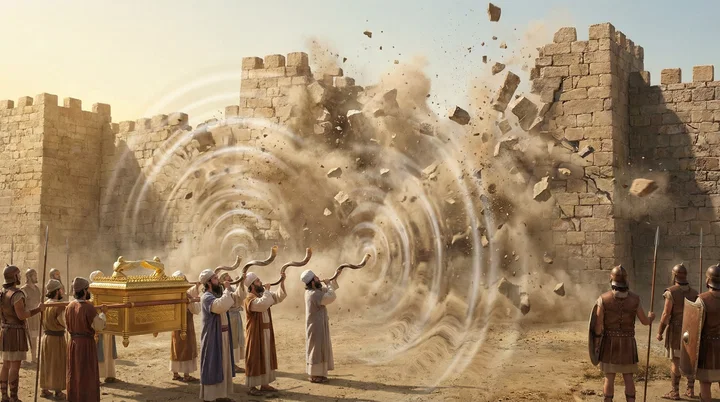
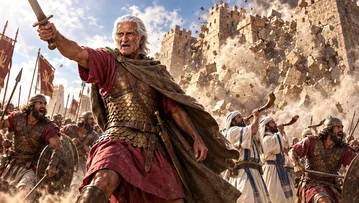
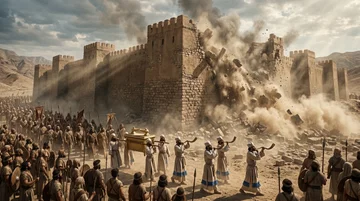
So the people shouted when the priests blew with the trumpets: and it came to pass, when the people heard the sound of the trumpet, and the people shouted with a great shout, that the wall fell down flat, so that the people went up into the city, every man straight before him, and they took the city.
Translations
American King James Version, King James Version, KJV Cambridge Paragraph Bible, Webster Bible
So the people shouted when the priests blew with the trumpets: and it came to pass, when the people heard the sound of the trumpet, and the people shouted with a great shout, that the wall fell down flat, so that the people went up into the city, every man straight before him, and they took the city.
So the people shouted, and the priests blew with the trumpets: and it came to pass, when the people heard the sound of the trumpet, that the people shouted with a great shout, and the wall fell down flat, so that the people went up into the city, every man straight before him, and they took the city.
So the people shouted, and the priests blew the trumpets: and it came to pass, when the people heard the sound of the trumpet, that the people shouted with a great shout, and the wall fell down flat, so that the people went up into the city, every man straight before him, and they took the city.
And the people shout, and blow with the trumpets, and it cometh to pass when the people hear the voice of the trumpet, that the people shout — a great shout, and the wall falleth under it, and the people goeth up into the city, each over-against him, and they capture the city;
And the people shouted, and they blew with the trumpets. And it came to pass when the people heard the sound of the trumpets, and the people shouted with a great shout, that the wall fell down flat; and the people went up into the city, each one straight before him, and they took the city.
So the people shouted, when the horns were blown,—yea it came to pass, when the people heard the sound of the horn, that the people shouted with a great shout, and the wall fell down under it, and the people went up into the city every man straight before him, and so they captured the city.
Berean Standard Bible, Majority Standard Bible
So when the rams’ horns sounded, the people shouted. When they heard the blast of the horn, the people gave a great shout, and the wall collapsed. Then all the people charged straight into the city and captured it.
So the people shouted and the priests blew the trumpets. When the people heard the sound of the trumpet, the people shouted with a great shout, and the wall fell down flat, so that the people went up into the city, every man straight in front of him, and they took the city.
So the people gave a loud cry, and the horns were sounded; and on hearing the horns the people gave a loud cry, and the wall came down flat, so that the people went up into the town, every man going straight before him, and they took the town.
So the people shouted, whe they had blowen trumpets: for when the people had heard the sound of the trumpet, they shouted with a great shoute: and the wall fel downe flat: so the people went vp into the citie, euery man streight before him: and they tooke the citie.
Douay-Rheims (Challoner revision)
So all the people making a shout, and the trumpets sounding, when the voice and the sound thundered in the ears of the multitude, the walls forthwith fell down: and every man went up by the place that was over against him: and they took the city,
Pictures
Cross-references 20 of 23
- Hebrews 11:30
By faith the walls of Jericho fell down, after they were compassed about seven days.
Jericho’s walls fell after Israel acted in faith.
- Joshua 5:13-15
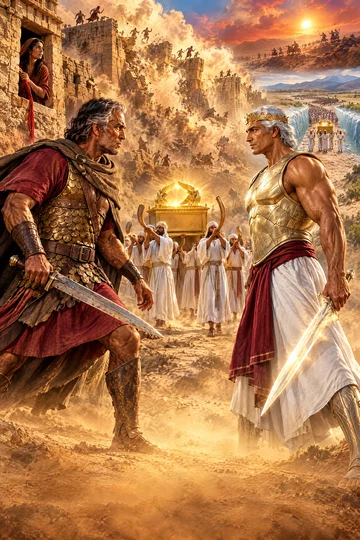
And it came to pass, when Joshua was by Jericho, that he lifted up his eyes and looked, and, behold, there stood a man over against him with his sword drawn in his hand: and Joshua went unto him, and said unto him, Art thou for us, or for our adversaries?
The Lord’s host captain meets Joshua before leading Israel’s victory at Jericho.
- Joshua 6:2
And the LORD said unto Joshua, See, I have given into thine hand Jericho, and the king thereof, and the mighty men of valour.
The Lord promises Joshua the city before the wall falls.
- Judges 7:19-22
So Gideon, and the hundred men that were with him, came unto the outside of the camp in the beginning of the middle watch; and they had but newly set the watch: and they blew the trumpets, and brake the pitchers that were in their hands.
Trumpet blasts and shouts bring victory over a stronger enemy through God’s power.
- Joshua 3:14-17
And it came to pass, when the people removed from their tents, to pass over Jordan, and the priests bearing the ark of the covenant before the people;
Israel crosses the Jordan before taking Jericho.
- Joshua 6:16
And it came to pass at the seventh time, when the priests blew with the trumpets, Joshua said unto the people, Shout; for the LORD hath given you the city.
Joshua commands the people to shout, declaring victory before the walls fall.
- 1 Kings 16:34
In his days did Hiel the Beth-elite build Jericho: he laid the foundation thereof in Abiram his firstborn, and set up the gates thereof in his youngest son Segub, according to the word of the LORD, which he spake by Joshua the son of Nun.
Hiel’s rebuilding of Jericho fulfilled Joshua’s curse.
- Hebrews 11:31
By faith the harlot Rahab perished not with them that believed not, when she had received the spies with peace.
Rahab’s faith in receiving the spies spared her when Jericho fell.
- Joshua 6:1
Now Jericho was straitly shut up because of the children of Israel: none went out, and none came in.
Jericho’s closed defenses set the scene for its fall.
- Joshua 6:26
And Joshua adjured them at that time, saying, Cursed be the man before the LORD, that riseth up and buildeth this city Jericho: he shall lay the foundation thereof in his firstborn, and in his youngest son shall he set up the gates of it.
Joshua’s curse warned against rebuilding Jericho.
- Joshua 2:1-21
And Joshua the son of Nun sent out of Shittim two men to spy secretly, saying, Go view the land, even Jericho. And they went, and came into an harlot’s house, named Rahab, and lodged there.
The spies visit Jericho before its capture, and Rahab is spared for sheltering them.
- Joshua 7
But the children of Israel committed a trespass in the accursed thing: for Achan, the son of Carmi, the son of Zabdi, the son of Zerah, of the tribe of Judah, took of the accursed thing: and the anger of the LORD was kindled against the children of Israel.
Achan is also described as accursed after Jericho’s destruction.
- Joshua 6:3-5
And ye shall compass the city, all ye men of war, and go round about the city once. Thus shalt thou do six days.
The six days around Jericho lead to the trumpet blast and the wall’s fall.
- Joshua 6:15
And it came to pass on the seventh day, that they rose early about the dawning of the day, and compassed the city after the same manner seven times: only on that day they compassed the city seven times.
seventh-day sevenfold march before shout
- Joshua 6:24
And they burnt the city with fire, and all that was therein: only the silver, and the gold, and the vessels of brass and of iron, they put into the treasury of the house of the LORD.
Describes Jericho’s destruction by fire after its fall.
- Joshua 2:9-11
And she said unto the men, I know that the LORD hath given you the land, and that your terror is fallen upon us, and that all the inhabitants of the land faint because of you.
Rahab believed after Jericho heard of God’s works.
- Joshua 6:11
So the ark of the LORD compassed the city, going about it once: and they came into the camp, and lodged in the camp.
The ark is carried around Jericho before its walls fall.
- Deuteronomy 34
And Moses went up from the plains of Moab unto the mountain of Nebo, to the top of Pisgah, that is over against Jericho. And the LORD shewed him all the land of Gilead, unto Dan,
earlier history leading to Jericho
- James 2:25
Likewise also was not Rahab the harlot justified by works, when she had received the messengers, and had sent them out another way?
Rahab’s actions illustrate practical faith.
- Joshua 2:13
And that ye will save alive my father, and my mother, and my brethren, and my sisters, and all that they have, and deliver our lives from death.
Rahab appeals for her household to be rescued from death.
Commentary
Each commentary is drawn from primary sources: the writings of Ellen G. White and Adventist pioneers and periodicals. Each commentary is separate. Its own words are not a quotation; follow the references to read the source passages.
Ellen G. White
55 sources
Israel circled Jericho once a day for six days in solemn silence behind priests with trumpets and the ark, then seven times on the seventh day, and at the long trumpet blast shouted as commanded until the massive walls fell flat and they went straight in and took the city.1SP 349.24T 161.2ST Apr 14, 1881ST Oct 19, 1888 The walls fell by God's power alone and not by Israel's strength or skill, with no human hand touching them, so no warrior had cause to glory.ST Apr 14, 1881ST Oct 19, 1888SG4 64.1–2SG4 63.14T 161.3 Christ Himself as Captain of the Lord's host with His angels threw the walls down and prepared the entrance for His people.SG4 64.1–2SG4 102.31SP 351.1–2 Israel took the city by believing God's promise that it was already given and by obeying His simple appointed means even when the march and trumpets seemed useless.ST Apr 14, 1881SG4 63.14T 162.4–163.14T 148.3 The overthrow was judgment on a proud idolatrous stronghold that defied God, and it will be repeated when the walls of antichrist fall flat before the same Captain in the last battle of truth with error.1SP 351.1–23T 264.1PP 495.5–496.1Lt 16j, 1892, par. 8RH Sep 16, 1873
March Order and Collapse
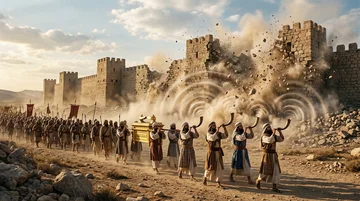
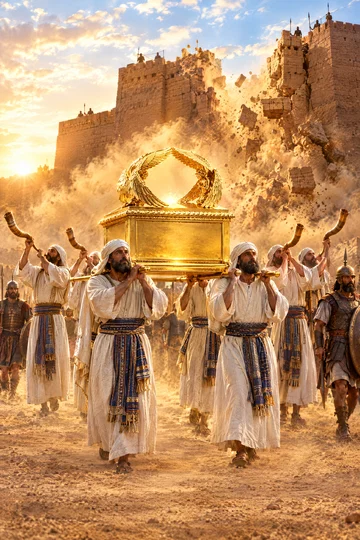
For six days Israel marched once around the city each day in solemn silent order, armed men first, then seven priests with trumpets, then the ark glittering with gold under a halo of glory, then the vast army tribe by tribe under its standards with Joshua at their head, with no sound but marching feet and trumpets echoing through the city.1SP 349.2ST Apr 14, 1881 Behind shut and closely guarded gates the watchmen of Jericho looked on in wonder and alarm, some ridiculing and others awed by the ark and the priests, remembering the parting of the Red Sea forty years before and the passage just made through the Jordan.1SP 349.2 On the seventh day they rose early and compassed the city seven times in silence, and at the seventh circuit when the priests made a longer blast Joshua commanded the people to shout because God had given them the city.1SP 349.2ST Apr 14, 1881 At the sound of the trumpet and the great united shout the massive walls of solid stone with massive towers tottered and fell flat with a stunning crash like peals of loudest thunder.1SP 349.2ST Apr 14, 1881ST Oct 19, 1888PP 488.3–491.11SP 351.1–2
The ark was borne before the people and carried about the city for seven days in solemn silence, then the trumpets pealed and the people gave a great shout, and the massive walls fell flat upon the earth in glorious triumph given by God through the presence of the ark.ST Dec 22, 1881 When the wall fell flat the defenders and the inhabitants with the enemy army were paralyzed with terror and offered no resistance and could offer no resistance.4T 161.2ST Apr 14, 1881ST Oct 19, 18881SP 351.1–2 Israel then went straight in, every man straight before him, and entered and took the city and took possession, the city having been given by God and its massive defenses unable to withstand His word.1SP 349.2ST Apr 14, 1881ST Oct 19, 1888PP 488.3–491.1SG4 63.1
The taking of Jericho was the first step in the conquest of Canaan, reached by marching out from Gilgal, the first encampment in the promised land, after divine guidance sought by Joshua in prayer apart from the camp that God would go before Israel.PP 487.3ST Jul 27, 1882PP 613.3–614.2 Before the battle Christ stood before Joshua as an armed warrior with drawn sword as Captain of the host of the Lord, His glory hidden in human garb, accepted Joshua's worship, commanded him to remove his shoe because the ground was holy, and assured him that Jericho with its king and mighty men of valor was already given into his hand.PP 487.3Ms 134, 1899, par. 16–17 He gave Joshua confidence to follow God's instruction and leave his great and perplexing burden with the Lord, a wonderful manifestation with the heavenly host present to take down the walls that Israel should never forget.Ms 134, 1899, par. 16–17
The event belongs to a chain of unrepayable blessings that ended the wandering tent-life and brought Israel to take possession of Canaan, including choosing them as His people, bringing them out of Egypt from Egyptian oppression, proclaiming His law from Sinai, dividing the Red Sea so they passed through on dry land while Pharaoh's pursuing army perished, miraculously opening a path through the waters of Jordan, giving water from the rock and bread from heaven, and rehearsing the incidents of the journey and declaring God's holy commandments under Moses before they were placed under Joshua's charge.1SP 349.2ST Feb 21, 187821MR 408.1–2Ms 133, 1899, par. 1–5 Jericho stood not many miles from where John later baptized in the Jordan, so its nearness kept God's wonderful work before the Jews when the walls fell before the command of the Prince of heaven.RH Nov 28, 1907DA 132.1Ms 113, 1907, par. 17 That remembrance revived hope that God would again act powerfully to deliver Israel and stirred the whole nation with expectation of what the Messiah might do if He had actually come to earth.RH Nov 28, 1907DA 132.1Ms 113, 1907, par. 17
Divine Power Alone
The walls fell by God's power alone, not by Israel's military strength or skill in warfare.ST Apr 14, 1881ST Oct 19, 1888SG4 64.1–2ST Apr 14, 18814T 163.4–164.1 The Majesty of Heaven with His army of angels leveled them before His people, so the armed warriors had no cause to glory or to claim credit for the victory.ST Apr 14, 1881ST Oct 19, 1888ST Apr 14, 18814T 163.4–164.1 No human aid joined in the overthrow, for God by the might of His own word threw down the stronghold.ST Apr 14, 18814T 163.4–164.1PP 495.5–496.1
Christ Himself, the Captain of the Lord's host and mighty General of armies, with heavenly angels, was engaged in the conquest.SG4 64.1–2SG4 102.31SP 351.1–21SP 399.23T 264.1 He commanded the armies of heaven to throw down the walls and to prepare an entrance for Joshua and the armies of Israel.SG4 64.1–21SP 351.1–21SP 399.2 He with His angels attended the circuits of the ark around Jericho and delivered the city into Israel's hands.SG4 102.31SP 399.2Ms 134, 1899, par. 16–17 The wall fell flat and the city was placed in the hands of God's people by heavenly instrumentalities, with the heavenly host present to take down the walls.3T 264.1Ms 134, 1899, par. 16–17
Four heavenly angels always accompanied the ark to guard it from all danger and to fulfill every mission connected with it.1SP 399.2 Jesus the Son of God, followed by heavenly angels, attended the circuits of the ark around Jericho and finally cast down the walls.1SP 399.2
No human hand touched the walls or cast them down.4T 161.3Ms 143, 1899, par. 22–23Lt 58, 1895, par. 22–25Ms 32, 1897, par. 7–10Ms 12, 1895, par. 13–14 The people and the priests did their appointed part in believing and obeying, but God's word was the only weapon used.SG4 63.14T 161.3Lt 58, 1895, par. 22–25 The plan was made in such simplicity that no person could take glory for the victory and God alone would be glorified.4T 161.3Ms 143, 1899, par. 22–23Lt 58, 1895, par. 22–25 God works in His own way when men move in accordance with His will and obey their great Captain.Ms 32, 1897, par. 7–10
The victory and the conquest belonged to God alone, so the city with all that it contained was to be devoted to Him alone.PP 495.5–496.1 Because God alone gave the victory, solemn weight was added to the command prohibiting Israel from partaking of the spoils.PP 495.5–496.1
Even walls of unimaginable height and strength would have fallen in the same way, so that no human warrior could claim the glory or frustrate God's will.4T 161.3 What looks formidable God can lay even with the ground by His own power.4T 161.3Lt 19, 1898, par. 6–7
The ark carried around the city was only a symbol of the divine presence, not a charm and not the source of strength.SG4 105.1–2 The blessing and the glorious triumph came from God alone through its presence.ST Dec 22, 1881 Its presence brought blessing only as Israel obeyed the law contained in the ark, which represents God Himself.SG4 105.1–21SP 402.3–403.1
Faith Obedience and Trust
Israel took the city by belief and obedience rather than by skill in warfare, for God had declared He would give them the country and the city had already been given to them, and they should have trusted Him to fulfill His word.ST Apr 14, 1881SG4 63.14T 148.3 The armed men’s part was to believe and obey, not to win the battle by their own strength, since taking Jericho, the key to Canaan, did not depend solely on military power.ST Apr 14, 1881SG4 63.14T 148.3
They obeyed God’s directions though they did not see the angelic host leading them, and though the marching and trumpet blasts appeared ineffective.4T 162.4–163.1 The repeated ceremony day after day before the walls fell tested their faith and strengthened it.4T 162.4–163.1
That testing taught that victory depended not on human wisdom or strength but on God as their salvation and divine Leader, requiring them to rely wholly on Him.4T 162.4–163.1ST Jul 21, 1881 Success comes by God’s help working with human effort, not by human wisdom or skill, so humble trust in God and faithful obedience are essential.4T 162.4–163.1ST Jul 21, 1881 This calls for wholehearted confidence and humble submission to the divine will without questioning or doubt, giving up all desire for self-exaltation.ST Apr 14, 1881
The simple act of blowing trumpets around Jericho was a humble means sanctioned by God, made effectual through His power to overthrow the might of His enemies and the strongholds of Satan.ST Jul 21, 1881PP 553.2–554.1 It teaches simple dependence on God’s mighty arm today, for the prayer of faith offered by humble, obedient, trusting people will bring victory.ST Jul 21, 1881 God used such victories to lead Israel to rely on Him and to seek His help in every emergency.PP 553.2–554.1
The most complete and perfect human system apart from God’s power and wisdom will fail, while humble means God sanctions must succeed, even when the method seems unlikely.ST Jul 21, 1881PP 553.2–554.1 God’s wisdom in such methods is foolishness to the boastful and self-confident who do not know the mystery of godliness, for deep are the counsels of God beyond finite comprehension.ST Jul 21, 1881
God will do marvelous things and work mightily for a faithful people who place their entire confidence in Him, helping His believing children in every emergency.ST Apr 14, 1881PP 553.2–554.1Lt 51, 1895, par. 8–13 The Captain of the Lord’s host directed the battle in so simple a way that God alone would receive the glory and no person would be exalted.ST Apr 14, 1881Lt 51, 1895, par. 8–13 His professed people have no strength when they trust their own wisdom and strength instead of giving the Lord opportunity to reveal His power in their behalf.ST Apr 14, 1881 His people are therefore to face seemingly overwhelming conflicts with humble faith, perseverance, and trust in His promised power, expecting supernatural help and victory rather than relying on human ability.ST Apr 14, 1881PP 553.2–554.1Lt 51, 1895, par. 8–13
Judgment Memorial and Warning
The fall was God's judgment on a wealthy stronghold given to extravagant idolatry, corruption, blasphemy and wicked works, which insulted and provoked the God of heaven.3T 264.1RH Sep 16, 1873 That city had defied the armies of Israel and the God of heaven while trusting in its firm and high walls.1SP 351.1–2 The Captain of the Lord's host came Himself from heaven to lead the armies of heaven in the attack, commanding them to throw down the walls and prepare an entrance for Joshua and Israel.1SP 351.1–2RH Sep 16, 1873 Angels of God laid hold of the massive walls and brought them to the ground, so that they suddenly tottered and fell with a stunning crash like peals of loudest thunder.1SP 351.1–2RH Sep 16, 1873 Its people were paralyzed with terror and could offer no resistance, and Israel could enter and take the city.1SP 351.1–2RH Sep 16, 1873
The overthrow was accomplished by the might of His own word, by divine power alone and not by Israel's own strength.PP 495.5–496.1 The victory and the conquest belonged to Him alone, and therefore the city with all that it contained was to be devoted to Him alone.PP 495.5–496.1 That overthrow gives evidence of the destruction that will surely overtake all transgressors of God's law.PP 495.5–496.1 Because God alone gave the victory, it gave solemn weight to the command prohibiting Israel from partaking of the spoils.PP 495.5–496.1
The miracle displayed God's power to defeat their enemies, strengthened Israel's faith in His power to subdue them, and rebuked their former unbelief.ST Oct 19, 1888SG4 64.1–21SP 351.1–2 When the priests blew the trumpets and the people shouted as commanded, the wall fell and allowed the Israelites to go up into the city and take it.ST Oct 19, 1888 The victory was accomplished by the Lord and His angels, not by Israel's military strength or skill, and was not ascribed to Israel but to the Captain of the Lord's host with His angels engaged in the conquest.ST Oct 19, 1888SG4 64.1–21SP 351.1–2 God leveled the walls without human power to impress Israel that angels under the generalship of Christ were in the camp and that heaven's army stood ready to bring them into Canaan.Ms 135, 1899, par. 17 That army would have taken them in long before if they had been obedient, and they need not have traveled forty years in the wilderness if they had not accepted the evil report of the faithless spies and rebelled against God.Ms 135, 1899, par. 17
The capture was an exhibition of God's power to be kept fresh in memory and repeated by parents to their children.Lt 8a, 1896, par. 8–9 It was to be rehearsed together with the deliverance from Egypt, the water from the rock, the bread from heaven, and the commandments.Lt 8a, 1896, par. 8–9 The purpose was to teach them to serve God and keep His Sabbaths.Lt 8a, 1896, par. 8–9 No human general devised the plan for taking the city and no human hand touched its massive walls, for the Captain of the Lord's host gave His orders to the heavenly army and down came the walls of Jericho.Lt 8a, 1896, par. 8–9
God's mighty deliverance was given to an obedient and believing Israel then walking in obedience to God. The ark carried at Jericho was but a symbol of the divine presence, not the source of blessing, for the blessings came from God alone and not from the ark itself. At that time the ark was borne by holy men in accordance with His express command, and the Captain of the Lord's host went before the repository of His law, so His arm brought deliverance for them. The verse therefore does not support a disobedient people following their own plans in opposition to divine counsel and authority who expect the symbol to make God fight for them. When they do not walk in obedience, when the ark is not so borne and the Captain does not go before them, the law under the mercy-seat condemns them to defeat, disaster, and death.
Final Battle Prophecy
The collapse of Jericho's wall will be repeated in the last battle to be fought on this earth, in the fast-approaching crisis of mind with mind, principle with principle, and truth with error.Lt 16j, 1892, par. 8 When every man who is on the Lord's side comes up to the battle of the Lord to the help of the Lord against the mighty, the walls of antichrist shall fall flat before the Captain of the Lord's host.Lt 16j, 1892, par. 8 That coming fulfillment demands constant vigilance and unity without dissension.Lt 16j, 1892, par. 8 It demands aggressive warfare by every Scriptural and holy means, directed not against brethren nor against the Lord's anointed but against satanic agencies.Lt 16j, 1892, par. 8 It demands receiving rather than opposing the messengers and the messages God sends.Lt 16j, 1892, par. 8
The Lord's overthrow of Jericho stands as a pledge that He will bring victory to His commandment-keeping people and defeat to all opposing elements.DTCP 6.1Ms 92, 1897, par. 19 The walls fell when the people shouted after the priests sounded the trumpets, and Israel then entered and took the city.DTCP 6.1 The same act by the Captain of the Lord's host who tore down the walls pledges that God's commandment-keeping people will triumph and every opposing element will be defeated.Ms 92, 1897, par. 19 His servants sent with a heaven-sent message must therefore speak positively and strongly, without being condemned for doing so.Ms 92, 1897, par. 19 God will make the ears of unwilling hearers tingle, and will denounce all who resist His Word.Ms 92, 1897, par. 19
Shouting to the glory of God beats back the enemy and gives victory, and singing to the glory of God often drives him off.19MR 129.2–3 Satan has come down in great power knowing his time is short, and the power of modern magicians has increased tenfold and is still increasing and spreading, like the magicians who opposed Moses before Pharaoh in Egypt.19MR 129.2–3 Unless Israel is rising and increasing in power and strength and growing in grace and in the knowledge of the truth, the powers of darkness will gain the victory over them.19MR 129.2–3 Israel must therefore be constantly rising and must keep the ascendancy above the powers of darkness through childlike simplicity and much glorifying of God in singing and shouting.19MR 129.2–3
Present Practical Applications
The fall of the wall when Israel obeyed shows how walls of racial prejudice between white and Black people will tumble down when Christians obey the commands to love God supremely and to love their neighbors impartially.SW 54.1Ms 73, 1903, par. 3 The shouting at the sound of the trumpet shows how wholehearted love for God and for one another through the love of Christ can break down barriers.Ms 26, 1888, par. 15–17 What God tore down at Jericho He can also build up, and applied to lack of money for churches, schools, and health institutions, He can remove financial barriers and advance His cause by His own power laying what looks formidable even with the ground without a human hand laid upon it.Lt 19, 1898, par. 6–7 Yet He does nothing without human cooperation, for God works and man works together.Lt 19, 1898, par. 6–7
The casting down of the walls without human hands bringing them down shows that Christ the Captain of salvation can be with His people to give them power and grace to face opposition and trials.Ms 12, 1895, par. 13–14 The Captain of the Lord's host casting down the walls shows how heavenly angels remove obstacles and help save souls.Lt 4, 1890, par. 11 It encourages God's workers to act with courage, trusting that God can accomplish a mighty work through them.Lt 4, 1890, par. 11
God left human control and power out and kept the work in the hands of the great I AM, planning the taking in such simplicity that no human hand threw down the walls and no human being could take glory for the victory.Ms 143, 1899, par. 22–23Lt 51, 1895, par. 8–13Ms 40a, 1890, par. 65–67Ms 36, 1885, par. 23–24RH Oct 16, 1900 So no worker is to desire power and control or seek the highest place, no one is to manage the work God should direct or take glory for what is accomplished, for people have nothing better than their fellow human beings except what God has given them, and the Lord alone is to be magnified and exalted.Ms 143, 1899, par. 22–23Ms 36, 1885, par. 23–24RH Oct 16, 1900 Men must look to God for orders and follow His directions with faith, with Jesus the Captain of the Lord's host present to lead, while God works by His might and power without waiting for the human voice to be heard.3MR 21.1–22.3RH Oct 16, 1900 The same God still works not by might nor by power but by His Spirit through whomever He will, with faithful men like Caleb, in fighting unseen foes more formidable than giants where the devil is hard to conquer and cannot be overcome except with the sword of the Spirit.3MR 21.1–22.3 Facing seemingly overwhelming conflicts with humble faith, perseverance, and trust in promised power, His people are to expect supernatural help and victory rather than relying on finite human strength.Lt 51, 1895, par. 8–13
Israel's failure to make the most of such blessings culminated when pride, ambition, and love of applause and display hardened hearts and blinded minds so they could not discern Christ in the Man of Nazareth and would not accept Heaven's best gift in Jesus.ST Feb 21, 1878 Even their best service could never have repaid being chosen as His people, freed from Egyptian oppression, given the law proclaimed from Sinai, brought through the Red Sea on dry land while Pharaoh's pursuing army perished, and miraculously opened a path through the waters of the Jordan at the taking of Jericho.ST Feb 21, 1878
Sources
Pioneers and periodicals
118 sources
When the trumpets sounded and the people gave the appointed great shout, the wall collapsed flat so that each man went straight forward into the city and took it.ST Mar 21, 1911ST Oct 8, 1902RH Apr 21, 1851 The fall came by God's power and not by Israel's strength, skill, or siege engines.ST Oct 19, 1888ST Mar 20, 1901ST Sep 17, 1874 The walls fell by faith after being compassed seven days, trusting and obeying God's word without visible sign of success.ST Sep 12, 1895RH Nov 22, 1906RH Nov 11, 1915 Grace provided the victory, yet Israel had to do its exact part in marching and shouting together, for neglect of obedience would have left the walls standing.RH Feb 6, 1879RH May 29, 1913RH Apr 8, 1902 The shout itself was the claim of a promised victory already given, daring to believe the impossible on God's word alone.
Story Setting and Sequence
The wall fell flat when the priests blew the trumpets and the people shouted with a great shout as directed, so that the people went up into the city every man straight before him and took the city.ST Mar 21, 1911ST Oct 8, 1902RH Apr 21, 1851ST Aug 26, 1880ST Oct 20, 1914 The day was gained at that shout at the trumpet sound at the end of the commanded order, and the conquest came by faith, persistence, order, earnestness and preparation under God's leadership, not by Israel's fighting but as God's work.ST Oct 8, 1902ST Oct 20, 1914RH Mar 21, 1912 The invisible army of God leveled the wall, and the victory came with the Captain of Jehovah's hosts with Joshua, with the ark of the covenant going before the people and the ten commandments in the ark standing prominent among the united agencies.ST Mar 21, 1911RH Apr 21, 1851ST Aug 26, 1880
The walls were of solid stone with massive towers that tottered and fell flat with a crash and a stunning crash at the united shout.ST Apr 14, 1881ST Oct 19, 1888RH Nov 9, 1911 The defenders were paralyzed with terror and offered no resistance and were unable to resist Israel.ST Apr 14, 1881ST Oct 19, 1888 Each man went straight ahead on the path before him into the city without seeking an easier route, by belief and obedience rather than by skill in warfare.ST Apr 14, 1881ST May 22, 1907
Israel marched around Jericho once each day for six days in solemn silent order with armed men, seven priests with trumpets, the ark, and the rear guard in silence except for marching feet and trumpets.ST Apr 14, 1881RH Feb 24, 1910 The whole people, including men, women and children, marched for six days and then seven times on the seventh day, and at the final circuit seven priests gave a long trumpet blast and the shout followed because God had given the city.ST Apr 14, 1881RH Feb 24, 1910RH Sep 8, 1904 They shouted for victory before there was any sign that the walls would fall, using no heavy artillery though the command seemed foolish by human reasoning, and faith acted as a weapon just as faith had made the Red Sea a protective wall and now made Jericho's solid wall fall away.RH Sep 8, 1904ST Nov 17, 1898 The marching in silence for seven days as commanded prepared the people for what was coming and revealed whether their hearts accepted God's ways and plans.ST Nov 17, 1898RH Apr 21, 1868
Jericho was the first stronghold and first city taken by Israel after crossing the Jordan, forty years after the spies came to Rahab, with its walls overthrown by faith under utter destruction as God's judgment carried out at Joshua's hands.ST Mar 21, 1911RH Aug 24, 1905 Israel reached the overthrow by marching out from Gilgal, their first encampment in the promised land, and took the land city by city as Joshua led into the homeland after Moses had been permitted to lead only to the border.ST Jul 27, 1882RH May 13, 1915RH Aug 31, 1905 The Tel el-Amarna tablets of the fifteenth century before Christ, letters in Babylonian between the kings of Egypt and Babylon, Assyria, Ashkelon, Phenicia and Abdi-Hiba of Jerusalem, record that same invasion from the Canaanite side with local kings imploring Egypt for troops lest the land be lost to the Habiri making inroads, the Habiri being the Hebrews under Joshua.RH Aug 31, 1905 The taking stands in the clear connected story after the death of Moses and the crossing of the Jordan and before the sin of Achan and the defeat at Ai, marking the conquest of the promised land and proving that in every crisis God has a willing people and with every call gives His Spirit to accomplish its object.RH May 13, 1915RH Nov 21, 1854RH Apr 28, 1904
The account continues the conversation between Joshua and the captain of the Lord's host in Joshua 5, with Joshua 6:1 as a parenthesis obscured by the chapter break.RH Jan 8, 1861 It records the real historical conquest of Canaan by Israel under Joshua as true Scripture fact.ST Apr 20, 1904 The destruction left a ruin intended to stand as a memorial, and the fulfilled event testifies to the reliability of God's word. The country was already in a disturbed and weakened state when Joshua led them, and Jericho was a strong city as digging has uncovered a double wall embracing the whole city, though that double wall may have been built by the Jews at a later time.RH Aug 4, 1910
The shout given at God's command was not an empty sound but an expression of praise for a victory achieved or about to be achieved, accompanying the fall and the taking of the city.ST Feb 4, 1903 The walls fell during Israel's shout of victory and the sounding of musical instruments with ram's-horn trumpets, music being part of the circumstances in which God performed the miracle.RH Apr 21, 1851RH Feb 24, 1910ST Dec 25, 1901 God used a trumpet's sound rather than a mine's force to bring down the battlements when the people shouted at the priests' blast.ST Jul 29, 1886
Divine Power Behind Fall
The city was taken by God's power and not by Israel's military strength, skill, valor, or physical force, without weapons or blows, battering rams, siege weapons, or engines.ST Oct 19, 1888ST Apr 21, 1881ST Apr 14, 1881ST Mar 20, 1901ST Sep 17, 1874 The shout and the priests' feeble trumpets brought down massive walls, so the glory went to God rather than to the means used or the people who used them.ST Oct 19, 1888ST Mar 20, 1901RH Apr 2, 1861 The work was that of His invisible host, and the miracle displayed His power to defeat enemies, strengthened Israel's faith, and rebuked earlier unbelief.ST Oct 19, 1888ST Mar 20, 1901ST Sep 17, 1874 The armed warriors had no cause to glory in achievement, for all was done through the power of God.ST Apr 21, 1881ST Apr 14, 1881
God's invisible army threw the walls down, and myriads of angels were sent down to prostrate the mighty walls, showing the great exaltation and power of angels.ST Jan 17, 1878ST Oct 8, 1902ST Jul 23, 1912 The massive walls were torn down by the angels of God, and His invisible host brought them down when opportunity for Jericho to yield had passed.ST Jul 4, 1906ST Oct 8, 1902 The victory by faith in God's presence and strength, represented by the ark, came when the angelic host under Michael fought for Israel despite the walls' apparent strength.ST Jul 4, 1906ST Jul 23, 1912 What could have been salvation if the city had opened itself to God's hosts became destruction when it refused to yield.ST Oct 8, 1902
The Majesty of Heaven with His army of angels leveled the walls before His people, and the actual casting down was left to invisible hands of the heavenly host led on by the Son of God as Captain of the host of the Lord.ST Apr 14, 1881ST Sep 17, 1874RH Aug 12, 1873 Christ the Captain was with His angels and gave Joshua and Israel victory and possession of the city according to their faith, and Michael as commander of the heavenly host led and protected Israel on its way to the promised land.ST Jan 23, 1907ST Jul 23, 1912ST Jul 23, 1912 The mighty General planned the taking in such simplicity that no human hand was to cast down the walls, lest man take glory to himself, so the Lord alone is to be magnified.ST Apr 14, 1881RH Oct 16, 1900RH Aug 12, 1873 The Prince of heaven commanded the fall, a wonderful work whose nearness to where John baptized in the Jordan stirred expectation of what the Messiah might do.RH Nov 28, 1907ST Jan 23, 1907 Prominent among the united agencies were the Ten Commandments in the ark and the leadership of Christ, with armed men before the trumpet-blowing priests, then priests bearing the ark with seven priests bearing seven trumpets of rams' horns before it.ST Sep 17, 1874RH Aug 12, 1873
God used feeble instrumentalities and humble means sanctioned by Him and made effectual through His power, giving glory to God rather than to means or people.ST Jul 21, 1881RH Apr 2, 1861ST May 6, 1875RH Apr 15, 1875 The simple trumpet blast was a humble means to overthrow the might of enemies and strongholds of Satan, and faith blowing the ram's horn was met by unseen forces bringing down the walls.ST Jul 21, 1881ST Feb 13, 1912RH Jan 29, 1861 Such wisdom is foolishness to the boastful and self-confident who do not know the mystery of godliness, for deep are the counsels of God beyond finite comprehension.ST Jul 21, 1881 This proves success is certain if labor is done in God, even when the work demands immense severe toil and painful labor, while the most complete human system apart from God's power and wisdom will fail.ST Jul 21, 1881ST May 6, 1875RH Apr 15, 1875
The ark accompanied the procession and bore a conspicuous central part visibly representing God, carried about the city for seven days in solemn silence before the trumpets pealed and the great shout came.ST Dec 22, 1881ST Jun 10, 1875RH May 27, 1852 God honored His sacred law inside it through a mighty miracle, and the triumph did not come from the wooden chest itself but from the law of God kept inside it.ST Apr 8, 1889ST Jun 10, 1875RH May 27, 1852 The victory was given by God through the presence of the ark, connected with the ark containing His ten immutable laws spoken on Sinai amid smoke, lightning, and thunder and engraved by His finger on stone.ST Dec 22, 1881RH Aug 5, 1851RH Aug 11, 1853 The ark overlaid with pure gold was afterward put in the Most Holy Place as center of Israel's religious system and glory of Israel, and the fourth commandment in that ark carried at Jericho honors God's law including the Sabbath.RH Aug 11, 1853 Having God's law and truth brings triumph when prospects seem dark, and the remnant in the latter days who keep God's law and refuse the mark of the beast will likewise surely triumph.ST Jun 10, 1875
Faith Obedience and Victory
The walls fell by faith after they were compassed about seven days.ST Sep 12, 1895RH Nov 22, 1906RH Nov 11, 1915ST Aug 28, 1884ST Mar 10, 1909 Faith was the weapon by which the solid wall fell away, as faith had made the Red Sea a protective wall, and the walled cities that had stood in Israel's plans all through the journey were met in reality only to become as nothing when the Lord worked.ST Sep 12, 1895RH Nov 25, 1902 That faith trusted and obeyed without relying on visible signs of success, continuing to the appointed time and waiting for God to act before the promised victory could be seen.RH Nov 11, 1915ST Aug 28, 1884 The Lord sometimes asks for acts of obedience not understood at the time, like the seven days' marching around Jericho, and then He works, and afterward it is seen that the marching was necessary to perfect faith.ST Sep 12, 1895 This victory was a pledge that, had Israel remained obedient, the same power would have given deliverance and victory throughout the conquest, for the promised land could be possessed only by faith and belongs to a righteous people pointing to the new heavens and new earth where righteousness dwells.ST Mar 10, 1909RH Nov 25, 1902 Belief enabled obedience, so overcoming deeply rooted sin also requires believing and obeying God.RH Nov 11, 1915
God does nothing without human cooperation, for grace provided the victory but Israel had to do its exact part.RH May 29, 1913RH Apr 8, 1902RH May 30, 1907 God's design is perfect and must be followed exactly, doing duty always when and where He directs and speaking the right word at the right time in the right place, marching on the very days commanded.RH Feb 6, 1879 Israel did not win by fighting but by marching around the city and at the seventh circuit shouting in triumph, carrying out God's plan in seven days with practical faith that trained them for active service.RH May 29, 1913RH Apr 8, 1902 When they acted together under direction neither the walls nor other obstacles could prevent entrance, for God led with a strong arm and brought down the wall while they followed with zeal, service, consecration, and obedience.RH May 29, 1913RH Oct 8, 1908 If they had neglected obedience the walls would never have fallen, for success comes when God is with His people and they obey His direction, while failure comes when they forsake their Leader or fail to do His bidding, and substituting human ideas for His instructions mars the work and leads to failure and ruin.RH Feb 6, 1879RH May 30, 1907 Going forward together as an advancing army still carries eternal principles for arousing God's people and proclaiming the gospel through humble means.
The secret of victory lay in the shout, for it was the shout of a faith that dared to claim a promised victory on God's word alone while as yet there were no signs of victory. God had declared He had given Israel the city, and faith reckoned it true and laughed at prudential fear of failure and dishonor, resting confidently and giving a shout of victory while to sense victory seemed impossible, and according to their faith it was done unto them. Joshua told the people to shout, for the Lord hath given the city, not will give it, and the wall fell flat and opened a straight pathway for every man to go up and take the city. Temptation and Satan must therefore be met as an already conquered foe, not one yet to be conquered, because Jesus has fought and overcome, and when faith reckons the enemy overcome and dares to raise the shout in sight of any foe, saying Jesus saves now, every wall falls flat. That shout is to be raised in the midst of the sorest stress of temptation, even when the walls look as high and immovable as ever and prudence says it is not safe to shout until victory is won, even when feeling says Jesus will not save at all, by forcing the lips to utter He does save me over and over and shutting eyes and ears against doubt, for such faith wins a glorious and speedy victory and the Lord never fails to give it when faith shouts.
Had Israel remained obedient the same delivering power would have continued, but success required vigilance, sanctification, and a cleansed camp.ST Mar 10, 1909RH Sep 21, 1916 God's wonders in behalf of His people depend on their moral and spiritual condition, showing the call to sanctify themselves before Jericho fell open to them.RH Sep 21, 1916 After the marvelous overthrow, which was God's work and not the result of Israel's strength and skill, they wrongly exalted their own strength, looked with contempt on the inhabitants of the land, and expected an easy victory at Ai.ST Apr 21, 1881 That divinely given victory made them self-confident and secure, so they failed to put forth every effort and humbly seek divine help, even laying plans for Ai without earnest prayer for counsel from God.ST Apr 21, 1881 Complicity with evil brings weakness and defeat until the evil is removed, as Achan's covetousness brought shame and required purging before victory followed, giving the valley the name Achor meaning trouble yet making a way for hope when trouble is learned from.ST Feb 14, 1906 Taking new ground still calls for truly converted people, since an Achan among them can bring defeat.RH Apr 3, 1913
God works mightily for a faithful people who place entire confidence in Him, obey without questioning, give up self-exaltation, and humbly submit to His will.ST Jul 21, 1881ST Apr 28, 1914 Jericho was conquered by God's power through simple means with the people's obedience, teaching that success depends on God's help working with human effort and not on human wisdom or skill.ST Jul 21, 1881 His professed people have no strength when trusting their own wisdom, while humble trust and faithful obedience are essential.ST Jul 21, 1881 The wall remained standing until the trumpet sounded and the people shouted, for it could not be brought down by human power, but God supplied what was needed and Israel took the city through faith and obedience.ST Apr 28, 1914 Had the people become discouraged after the sixth day's march, the victory would not have occurred.ST Apr 28, 1914
Law Sabbath and Ark
Israel's circling of Jericho and shouting at the trumpet blast was done by divine command as an act of obedience and worship, not as Israel's own work of fighting or human demolition, and the walls were thrown down by God himself and his invisible angelic armies.RH Jan 21, 1862RH Jul 27, 1876RH Apr 11, 1854ST Nov 10, 1914 Because the fourth commandment forbids doing one's own work and not doing God's bidding, carrying the ark around the city over seven consecutive days, so that one of those days must have been the Sabbath, was no violation of the commandment, and marching with the ark on the Sabbath did not violate the law that was inside the ark.RH Jan 21, 1862RH Jul 27, 1876RH Feb 3, 1852RH Apr 11, 1854ST Nov 10, 1914 God's own work of throwing down the walls, even if it occurred on that day, was not contrary to his own precepts about that day, and doing God's work is lawful on the Sabbath.RH Apr 11, 1854ST Nov 10, 1914
The first day and the seventh day named in the account are the first and seventh days of compassing the city, not days of the week, just as the first day and seventh day in the feasts are the first and seventh days of the feast, and the record gives no evidence or reasonable inference that Jericho was taken on the Sabbath.RH Oct 15, 1872RH Oct 29, 1872 The final day may have been the Sabbath, though the day is not known, and the episode does not prove that the Sabbath could be broken with impunity or set aside.RH Apr 11, 1854ST Nov 10, 1914 Those who held the other understanding taught that after going around during the week the people celebrated on the Sabbath as the walls fell flat with trumpets, a shout, and the ark of the Lord, illustrating the Sabbath as the culmination of six days.RH Mar 17, 1910
The ark carried at Jericho held the Ten Commandments spoken by God on Mount Sinai amid smoke like a furnace, lightning, and thunder, and engraved by his finger on tables of stone, afterward placed overlaid with pure gold in the Most Holy Place of the earthly sanctuary as the center of Israel's religious system and the glory of Israel.RH Aug 11, 1853 The fourth commandment was in that ark, so the victory honors God's law including the Sabbath and shows it remains binding, and Jericho's walls fell not through ram's horns alone but as Israel obeyed God's command and followed the ark containing the commandments.RH Aug 11, 1853RH Dec 10, 1861 The eighth, ninth, and tenth commandments likewise carried the death penalty by stoning, just as the Sabbath commandment did, so the penalty did not make the Sabbath uniquely a form of bondage.RH Mar 22, 1864
The ark itself was not the source of victory and its presence brought blessing only as Israel obeyed God's law and kept the covenant's conditions, for the victory came through God's power and not from the wooden chest as a charm.RH Aug 28, 1856 Israel succeeded at Jericho with the ark present after the priests carried it around the city for seven days in silence, the trumpets sounded, and the people shouted, yet the triumph does not support a disobedient people expecting the symbol to fight for them.RH Aug 28, 1856 Their later remembering of that success and supposing that merely bringing the ark into battle would protect them was mistaken, since God had departed because of their sin.RH Aug 28, 1856
Judgment Mercy and Devotion
Jericho was placed under an irrevocable ban, devoted to destruction under a curse.ST Jan 18, 1877RH Apr 30, 1867 Anathema meant set apart, separated and devoted to be extirpated, destroyed, consumed and annihilated, in an absolute, irrevocable and entire separation from the number of the living.RH Jun 11, 1872 The falling of the wall and the taking of the city was the carrying out of that ban.ST Jan 18, 1877RH Apr 30, 1867
As first-fruits of Canaan the city was wholly devoted to the Lord, so Israel was forbidden to appropriate any spoils for personal gain and was to gain only the destruction of enemies and control of the country.ST Apr 21, 1881 The gold and silver with the vessels of brass and iron were to enrich the treasury of the Lord, while all other wealth with every living creature was to be utterly consumed with fire.ST Apr 21, 1881 The curse resting on Jericho would surely fall on any Israelite who reserved a portion of the spoils.ST Apr 21, 1881 God had appointed the city to utter destruction, and its fall was God's judgment carried out at the hands of Joshua.RH Aug 24, 1905 It was the first city taken by Israel after crossing the Jordan forty years after the spies came to Rahab, and its walls were overthrown by faith and not by Israel's skill or valor but by the power of the Lord of hosts giving the victory.ST Apr 21, 1881RH Aug 24, 1905
The fall belonged to God's judgment on the Canaanites and warns that those who oppose God's purposes bring destruction on themselves.RH Jan 20, 1863 It fell as a wealthy city devoted to extravagant idolatry that was corrupt, blasphemous, and insulted and provoked the God of heaven by its wicked works.RH Sep 16, 1873 Though it was a stronghold, the Captain of the Lord's host came himself from heaven to lead the armies of heaven in the attack, and angels of God laid hold of the massive walls and brought them to the ground so that Israel could take the city.RH Sep 16, 1873 God's keeping hand thus bids walled cities fall before His people day by day, giving reason to look back on the desert way with a joyful chorus and to press forward in faith.RH Sep 8, 1874 The heavenly Joshua leads His ransomed hosts out of earth's wilderness into the goodly land of full salvation and the peace of God, uncovering a path through raging floods, covering guilt with His righteousness, and saving to the uttermost until all His people pass over.RH Sep 8, 1874
Each time Israel marched around the city was an opportunity for the inhabitants to open the gates and welcome Israel, proving God is no respecter of persons. Rahab was spared because she received the divine word and confessed the Lord, and Rahab and her household alone were saved.RH Mar 21, 1912 Those who respond to that word, like Rahab, will be saved, while a modern Jericho of opposition will fall before God's word.RH May 30, 1907 But each time their hearts grew harder until the walls were thrown down and opportunity passed. God gave the city to Israel despite its determined isolation, making the fall a notable example of successful conquest for God.RH Mar 21, 1912
The destruction of that one wicked city was delayed and drawn out, so that God was longer in destroying it than He was in creating the whole world.RH Oct 7, 1902 That delay was forbearance and long-suffering designed to lead to repentance, and if such forbearance will not lead a sinner to repentance nothing else will touch his feelings and influence him.RH Oct 7, 1902 Achan marched with Israel around Jericho and likely joined the victory shout as God delivered the city into their hands.RH Jul 29, 1909 His reserving of the spoil brought the curse into the camp.ST Apr 21, 1881 Had Israel given themselves wholly over to God and allowed no Achan in the camp, the victory at Jericho would have been victory all along the line.ST Jan 22, 1894 Then the seven nations who had filled their cup of iniquity would have been totally destroyed from their midst, the power of God would have been published to all the world, the disobedient would have been finally destroyed, and Satan's kingdom would have come to an end.ST Jan 22, 1894 What God accomplishes in six thousand years by His people in their weakness and transgressions and lack of faith, He would have accomplished even in the days of Joshua through a people wholly sanctified to Himself.ST Jan 22, 1894 Complicity with evil therefore brings weakness and defeat until the evil is removed and envy, backbiting, covetousness, display, and robbing God are cleaned out.ST Jan 22, 1894
Gospel Mission and Life
Entrenched walls falling show that entrenched wrongs in life can be driven out completely when met at once with full purpose of heart and whole-soul dependence on grace, for past victories over unbelief, lust and doubt prove further victory possible and seemingly impregnable opposition and strongholds of sin can be swiftly demolished to advance truth.ST Nov 29, 1910ST Feb 11, 1889RH Sep 1, 1910 If the convicted wrong is temporized with and yielded to again and again, victory is held for a while and then lost, because that course keeps appetite alive and the evil is permitted to remain as thorns and pricks until all compromise is utterly abandoned and the whole soul is cast upon God.ST Nov 29, 1910
The simple ram's-horn blast and great shout teach present dependence on divine power through the prayer of faith by humble, obedient and trusting people, praying earnestly around modern strongholds and advancing on the knees until barriers crumble and the kingdom is taken.RH Sep 10, 1857RH Aug 3, 1876RH Jan 23, 1913 Walls as high as Jericho are still overthrown for those who hope in God alone and are not dismayed, since the wonder wrought in the past proves power to do it again, and ability to act for a helpless people belongs to God.RH Jul 8, 1902RH Jan 23, 1913 Persevering sacrifice belongs to pressing on in that battle, and earnest circling prayer removes reproach and strengthens the work.RH Sep 10, 1857RH Aug 3, 1876
Fallen walls picture barriers to mission giving way when approached in faith and united forward movement as an advancing army through humble and despised means.RH Oct 8, 1908RH Jul 20, 1905 Great apartment houses standing like walled fortresses to shut workers from homes fall as workers go forward house to house and face to face, first giving literature freely, then taking subscriptions, then following with Bible work and sale of literature, so that long-barred gates open where there was no way and the citadel is taken.RH Jul 20, 1905 Tibet as a stronghold of the adversary is taken with assured victory through one who fights for his people, prejudice against work among the Jews is overthrown by faith in the promises, and the canvassing campaign for relief from debt and for buildings arouses the lethargic, awakens a sleeping world, proclaims the everlasting gospel and last message, brings personal spiritual help to each worker, reaches those long waiting for personal contact with those who know the divine voice, and strikes a death blow to narrow prejudice.ST Mar 19, 1894RH Mar 9, 1911 The walls now are not mortar and brick but a host of circumstances rendering the city almost impregnable, namely unsociability with neighbors unknown and divine service scarcely heard, wealth closing families from love while poverty and fear of want keep thousands from the worker, superstition and fear of thinking for oneself hindering study, the worldwide craze for amusements to escape strain and forget cares including the saloon, soul-destroying novels, theaters and cheap moving-picture shows making minds care less for truth as a dry book, and false religions richly adorned for those wanting some form of worship.RH Jan 6, 1916 That same victory is promise of triumph in the final conflict for those walking in the light of the divine presence.RH Oct 8, 1908
United obedience of all the people brought the walls down, making united effort the example of cooperation, whether standing still to see salvation, fighting, or marching around an enemy.RH Sep 23, 1862RH Jul 6, 1911 Leaders are shown as chief campaigners who stay with the people through the whole campaign, know the times, sound courage, take position in front and stand firm until victory is won.RH Nov 16, 1905 Triumphs come when all are taken and organized from least to greatest, from oldest pioneer to little children giving out paper or tract, joined in a mighty missionary movement to speedily finish the work and bring glorious consummation in final victory and entrance into the heavenly Canaan.RH Oct 29, 1914 Possession of the promised land only by faith shows the inheritance belongs to a righteous people and points to the promised new heavens and new earth where righteousness dwells, not to a promise that all must return to the earthly land before the coming.RH Nov 25, 1902
The overthrow is finished and irreversible like the selfsame fallen stones, so that to expect a temporal millennium before the coming is as groundless as to expect those stones to be built up again as walls around a modern city.RH Apr 4, 1854 Claims that denominational walls have fallen flat in sweet loving union with no sacrifice of peculiar views are false when love for Jesus and the blessed hope of seeing him at his coming in glory is met with indignation and must be ignored and kept in the background while conversion of the world, natural immortality and endless torment are freely spoken and a minister is snubbed and silenced, showing the walls have not truly fallen and truth must be preferred to union.RH May 27, 1875ST May 13, 1875 The same fall has been connected with mere physical manifestation by spirits pushing the walls down, with prison walls falling for the faithful condemned for conscience' sake, with treason compassed about and overthrown, and with military victory showing that participation in a just war does not by itself make one a murderer.RH Sep 23, 1862RH Feb 2, 1864RH Sep 23, 1862
The wonder stands among the great wonders of the past alongside liberating an enslaved nation, dividing the Red Sea so the people passed on dry land while pursuers perished, staying the Jordan and miraculously opening a path through its waters, leading millions through the wilderness for forty years, closing lions' mouths, quenching the furnace heat, choosing a people, proclaiming the law from Sinai, with ark and Sodom also in the chain, proving power no less today and to be trusted for time and eternity.ST Feb 21, 1878RH Jul 1, 1873AUST Jun 21, 1920 Even when the work is demonstrated with miracles only a few believe and are saved, for unrepayable blessings were not improved and pride, ambition and love of applause and display hardened hearts and blinded minds so that the very best gift of Heaven in Jesus was refused and not discerned.ST Feb 21, 1878RH Jul 1, 1873 In every crisis a willing people are called and given the Spirit, and wonderful providence is still seen in the shout that brings walls down.RH Feb 10, 1903
Sources