Judges 4:20
Again he said unto her, Stand in the door of the tent, and it shall be, when any man doth come and enquire of thee, and say, Is there any man here? that thou shalt say, No.
Translations
Again he said to her, Stand in the door of the tent, and it shall be, when any man does come and inquire of you, and say, Is there any man here? that you shall say, No.
Again he said unto her, Stand in the door of the tent, and it shall be, when any man doth come and enquire of thee, and say, Is there any man here? that thou shalt say, No.
Again he said unto her, Stand in the door of the tent, and it shall be, when any man doth come and inquire of thee, and say, Is there any man here? that thou shalt say, No.
Again he said to her, stand in the door of the tent, and it shall be, when any man doth come and inquire of thee, and say, Is there any man here? that thou shalt say, No.
Revised Version, American Standard Version
And he said unto her, Stand in the door of the tent, and it shall be, when any man doth come and inquire of thee, and say, Is there any man here? that thou shalt say, No.
And he saith unto her, 'Stand at the opening of the tent, and it hath been, if any doth come in, and hath asked thee, and said, Is there a man here? that thou hast said, There is not.'
And he said to her, Stand in the door of the tent, and it shall be if any one come and inquire of thee, and say, Is there any man here? that thou shalt say, No.
And he said unto her, Stand at the entrance of the tent,—and it shall be, if any man come and ask thee and say—Is there here a man? that thou shalt say, There is not.
Berean Standard Bible, Majority Standard Bible
“ Stand at the entrance to the tent,” he said, “ and if anyone comes and asks you, ‘ Is there a man here?’ say, ‘ No.’”
He said to her, “ Stand in the door of the tent, and if any man comes and inquires of you, and says, ‘ Is there any man here?’ you shall say, ‘ No.’”
And he said to her, Take your place at the door of the tent, and if anyone comes and says to you, Is there any man here, say, No.
Againe he sayde vnto her, Stande in the doore of the tent, and when any man doth come and enquire of thee, saying, Is any man there? thou shalt say, Nay.
Douay-Rheims (Challoner revision)
And Sisara said to her: Stand before the door of the tent, and when any shall come and inquire of thee, saying: Is there any man here? thou shalt say: There is none.
Pictures
Cross-references
- Judges 5:24-27
Blessed above women shall Jael the wife of Heber the Kenite be, blessed shall she be above women in the tent.
Deborah’s song recounts Jael’s role in Sisera’s defeat.
- Judges 4:4-9
And Deborah, a prophetess, the wife of Lapidoth, she judged Israel at that time.
Deborah, a prophetess, accompanies Barak in leading Israel against Sisera.
Commentary
Each commentary is drawn from primary sources: the writings of Ellen G. White and Adventist pioneers and periodicals. Each commentary is separate. Its own words are not a quotation; follow the references to read the source passages.
Ellen G. White
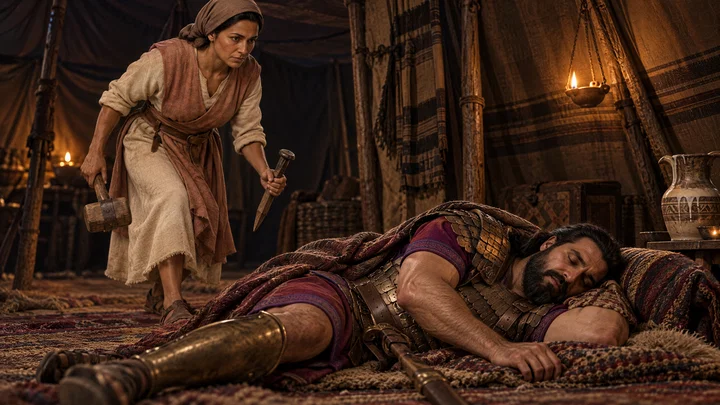
Sisera reached the tent of Heber, a descendant of Jethro, after abandoning his chariot to flee on foot like a common soldier, and Heber was absent. Jael courteously gave the weary general shelter, a refreshing drink, and rest until he fell asleep, and at first, being ignorant of her guest's identity, she resolved to conceal him. In the verse he asks her to stand in the door of the tent and to deny that anyone is there, to answer No if any man comes and inquires whether any man is there. When Jael afterward learned that he was Sisera, the enemy of God and of His people, her purpose changed and she overcame her natural reluctance to kill him. While he lay asleep before her she drove a nail through his temples that pinned him to the earth, and as Barak passed by in pursuit she called him in to see the boastful, vain-glorious captain dead at her feet, slain by the hand of a woman.
Pioneers and periodicals
13 sources
Sisera, fleeing on foot after leaving his chariot, asked Jael to stand in the door of Heber's tent while he was absent and to answer No if any man came asking if a man was there.RH Jun 29, 1911 She at first received the weary general courteously with shelter, drink and rest until he slept, but when she knew him as the enemy of God and His people she slew him with a nail through his temples, so that Barak pursuing him was called in to see him dead.RH Apr 1, 1902RH Jun 29, 1911 It was the overthrow of Jabin king of Canaan after twenty years of oppression, won under Deborah and Barak because Israel had faith though Sisera had nine hundred chariots of iron.ST May 27, 1913ST As one of the great battles at Megiddo it stands as an object lesson for the final gathering of the nations at Armageddon under the sixth plague.RH Mar 19, 1901RH Feb 2, 1905 The honor of the deed passing to a woman shows that God honors women in carrying out His purposes, and Jael's fearlessness calls mothers to like courage in the home to strike the death-blow to sin.RH Jun 29, 1911RH Dec 14, 1911RH Dec 14, 1911
Story and Historical Setting
Sisera had left his chariot and fled on foot as a common soldier when he asked Jael to stand in the door of the tent and to answer No if any man came and enquired if any man was there.RH Jun 29, 1911 He had come to the tent of Heber, a descendant of Jethro, when Heber was absent, and Jael courteously offered the weary general shelter with a refreshing draught and opportunity for repose until he fell asleep. At first ignorant of her guest's character she resolved to conceal him, but when she afterward learned he was Sisera, the enemy of God and His people, her purpose changed. Overcoming natural reluctance, while he lay asleep before her she slew him by driving a nail through his temples pinning him to the earth. He had fled to Heber's tent after his army was defeated and perished there at Jael's hand after falling asleep, and Barak, passing that way in pursuit, was called in to behold the vain-glorious captain dead at her feet, slain by the hand of a woman.RH Apr 1, 1902RH Jun 29, 1911
The verse belongs to Jael's part in delivering Israel from Jabin, king of Canaan, after twenty years of oppression.ST Though Sisera had nine hundred iron chariots, Israel overthrew him under Deborah and Barak because they had faith.ST May 27, 1913 By the victory of Barak and Deborah the Israelites first gained possession of the Plain of Jezreel, though the Canaanites continued to hold several cities in the plain until the time of the kings.ST May 9, 1916 The victory was one in which Israel's leaders took the lead and the people offered themselves willingly, and it was followed by a song of joy.RH Mar 14, 1907
Barak's triumph over the Canaanites was among the events that gave rise to Israel's earliest poetry in the Galilean hills.ST Feb 10, 1881 The verse stands within Judges 3 to 17 as one composite record of backsliding from God followed by suffering, oppression, captivity and servitude, and of returning to God followed by forgiveness and deliverance.ST It displays Israel's perversity and unbelief against God's long-suffering and goodness, amid awful moral surroundings and the demoralizing influences of the tribes Israel permitted to remain in the land of promise.ST
Megiddo and Final Prophecy
The verse belongs to the account of Barak's victory over the Canaanites.RH Feb 2, 1905 That victory stands among the great battles associated with Megiddo.RH Feb 2, 1905 Megiddo was the Old Testament battlefield of conflicts between Israel and God's enemies.RH Feb 2, 1905
The battle of Megiddo in the day of Deborah and Barak serves as an object lesson for the final gathering of the nations at Armageddon under the sixth plague.RH Mar 19, 1901 The account of that battle, especially Judges 5, is important for understanding the sixth and seventh plagues.RH Mar 19, 1901
Faith, Women, and Courage
Judges 4 shows women honored by God and involved in carrying out His purposes, as evidence that women's participation in worship and religious service is not prohibited. The account of Deborah the prophetess helping Barak shows that women may bear testimony for God publicly without usurping authority over men, provided they do so with becoming modesty.ST May 13, 1903 Sisera asked Jael to stand at the tent entrance and deny that he was there if anyone came looking for him.RH Jun 29, 1911 Jael did not protect him, for after he fell asleep she killed him, so that Barak found Sisera dead, and her role in defeating Israel's enemy gave to a woman the honor Barak had expected to gain and demonstrates that women share with men in serving God's purposes.RH Jun 29, 1911
Jael's courageous deed when the captain of the enemy bands came to her tent in flight and was delivered into her hands stands among the good works of woman recorded in the Bible, showing that God honors woman in all ages and places her as a beacon-light in every avenue of life.RH Dec 14, 1911 The story belongs to Jael's fearlessness and courage.RH Dec 14, 1911 That courage is not needed today on the field of worldly strife but in the home, the limited but mighty province where the greatest battle is being waged against principalities and powers, against the rulers of the darkness of this world and spiritual wickedness in high places.RH Dec 14, 1911 There mothers are to have the fearlessness and courage of Jael to strike the death-blow to sin.RH Dec 14, 1911
Sources