Judges 4:21
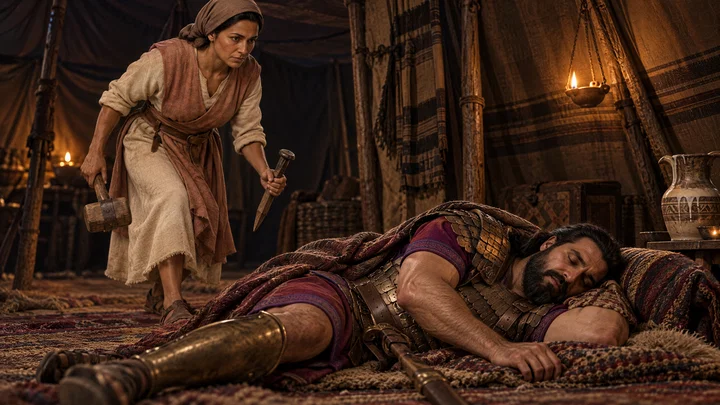
Then Jael Heber’s wife took a nail of the tent, and took an hammer in her hand, and went softly unto him, and smote the nail into his temples, and fastened it into the ground: for he was fast asleep and weary. So he died.
Translations
Then Jael Heber’s wife took a nail of the tent, and took an hammer in her hand, and went softly to him, and smote the nail into his temples, and fastened it into the ground: for he was fast asleep and weary. So he died.
Then Jael Heber’s wife took a nail of the tent, and took an hammer in her hand, and went softly unto him, and smote the nail into his temples, and fastened it into the ground: for he was fast asleep and weary. So he died.
Then Jael Heber’s wife took a nail of the tent, and took a hammer in her hand, and went softly unto him, and smote the nail into his temples, and fastened it into the ground: for he was fast asleep and weary. So he died.
Then Jael, Heber's wife, took a nail of the tent, and took a hammer in her hand, and went softly to him, and smote the nail into his temples, and fastened it into the ground: for he was fast asleep, and weary. So he died.
Then Jael Heber’s wife took a tent-pin, and took an hammer in her hand, and went softly unto him, and smote the pin into his temples, and it pierced through into the ground; for he was in a deep sleep; so he swooned and died.
Then Jael Heber’s wife took a tent-pin, and took a hammer in her hand, and went softly unto him, and smote the pin into his temples, and it pierced through into the ground; for he was in a deep sleep; so he swooned and died.
And Jael wife of Heber taketh the pin of the tent, and taketh the hammer in her hand, and goeth unto him gently, and striketh the pin into his temples, and it fasteneth in the earth — and he hath been fast asleep, and is weary — and he dieth.
And Jael Heber's wife took a tent-pin, and took the hammer in her hand, and went softly to him, and smote the pin into his temples, and it penetrated into the ground; for he had fallen into a deep sleep and was faint; and he died.
Then took Jael, wife of Heber, the tent-pin, and put the mallet in her hand, and went in unto him, softly, and smote the tent-pin into his temples, and it pierced through into the ground,—he being fast asleep and shrouded in darkness, and he died.
Berean Standard Bible, Majority Standard Bible
But as he lay sleeping from exhaustion, Heber’s wife Jael took a tent peg, grabbed a hammer, and went silently to Sisera. She drove the peg through his temple and into the ground, and he died.
Then Jael, Heber’s wife, took a tent peg, and took a hammer in her hand, and went softly to him, and struck the pin into his temples, and it pierced through into the ground, for he was in a deep sleep; so he fainted and died.
Then Jael, Heber's wife, took a tent-pin and a hammer and went up to him quietly, driving the pin into his head, and it went through his head into the earth, for he was in a deep sleep from weariness; and so he came to his end.
Then Iael Hebers wife tooke a nayle of the tent, and tooke an hammer in her hande, and went softly vnto him, and smote the nayle into his temples, and fastened it into the grounde, (for he was fast a sleepe and weary) and so he dyed.
Douay-Rheims (Challoner revision)
So Jahel Haber’s wife took a nail of the tent, and taking also a hammer: and going in softly, and with silence, she put the nail upon the temples of his head, and striking it With the hammer, drove it through his brain fast into the ground: and so passing from deep sleep to death, he fainted away and died.
Pictures
Cross-references
- Judges 5:24-27
Blessed above women shall Jael the wife of Heber the Kenite be, blessed shall she be above women in the tent.
Deborah’s song recounts Jael killing Sisera.
- Judges 4:9
And she said, I will surely go with thee: notwithstanding the journey that thou takest shall not be for thine honour; for the LORD shall sell Sisera into the hand of a woman. And Deborah arose, and went with Barak to Kedesh.
Deborah foretells that a woman will gain the honor of defeating Sisera.
- Judges 5:20
They fought from heaven; the stars in their courses fought against Sisera.
The song recalls the battle in which Sisera was defeated, with the stars fighting against him.
- Judges 4:1-3
And the children of Israel again did evil in the sight of the LORD, when Ehud was dead.
Sets the twenty-year oppression under Jabin.
- Judges 4:14
And Deborah said unto Barak, Up; for this is the day in which the LORD hath delivered Sisera into thine hand: is not the LORD gone out before thee? So Barak went down from mount Tabor, and ten thousand men after him.
Deborah and Jael are portrayed as godly women in Israel’s victory over Sisera.
- Judges 5:2
Praise ye the LORD for the avenging of Israel, when the people willingly offered themselves.
Israel’s leaders and people willingly offer themselves after Sisera’s defeat.
- Hebrews 11:32
And what shall I more say? for the time would fail me to tell of Gedeon, and of Barak, and of Samson, and of Jephthae; of David also, and Samuel, and of the prophets:
lists Barak as a man of faith despite weakness
- Judges 4:8
And Barak said unto her, If thou wilt go with me, then I will go: but if thou wilt not go with me, then I will not go.
gives Barak's demand for Deborah that cost him honor
Commentary
Each commentary is drawn from primary sources: the writings of Ellen G. White and Adventist pioneers and periodicals. Each commentary is separate. Its own words are not a quotation; follow the references to read the source passages.
Ellen G. White
After his army was defeated, Sisera fled on foot like a common soldier to the tent of Heber the descendant of Jethro. In Heber's absence, his wife Jael received the fugitive and gave him drink and rest until the weary general fell asleep. At first Jael did not know the character of her guest and resolved to conceal him.
When she learned he was Sisera, the enemy of God and of His people, her purpose changed. Though naturally reluctant to such an act, she slew him as he lay asleep by driving a nail through his temples and pinning him to the earth. As Barak pursued his enemy, Jael called him in to behold the vain-glorious captain dead at her feet, slain by the hand of a woman.
Pioneers and periodicals
21 sources
After his army with its nine hundred iron chariots was overthrown at Megiddo, the weary Sisera fled on foot to the tent of Heber the Kenite, where Jael gave him drink and rest until he fell fast asleep and then drove a tent nail through his temples and pinned him to the ground, completing Israel's deliverance from twenty years of oppression by Jabin king of Canaan.ST May 27, 1913RH Feb 2, 1905RH Jun 2, 1904RH Apr 1, 1902 This fulfilled Deborah's word that the Lord would sell Sisera into the hand of a woman, for Barak would not pursue the enemy unless the prophetess went with him, so the honor he might have gained went to Jael the wife of Heber.ST Jun 1, 1904RH Jun 29, 1911 The victory shows that Israel could overcome its enemies when leaders took the lead and the people offered themselves willingly in faith, a rule applied to the closing work of the third angel's message, and the battle at Megiddo stands as an object lesson connected with the final gathering of the nations at Armageddon under the sixth plague.RH Mar 14, 1907ST May 27, 1913RH Mar 19, 1901RH Feb 2, 1905ST Jun 1, 1904 It is an example of the honor God has given women in all ages, showing they can serve publicly for God and even lead the hosts of God in war with honor equal to men.ST May 13, 1903RH Jun 29, 1911 The stealthy blow against a sleeping man warns God's enemies of their fate, illustrates how sin entices and quiets its victim behind a welcoming appearance and then strikes unto death, and shows the fearlessness mothers now need not on fields of worldly strife but in the home to strike the death-blow to sin.RH Jun 2, 1904RH May 14, 1861RH May 28, 1857RH Dec 14, 1911RH Dec 1, 1859
Narrative and Historical Setting
After his army was defeated, the weary Sisera fled on foot like a common soldier to the tent of Heber the descendant of Jethro.RH Apr 1, 1902 In Heber's absence his wife Jael received him, gave him drink and rest until the weary general fell fast asleep, and then killed him in her tent by driving a tent nail with a hammer through his temples and pinning him to the ground.RH Jun 2, 1904RH Apr 1, 1902 At first not knowing the character of her guest she had resolved to conceal him, but when she learned he was Sisera the enemy of God and of His people her purpose changed, and though naturally reluctant to such an act she slew him as he lay asleep. Barak in pursuit of his enemy was then called in by Jael to behold the vain-glorious captain dead at her feet, slain by the hand of a woman with tent peg and hammer, fulfilling the fate of a commander who had taken up arms against the Lord's forces.RH Jun 2, 1904
The killing completed Israel's deliverance from Jabin king of Canaan after twenty years of oppression.ST Although Sisera had oppressed Israel with nine hundred iron chariots, he was overthrown by Israel under Deborah and Barak, and his chariots and army were swept away by the Kishon, showing that Israel could overcome its enemies when it acted in faith.ST May 27, 1913ST Aug 20, 1912 The triumph in Galilee at Megiddo was one of the two great victories associated with that Old Testament battlefield of conflicts between Israel and God's enemies, through which the Israelites first gained possession of the Plain of Jezreel.RH Feb 2, 1905ST May 9, 1916
The verse belongs to the composite record of Judges 3 to 17 of backsliding from God bringing suffering, oppression, captivity and servitude and of returning to God bringing forgiveness and deliverance.ST That record shows the perversity and unbelief of Israel and the long-suffering and goodness of God amid awful moral surroundings and the demoralizing influences of the tribes permitted to remain in the land of promise.ST Jael's tent stands in that history as one of the humble, private settings remembered alongside royal courts, cities and wars, showing ordinary people and places in Israel's history.RH May 1, 1879
The victory was followed by a song of joy and is celebrated in Deborah and Barak's song, in which Jael's strange part in the deliverance is remembered.RH Mar 14, 1907ST Barak's triumph over the Canaanites in Galilee is associated with the rise of Israel's earliest poetry.ST Feb 10, 1881
Prophecy and Doctrinal Teaching
The driving of the tent nail through the sleeping commander's temples fulfilled Deborah's word that the expedition would not be for Barak's honor because the Lord would sell Sisera into the hand of a woman, delivering him into the hands of Jael the wife of Heber the Kenite.ST Jun 1, 1904RH Jun 29, 1911 Barak had extraordinary faith, but his faith might have been stronger, for he would not go in pursuit of the enemy unless Deborah the prophetess went with him.ST Jun 1, 1904 So the man whose faith did not permit him to go forth to the conflict without the assistance of a woman was excelled by a woman, and the honor he could have gained by trusting God's word went to a woman who completed the defeat of Israel's enemy while he slept.ST Jun 1, 1904RH Jun 29, 1911
The account shows that Israel, although oppressed by Sisera with nine hundred iron chariots, overthrew him under Deborah and Barak and could overcome its enemies when it acted in faith.ST May 27, 1913ST Jun 1, 1904 It illustrates the rule, According to your faith be it unto you.ST Jun 1, 1904 The victory is linked with leaders taking the lead and the people offering themselves willingly, and it was followed by a song of joy.RH Mar 14, 1907 That willing engagement of leaders and people is applied to the closing work of the third angel's message, when leaders and people will engage willingly in the work.RH Mar 14, 1907
The battle of Deborah and Barak belongs to the account of the battle at Megiddo, one of the two great victories associated with Megiddo as the Old Testament battlefield linked with conflicts between Israel and the enemies of God's people.RH Mar 19, 1901RH Feb 2, 1905 As such it serves as an object lesson connected with the final gathering of the nations at Armageddon under the sixth plague.RH Mar 19, 1901 The Barak and Deborah history carries prophetic significance as a marvel in metaphor, a significance hitherto generally unnoticed.ST Feb 13, 1901
The deed is an example of the honor God has given women in all ages, supporting that women can take part in the worship of God and serve publicly for God as Deborah the prophetess did in helping Barak.ST May 13, 1903 Jael's victory, by which the captain of the Midianitish bands was delivered into her hands through her courage, led Barak to join Deborah in praise and showed Israel that women could hold honor equal to men.RH Jun 29, 1911RH Dec 14, 1911 It stands among the good works of women with which the Bible teems, placing woman as a beacon-light in every avenue of life, even in leading the hosts of God in war.RH Dec 14, 1911 The record of the bloody deed of driving a tent nail into the temples of a weary sleeping man and killing him, after which blessings were showered upon Jael, is counted among alleged inaccuracies, inconsistencies and hard places testing divine and human utterances and the inspiration of Scripture, standing alongside the fierce denunciations and prayers for destruction in the imprecatory psalms as a divine approval of human violence.
Warnings and Practical Illustrations
The fate of the commander who had taken up arms against the Lord's forces stands as a warning to God's enemies, for after he fell asleep Jael killed him with tent peg and hammer.RH Jun 2, 1904 The approach to the sleeping and weary man with peg and hammer shows how sin works, first enticing and quieting its victim and then striking when the victim is under its influence.RH May 14, 1861 As she seemed to offer hospitality and then struck while he slept, so sin practices deceptive betrayal, hiding its deadly purpose behind a welcoming appearance.RH Dec 1, 1859
What looks generous and desirable can become a means leading to death, as in the offering in a lordly dish, and so the prosperity and riches of the wicked prepare them for judgment rather than lasting happiness.RH May 28, 1857 Jael's fearlessness and courage in striking the death-blow is what mothers today need in order to strike the death-blow to sin in the home.RH Dec 14, 1911 The Jaels needed now are not needed on the field of worldly strife but in the home, where the greatest battle of the universe is being waged against principalities and powers, against the rulers of darkness and spiritual wickedness, as the closing struggle between good and evil draws speedily on.RH Dec 14, 1911
Sources