Judges 6:38
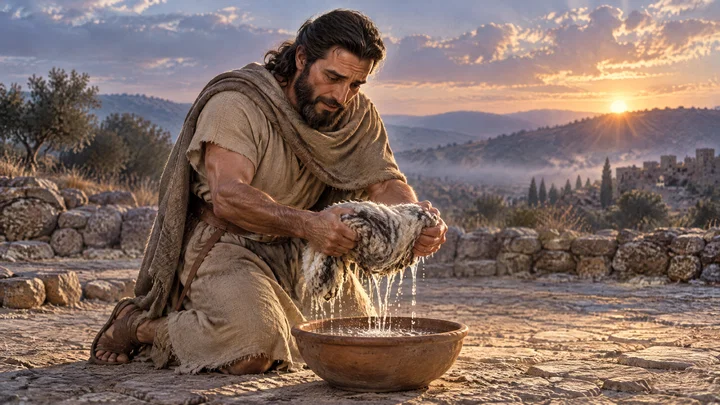
And it was so: for he rose up early on the morrow, and thrust the fleece together, and wringed the dew out of the fleece, a bowl full of water.
Translations
American King James Version, King James Version, KJV Cambridge Paragraph Bible
And it was so: for he rose up early on the morrow, and thrust the fleece together, and wringed the dew out of the fleece, a bowl full of water.
And it was so: for he rose early on the morrow, and pressed the fleece, and wrung the dew out of the fleece, a bowl-full of water.
And it was so: for he rose up early on the morrow, and pressed the fleece together, and wringed the dew out of the fleece, a bowlful of water.
And it was so; for he rose up early on the morrow, and pressed the fleece together, and wrung the dew out of the fleece, a bowlful of water.
and it is so, and he riseth early on the morrow, and presseth the fleece, and wringeth dew out of the fleece — the fulness of the bowl, of water.
And it was so. And when he rose up early on the morrow, he pressed the fleece together, and wrung dew out of the fleece, a bowl-full of water.
And it was so, and he rose up early, on the morrow, and pressed together the fleece,—and wrung out the dew from the fleece, a small bowl full of water.
Berean Standard Bible, Majority Standard Bible
And that is what happened. When Gideon arose the next morning, he squeezed the fleece and wrung out the dew— a bowlful of water.
It was so; for he rose up early on the next day, and pressed the fleece together, and wrung the dew out of the fleece, a bowl full of water.
And it was so: for he got up early on the morning after, and twisting the wool in his hands, he got a basin full of water from the dew on the wool.
And so it was: for he rose vp earely on the morow, and thrust the fleece together, and wringed the dew out of the fleece, and filled a bowle of water.
Douay-Rheims (Challoner revision)
And it was so. And rising before day wringing the fleece, he filled a vessel with the dew.
Pictures
Cross-references
- Judges 6:21
Then the angel of the LORD put forth the end of the staff that was in his hand, and touched the flesh and the unleavened cakes; and there rose up fire out of the rock, and consumed the flesh and the unleavened cakes. Then the angel of the LORD departed out of his sight.
The fire sign precedes the fleece sign as evidence of the Lord’s guidance.
- Judges 7:13-14
And when Gideon was come, behold, there was a man that told a dream unto his fellow, and said, Behold, I dreamed a dream, and, lo, a cake of barley bread tumbled into the host of Midian, and came unto a tent, and smote it that it fell, and overturned it, that the tent lay along.
A third manifestation strengthens Gideon after the fleece test.
- Judges 6:14-16
And the LORD looked upon him, and said, Go in this thy might, and thou shalt save Israel from the hand of the Midianites: have not I sent thee?
Gideon is called to deliver Israel from its enemies.
- Judges 6:13
And Gideon said unto him, Oh my Lord, if the LORD be with us, why then is all this befallen us? and where be all his miracles which our fathers told us of, saying, Did not the LORD bring us up from Egypt? but now the LORD hath forsaken us, and delivered us into the hands of the Midianites.
Gideon asks where God’s former miracles are.
Commentary
Each commentary is drawn from primary sources: the writings of Ellen G. White and Adventist pioneers and periodicals. Each commentary is separate. Its own words are not a quotation; follow the references to read the source passages.
Ellen G. White
4 sources
The verse belongs to the time when God raised up Gideon to deliver Israel from its enemies after the people had turned back to idolatry.PP 544.2–545.1 It records the first fleece sign, in which in the morning the fleece was wet with dew so that a bowlful of water could be wrung from it while the surrounding ground remained dry.ST Jun 23, 1881PP 548.2 Gideon had requested the sign for assurance that God had called him to deliver Israel and would save Israel through him.ST Jun 23, 1881PP 548.2
Gideon feared the first test was not decisive because wool naturally absorbs moisture, so he felt he needed a renewed sign.ST Jun 23, 1881PP 548.2 He then asked for the opposite sign, and God granted that request as well.PP 548.2 Gideon's use of the fleece to learn God's will does not authorize setting signs as tests for deciding duty; that practice is a delusion contrary to the Lord's will, and confidence in such signs can lead to serious wrongdoing, including adultery.Lt 36, 1911, par. 4
Sources
Pioneers and periodicals
28 sources
He rose early in the morning and squeezed a bowl full of water from the dew-soaked fleece while the ground around it stayed dry, the first half of a double sign whose conditions were reversed the next morning so the fleece stayed dry while the ground was wet.ST Jun 23, 1881RH Sep 18, 1900RH Jun 4, 1901RH Jul 22, 1902RH Apr 12, 1864 It falls within the record of Israel's backsliding, suffering under oppression, return to God, and deliverance through a called deliverer.ST The sign answered his request for assurance that God had called him to save Israel from the Midianites and would be with him for success, and it strengthened his confidence to act.ST Jun 23, 1881RH Sep 18, 1900 God in patience honored the request of one who felt too weak without His help even though asking showed lack of faith, while those who stressed the plainness of the call already given held that requiring the added sign was unbelief.ST Feb 15, 1905STRH Jun 4, 1901RH Jul 22, 1902 His victory with only three hundred men shows how mightily God works through a few who rely on His power rather than human strength, and the fleece must not be made a rule for demanding a sign to decide whether to obey a duty plainly stated in God's word.ST Mar 24, 1909RH May 13, 1915ST Mar 6, 1893ST Jan 15, 1880
Setting and Wording Explained
The verse falls within a record of Israel's backsliding, resulting suffering and oppression, and return to God, followed by forgiveness and deliverance.ST The morrow sometimes means the light, morning part of the same sunset-to-sunset day, so rising early on the morrow to wring the fleece is the next daylight after the evening, morrow being used generally and not technically for the next light day, and morning and morrow being from the same root.ST Jan 11, 1905 He rose early in the morning, thrust the fleece together, and wrung from the dew-soaked fleece a bowl full of water while the ground around remained dry.ST Jun 23, 1881RH Sep 18, 1900ST Jun 20, 1900ST Jan 15, 1880RH Nov 13, 1856 The fleece was found full of dew and yielded a bowl of water when wrung, in contrast with the dry surroundings.RH Apr 12, 1864
The sign was double: first dew wetting the fleece while the ground stayed dry, with the conditions reversed the next morning so the fleece remained dry while the ground was wet.RH Jun 4, 1901RH Jul 22, 1902ST Sep 27, 1910 The first part was dew to wet the fleece while the ground stayed dry, with the reverse to follow.RH Jul 22, 1902 The dew test stands with the acceptance of his offering at the angel's visit and the Midianite dream and its interpretation as a series of manifestations of the Lord's guidance to strengthen Gideon with his small company of chosen warriors for the attack.ST Sep 26, 1895ST Sep 26, 1895 The fleece test fulfilled is the second of the three, after the offering and before the dream, given as evidence that the Lord was indeed leading him to deliver Israel from the Midianites.ST Sep 26, 1895ST Sep 26, 1895
Assurance Given to Gideon
The wrung-out bowlful was the first half of a double token, wet fleece on dry ground with the conditions reversed the next morning, given to answer the request for assurance that the call to deliver Israel from the Midianites was real and that deliverance would come through the one called and with divine presence for success.ST Jun 23, 1881RH Sep 18, 1900RH Aug 19, 1862RH Jun 11, 1901 It was a direct call from a superhuman source proving chosenness to lead, confirming that God would deliver Israel, and afterward there was belief and strengthened confidence to act.RH Sep 18, 1900RH Aug 19, 1862RH Jun 11, 1901ST Jun 20, 1900 Abundant proof had been given that the Lord was with the one called to rid Israel of the Midianites and Amalekites, with promise to deliver the enemy host into his hand, yet with only three hundred men looking down on a host in the valley like locusts for multitude there was trembling because the way of accomplishment could not be seen. The victory then shows how mightily work is done through a few against many, for from thirty-two thousand only three hundred were chosen and the great victory came through reliance on divine power rather than human strength.ST Mar 24, 1909RH May 13, 1915 That same account shows supply of the Spirit to accomplish the purpose of the call.RH May 13, 1915
The test with the fleece was honored and not met with displeasure, showing patience toward one who sought reassurance because of felt weakness for the task without help.ST Feb 15, 1905STRH Jun 4, 1901 Asking for the sign nevertheless showed lack of faith.ST Feb 15, 1905RH Jun 4, 1901 Need for a renewed sign arose from fear that the first test was not decisive.ST Jun 23, 1881 The sign belonged to the effort to become sure the Lord was with him, so discouragement and opposition could be faced with confidence.ST Jun 23, 1881RH Nov 13, 1856
The call was already distinct and imperative without these signs, so requiring the added sign was unbelief, and waiting for a sign before obeying a plain call repeats that unbelief.RH Jul 22, 1902 At the same time the one who asked is set forth as the greatest of the judges, notable as a man of faith and of principle, who in every step sought counsel or encouragement directly from God and then did precisely what was said.ST Jul 17, 1884 The verse belongs to testing the word by a visible sign and stands as one example of allowing the word to be tested to reassure a servant slow to accept it without such proof.ST May 1, 1901 The account of Gideon and his army gives visible proof of power to deliver in battle when there was belief and trust in the Lord.ST Jun 18, 1885 Its purpose is not to promise help in physical warfare but to give courage and confidence that there is power to help all who are in trouble, strengthening trust in the promises to be a stronghold in trouble and to make a way to escape temptation.ST Jun 18, 1885
Application Guidance and Misuse
God gives the privilege of proving Him and finding out for oneself that He will do whatever He has said, rather than taking Him on another's testimony alone.RH Jun 4, 1901 As no explanation can make another know how honey tastes, and as the sweetness of salvation cannot be appreciated until tasted, so the fleece wet with dew while the ground stayed dry, with the conditions reversed the next morning, was tasting and proving for oneself the call to lead Israel to victory.RH Jun 4, 1901 God was not displeased with that request but granted it.RH Jun 4, 1901
To propose a test with the fleece or something equivalent today, asking that a specific event take place to show what is best in order to learn the will of God, is presumptuous and comes from lack of faith, because believers are nowhere directed to learn His will by such means.ST Mar 6, 1893 The fleece is an example of asking God for a sign, but a sign should not be demanded to decide whether to obey a duty plainly stated in His word, though room is left for God to grant such a sign if He chooses.ST Jan 15, 1880 The rising early and wringing a bowlful of water from the dew-soaked fleece became a means of seeking God's guidance, as in repeatedly seeking direction before undertaking the establishment of a school.RH Jul 12, 1906
As the fleece was drenched with dew, the Holy Spirit can bring life and power to people who are spiritually dry and powerless.RH Jan 16, 1913 The dew represents the Spirit's transforming work, bringing earnestness, zeal, and strength to serve in the struggle against sin.RH Jan 16, 1913 When the dews of grace fall around at religious meetings, one who withholds offerings from God may remain spiritually dry, like the fleece in the sign, with no expression of holy triumph.RH Jan 16, 1866 The contrast of the fleece full of dew with the dry surroundings is echoed when rain falls on the town where prayer was offered while neighboring towns remain almost entirely dry.RH Apr 12, 1864 The image of dew soaking a fleece while the ground remained dry, and then the fleece remaining dry while the ground was wet, is also applied to describe clerical privilege in Spain, with the clergy receiving advantages while the laity remain without them.ST Sep 27, 1910
The fleece wrung full of dew is made by others to mean Mary as the fleece between the dew and the floor, established between Christ and the church, also as the woman between the sun and the moon.ST Mar 30, 1876RH May 12, 1874 She is presented as mediator to the Mediator Christ, all sweetness offering milk and wool, full of goodness and mercy, to be embraced and held until she blesses, because she is powerful and always heard.ST Mar 30, 1876 On that showing sinners must have recourse to her as advocate with Christ, receiving fullness from above to give to all below, so that the captive receives redemption, the sick healing, the sorrowful consolation, the sinner pardon, the righteous grace, and the angel joy.ST Mar 30, 1876RH May 12, 1874 That use stands in direct contrast to Christ's own invitation for all who labor and are heavy laden to come to Him for rest.ST Mar 30, 1876
Sources