Judges 7:13
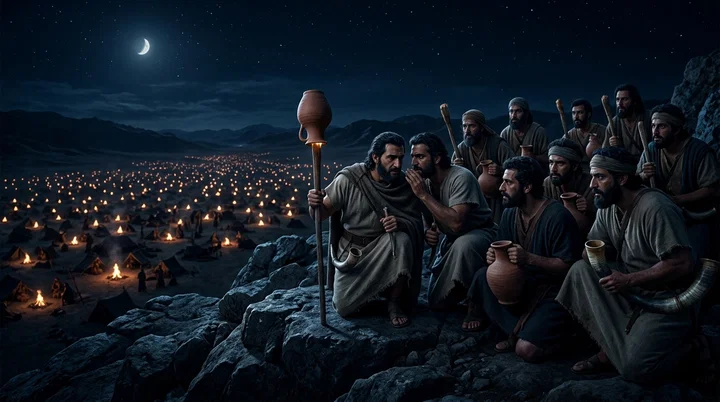
And when Gideon was come, behold, there was a man that told a dream unto his fellow, and said, Behold, I dreamed a dream, and, lo, a cake of barley bread tumbled into the host of Midian, and came unto a tent, and smote it that it fell, and overturned it, that the tent lay along.
Translations
And when Gideon was come, behold, there was a man that told a dream to his fellow, and said, Behold, I dreamed a dream, and, see, a cake of barley bread tumbled into the host of Midian, and came to a tent, and smote it that it fell, and overturned it, that the tent lay along.
And when Gideon was come, behold, there was a man that told a dream unto his fellow, and said, Behold, I dreamed a dream, and, lo, a cake of barley bread tumbled into the host of Midian, and came unto a tent, and smote it that it fell, and overturned it, that the tent lay along.
And when Gideon was come, behold, there was a man that told a dream unto his fellow, and said, Behold, I dreamed a dream, and lo, a cake of barley bread tumbled into the host of Midian, and came unto a tent, and smote it that it fell, and overturned it, that the tent lay along.
And when Gideon had come, behold, there was a man that told a dream to his fellow, and said, Behold, I dreamed a dream, and lo, a cake of barley-bread rolled into the host of Midian, and came to a tent, and smote it that it fell, and overturned it that the tent lay along.
And when Gideon was come, behold, there was a man that told a dream unto his fellow, and said, Behold, I dreamed a dream, and, lo, a cake of barley bread tumbled into the camp of Midian, and came unto the tent, and smote it that it fell, and turned it upside down, that the tent lay along.
And when Gideon was come, behold, there was a man telling a dream unto his fellow; and he said, Behold, I dreamed a dream; and, lo, a cake of barley bread tumbled into the camp of Midian, and came unto the tent, and smote it so that it fell, and turned it upside down, so that the tent lay flat.
And Gideon cometh in, and lo, a man is recounting to his companion a dream, and saith, 'Lo, a dream I have dreamed, and lo, a cake of barley-bread is turning itself over into the camp of Midian, and it cometh in unto the tent, and smiteth it, and it falleth, and turneth it upwards, and the tent hath fallen.'
And Gideon came, and behold, a man was telling a dream to his fellow; and he said, Behold, I dreamed a dream, and lo, a cake of barley-bread tumbled into the camp of Midian, and came to the tent, and smote it that it fell, and overturned it; and the tent lay along.
And Gideon came in, and lo! a man relating to his neighbour a dream,—and he said—Lo! a dream, have I dreamt, and lo! a round cake of barley bread tumbling into the camp of Midian, and it came as far as the tent—and smote it that it fell, and turned it upside down, and the tent lay along.
Berean Standard Bible, Majority Standard Bible
And as Gideon arrived, a man was telling his friend about a dream. “ Behold, I had a dream,” he said, “ and I saw a loaf of barley bread come tumbling into the Midianite camp. It struck the tent so hard that the tent overturned and collapsed.”
When Gideon had come, behold, there was a man telling a dream to his fellow. He said, “ Behold, I dreamed a dream; and behold, a cake of barley bread tumbled into the camp of Midian, came to the tent, and struck it so that it fell, and turned it upside down, so that the tent lay flat.”
When Gideon came there, a man was giving his friend an account of his dream, saying, See, I had a dream about a cake of barley bread which, falling into the tents of Midian, came on to the tent, overturning it so that it was stretched out flat on the earth.
And when Gideon was come, beholde, a man tolde a dreame vnto his neighbour, and said, Behold, I dreamed a dreame, and lo, a cake of barley bread tumbled from aboue into the hoste of Midian, and came vnto a tent, and smote it that it fell, and ouerturned it, that the tent fell downe.
Douay-Rheims (Challoner revision)
And when Gedeon was come, one told his neighbour a dream: and in this manner related what he had seen: I dreamt a dream, and it seemed to me as if a hearth cake of barley bread rolled and came down into the camp of Madian: and when it was come to a tent it struck it, and beat it down flat to the ground.
Pictures
Cross-references
- Judges 7:20-22
And the three companies blew the trumpets, and brake the pitchers, and held the lamps in their left hands, and the trumpets in their right hands to blow withal: and they cried, The sword of the LORD, and of Gideon.
Gideon’s three hundred rout the Midianites, fulfilling the dream’s image.
- Hebrews 11:32-34
And what shall I more say? for the time would fail me to tell of Gedeon, and of Barak, and of Samson, and of Jephthae; of David also, and Samuel, and of the prophets:
Gideon is named among those who acted by faith.
- Isaiah 9:4
For thou hast broken the yoke of his burden, and the staff of his shoulder, the rod of his oppressor, as in the day of Midian.
Calls the Lord’s victory “the day of Midian,” recalling Gideon’s defeat of Midian.
- Judges 6:5
For they came up with their cattle and their tents, and they came as grasshoppers for multitude; for both they and their camels were without number: and they entered into the land to destroy it.
describes Midianite multitude as locusts
- Judges 6:37-40
Behold, I will put a fleece of wool in the floor; and if the dew be on the fleece only, and it be dry upon all the earth beside, then shall I know that thou wilt save Israel by mine hand, as thou hast said.
second prior sign with the fleece
- Judges 7:2
And the LORD said unto Gideon, The people that are with thee are too many for me to give the Midianites into their hands, lest Israel vaunt themselves against me, saying, Mine own hand hath saved me.
God reduced Gideon’s army so Israel could not claim victory by its own strength.
- Judges 7:24
And Gideon sent messengers throughout all mount Ephraim, saying, Come down against the Midianites, and take before them the waters unto Beth-barah and Jordan. Then all the men of Ephraim gathered themselves together, and took the waters unto Beth-barah and Jordan.
Ephraim called to cut off fugitives
- Judges 8:4
And Gideon came to Jordan, and passed over, he, and the three hundred men that were with him, faint, yet pursuing them.
Gideon’s men continue pursuing despite being faint.
- Judges 8:21
Then Zebah and Zalmunna said, Rise thou, and fall upon us: for as the man is, so is his strength. And Gideon arose, and slew Zebah and Zalmunna, and took away the ornaments that were on their camels’ necks.
capture and death of Zebah and Zalmunna
Commentary
Each commentary is drawn from primary sources: the writings of Ellen G. White and Adventist pioneers and periodicals. Each commentary is separate. Its own words are not a quotation; follow the references to read the source passages.
Ellen G. White
8 sources
The dream stands within Israel's repeated cycle of forsaking the Lord for idols, being separated from God and His strength and brought into subjection to nations it should have subdued, then after chastisement confessing sin and being delivered by faithful and valiant men raised up by God, while a remnant stayed true and God never utterly forsook His people, though after each deliverer's death the people returned to their idols.PP 544.2–545.1 The deliverance here followed seven years of Midianite oppression joined by Amalekites from the south and others from the eastern deserts, unrelenting enemies who had nearly been destroyed in the days of Moses but had grown numerous, powerful, and vengeful for revenge.PP 545.2–3 Once God's protecting hand was withdrawn they first struck the tribes east of the Jordan and then ravaged the whole land like locusts with flocks, herds, and countless camels, spreading from the Jordan to the Philistine plain, arriving when harvests ripened and staying until the last fruits were gathered, stripping fields, robbing and abusing the people, then returning to the deserts and forcing those in open country into walled towns, fortresses, caves, and rocky strongholds, until in distress the people heeded reproof, confessed sin, and God raised up a helper.PP 545.2–3
On the night before battle God strengthened fearful Gideon by sending him with his attendant Phurah down to the enemy camp to hear encouragement, while Israel waited on a hill above the valley where Midianites, Amalekites, and eastern peoples lay thick as locusts.PP 550.1–553.1 Gideon listened in darkness and silence as one soldier told his dream to his companion of a cake of barley bread tumbling into the host of Midian and coming to a tent and striking it so that it fell and overturned it.Ms 89, 1906, par. 1–7PP 550.1–553.1 That tumbling barley cake foretold Midian's defeat, and its companion's answer that this was the sword of Gideon and that God had delivered Midian and all its army into his hand explained it as a sign of divinely given victory spoken to Gideon through Midianite strangers.Ms 89, 1906, par. 1–7PP 550.1–553.1ST Jul 21, 1881
Gideon recognized the interpretation as the voice of God, was strengthened and assured that the Lord had delivered the host into his hand, worshiped, and returned to his few men confident of victory.Ms 89, 1906, par. 1–7PP 550.1–553.1 He commanded them to arise for battle, leading to the divided companies with trumpets and torches hidden in pitchers, the war cry, panic and self-destruction among the enemy, pursuit joined by previously dismissed Israelites and by Ephraim at the fords, and the complete breaking of Midianite power so that they never again made war on Israel.PP 550.1–553.1 His army prevailed not because of numbers, human wisdom, power, strength, distinction, or visible means, but because in living faith it followed God's special directions, with power and wisdom from heaven working through humble instruments and simple means to leave no room for any human to claim the glory and to make clear that God alone brought success.GW92 297.2Lt 12a, 1888, par. 9–11ST Jul 21, 1881Ms 40a, 1890, par. 65–67
The account rebukes faithlessness and narrowness of view and teaches that narrow plans accomplish very little.GW92 297.2 It teaches that people must not seek glory for themselves but exalt the Lord God of Israel.Lt 12a, 1888, par. 9–11Ms 40a, 1890, par. 65–67 God's work in this victory brings Him glory while strengthening Israel's faith and shaming its enemies.ST Jul 21, 1881
Sources
Pioneers and periodicals
29 sources
Gideon stood trembling with only three hundred men against a host like locusts for multitude, and in the night God sent him down to the enemy camp where he overheard a man tell of a barley cake tumbling in and overturning a tent, which his fellow interpreted to mean God had delivered Midian and all the host into Gideon's hand to give him courage for the attack.ST Sep 26, 1895 The barley loaf rolling in and toppling the tent represented Israel's small, apparently powerless force overthrowing the much larger, proud and powerful Midianite army, making clear the victory was God's work by humble means for his glory.ST Jul 14, 1881ST Jul 14, 1881ST Jul 21, 1881 God had thinned Israel's numbers because they trusted in their strength and boasted of their multitude, to teach that victory comes by God's Spirit rather than human strength and that divine strength is made perfect in human weakness.RH Apr 21, 1868ST Mar 6, 1893RH May 13, 1915ST Jul 14, 1887ST Jul 21, 1909 With only three hundred men with pitchers and lamps suddenly breaking them to show the glare, the 135,000 Midianites were put to flight in terror, showing the Lord wins through apparently weak means and cares for those who trust him.ST Dec 12, 1895ST Oct 1, 1885ST Mar 24, 1909 Gideon's little band overcoming Midian proves God's work can be accomplished even when his people are few and the task seems beyond their strength, so those who hold the truth though few should not be intimidated by majorities against them.RH Apr 1, 1902RH Dec 18, 1900 The seventh chapter of Judges applies especially to this time, in those giving the third angel's message though few overthrowing opposition, in the Sabbath cause from a small beginning overturning powerful opposition to complete victory, and in missionary forces belting the world with light until God cuts short the work.RH Mar 12, 1901RH Aug 16, 1906ST May 6, 1875ST Nov 7, 1878
Dream's Setting and Meaning
Gideon stood discouraged before the Midianites and Amalekites with only three hundred men against a host like locusts for multitude, trembling because he could not see how victory was possible despite abundant proof the Lord was with him and the promise that the host was delivered into his hand. In the night God told him to take his servant down toward the enemy camp where he would hear something to give him courage. There he overheard with his servant a man telling his dream to his fellow, of a cake of barley bread tumbling into the host of Midian and coming unto a tent and smiting it that it fell and overturning it so that the tent lay along.ST Sep 26, 1895
The fellow interpreted the dream to mean that God had delivered Midian and all the host into Gideon's hand.ST Sep 26, 1895 The dream and its interpretation were directed by God for Gideon's special benefit to encourage and assure him and to strengthen him with his small company of chosen warriors.ST Sep 26, 1895 It was the third manifestation of God's guidance to him, after the acceptance of his offering at the angel's visit and the test with the fleece.ST Sep 26, 1895 The assurance removed his discouragement and led him to worship, and he returned at once exultant to carry out the divinely directed plan of attack, moving forward to the assault by which the enemy was routed and delivered into his hands.ST Sep 26, 1895ST Jul 17, 1884
The barley loaf rolling into camp and toppling a tent represented Israel's small, apparently powerless force overthrowing the much larger, proud and powerful Midianite army.ST Jul 14, 1881ST Jul 14, 1881 The loaf knocking down the tent foretold Midian's defeat, that the handful of Israelites would defeat their numerous enemies.ST Jul 14, 1881ST Jul 14, 1881ST Jul 21, 1881 The victory achieved by such simple, humble means made clear the work was God's alone, to bring Him glory, strengthen Israel's faith, and shame its enemies.ST Jul 14, 1881ST Jul 21, 1881 Gideon's nighttime visit inside the camp for encouragement before battle, acting at God's direction and returning exultant to act, shows faith and principle in contrast with superstition and self-willed expediency.ST Jul 17, 1884ST Jul 17, 1884
Victory Through Weak Means
God thinned Israel's numbers because they trusted in their own strength and boasted of their multitude.RH Apr 21, 1868ST Mar 6, 1893 He humbled them so that He could use them and receive the glory, bringing them to acknowledge that victory came from God.RH Apr 21, 1868 This test of obedience exposed the people's motives and taught them what they needed to overcome.RH Apr 21, 1868 Gideon was chosen despite his modest status and was given a sign to strengthen his confidence, and his army was reduced to three hundred men who relied on divine power rather than human strength and won a great victory.ST Mar 6, 1893RH May 13, 1915
Gideon did not win with thirty thousand warriors, two-thirds of whom were in a hurry to get home, for his force was too large and had to be whittled down until only three hundred remained.ST Mar 6, 1893 With only those three hundred men with pitchers and lamps, crying the sword of the Lord and of Gideon, he conquered with that battle cry.ST Mar 6, 1893 Suddenly breaking the pitchers to show the glare of the lamps or torches, he put the one hundred thirty-five thousand Midianites to flight in terror, showing how easily the Lord spreads terror among men.ST Oct 1, 1885 The account in Judges 7:13-23 is of the Lord winning through apparently weak human means, mightily working through few against many.ST Dec 12, 1895ST Mar 24, 1909 It teaches that victory comes by God's Spirit rather than by human strength, showing His care for those who trust Him and calling them to place no confidence in human power.ST Dec 12, 1895 Gideon ventured against the Midianites with only three hundred men, and God brought a great deliverance through him and his small army.ST Sep 17, 1896
God's work is done by minorities, not by counting numbers, for one man strong in God counts for more than a multitude without God.ST Mar 6, 1893 Gideon's little band overcoming the host of Midian proves that truth, right, and victory are not decided by numbers, that the race is not always to the swift nor the battle to the strong, and that power belongs to a minority when God is on its side.ST Jul 14, 1887 It is the example of God winning battles through the weak rather than through earthly might or superior numbers, with divine strength made perfect in human weakness so that no one can glory in human strength.ST Jul 21, 1909 God's work can therefore be accomplished even when His people are few and the task seems beyond their strength.RH Dec 18, 1900 Those who hold the truth though few should not be intimidated or discouraged by majorities against them, but should take courage in God-given victory over overwhelming opposition.ST Jul 14, 1887RH Apr 1, 1902
End-Time and Present Applications
The seventh chapter of Judges belongs especially to the present time, when from the immense crowd rallying around the standard the Lord has a chosen few who bow only enough to lap water from their hands with eyes vigilantly fixed on the enemy's movements and who will go up and take the city, while the rest bow down at ease to drink and refresh themselves until satisfied though claiming to belong to the regular army.RH Mar 12, 1901
Gideon's three hundred overthrowing Midian means that those giving the third angel's message, though no more in number, are destined to overthrow opposition when they stand shoulder to shoulder unto life or death with the ark of the Lord with them. That same small chosen force taking the camp of Midian shows what the Laodicean church becomes when strictly and universally heeding the counsel of the faithful and true Witness, a peculiar people walking by faith and not by sight like Abraham, Moses, Caleb and Joshua, David and the worthies of Hebrews 11, whose victories are eternal and lead to heirship with Christ, power over the nations, and the song of Moses and the Lamb.RH Nov 19, 1857
The barley loaf tumbling into camp and bringing down tents illustrates how the Sabbath cause from a small beginning will overturn powerful opposition and advance to complete victory.RH Aug 9, 1864RH Mar 29, 1864 The dream heard by Gideon's spy served as a token of victory, and the Sabbath interest of Frenchmen who had read the tracts recalled that token and encouraged continued work. The setting of Gideon's small army facing the host of Midian compares to the two Sabbath-keeping denominations, few in number, upholding the Sabbath against many opponents.ST Nov 7, 1878
Gideon's battle, in which three hundred true men faced a vast horde filling the valley like grasshoppers, is the precedent for missionary forces, for he did not mass his few men together but threw out a thin line until the slender force surrounded the vast camp, every heart courageous and every man with light to shine, until at the signal the shout rose from every side and God wrought the victory faith had grasped.RH Nov 4, 1902 So the barley-bread cake striking down and overturning a tent foreshadows surrounding the world in open formation and belting a continent such as South America with stations, a little light amid dark masses shining in every land with victory in every tongue until God cuts short the work in righteousness.RH Nov 4, 1902RH Aug 16, 1906 Gideon warring upon Midian with feeble instrumentalities to accomplish a mighty result proves God can use weak means to do great things, so labor in God through the press will certainly succeed in Europe despite severe toil, painful labor and many languages.ST May 6, 1875RH Apr 15, 1875
As Midian's army trembled before Gideon and his three hundred, so New York's workers of iniquity trembled before reformers.ST Sep 12, 1895 As Israel's hosts acted under God's direction against Midian and around Jericho, so they act against treason.RH Sep 23, 1862 Gideon's battle with Midian also gives the name day of Midian to the day of the Lord as a day of divine wrath.ST Jul 11, 1916
Sources