Judges 7:1
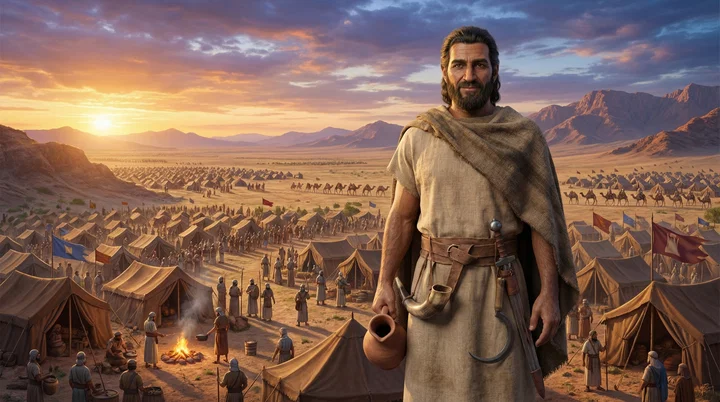
Then Jerubbaal, who is Gideon, and all the people that were with him, rose up early, and pitched beside the well of Harod: so that the host of the Midianites were on the north side of them, by the hill of Moreh, in the valley.
Translations
American King James Version, King James Version, KJV Cambridge Paragraph Bible
Then Jerubbaal, who is Gideon, and all the people that were with him, rose up early, and pitched beside the well of Harod: so that the host of the Midianites were on the north side of them, by the hill of Moreh, in the valley.
Then Jerubbaal (who is Gideon) and all the people that were with him, rose early, and encamped beside the well of Harod: so that the host of the Midianites were on the north side of them by the hill of Moreh, in the valley.
Then Jerubbaal, who is Gideon, and all the people that were with him, rose up early, and pitched beside the spring of Harod: and the camp of Midian was on the north side of them, by the hill of Moreh, in the valley.
Then Jerubbaal, who is Gideon, and all the people that were with him, rose up early, and encamped beside the spring of Harod: and the camp of Midian was on the north side of them, by the hill of Moreh, in the valley.
And Jerubbaal (he [is] Gideon) riseth early, and all the people who [are] with him, and they encamp by the well of Harod, and the camp of Midian hath been on the south of him, on the height of Moreh, in the valley.
And Jerubbaal, who is Gideon, arose early, and all the people that were with him, and they encamped beside the spring Harod; and he had the camp of Midian on the north by the hill of Moreh in the valley.
Then Jerubbaal, the same, is Gideon, and all the people that were with him, rose up early, and encamped by the fountain of Harod,—and, the camp of Midian, was on the north of them, by the hill of Moreh, in the vale.
Berean Standard Bible, Majority Standard Bible
Early in the morning Jerubbaal ( that is, Gideon) and all the men with him camped beside the spring of Harod. And the camp of Midian was north of them in the valley near the hill of Moreh.
Then Jerubbaal, who is Gideon, and all the people who were with him, rose up early and encamped beside the spring of Harod. Midian’s camp was on the north side of them, by the hill of Moreh, in the valley.
Then Jerubbaal, that is, Gideon, and all the people with him, got up early and put up their tents by the side of the water-spring of Harod; the tents of Midian were on the north side of him, under the hill of Moreh in the valley.
Then Ierubbaal (who is Gideon) rose vp early, and all the people that were with him, and pitched beside the well of Harod, so that the hoste of the Midianites was on the Northside of them in the valley by the hill of Moreh.
Douay-Rheims (Challoner revision)
Then Jerobaal, who is the same as Gedeon, rising up early and all the people with him, came to the fountain that is called Harad. Now the camp of Madian was in the valley on the north side of the high hill.
Pictures
Cross-references
- Judges 7:5
So he brought down the people unto the water: and the LORD said unto Gideon, Every one that lappeth of the water with his tongue, as a dog lappeth, him shalt thou set by himself; likewise every one that boweth down upon his knees to drink.
passage describes the waterside drinking test
- Judges 6:5
For they came up with their cattle and their tents, and they came as grasshoppers for multitude; for both they and their camels were without number: and they entered into the land to destroy it.
Midian’s vast invading host is described as countless, like grasshoppers.
- Judges 6:14-16
And the LORD looked upon him, and said, Go in this thy might, and thou shalt save Israel from the hand of the Midianites: have not I sent thee?
Gideon is called and promised strength to deliver Israel from Midian.
- Isaiah 9:4
For thou hast broken the yoke of his burden, and the staff of his shoulder, the rod of his oppressor, as in the day of Midian.
The Lord’s deliverance is compared to Gideon’s victory over Midian.
- Hebrews 11:32
And what shall I more say? for the time would fail me to tell of Gedeon, and of Barak, and of Samson, and of Jephthae; of David also, and Samuel, and of the prophets:
Names Gideon among the faithful worthies.
- Judges 7:7
And the LORD said unto Gideon, By the three hundred men that lapped will I save you, and deliver the Midianites into thine hand: and let all the other people go every man unto his place.
passage has God approving the three hundred to go in
- Judges 7:21-22
And they stood every man in his place round about the camp: and all the host ran, and cried, and fled.
The Lord turns Midian’s confusion into victory for Gideon’s small force.
- Judges 7:6
And the number of them that lapped, putting their hand to their mouth, were three hundred men: but all the rest of the people bowed down upon their knees to drink water.
The verse distinguishes the three hundred who lapped from those who knelt to drink.
Commentary
Each commentary is drawn from primary sources: the writings of Ellen G. White and Adventist pioneers and periodicals. Each commentary is separate. Its own words are not a quotation; follow the references to read the source passages.
Ellen G. White
4 sources
The verse stands in the repeated story of Israel's backsliding followed by chastisement, then confession and deliverance, in which God did not utterly forsake Israel but preserved a remnant true to Him and at times raised up faithful, valiant men to put down idolatry and deliver Israel from its enemies.PP 544.2–545.1 Its immediate setting is the Midianite oppression that came after Israel did evil, when the Lord delivered them into the hand of Midian, with the tribes east of the Jordan as the first sufferers but the whole land coming to suffer.PP 545.2–3 The oppressors were the Midianites from the eastern border and the deserts beyond together with the Amalekites from the south, still unrelenting enemies of Israel, for Midian had been nearly destroyed by Israel in the days of Moses but had since increased greatly and become numerous and powerful and thirsted for revenge, and seized its opportunity when God's protecting hand was withdrawn from Israel.PP 545.2–3 The wild, fierce desert inhabitants came as locusts for multitude with their flocks and herds, spreading like a devouring plague from the Jordan to the Philistine plain, arriving when the harvests began to ripen and remaining until the last fruits were gathered, stripping the fields, robbing and maltreating the inhabitants, and then returning to the deserts, while Israelites in the open country abandoned their homes for walled towns, fortresses, and caves and rocky fastnesses in the mountains.PP 545.2–3 The oppression continued seven years, until in distress the people gave heed to the Lord's reproof and confessed their sins, and God raised up a helper for them.PP 545.2–3
The verse pitches Gideon's force of 32,000 beside the well of Harod, with the vast Midianite host on the north side of them by the hill of Moreh in the valley of Jezreel.PP 548.3–549.3 God declared Gideon's 32,000 too large lest Israel claim the victory for itself, so the force was reduced first by sending home the fearful and then by choosing 300 men at the water.PP 548.3–549.3 Gideon's army prevailed not because of numbers but because in living faith they followed God's special directions, showing that victory depended on God.PP 548.3–549.3GW92 297.2 The choice of the 300 shows that courage, self-control, faith, and readiness to put duty before personal needs matter in those chosen to serve.PP 548.3–549.3 The story warns that being faithless and narrow in views and making narrow plans results in very little accomplished.GW92 297.2
Sources
Pioneers and periodicals
21 sources
Jerubbaal is Gideon, who rose up early with all his people and pitched beside the well of Harod, while the host of the Midianites was on the north of them by the hill of Moreh in the valley below.ST Oct 1, 1885RH Nov 28, 1912 Thirty-two thousand rallied to his standard, but the fearful were sent home leaving ten thousand, and those brought down to the water were reduced to only three hundred for the battle.RH Nov 28, 1912RH Mar 12, 1872 God reduced and humbled their numbers because when Israel felt strong in numbers He could not give the enemy into their hands lest they take the glory to themselves, so that He would get the glory.RH Apr 21, 1868RH Mar 12, 1872 The account is visible proof of His power to deliver His people, showing how mightily He can work through few against many and that victory does not depend on having many fighters.ST Jun 18, 1885ST Mar 24, 1909ST Jul 14, 1887 The very small tested army facing a much larger hostile host pictures those upholding truth against the great majority, and the chosen few who are tested will accomplish a mighty work.RH Mar 12, 1901ST Nov 7, 1878ST Oct 4, 1899
Camp Beside Harod
Jerubbaal is Gideon, who rose up early with all his people and pitched beside the well or waters of Harod on the brow of the hill.ST Oct 1, 1885RH Nov 28, 1912RH May 13, 1915ST Oct 4, 1899 The host of the Midianites with the Amalekites lay on the north of them by the hill of Moreh in the valley below across the creek, like locusts for multitude.ST Oct 1, 1885RH Nov 28, 1912ST Oct 4, 1899ST Jul 11, 1916
Thirty-two thousand rallied to his standard at the sound of the war trumpet to face that mighty host, but by the Lord's direction those fearful and afraid were sent home.RH Nov 28, 1912RH Mar 12, 1872 Twenty-two thousand departed, leaving ten thousand, who were still too many.RH Nov 28, 1912RH Mar 12, 1872 Brought down to the water to drink they were reduced to only three hundred for the battle, and the waters became a picture of trial.RH Nov 28, 1912RH Mar 12, 1872
On the morning before the battle Gideon looked down on the great army he must meet the next day and trembled, because he and his handful were no match for it. He had been called to rid Israel of foes, had been given abundant proof the Lord was with him, and had been told the host was delivered into his hand, yet his discouragement and unbelief because he could not see how deliverance could come led God in the night to send him with his servant down toward the enemy camp to hear what would give him courage. When his three hundred men broke their pitchers and displayed their torches, sudden terror drove the one hundred thirty-five thousand Midianites to flee.ST Oct 1, 1885 This victory over the Midianites is one of the two great victories associated with the Old Testament battlefield of Megiddo.ST Oct 1, 1885RH Feb 2, 1905
God's Power Through Few
The Lord said there were too many to face the mighty host of Midianites, for He could not give the enemy into their hands lest Israel take the glory to themselves when feeling strong and boasting in numbers and thinking by numbers to do some great exploit.RH Apr 21, 1868RH Mar 12, 1872 Thirty-two thousand had rallied to the standard at the sound of the war trumpet, but by the Lord's direction a proclamation sent all who were fearful and afraid home, and twenty-two thousand departed leaving ten thousand, still too many in His sight.RH Mar 12, 1872 Brought down to the water to drink, they were chosen down to only three hundred to go to the battle.RH Mar 12, 1872 He thus reduced and humbled their numbers until He could use them in a way that He would get the glory and they would acknowledge it to be all of God.RH Apr 21, 1868 The circumstances in which He placed them developed the secret motives of the heart and thus discovered to them what they must overcome, testing whether their hearts beat in unison with His ways and plans.RH Apr 21, 1868 Those three hundred were men who by faith would do His bidding and give Him the glory and praise for saving them.RH Mar 12, 1872
The account is visible proof of God's power to deliver His people, teaching that He can help those in trouble and giving courage to trust His help.ST Jun 18, 1885 It shows how mightily He can work through few people against many, giving a small band victory over a much larger force.ST Mar 24, 1909ST Jul 21, 1909 God wins battles through the weak, and victory does not depend on having many fighters.ST Jul 21, 1909 Truth does not lie with the majority and the battle is not to the strong, for the little band is an illustrious example of divine strength made perfect in human weakness and of the power of minorities when God is on their side, giving reason not to be intimidated or discouraged when majorities oppose the truth.ST Jul 14, 1887 This is not a call to engage in physical warfare.ST Jun 18, 1885
God chose only three hundred men from thirty-two thousand to help win the battle, men with no divided interest who relied not on human strength but on God's power.RH May 13, 1915 The fight was to be won by quality not numbers, and He approved only lean, dry-lipped, obedient, uncalculating fighters.ST Oct 4, 1899 They bowed down just enough to lap water hastily from their hands while their eyes stayed vigilantly fixed on the enemy and then leaped up the far bank toward Moreh, camped beside the well of Harod with the host to the north by the hill of Moreh in the valley across the creek.RH May 13, 1915ST Oct 4, 1899 The nine thousand seven hundred who knelt for a comfortable drink until satisfied were sent to the tents as not cowards but selfish, fit only for garrison duty after the fight.ST Oct 4, 1899 Their victory shows that God gives His Spirit to accomplish the work for which He calls people.RH May 13, 1915
Gideon ventured in faith to meet the Midianites with only three hundred men, and God wrought a great deliverance through him and his little army.ST Sep 17, 1896 It proves that those who ask for great things and venture much receive much.ST Sep 17, 1896 Venturing cultivates faith and multiplies grace.ST Sep 17, 1896 God does mighty works for and through men of faith who will do His bidding and give Him glory and praise.RH Mar 12, 1872ST Sep 17, 1896
Prophecy and Present Application
The famous battle against Midian gives its name, day of Midian, to the day of the Lord, and stands as a figure for that day.ST Jul 11, 1916 The very small faithful army facing a much larger hostile host pictures those upholding the truth of God's holy Sabbath against the great majority who trample it in the dust.ST Nov 7, 1878 The picked army that took the Midianite camp is an example of the victories the faithful Laodicean church will share when it follows God.RH Nov 19, 1857
Gideon's warring upon Midian beginning at the well proves that God can use feeble instrumentalities to accomplish mighty results.ST May 6, 1875RH Apr 15, 1875 Success in setting truth before the people of Europe by the press in many languages is therefore certain if the labor is done in God.ST May 6, 1875RH Apr 15, 1875 This holds despite great difficulties and the need for immense severe toil and painful labor to print truth correctly in grammar and idiom.ST May 6, 1875RH Apr 15, 1875
The gathering beside the well applies especially to this time, when an immense crowd rallies around the standard in great outward success in numbers.RH Mar 12, 1901ST Oct 4, 1899 The woods are full of people opposed to the enemy on one ground or another, in conventions and consecration meetings with singing, speeches, badges, reports of new societies, and expectation, yet comparatively few have formed any real purpose about fighting and most would let the foe alone for prosperity.RH Mar 12, 1901ST Oct 4, 1899 Those whose hearts are not ardent for the struggle will be removed, while the chosen few who are tested will accomplish a mighty work and take the city.RH Mar 12, 1901 From that crowd the Lord has a chosen few who bow down just enough to lap water from their hands while their eyes stay vigilantly fixed on the movements of the enemy, and these will go up and take the city, while the rest bow down in an easy position and drink and refresh themselves until satisfied, though doubtless claiming to belong to the regular army, for the Lord Himself counts when He writes up the people.RH Mar 12, 1901
The account of the small people facing the Midianites is remembered as an example of God's victories offered to His people and of a great work accomplished through God's strength rather than human strength.RH Dec 18, 1900RH Apr 1, 1902 It encourages confidence that the undertaking can succeed through God's strength rather than human strength.RH Dec 18, 1900 It gives strength and courage to go forward in God's work even when facing overwhelming opposition.RH Apr 1, 1902
Sources