Judges 7:6
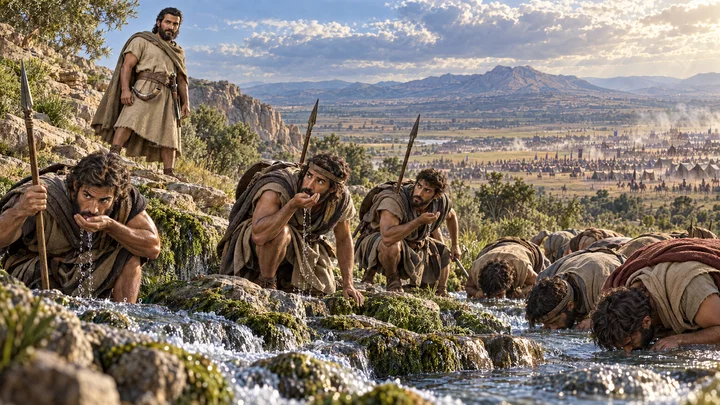
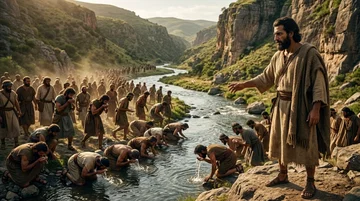
And the number of them that lapped, putting their hand to their mouth, were three hundred men: but all the rest of the people bowed down upon their knees to drink water.
Translations
And the number of them that lapped, putting their hand to their mouth, were three hundred men: but all the rest of the people bowed down on their knees to drink water.
King James Version, KJV Cambridge Paragraph Bible, Webster Bible
And the number of them that lapped, putting their hand to their mouth, were three hundred men: but all the rest of the people bowed down upon their knees to drink water.
Revised Version, American Standard Version
And the number of them that lapped, putting their hand to their mouth, was three hundred men: but all the rest of the people bowed down upon their knees to drink water.
And the number of those lapping with their hand unto their mouth is three hundred men, and all the rest of the people have bowed down on their knees to drink water.
And the number of them that lapped, with their hand to their mouth, were three hundred men; and all the rest of the people bowed down on their knees to drink water.
And so it was, that, the number of them that lapped with their hand to their mouth, was three hundred men,—but, all the rest of the people, bowed down on their knees, to drink water.
Berean Standard Bible, Majority Standard Bible
And the number of those who lapped the water with their hands to their mouths was three hundred men; all the others knelt to drink.
The number of those who lapped, putting their hand to their mouth, was three hundred men; but all the rest of the people bowed down on their knees to drink water.
Now the number of those who took up the water with their tongues was three hundred; all the rest of the people went down on their knees to the water.
And the nomber of them that lapped by putting their handes to their mouthes, were three hundreth men: but all the remnant of the people kneeled downe vpon their knees to drinke water.
Douay-Rheims (Challoner revision)
And the number of them that had lapped water, casting it with the hand to their mouth, was three hundred men: and all the rest of the multitude had drunk kneeling.
Pictures
Cross-references
- Judges 7:2
And the LORD said unto Gideon, The people that are with thee are too many for me to give the Midianites into their hands, lest Israel vaunt themselves against me, saying, Mine own hand hath saved me.
God reduces the army so Israel cannot boast that its own strength saved it.
- Judges 7:20
And the three companies blew the trumpets, and brake the pitchers, and held the lamps in their left hands, and the trumpets in their right hands to blow withal: and they cried, The sword of the LORD, and of Gideon.
The three hundred sound trumpets and raise lamps as God routs the enemy.
- Judges 6:1
And the children of Israel did evil in the sight of the LORD: and the LORD delivered them into the hand of Midian seven years.
Begins the Midianite oppression from which Gideon delivers Israel.
- Isaiah 9:4
For thou hast broken the yoke of his burden, and the staff of his shoulder, the rod of his oppressor, as in the day of Midian.
Names the day of Midian by alluding to Gideon’s battle.
- Hebrews 11:32
And what shall I more say? for the time would fail me to tell of Gedeon, and of Barak, and of Samson, and of Jephthae; of David also, and Samuel, and of the prophets:
Gideon is named among the faithful who won victories.
- Judges 7:1
Then Jerubbaal, who is Gideon, and all the people that were with him, rose up early, and pitched beside the well of Harod: so that the host of the Midianites were on the north side of them, by the hill of Moreh, in the valley.
Gives the encampment setting.
- Judges 8:28
Thus was Midian subdued before the children of Israel, so that they lifted up their heads no more. And the country was in quietness forty years in the days of Gideon.
Records Israel’s rest after the Midianites are subdued.
- Judges 6:5
For they came up with their cattle and their tents, and they came as grasshoppers for multitude; for both they and their camels were without number: and they entered into the land to destroy it.
Describes the multitude of Midianites Gideon faced.
- 1 Corinthians 1:27
But God hath chosen the foolish things of the world to confound the wise; and God hath chosen the weak things of the world to confound the things which are mighty;
God uses the weak to defeat the mighty, leaving no room for human boasting.
Commentary
Each commentary is drawn from primary sources: the writings of Ellen G. White and Adventist pioneers and periodicals. Each commentary is separate. Its own words are not a quotation; follow the references to read the source passages.
Ellen G. White
11 sources
The verse belongs to God's deliverance of Israel from Midian through Gideon after seven years of oppression.PP 545.2–3 The Midianites with the Amalekites and the peoples of the east and of the desert came as locusts for multitude with flocks and herds, spreading from the Jordan to the Philistine plain, stripping harvests and robbing the inhabitants.PP 545.2–3 They drove Israel from the open country into walled towns, fortresses, caves and rocky fastnesses, until Israel heeded reproof and confessed sin and God raised up a helper.PP 545.2–3
At the water God tested Gideon's force and reduced ten thousand to three hundred.Ms 89, 1906, par. 1–7PP 548.3–549.3Ms 14, 1887, par. 37Ms 25a, 1891, par. 30 He selected the three hundred who lapped for the reduced army through which He would deliver Israel, while sending home all the rest who bowed down upon their knees to drink.Ms 89, 1906, par. 1–7PP 548.3–549.3Ms 14, 1887, par. 37Ms 25a, 1891, par. 30 Those who could not share undivided commitment to the one great object before them were not suited to remain in their positions, but those intent on it and ready for battle were kept.PP 548.3–549.3Ms 14, 1887, par. 37Ms 25a, 1891, par. 30
Lapping meant hastily scooping water into the hand to the mouth and sucking it up as they went on, eager for immediate advance and unwilling to stop to kneel.ST Jun 30, 1881PP 548.3–549.3GW92 297.1Ms 14, 1887, par. 37 The rest bowed on their knees and drank leisurely from the stream, with deliberate preparation and taking their time.ST Jun 30, 1881PP 548.3–549.3GW92 297.1Ms 14, 1887, par. 37 The three hundred were so earnest for the battle that they would not stop to kneel by the brook but dipped up water in their hands as they hurried on.ST Jun 30, 1881PP 548.3–549.3GW92 297.1
By this simplest means character was tested and revealed.PP 548.3–549.3 The three hundred were earnest, whole-hearted men with their hearts in the work, intent on the one great object before them and ready for battle.PP 548.3–549.3GW92 297.1Ms 25a, 1891, par. 30 They showed self-control and readiness to keep duty ahead of personal wants, with courage and faith and freedom from idolatry and from indolence and self-indulgence.ST Jun 30, 1881PP 548.3–549.3GW92 297.1 Those intent on supplying their own wants in time of peril and unable to share that undivided commitment could not be trusted in emergency, for the men of His choice were the few who would not let their own wants delay duty.PP 548.3–549.3GW92 297.1Ms 25a, 1891, par. 30
The verse teaches that success does not depend on numbers, for God can deliver by few as well as by many.Ms 89, 1906, par. 1–7ST Jun 30, 1881PP 548.3–549.3Ms 14, 1887, par. 37Lt 187, 1902, par. 2 He works through humble instruments and by simple means, and Israel prevailed because in living faith the three hundred followed His special directions in obedience, not because of superior numbers.ST Jun 30, 1881PP 548.3–549.3GW92 297.2Ms 14, 1887, par. 37 In this way He prevented Israel from claiming that its own strength, wisdom, or skill had saved it, that glory might be given to God as its source of strength and mighty King.Ms 89, 1906, par. 1–7ST Jun 30, 1881PP 548.3–549.3Lt 12a, 1888, par. 9–11 This rebukes pride, self-reliance, self-importance, and self-exaltation, for He is honored not by great numbers but by the character of those who serve Him.ST Jun 30, 1881PP 548.3–549.3Lt 187, 1902, par. 2
The victory won through Gideon and his three hundred brave associates shows that success rests on God's help working with human effort.Lt 12a, 1888, par. 9–11ST Jul 21, 1881Lt 187, 1902, par. 2 It is made effective by whole dependence on Him, entire surrender and humble service, trust in Him, and obedience to His commands.Lt 12a, 1888, par. 9–11ST Jul 21, 1881Lt 187, 1902, par. 2 The way God gave the victory to keep the people from crediting human wisdom or strength shows that their desire for a visible human ruler reflected failure to recognize and trust His rule.Lt 12a, 1888, par. 9–11
Applied to workers in God's cause, the verse means God watches every worker to see whether he is in earnest and carries the burden of souls on his heart, whether he merely touches living interests with the ends of his fingers or grasps them with all his might.GW92 297.1 He works with and makes mighty only whole-hearted workers, who must be tested and proved and serve with undivided purpose.GW92 297.1Ms 25a, 1891, par. 30 They wrestle without being denied for souls, and are grateful for souls saved with praise in their hearts and on their lips day and night.GW92 297.1 They are not lifted up by success and do not fear that another will receive due credit.GW92 297.1 They must not be faithless and narrow in views and plans, since narrow plans accomplish very little.GW92 297.2
Sources
Pioneers and periodicals
71 sources
God cut Gideon's force from thirty-two thousand to ten thousand to only three hundred, who scooped water with the hand to the mouth and moved on while all the rest bowed on their knees to drink at leisure.ST Nov 19, 1902RH Jun 2, 1868RH Mar 12, 1872ST Mar 24, 1887RH Nov 28, 1912 The manner of drinking was a revealing test of fitness, for those who lapped stayed erect and watchful with eyes on the enemy and duty before comfort, while those who knelt gave themselves to ease and lost sight of the foe.ST Jun 30, 1881ST Jan 13, 1914RH Mar 12, 1901RH Apr 1, 1902ST Mar 24, 1887 He made the number so small lest Israel boast that its own hand had saved it, that all might know the victory came not by numbers, weapons or human strength but by His presence and power.ST Nov 19, 1902RH Mar 12, 1872ST Aug 4, 1881RH Feb 14, 1907RH Apr 2, 1861 The three hundred were faithful, courageous, self-denying and temperate men who trusted God to work a miracle in their own day and kept ready for instant action rather than seeking personal ease.ST Jun 30, 1881RH Jun 2, 1868RH Mar 12, 1872ST Aug 4, 1881ST Aug 7, 1884 They stand for the small purified remnant in the last days, sifted from the fearful and ease-loving and chosen to carry the final warning quickly to the world in God's power rather than in numbers.RH Mar 12, 1901RH Jun 24, 1902RH May 30, 1907RH Jan 14, 1873
Narrative Setting and Details
The choosing at the water was the final sifting after thirty-two thousand had rallied, the fearful had been sent home leaving ten thousand, and the water test left only three hundred to go to battle against the mighty host of the Midianites.RH Mar 12, 1872ST Mar 24, 1887ST Aug 4, 1881ST Sep 19, 1900 That remnant was fewer than one in a hundred of the original army, yet this small band won a complete victory.ST Jun 1, 1904ST Sep 19, 1900 The reduction from thousands to three hundred was deliberate, because there were too many, lest Israel vaunt themselves saying their own hand had saved them.ST Nov 19, 1902RH Mar 12, 1872 Those tested by this choosing were to give God the glory and praise for saving them and to look forward to the victory and glory to come.RH Mar 12, 1872ST Aug 4, 1881
The three hundred lapped putting their hand to their mouth by scooping water with the hands and bringing it to the mouth like dogs lapping, while all the rest bowed down upon their knees to drink.ST Nov 19, 1902RH Jun 2, 1868RH Apr 1, 1902 This manner of drinking could be done quickly and skillfully, and was the way of people without drinking vessels.RH Jun 2, 1868 Only three hundred drank by bringing water to their mouths in this way, while the rest knelt to drink.ST Oct 4, 1899ST Apr 13, 1904RH Jan 7, 1915 Their manner of drinking determined which men could be used to win the victory, marking the three hundred as fit for an emergency requiring self-denial.RH Apr 1, 1902ST Apr 13, 1904
The second winnowing took place at the fountain of Harod in sight of the enemy to test beyond courage.ST Aug 7, 1884 Gideon stood on the brow of the hill with only his handful of three hundred men to rid Israel of the Midianites and Amalekites, while below in the valley lay a host like locusts for multitude which he must meet in conflict on the morrow, and he and his handful were no match for that great army.ST Aug 7, 1884 Though he had received abundant proof that the Lord was with him and God had said He had delivered the host into his hand, he trembled because he could not see how victory could come.
The three hundred were retained as the attacking party by whom God would save Israel and deliver the Midianites into Gideon's hand, while all the rest were sent home or to the tents for garrison duty.ST Nov 19, 1902ST Oct 4, 1899 With pitchers and torches and trumpets they faced one hundred thirty-five thousand Midianites.ST Oct 1, 1885 All of a sudden the breaking of the pitchers and the glare of the torches put the Midianites to flight in terror, showing it is easy for the Lord to spread terror among men and so deliver His people by few against many.ST Oct 1, 1885
The three hundred did not break rank or stop in their march to drink, but dipped their hollowed palms into the stream and tossed a little water into their mouths as they marched.ST Nov 19, 1902 They did so like a dog running along the bank of a shallow stream snatching mouthfuls without pausing, too intent on pursuit to take a leisurely drink or turn aside from the chase.ST Nov 19, 1902 The trumpets and torches were taken from the leaders left behind and given to every one of the three hundred so each would appear to the enemy as the leader of a band and greatly increase their apparent numbers.ST Nov 19, 1902 Standing before so great a host as a leader without a visible command required courage driven by strong faith, and the Lord Himself chose these men because each was to stand as a leader.ST Nov 19, 1902
How Drinking Tested Men
The manner of drinking at the water was a small but revealing test of disposition that decided which men could be used to win the victory.ST Jan 13, 1914RH Apr 1, 1902 Three hundred lapped water from their hands as they passed, while the rest knelt to drink.ST Jan 13, 1914RH Apr 1, 1902 The three hundred kept attention on the expedition rather than stopping for comfort, while the others paused and drank deliberately, and were rejected.ST Jan 13, 1914
Those who lapped stayed erect and drank only to sustain themselves, quickly scooping water with the hand to the mouth and moving on.ST Jun 30, 1881RH Jun 4, 1901RH Jun 4, 1901RH Nov 12, 1901 They bowed only far enough to take water from their hands while keeping their eyes vigilantly fixed on the movements of the enemy.RH Mar 12, 1901ST Mar 24, 1887 Their attention stayed on the expedition and on the crisis at hand, with the burden of the work in their hearts.ST Mar 24, 1887RH Nov 12, 1901 In this they showed readiness to act at once, with duty standing above self-indulgence and personal comfort, credit, and praise.ST Aug 7, 1884RH Jun 4, 1901RH Nov 12, 1901 They were minutemen who cared more for readiness than comfort, proving fit by self-control, courage, faith, and freedom from idolatry to be directed for deliverance.ST Jun 30, 1881RH Jun 4, 1901ST Aug 7, 1884
Those who bowed down flung themselves on the ground and knelt to drink deliberately at leisure until satisfied.ST Jan 13, 1914ST Aug 7, 1884RH Nov 12, 1901 They took an easy, comfortable, self-absorbed position to refresh themselves, abandoning themselves to quenching thirst.ST Aug 7, 1884RH Jun 4, 1901 In that posture they lost sight of the enemy and showed concern for personal ease and convenience rather than watchfulness and readiness for battle.ST Mar 24, 1887RH Jun 4, 1901RH Nov 12, 1901 Though claiming to belong to the regular army, their carelessness of danger and surprise marked an unsoldierly, self-indulgent attitude.RH Mar 12, 1901ST Aug 7, 1884 Their way of drinking thus revealed unreadiness, and they were set aside.ST Jan 13, 1914ST Mar 24, 1887
Unlike the first test that set aside the unwilling, when two-thirds confessed they were cowards, this second test chose from among those willing to fight.ST Nov 19, 1902 Mere willingness to engage in the conflict is not qualification for service in an important emergency.ST Apr 13, 1904ST Nov 19, 1902 Such a position requires special tact and steadiness of purpose, with prudence, watchfulness, and self-denial beyond courage.ST Aug 7, 1884ST Nov 19, 1902 Only those fit for an emergency requiring self-denial were retained.ST Apr 13, 1904
Character of Three Hundred
The three hundred were men who by faith could do the Lord's bidding and give Him the glory for saving them, deliberately kept after thirty-two thousand had rallied and ten thousand remained so Israel could not claim the victory for itself.RH Mar 12, 1872ST Aug 4, 1881RH Jun 24, 1902 They had confident trust in the cause and in the commander, with courage and freedom from idolatry, quickly scooping water into their hands instead of kneeling to drink at leisure.ST Jun 30, 1881ST Jan 1, 1885 Unlike those who thought miracles belonged only to the past, they believed God would perform a miracle in their own day to deliver Israel from the mighty host of Midian.ST Jun 20, 1900 Full of faith and ready to face anything, they moved forward to a great victory that made Israel rush forward as one man anxious for the closing work.RH Jun 24, 1902
Their manner of drinking by scooping water with the hands and bringing it to the mouth, like dogs lapping, was a sign of temperance and noble spirit, a way that could be done quickly and skillfully even without drinking vessels.RH Jun 2, 1868 They showed self-control and readiness to keep duty ahead of personal needs, proving that duty stood above self-indulgence.ST Jun 30, 1881ST Aug 7, 1884 They stayed erect and lapped water with hand to mouth rather than flinging themselves on the ground to quench thirst at leisure, and so proved faith, courage, prudence, watchfulness and self-denial.ST Aug 7, 1884 They were fit for an emergency requiring self-denial, with attention fixed on the crisis and on the Lord's cause rather than on their own comfort, credit or praise.ST Apr 13, 1904RH Nov 12, 1901 Their service was acceptable because they were wholly devoted to the task, moving on at once and needing no flattery to inspire them.RH Nov 12, 1901
They were alert, obedient, uncalculating fighters who drank only to sustain themselves and could act at once, remaining ready for battle instead of seeking ease in a comfortable, self-absorbed posture.ST Oct 4, 1899RH Jun 4, 1901 Keeping their eyes on the enemy while lapping from their hands, they had the burden of the work in their hearts, while those who bowed on their knees to drink lost sight of the enemy and sought their own convenience.ST Mar 24, 1887RH Jun 11, 1901 They had no divided interest and depended not on human strength but on God's power, through which a small company chosen from thirty-two thousand won a great victory.RH May 13, 1915 They were faithful, zealous, self-sacrificing and humble workers who trusted God and loved Christ and God's cause and unpopular truth above everything else.ST Mar 24, 1887
They were brave, tried and loyal men, minutemen who cared more for readiness than comfort and took water quickly while remaining ready for action.RH Sep 29, 1863RH Jun 4, 1901 They were Gideon's brave associates, a select and steadfast force of integrity through whom success came by God's help working with human effort as they trusted and obeyed.ST Jul 21, 1881ST Mar 18, 1897 God could use this small united company more effectively than a larger army of men who did not trust Him, since the unready might flee at the sight of the enemy and discourage the faithful.RH Jun 4, 1901 Their victory did not depend on having a large army but on the courage, loyalty and discipline of those who remained.RH Sep 29, 1863
They represent the faithful minority always present in the church who live by unfaltering faith, earnest prayer and loyal devotion, refusing self-indulgence to do good.ST Aug 7, 1884 Ready for labor and counting all they have as God's, they love Christ and God's cause above everything else, and when such true men are made manifest the cause prospers and God's people go forward conquering and to conquer.ST Mar 24, 1887ST Aug 7, 1884 God looks upon them with delight and honors them as true conquerors of the world who will walk with Christ in white because they are worthy.ST Aug 7, 1884
They illustrate that God may call His people to a humble place, and that the humble and faithful obey even when the task is lowly. As a picked army that took the camp of Midian, they are an example of faithful people who follow God and overcome.RH Nov 19, 1857
Purpose of Small Numbers
God deliberately cut the force down because there were too many, lest Israel vaunt themselves and say their own hand had saved them.ST Nov 19, 1902RH Mar 12, 1872ST Aug 4, 1881ST Nov 19, 1902RH Apr 2, 1861 The victory had to leave no room for self-confidence, self-aggrandizement and boasting in numbers, since pride is man's worst enemy and Israel's greatest danger.RH Jul 18, 1912ST Nov 19, 1902 Israel had to know beyond doubt that the hand of the Lord saved them, for their own good and future safety.ST Nov 19, 1902 It is better to trust in the Lord than to put confidence in man.ST Nov 19, 1902RH Feb 14, 1907ST Oct 16, 1884
Victory did not depend on keeping a large force, nor on human strength, plans, weapons of war, skill, knowledge or numbers, but on God's presence and power.ST Jul 21, 1881RH Feb 14, 1907RH Apr 2, 1861RH May 13, 1915ST Oct 16, 1884 The men were sent against a much larger host without weapons of war, so that success could not be credited to human strength or numbers.RH Feb 14, 1907RH Apr 2, 1861ST Oct 16, 1884 Success rests on God's help working with human effort while people trust in Him and obey His commands, with no divided interest but dependence on God's power.ST Jul 21, 1881RH May 13, 1915 God values quality over numbers and wins by minorities rather than by counting noses.ST Dec 27, 1905ST Mar 6, 1893ST Jul 14, 1887
Gideon did not win with thirty thousand warriors, and his force had to be thinned and whittled down to the three hundred who lapped.ST Jun 23, 1881ST Dec 27, 1905ST Mar 6, 1893RH May 13, 1873 One man strong in God counts for more than multitudes, and He conquers through such men whether few or many, making His divine strength perfect in human weakness so that truth and right are not decided by numbers.ST Mar 6, 1893ST Jul 14, 1887RH May 13, 1873 A church with many nominal members may need to be scaled down to work effectively, for numbers do not count with the Lord so much as piety.ST Jun 23, 1881ST Feb 13, 1901 With the Spirit of God upon them, the three hundred were far more powerful than all the great hosts of Israel cowering in terror before the enemy.RH Feb 14, 1907ST Feb 13, 1901 The reduction humbled Israel when they felt strong and inclined to boast in numbers and do some great exploit by themselves, until God could use them in a way that gave Him the glory and led them to acknowledge the deliverance as wholly of God.RH Apr 21, 1868
God places His people where obedience tests and reveals the secret motives of the heart, showing them what must be overcome in order to prepare for what is coming.RH Apr 21, 1868 The Lord can bring a signal victory by thinning out His forces rather than increasing them. Though reduced to fewer than one in a hundred of the original army, the small band won a complete victory, showing that God's ways are not like human ways.ST Jun 1, 1904 God can use feeble instrumentalities, weak in themselves, to accomplish mighty results.ST May 6, 1875RH Apr 15, 1875 His weapons and army were weak in themselves, yet He gave mighty victory through them.ST May 6, 1875RH Apr 15, 1875
Prophecy and Last Days
Gideon's defeat of Midian stands with Barak's defeat of the Canaanites as one of the two great victories that made Megiddo famous as the great Old Testament battlefield between Israel and the enemies of God, set alongside the two great disasters on the same ground in the deaths of Saul and Josiah, and this history gives the meaning of Har-Magedon as the hill of Megiddo and places Gideon's victory within the gathering of the kings of the whole world to the war of the great day of God the Almighty.RH Feb 2, 1905 That battle against Midian gives the name the day of Midian to the day of the Lord.ST Jul 11, 1916 The choosing of the three hundred from those who drank represents the leaving of a small faithful group after the fearful departed, and in its application to the Advent movement those tested by the commandments of God were chosen to proclaim the final warning after the disappointment of 1844, to give God the glory and to look forward to victory and glory to come.ST Aug 4, 1881
In the last days God will choose only a few tried ones, like the remnant of Gideon's army, from among many professing the truth, and fit them to proclaim the final message of the commandments of God and the testimony of Jesus that will lighten the earth and startle and alarm the world.RH Jan 14, 1873 Those who obey from the heart may hope to be chosen to awaken a sleeping church and save a remnant to hail the soon-coming Saviour, while those who reject this light after clear conviction or neglect its reproofs will come short of God's favor.RH Jan 14, 1873 The three hundred supply the picture of a small selected band standing apart as the purified remnant, separated from those who reject the searching message and return to the world, and freed from Babylon's selfish spirit they are entrusted with the loud cry and are invincible in carrying the gospel to the whole earth. This shows the sifting that must take place among God's people, in which those lacking ardent hearts for the work fall away and only a tested remnant is retained for a mighty work.RH May 30, 1907 As workers are reduced like Gideon's army the work is greatly enlarged and still goes onward, yet believers long professing the truth face a crisis in the closing work in which they must prove the sincerity of their love, and if they do not repent of lukewarmness they will be spewed out.RH Sep 16, 1873
The sifting removed the worldly, unbelieving, indifferent and self-seeking, leaving people of unshaken faith wholly devoted to God's cause, and the three hundred won because the battle belonged to God and not because numbers or human plans seemed sufficient.RH Jan 14, 1915 The army was reduced from thirty-two thousand to three hundred, less than one in a hundred, with the fearful sent home first and then those who knelt to drink dismissed, showing that fear and ease-loving reluctance turn people back from a task while a small resolute group can still accomplish deliverance.ST Dec 15, 1898 The passage applies especially to this time, when from the immense crowd now rallying around the standard the Lord counts only His chosen few, the three hundred who lapped with hand to mouth while keeping eyes vigilantly fixed on the enemy, who will go up and take the city, whereas the rest who bowed down on their knees to drink take an easy position to refresh themselves until satisfied.RH Mar 12, 1901 With this small number a great victory is achieved, and when Israel sees that the Lord is with His people they rush forward as one man anxious to have part in the closing work, so now is the time for men of courage and faith full of faith and ready to face anything to move forward with the third angel's message and give God the glory.RH Jun 24, 1902
That same spirit is continual watchfulness with eyes on the enemy, marking those who love the appearing of the Lord and prove themselves soldiers in the short fierce final conflict by carrying the message quickly to all lands.RH Jul 4, 1907 Its power depends not on numbers but on consecrated people and on God, since earnest consecration made the three hundred more effective than forty-two thousand irresolute and ease-loving and turned the victory to Israel.RH Oct 14, 1909 Like Gideon's small army facing Midian, the Sabbath-keeping denominations are few compared with opposers yet charged with upholding the Sabbath truth.ST Nov 7, 1878 Those who reject testing truths such as the Sabbath and Christian humility expressed in foot-washing risk failing to share the final victory and perishing along the way.RH Sep 29, 1863 The testing of Gideon's host pictures the close test the people of God are now passing, where receiving present light on passing events as theory does well but making it practical does far better, and the test decides who is sufficient and able to stand while great light from the heavenly sanctuary shines on God's people and thick darkness of error, unbelief and intolerance covers the unbelieving world and the nominal churches.RH Jun 9, 1868
Courage for Present Work
The account of the small force shows that God can deliver His people even when enemies greatly outnumber them, for He works mightily through a few against many.ST Jun 18, 1885ST Mar 24, 1909 It gives courage and confidence in His power to help those in trouble, and is not a pattern for physical warfare.ST Jun 18, 1885 The victory teaches that those who ask great things and venture much receive much and gain wonderful victories.ST Sep 17, 1896 It stands as an example of the victories God works and offers, encouraging strength and courage for present work by going forward trusting in Him even when few workers remain.RH Jul 29, 1902ST Sep 17, 1896RH Apr 1, 1902
The example teaches a battle plan that relies not on assembling a large force but on placing a slender line around the field so as to reach the whole field.ST Jun 14, 1905 The small number possessing the spirit of battle illustrates the need for a larger proportion of genuine missionaries.RH Oct 7, 1902 Solitary work like Morrison's is like the sifted band led to triumph.RH Oct 28, 1902 Severe toil in setting truth before Europe by the press in many languages with correct grammar and idiom gains certain success through God's blessing and providence, since feeble instrumentalities weak in themselves can accomplish mighty results.RH Apr 15, 1875
The drinking test is like bad weather revealing which Christians truly want to attend church despite discomfort. Their way of drinking marks them as alert and ready while the enemy is nearby.RH Apr 1, 1902 Applied to present duty, it calls for staying watchful and courageous in the work required.RH Apr 1, 1902 It means the work is the Lord's and His people must stand firm without wavering, each in his own place, holding his post under opposition instead of shutting himself away in hiding.RH Mar 21, 1912
Gideon's army is a figure for canvassers and book-selling workers.RH Dec 18, 1900 Earlier victories over panic and politics encourage taking on winter weather as another challenge. The rescue of Israel by three hundred shows God can accomplish His work with few people as well as many, so that a small number of faithful workers can accomplish a great deliverance.RH Sep 10, 1901RH Mar 6, 1900 Cited in this way, it encourages confidence that a great work and the book-selling work can succeed through God's strength.RH Sep 10, 1901RH Dec 18, 1900 The three hundred, as transformed consecrated believers contrasted with the larger indifferent host sent home, show that God's work depends not on numbers, organization, or resources, but on divine power working in individual hearts.RH Nov 18, 1909
Sources