Judges 9:15
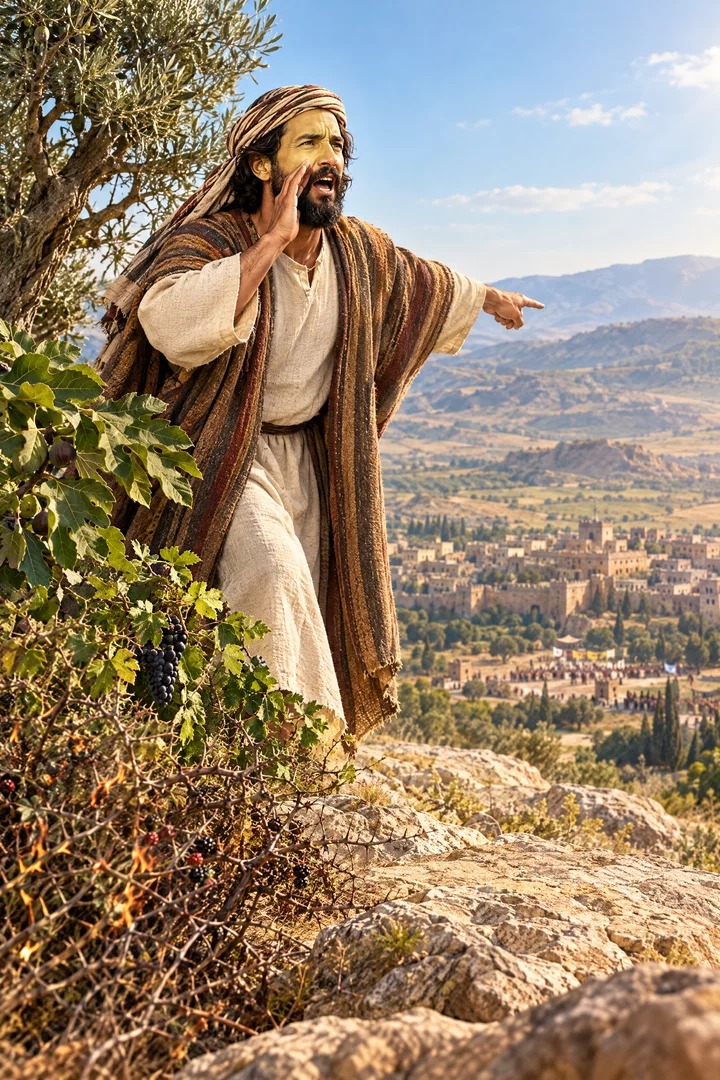
And the bramble said unto the trees, If in truth ye anoint me king over you, then come and put your trust in my shadow: and if not, let fire come out of the bramble, and devour the cedars of Lebanon.
Translations
And the bramble said to the trees, If in truth you anoint me king over you, then come and put your trust in my shadow: and if not, let fire come out of the bramble, and devour the cedars of Lebanon.
King James Version, KJV Cambridge Paragraph Bible, Revised Version
And the bramble said unto the trees, If in truth ye anoint me king over you, then come and put your trust in my shadow: and if not, let fire come out of the bramble, and devour the cedars of Lebanon.
And the bramble said to the trees, If in truth ye anoint me king over you, then come and put your trust in my shadow: and if not, let fire come out of the bramble, and devour the cedars of Lebanon.
And the bramble said unto the trees, If in truth ye anoint me king over you, then come and take refuge in my shade; and if not, let fire come out of the bramble, and devour the cedars of Lebanon.
And the bramble saith unto the trees, If in truth ye are anointing me for king over you, come, take refuge in my shadow; and if not — fire cometh out from the bramble, and devoureth the cedars of Lebanon.
And the thorn-bush said to the trees, If in truth ye anoint me king over you, come, put confidence in my shadow; but if not, fire shall come out of the thorn-bush and devour the cedars of Lebanon.
And the bramble said unto the trees, If, in truth, ye are about to anoint me to be king over you, come, take refuge in my shade,—but, if not, there shall come forth fire out of the bramble, and devour the cedars of Lebanon.
Berean Standard Bible, Majority Standard Bible
But the thornbush replied,
‘If you really are anointing me as king over you,
come and find refuge in my shade.
But if not, may fire come out of the thornbush
and consume the cedars of Lebanon.’“ The bramble said to the trees, ‘If in truth you anoint me king over you, then come and take refuge in my shade; and if not, let fire come out of the bramble, and devour the cedars of Lebanon.’
And the thorn said to the trees, If it is truly your desire to make me your king, then come and put your faith in my shade; and if not, may fire come out of the thorn, burning up the cedars of Lebanon.
And the bramble said vnto the trees, If ye will in deede anoynt me King ouer you, come, and put your trust vnder my shadowe: and if not, the fire shall come out of the bramble, and consume the Cedars of Lebanon.
Douay-Rheims (Challoner revision)
And it answered them: If indeed you mean to make me king, come ye and rest under my shadow: but if you mean it not, let fire come out from the bramble, and devour the cedars of Libanus.
Pictures
Cross-references
- 2 Kings 14:9
And Jehoash the king of Israel sent to Amaziah king of Judah, saying, The thistle that was in Lebanon sent to the cedar that was in Lebanon, saying, Give thy daughter to my son to wife: and there passed by a wild beast that was in Lebanon, and trode down the thistle.
Both passages use plants speaking as a figurative object lesson.
- Judges 9:22-57
When Abimelech had reigned three years over Israel,
The conflict and destruction fulfill Jotham’s prophecy.
Commentary
Each commentary is drawn from primary sources: the writings of Ellen G. White and Adventist pioneers and periodicals. Each commentary is separate. Its own words are not a quotation; follow the references to read the source passages.
Ellen G. White
2 sources
The bramble in Jotham's parable stands for Abimelech in his worthlessness, grasping ambition, and cruelty.ST Aug 4, 1881ST Aug 4, 1881 Unlike the worthy trees that refused kingship, he eagerly seized it and grasped for honor for himself.ST Aug 4, 1881ST Aug 4, 1881 In doing so he destroyed those better than himself.ST Aug 4, 1881 His call for the trees to come and put their trust in his shadow exposes the false security of accepting such a ruler, since a bramble offers no real shelter or protection.ST Aug 4, 1881
His threat that fire would come out of the bramble and devour the cedars of Lebanon expresses the destruction he would bring upon those who opposed him.ST Aug 4, 1881 That threat was Jotham's prophecy of mutual ruin, foretelling that fire would go out between Abimelech and the chief men of Shechem who had made him king until they destroyed one another.ST Aug 4, 1881
Sources
Pioneers and periodicals
22 sources
Jotham spoke this parable to rebuke the men of Shechem for choosing Abimelech as king after he had slain Gideon's sons to make himself ruler and gathered vain followers about him.ST Oct 1, 1902ST Jun 29, 1904ST Aug 19, 1880 The bramble is a fitting picture of Abimelech as a worthless, grasping and cruel ruler who eagerly took the honor the fruitful trees refused, whose offer of shelter in his shadow is false security and whose threat of fire devouring the cedars is the mutual destruction he would bring upon himself and the chief men who made him king.ST Aug 4, 1881ST Aug 4, 1881ST Oct 1, 1902 The story is a fable in which trees hold council and speak and the bramble answers, a personification giving speech and reason to lifeless things to teach moral truth about kingship, and it never happened literally.ST May 20, 1886ST Dec 4, 1884ST Jun 30, 1881ST Mar 28, 1906ST Mar 15, 1877 Its imagined speech does not prove that trees are conscious or can think and speak, since hearers understand the figurative form and receive no false impression about plants.ST Aug 19, 1880ST Aug 25, 1881ST May 20, 1886 Those doing valuable work for the Lord have no desire to rule over their brethren, so ambition to exalt self proves unfitness to rule, while unlike the trees men can truly choose and are accountable to God for their choice, and rivalry after the pattern of the bramble is unprofitable and ends in destruction.ST Oct 1, 1902RH May 17, 1864RH Feb 15, 1870
Parable Setting and Meaning
The bramble's speech belongs to Jotham's parable in Judges 9:8-15, in which the trees seek a king, and Jotham applies it to rebuke the men of Shechem for choosing Abimelech as king, the bramble's offer of protection and its threat against the cedars forming part of the graphic word picture.ST Aug 19, 1880
In that history Abimelech was the son of Gideon's maid, who caused Gideon's sons to be slain in order that he himself might become ruler of Israel.ST Oct 1, 1902ST Jun 29, 1904
He gathered vain and light followers about him, and afterward Shechem was utterly destroyed by him.ST Oct 1, 1902ST Jun 29, 1904
The bramble is a fitting symbol of Abimelech as a worthless, grasping, cruel and unfit ruler chosen by the men of Shechem, who readily accepted the kingship the useful trees had refused.ST Aug 4, 1881ST Aug 4, 1881ST Oct 1, 1902
He grasped for honor and destroyed those better than himself, and unlike the vine and the olive he offers no good fruit.ST Aug 4, 1881RH May 17, 1864
The bramble's condition that the trees come and put their trust in its shadow portrays the false security of accepting such a ruler, accepting his rule on condition of trusting his shelter.ST Aug 4, 1881ST Oct 1, 1902
Its threat that fire would come out of the bramble and devour the cedars of Lebanon expresses the destruction Abimelech would bring upon those who opposed him, which Jotham prophesied would come between Abimelech and the chief men of Shechem who had made him king.ST Aug 4, 1881ST Aug 4, 1881ST Oct 1, 1902
The whole episode shows the degeneration of the family of Gideon after the triumphs God wrought through him, caused by trusting in things which are seen instead of in the power that is unseen.ST Mar 24, 1909
Fictive Form and Personification
Judges 9:15 belongs to an apologue or fable, a story of imagined actions and speech by inanimate things that conveys a moral truth in a striking manner, here about the work of kings.ST May 20, 1886ST Dec 4, 1884ST Mar 28, 1906 The speaking bramble addressing the trees is an impossible action that marks the form, with inanimate things represented as talking and choosing a king.ST May 20, 1886ST Dec 4, 1884RH Feb 15, 1870 It stands as one of two such fictitious parables about trees and kingship, the other being in Ezekiel 17:2-8.ST Mar 28, 1906
The trees holding a council, speaking, making speeches, holding an election and choosing a king, and the bramble answering and offering to rule and proposing trust in its shade, are fictitious and imaginary rather than a literal account.ST Aug 19, 1880RH Aug 7, 1916ST Mar 15, 1877RH Mar 16, 1916RH Mar 28, 1865 The trees did not actually talk, yet the account can state without qualification that they spoke because listeners understand the figurative form.ST Aug 19, 1880RH Mar 16, 1916 A parable may therefore give imagined characters powers and actions they do not naturally possess without making the point false.ST Aug 19, 1880
The device is personification, in which trees and a bramble are represented as speaking, reasoning and acting like people.ST Jun 30, 1881ST Mar 15, 1877RH Sep 25, 1913RH Mar 28, 1865 It gives to inanimate beings without life or voice the sentiments, language and actions of rational beings, as when the bramble is shown offering to rule and warning that fire will consume the cedars if refused, and when the trees hold an election and make speeches though they have no life or voice.ST Jun 30, 1881RH Sep 25, 1913RH May 12, 1874 The imagined speech does not prove that trees are conscious, can think or speak, or possess human attributes.ST Aug 25, 1881ST Jun 30, 1881RH Jan 7, 1902 The talking trees and talking bramble are a figurative device and not evidence that trees can speak, and the speaking bramble is not meant to create a false impression about what plants can do.ST Aug 19, 1880ST Aug 25, 1881ST May 20, 1886ST Jun 30, 1881RH Jan 7, 1902
Doctrine and Moral Application
The bramble speaking to the trees about being made king and about putting trust in its shadow is personification, the giving to an inanimate being the sentiments and language of a rational being.RH May 12, 1874 The trees holding an election and making speeches though they have no life or voice proves that lifeless things are made to speak and act as though alive.RH May 12, 1874 The dead being made to speak and act as though alive is the same figure.RH May 12, 1874
The trees choosing a king in a fable shows by contrast that trees do not actually elect rulers, while human beings can choose and are called by God to do so.RH Feb 15, 1870 This affirms human freedom of choice and accountability, rather than explaining the other details of the fable.RH Feb 15, 1870
The bramble accepting rule over the trees on condition that they trust its shelter, while threatening destruction if they do not, marks an unfit ruler chosen by the men of Shechem.ST Oct 1, 1902 That ruler had caused his brothers to be slain and had gathered vain and light followers.ST Oct 1, 1902 Those doing valuable work for the Lord have no desire to rule over their brethren, and ambition to exalt oneself over others shows lack of qualification for rulership.ST Oct 1, 1902
The bramble illustrates rivalry that is unprofitable, for unlike the vine and the olive it offers no good fruit, and its challenge ends in destruction.RH May 17, 1864 Striving to bear better fruit is therefore to be distinguished from competing to be the most useless.RH May 17, 1864
Sources