Leviticus 17:3
What man soever there be of the house of Israel, that killeth an ox, or lamb, or goat, in the camp, or that killeth it out of the camp,
Translations
What man soever there be of the house of Israel, that kills an ox, or lamb, or goat, in the camp, or that kills it out of the camp,
King James Version, KJV Cambridge Paragraph Bible
What man soever there be of the house of Israel, that killeth an ox, or lamb, or goat, in the camp, or that killeth it out of the camp,
Whatever man there may be of the house of Israel, that killeth an ox, or lamb, or goat in the camp, or that killeth it out of the camp,
Revised Version, American Standard Version
What man soever there be of the house of Israel, that killeth an ox, or lamb, or goat, in the camp, or that killeth it without the camp,
Any man of the house of Israel who slaughtereth ox, or lamb, or goat, in the camp, or who slaughtereth at the outside of the camp,
Every one of the house of Israel that slaughtereth an ox, or sheep, or goat, in the camp, or that slaughtereth it out of the camp,
What man soever, there be of the house of Israel, who slayeth an ox or lamb or goat, in the camp,—or who slayeth it outside the camp;
Berean Standard Bible, Majority Standard Bible
‘Anyone from the house of Israel who slaughters an ox, a lamb, or a goat in the camp or outside of it
Whatever man there is of the house of Israel who kills a bull, or lamb, or goat in the camp, or who kills it outside the camp,
If any man of Israel puts to death an ox or a lamb or a goat, in or outside the tent-circle;
Whosoeuer he be of the house of Israel that killeth a bullocke, or lambe, or goate in the hoste, or that killeth it out of the hoste,
Douay-Rheims (Challoner revision)
Any man whosoever of the house of Israel if he kill an ox, or a sheep, or a goat in the camp, or without the camp,
Pictures
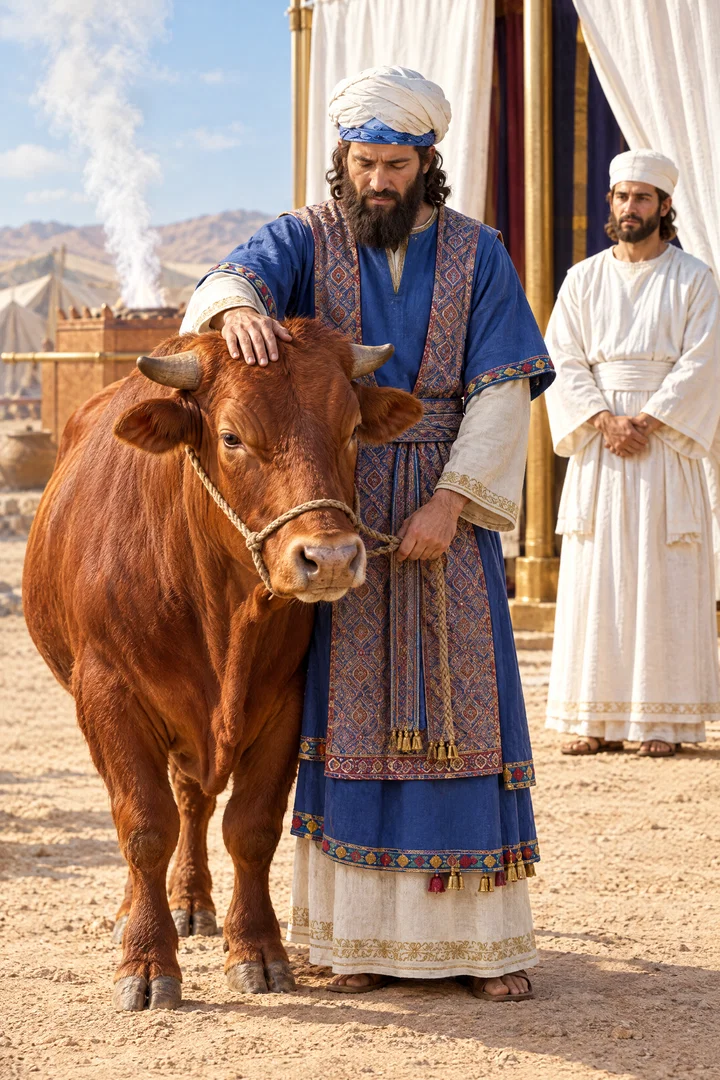
Cross-references
- Deuteronomy 12:5-14
But unto the place which the LORD your God shall choose out of all your tribes to put his name there, even unto his habitation shall ye seek, and thither thou shalt come:
Israel was directed to bring sacrifices to the place God chose.
- Hebrews 9:22
And almost all things are by the law purged with blood; and without shedding of blood is no remission.
Remission requires the shedding of blood.
- Deuteronomy 12:13-14
Take heed to thyself that thou offer not thy burnt offerings in every place that thou seest:
both limit offerings to God's chosen place
- Leviticus 17:7-9
And they shall no more offer their sacrifices unto devils, after whom they have gone a whoring. This shall be a statute for ever unto them throughout their generations.
The nearby commands connect proper worship at the sanctuary with rejecting idolatry.
- Deuteronomy 12:23
Only be sure that thou eat not the blood: for the blood is the life; and thou mayest not eat the life with the flesh.
Both state that blood is life.
- Leviticus 17:14
For it is the life of all flesh; the blood of it is for the life thereof: therefore I said unto the children of Israel, Ye shall eat the blood of no manner of flesh: for the life of all flesh is the blood thereof: whosoever eateth it shall be cut off.
Blood is the life of flesh.
- Leviticus 17:11
For the life of the flesh is in the blood: and I have given it to you upon the altar to make an atonement for your souls: for it is the blood that maketh an atonement for the soul.
Blood makes atonement for the soul.
- Genesis 9:5
And surely your blood of your lives will I require; at the hand of every beast will I require it, and at the hand of man; at the hand of every man’s brother will I require the life of man.
God requires an account for the blood of lives.
- Joshua 22:19
Notwithstanding, if the land of your possession be unclean, then pass ye over unto the land of the possession of the LORD, wherein the LORD’s tabernacle dwelleth, and take possession among us: but rebel not against the LORD, nor rebel against us, in building you an altar beside the altar of the LORD our God.
Phinehas urges Israel to worship at the LORD’s tabernacle rather than build a rival altar.
- Exodus 29:38-43
Now this is that which thou shalt offer upon the altar; two lambs of the first year day by day continually.
Offerings were brought to the sanctuary, where God met the people.
Commentary
Each commentary is drawn from primary sources: the writings of Ellen G. White and Adventist pioneers and periodicals. Each commentary is separate. Its own words are not a quotation; follow the references to read the source passages.
Ellen G. White
1 source
God gave a positive command binding on all Israel that no sacrifice was to be offered except at the door of the tabernacle.ST May 12, 1881 The tabernacle at Shiloh was the one appointed place of sacrifice and worship for the whole nation.ST May 12, 1881 To erect another altar for sacrifice elsewhere was rebellion against the Lord and departure from God.ST May 12, 1881 Such disobedience, when committed by a large company, brought the wrath of God upon the whole nation, not upon the offenders alone.ST May 12, 1881
Therefore the tribes settled east of Jordan were required to live without a local altar for sacrifice.ST May 12, 1881 If they were unwilling to abide in their land without that privilege, the right course was to leave their land rather than transgress.ST May 12, 1881 They were invited instead to come over and share the possessions and privileges of their brethren on the west, where they could remain obedient by worshiping at the one altar.ST May 12, 1881
Sources
Pioneers and periodicals
8 sources
No man of Israel was permitted to kill an ox or lamb or goat on his own, whether in the camp or out of the camp, but every sacrifice had to be brought to the door of the tabernacle of the congregation.ST Nov 27, 1884RH Dec 15, 1868RH Sep 16, 1852RH Oct 30, 1855 That was the one place where God put His name and met His people and where the sanctuary was built and only the priests ministered, and anyone who offered elsewhere was to be cut off from among the people.ST Nov 27, 1884RH Sep 16, 1852 The statute was given to prevent Israel from slaughtering animals as sacrifices in the open fields to demons or devils.RH Dec 15, 1868RH Sep 8, 1904RH Oct 30, 1855 To kill outside the prescribed worship was a failure to recognize God's presence in the sanctuary and was evidence of idolatrous worship.RH Sep 8, 1904
For an individual sin or trespass offering the sinner or the elders brought the victim to the tabernacle door, laid a hand on its head, and killed it there before the priest performed the blood rites that made atonement and brought forgiveness.RH Sep 16, 1852 The chapter teaches that blood is life and that all its instructions about blood were given to teach and enforce a proper regard for life.RH Sep 6, 1870 By a life-for-life principle sin requires death and blood redeems those who have sinned and forfeited their lives, which is why forgiveness requires bloodshed.RH Sep 6, 1870 Sins forgiven through the sin offering were transferred in figure to the victim and carried in its blood or flesh into the sanctuary, and for the one who remained penitent they were blotted out entirely when the sanctuary was cleansed on the day of atonement.ST Jan 1, 1885
The verse does not determine where forgiveness was obtained, does not establish that forgiveness was available only in the first apartment of the sanctuary, and does not contradict the account in the preceding chapter of the high priest making atonement in the holiest place for the sins of the people.RH Dec 15, 1868RH Oct 30, 1855 Israel's sacrifices took place in the court of the earthly tabernacle, while their antitype was Christ's once-for-all death outside the heavenly tabernacle at the hands of sinners. God restricted all burnt offerings and sacrifices to the one place He chose, which became Jerusalem, so with Jerusalem in the hands of strangers and the dwelling-place of His name destroyed it is now impossible to offer the appointed sacrifices.ST Nov 27, 1884 Leaving off blood atonement is therefore conformity to circumstances of necessity rather than obedience to Scripture.ST Nov 27, 1884
With the tabernacle at Shiloh as the one place of sacrifice and worship the command bound all Israel.ST May 12, 1881 To erect another altar for sacrifice is rebellion against the Lord and departure from God.ST May 12, 1881 Such disobedience when done by a large company brings God's wrath upon the whole nation.ST May 12, 1881 Therefore the tribes east of the Jordan had to live without a local altar for sacrifice, and if unwilling to do so they should leave their land and share the possessions and privileges of their brethren on the west rather than transgress.ST May 12, 1881
Sources