Hebrews 9:22
And almost all things are by the law purged with blood; and without shedding of blood is no remission.
Translations
American King James Version, King James Version, KJV Cambridge Paragraph Bible
And almost all things are by the law purged with blood; and without shedding of blood is no remission.
And almost all things are by the law cleansed with blood; and without shedding of blood is no remission.
Revised Version, American Standard Version
And according to the law, I may almost say, all things are cleansed with blood, and apart from shedding of blood there is no remission.
and with blood almost all things are purified according to the law, and apart from blood-shedding forgiveness doth not come.
and almost all things are purified with blood according to the law, and without blood-shedding there is no remission.
And, nearly, all things, with blood, are purified, according to the law, and, apart from blood-shedding, cometh no remission.
Berean Standard Bible, Majority Standard Bible
According to the law, in fact, nearly everything must be purified with blood, and without the shedding of blood there is no forgiveness.
According to the law, nearly everything is cleansed with blood, and apart from shedding of blood there is no remission.
And by the law almost all things are made clean with blood, and without blood there is no forgiveness.
And almost all things are by the Law purged with blood, and without sheading of blood is no remission.
Douay-Rheims (Challoner revision)
And almost all things, according to the law, are cleansed with blood: and without shedding of blood there is no remission.
Pictures
Cross-references 20 of 124
- Leviticus 17:11
For the life of the flesh is in the blood: and I have given it to you upon the altar to make an atonement for your souls: for it is the blood that maketh an atonement for the soul.
Blood, containing life, is given to make atonement for the soul.
- Leviticus 16:15-16
Then shall he kill the goat of the sin offering, that is for the people, and bring his blood within the vail, and do with that blood as he did with the blood of the bullock, and sprinkle it upon the mercy seat, and before the mercy seat:
The high priest cleanses the sanctuary by applying sacrificial blood.
- Hebrews 9:12
Neither by the blood of goats and calves, but by his own blood he entered in once into the holy place, having obtained eternal redemption for us.
Christ enters the heavenly sanctuary by his own blood and obtains eternal redemption.
- Hebrews 10:4
For it is not possible that the blood of bulls and of goats should take away sins.
Animal blood cannot take away sins, pointing to the need for Christ’s sacrifice.
- Genesis 4:3-5
And in process of time it came to pass, that Cain brought of the fruit of the ground an offering unto the LORD.
Abel’s accepted animal offering shed blood, unlike Cain’s bloodless offering.
- John 1:29
The next day John seeth Jesus coming unto him, and saith, Behold the Lamb of God, which taketh away the sin of the world.
Jesus is the Lamb whose sacrifice takes away the world’s sin.
- Romans 3:25
Whom God hath set forth to be a propitiation through faith in his blood, to declare his righteousness for the remission of sins that are past, through the forbearance of God;
Christ’s blood is the means of propitiation and remission.
- 1 Peter 1:18-19
Forasmuch as ye know that ye were not redeemed with corruptible things, as silver and gold, from your vain conversation received by tradition from your fathers;
Redemption comes through Christ’s precious blood, foreshadowed by the spotless sacrificial lamb.
- 1 John 1:7
But if we walk in the light, as he is in the light, we have fellowship one with another, and the blood of Jesus Christ his Son cleanseth us from all sin.
Christ’s blood cleanses from all sin.
- Hebrews 9:15
And for this cause he is the mediator of the new testament, that by means of death, for the redemption of the transgressions that were under the first testament, they which are called might receive the promise of eternal inheritance.
Christ’s death redeems transgressions under the first covenant.
- Hebrews 8:1-5
Now of the things which we have spoken this is the sum: We have such an high priest, who is set on the right hand of the throne of the Majesty in the heavens;
Identifies the heavenly sanctuary and Christ’s ministry there.
- Matthew 26:28
For this is my blood of the new testament, which is shed for many for the remission of sins.
Christ’s covenant blood is shed for remission of sins.
- Hebrews 9:14
How much more shall the blood of Christ, who through the eternal Spirit offered himself without spot to God, purge your conscience from dead works to serve the living God?
Christ’s blood purges the conscience.
- Hebrews 9:1-5
Then verily the first covenant had also ordinances of divine service, and a worldly sanctuary.
Describes the first covenant’s earthly sanctuary and its furnishings.
- Ephesians 1:7
In whom we have redemption through his blood, the forgiveness of sins, according to the riches of his grace;
Redemption and forgiveness come through Christ’s blood.
- Hebrews 9:26
For then must he often have suffered since the foundation of the world: but now once in the end of the world hath he appeared to put away sin by the sacrifice of himself.
Christ’s self-sacrifice puts away sin.
- Hebrews 10:14
For by one offering he hath perfected for ever them that are sanctified.
Christ’s single offering is sufficient.
- Exodus 24:8
And Moses took the blood, and sprinkled it on the people, and said, Behold the blood of the covenant, which the LORD hath made with you concerning all these words.
Moses ratifies the covenant by sprinkling blood on the people.
- Hebrews 9:8-9
The Holy Ghost this signifying, that the way into the holiest of all was not yet made manifest, while as the first tabernacle was yet standing:
The first tabernacle and its sacrifices were figures, while the way into the holiest remained unopened.
- Leviticus 16:30
For on that day shall the priest make an atonement for you, to cleanse you, that ye may be clean from all your sins before the LORD.
The Day of Atonement cleansed the people from all their sins.
Commentary
Each commentary is drawn from primary sources: the writings of Ellen G. White and Adventist pioneers and periodicals. Each commentary is separate. Its own words are not a quotation; follow the references to read the source passages.
Ellen G. White
65 sources
Under the law almost all things are purified with blood, and without shedding of blood there is no remission, which is forgiveness and the putting away of sin.RH Nov 8, 1915GC88 417.2–3ST Jan 2, 1893GC 417.2–3 Animal blood itself had no virtue to take sin away but had value only as it pointed forward to Christ, while the earthly sanctuary was cleansed in symbol with animals' blood and the heavenly sanctuary is cleansed in reality with Christ's precious blood as the better sacrifice.RH Nov 8, 1915GC88 417.2–3ST Jan 2, 1893RH Mar 3, 1874ST Apr 8, 1875 God made this blood requirement known to Adam, and every sacrifice taught that sin brings death, that the sentence rests on a substitute, and that the slain victim bore the sinner's guilt and forfeited life under the broken law.1SP 55.11SP 53.3LC1 123.11SP 53.1–2PP 68.1 The covenants were ratified by shed blood, the covenant at Sinai by sacrificial blood sprinkled on altar and people and the covenant with Adam and Abraham renewed by Christ's death, with bread and wine keeping His infinite sacrifice before believers.RH Oct 17, 1907DA 656.5Ms 65, 1906, par. 17–18Ms 126, 1901, par. 52–56 Only the blood of Jesus Christ the sinless Lamb cleanses from sin and shelters from wrath, as foreshadowed by the Passover lamb, and that remission is fully available for sins least and greatest and is received by faith to cleanse, wash, change and transform.ST Jan 2, 1893Lt 43, 1892, par. 11–131RED 30.1Lt 85, 1886, par. 4–5Ms 53, 1890, par. 48–59
Law's Blood Requirement
Under the law almost all things are purified and cleansed with blood.RH Nov 8, 1915GC88 417.2–3GC 417.2–3 This cleansing was provided in symbol in the earthly sanctuary service by the blood of animals, while the cleansing of the heavenly sanctuary is accomplished in reality by a better sacrifice, Christ's own precious blood.RH Nov 8, 1915GC88 417.2–3GC 417.2–3 The blood is necessary because remission of sin is the work to be accomplished.GC88 417.2–3
Without shedding of blood there is no remission, and remission means forgiveness and the putting away of sin.RH Nov 8, 1915GC88 417.2–3GC 417.2–3 The sacrifices of the old dispensation pointed to Christ, the Lamb of God, through whom alone sin is forgiven, for the blood of bulls and goats could not take sin away.ST Jan 2, 1893 Israel's sacrificial offerings were appointed as solemn symbols to impress upon the people that Christ's blood alone cleanses from sin and brings forgiveness.Lt 43, 1892, par. 11–13ST Aug 28, 1898 Each repeated sacrifice symbolized Christ whose blood was shed for the salvation of the world, and the solemn ceremony of the sin offering with its details taught that the Son of God would be offered for their sins.ST Aug 28, 1898 His suffering was not to make atonement for Himself, but its depth was proportionate to His divine dignity, sinless character, equality with God and perfect purity, and this truth calls sinners to trust in His cleansing blood, to recognize the gravity of sin and to hate it.Lt 43, 1892, par. 11–13
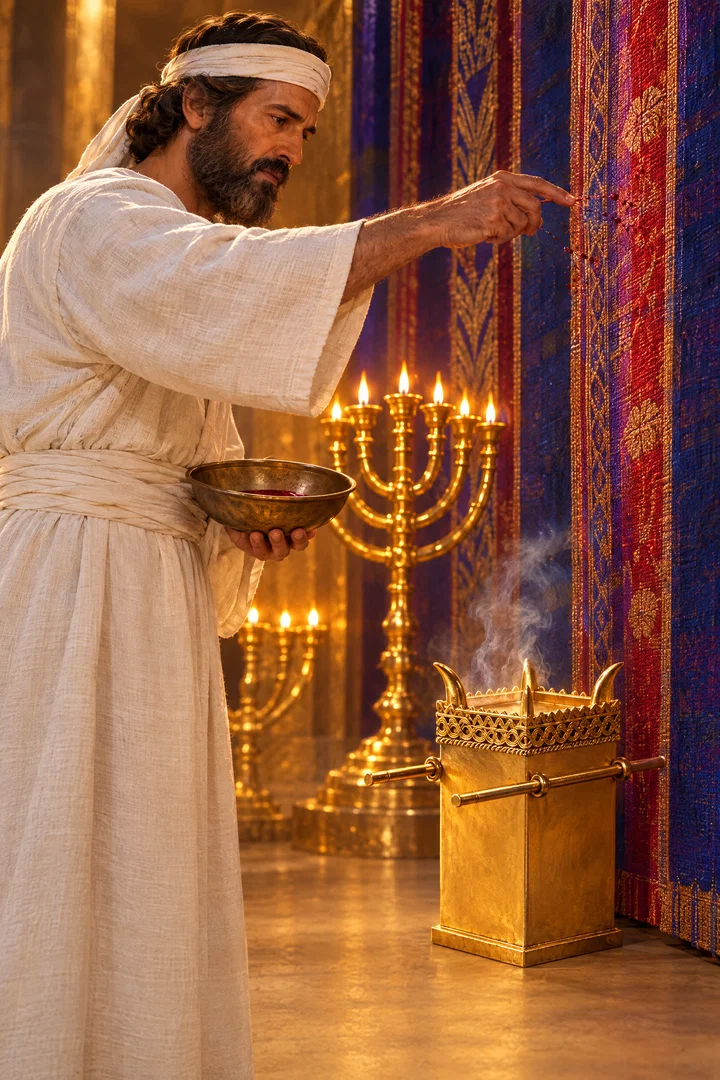
The setting is a temple in the Holy City having a door, with a first veil leading into the Holy Place and a second veil leading into the Holy of Holies.WLF 18.3–4 The Holy Place contains the altar of incense, the candlestick with seven lamps, and the table of showbread.WLF 18.3–4 Jesus ministers there, lifting the veils to give entrance from the Holy into the Holiest.WLF 18.3–4
Earthly and Heavenly Cleansing
Under the law almost all things are purified with blood, because remission means the putting away of sin and there is no remission without shedding of blood.RH Nov 8, 1915GC88 417.2–3GC 417.2–3 For this reason the earthly sanctuary was cleansed in symbol by the blood of animals, while the heavenly sanctuary is cleansed in reality by the better sacrifice of Christ's precious blood.RH Nov 8, 1915GC88 417.2–3GC 417.2–3RH Nov 8, 1915 The cleansing of both sanctuaries rests on the same necessity, since the work to be accomplished is the remission of sin.RH Nov 8, 1915GC88 417.2–3
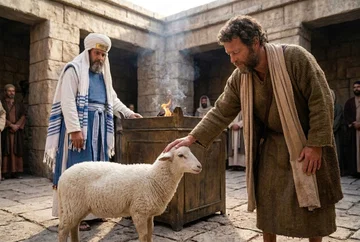
The ministry of the earthly priests was an example and shadow of heavenly things.RH Nov 8, 1915 In the earthly service a repentant sinner confessed sins over the animal and laid hands on its head, thereby transferring guilt symbolically to the innocent victim, which was then slain.RH Nov 8, 1915ST Jul 15, 1880 That victim bore the sinner's guilt, and its blood represented the sinner's life forfeited by God's broken law, which demands the transgressor's life.RH Nov 8, 1915GC88 418.1GC 418.1–2ST Jul 15, 1880 When the priest carried the blood into the holy place and sprinkled it there, sin was symbolically transferred from the repentant sinner to the sanctuary.RH Nov 8, 1915GC88 418.1GC 418.1–2
The offering was brought with confession of sinfulness and desert of wrath, with repentance and faith in Jesus Christ whose blood would remove guilt, and God signified acceptance by consuming the offering on the altar.ST Jul 15, 1880 Only clean, precious animals without spot or blemish could be used, because they best symbolized Christ, and since Heaven's most perfect and valuable treasure was given for salvation, only the dearest and most precious gift is acceptable in return.ST Jul 15, 1880 When the blood was not brought into the holy place, the priest instead ate the flesh of the sacrifice to bear the iniquity of the congregation.RH Nov 8, 1915GC 418.1–2 Both ceremonies alike represented the transfer of sin from the penitent to the sanctuary, showing that sin lodged there required a later work of atonement for its removal.RH Nov 8, 1915GC 418.1–2
Covenant Ratified by Blood
Forgiveness and the ratifying of a covenant require the shedding of blood.RH Oct 17, 1907 The covenant made with Adam and renewed to Abraham was ratified by the death of Christ, while the covenant made at Sinai was ratified by sacrificial blood.RH Oct 17, 1907 The Abrahamic covenant is called new or second because the blood of Christ was shed after the blood that ratified the first covenant.RH Oct 17, 1907 The blood that Moses sprinkled on the altar and on the people when Israel promised obedience to the covenant was a most solemn service that set Israel apart as a peculiar people, and it represented cleansing from sin by the shedding of the blood of Jesus.Ms 65, 1906, par. 17–18
The blood sprinkled on the altar meant that Israel consecrated body, mind, and soul to God.Ms 126, 1901, par. 52–56 The blood sprinkled on the people meant that God graciously accepted them as His special treasure through the sprinkled blood of Christ.Ms 126, 1901, par. 52–56 By that blood they were set apart and sealed to God and entered into solemn covenant with Him, typifying the covenant made between God and every believer in Jesus Christ.Ms 126, 1901, par. 52–56 The covenant was ratified through the blood of Christ, and the bread and wine of the sacrament keep before believers the infinite sacrifice He made for each person and for fallen humanity.DA 656.5
Sacrifice Taught Since Eden
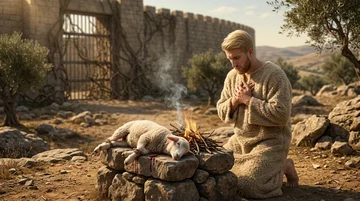
From the beginning the requirement that forgiveness comes only by shedding of blood was made known to Adam, and his first sacrifice taught him that disobedience had brought death and that only the death of the Son of God could atone for sin.1SP 55.11SP 53.1–2PP 68.1 The slain innocent animal made him acknowledge guilt and see the death penalty due to sin, while its blood pointed forward in faith to the promised Sacrifice and gave hope by prefiguring a perfect offering.1SP 53.1–2PP 68.1 That victim pointed to the spotless Lamb of God and to the ransom provided to save the guilty, reminding the sinner of sin, acknowledging repentance, and expressing faith in the coming Redeemer.SG3 47.1–48.11SP 54.1PP 68.1
The offerings ordained for Cain and Abel were to keep sin and the promised Redeemer in mind, expressing faith in Christ whom the sacrifices represented and acknowledging dependence on Him for pardon.SG3 47.1–48.1PP 71.21SP 54.1 By offering firstlings of the flock in faith as commanded they showed faith in Christ as the promised atonement and obedience to the plan of redemption, while first-fruits of the earth were presented separately as a thank-offering.SG3 47.1–48.1PP 71.2 The slain lamb and its blood pointed to the Messiah as the great sacrifice for humanity, teaching that remission requires shed blood.SG3 47.1–48.11SP 54.1
God specified a lamb without blemish to declare faith in the promised Redeemer, so an offering without the lamb was worthless, offensive, and could not be accepted.LC1 124.3ST Dec 25, 1901Ms 78, 1901, par. 3–11 Cain brought only fruit of the ground and refused to add a lamb, while Abel brought firstlings of his flock and was accepted, because Cain's offering lacked the one thing that gave an offering value.ST Dec 25, 1901Ms 78, 1901, par. 3–11 That lack came from rejecting submission and obedience to the ordinance, choosing his own plan as nobler and less humiliating and slighting the blood of atonement.LC1 124.34T 395.3Ms 78, 1901, par. 3–11 In the same way labor to introduce truth that is almost entirely theoretical and does not urge Christ home upon the conscience when feelings are softened lacks that sacrificial blood and is not acceptable.4T 395.3 Cain's disobedience to the blood requirement, followed by jealousy over Abel's acceptance, led to the first death when he killed Abel.Ms 78, 1901, par. 3–11
The solemn shedding of the victim's blood signified repentance for sin and typified a future atonement through a Redeemer to come.2RED 19.2LC1 123.2 Satan watched those sacrifices with intense interest and great uneasiness, learned that mystery, and because it opposed his purposes at once began to work on Cain's heart to lead him to rebellion against the blood offering.LC1 123.2 Israel's repeated sacrifices, ceremonies, symbols and figures were afterward appointed to impress that same truth of atonement upon the world and ever keep the gospel before them.Lt 43, 1892, par. 11–13ST Aug 28, 1898Lt 85, 1886, par. 4–5Lt 12, 1892, par. 2–4Ms 71, 1901, par. 4–5 Each sacrifice symbolized Christ, whose blood alone cleanses from sin and brings forgiveness, and the solemn ceremony and details of the sin offering taught how the Son of God would be offered for sins.Lt 43, 1892, par. 11–13ST Aug 28, 1898Lt 85, 1886, par. 4–5Lt 12, 1892, par. 2–4 His sufferings were not for atonement for Himself but for fallen humanity, proportionate to His divine dignity, sinless character, equality with God and perfect purity, and faith grasps the complete pardon for sins least and greatest without setting aside justice, holiness or truth.Lt 43, 1892, par. 11–13Lt 85, 1886, par. 4–5Lt 12, 1892, par. 2–4
Substitute Death For Sin
Sin brings death, and therefore forgiveness requires blood to be shed.RH Mar 3, 18741SP 53.3LC1 123.12SP 85.3ST May 23, 1911 Fallen man's guilt and transgression of the divine law placed an impassable barrier between the holy God and the transgressor so that he could no longer come directly before God with his supplications, so the sentence of death was made to rest upon a substitute.LC1 123.1 In the slain victim man was to see God's death sentence against sin fulfilled for the time being, and the flowing of the blood signified an atonement.LC1 123.12SP 85.32RED 19.1 The victim's death displayed the penalty their sin deserved and was associated with the blood of the Son of God.1SP 53.3 Without sin man would never have known death, but in the innocent offering slain by his own hand he beholds the fruits of sin, even the death of the Son of God in his behalf.ST May 23, 1911
The slain offering reveals the immutable character of the law he has transgressed, leading him to confess his sin and rely upon the merits of the Lamb of God who takes away the sins of the world, while through the love of God in providing such a ransom a star of hope illumines the terrible future spread before the transgressor.ST May 23, 1911 By sacrificing, sinners acknowledged their guilt and showed faith in the coming perfect sacrifice of God's Son, which animal offerings prefigured, for without Christ's atonement there could be no blessing or salvation from God to humanity.1SP 53.3 There was no virtue or power in the blood of animals itself to remove sin; it signified atonement and had value only as it pointed forward to a Redeemer who would one day come to the world and die for the sins of men.ST Jan 2, 1893RH Mar 3, 1874LC1 123.1ST Mar 28, 18782RED 19.1 The blood of bulls and goats could not take sin away, and only the blood of Jesus Christ, the sinless Lamb, cleanses from sin.ST Jan 2, 1893 Once Christ, the reality foreshadowed by those offerings, gave His own life as the one great sacrifice, His death ended the value of the Jewish sacrificial offerings.ST Apr 8, 1875
By that death Christ would fully uphold and vindicate His Father's law.RH Mar 3, 1874LC1 123.12SP 85.32RED 19.1 His sacrifice on the cross, where He shed His blood and bore sin's penalty, is the only ground for forgiveness and for the imputation of His righteousness to the believing sinner.ST Jun 18, 1894 This remission does not make the law void or permit a person to remain in sin, for Christ's righteousness makes obedience acceptable and faith establishes the law.ST Jun 18, 1894 It was not enough for Him merely to live the law and reveal God's character in a spotless life; He had to offer Himself voluntarily as a willing, spotless sacrifice and suffer the agony of a public death on the cross, so that His atoning death would be witnessed without the shadow of a doubt.12MR 395.2–396.1Ms 101, 1897, par. 27–29 The atonement is necessary and cannot be set aside without sweeping away the whole Christian economy.MH 428.4 To do away with the necessity for the atonement makes man his own saviour and makes God's word of no effect, and without it the defenses of the soul are broken down so that man has no barrier against sin, and when the restraints of God's word and His Spirit are rejected there is no knowing to what depths one may sink.MH 428.4
Christ's Blood Alone Saves
The blood of bulls and goats could not take sin away, and forgiveness comes only through shed blood pointing to Christ the Lamb of God through whom alone sin is forgiven.ST Jan 2, 1893Lt 43, 1892, par. 11–13Ms 53, 1890, par. 48–59 Israel's offerings were appointed as solemn symbols to impress that Christ's blood alone cleanses from sin and brings forgiveness.Lt 43, 1892, par. 11–13Ms 53, 1890, par. 48–59 He is the sinless Lamb whose sacrifice makes pardon possible, and only the Son of God could pay sin's penalty.Ms 53, 1890, par. 48–5916MR 223.3–224.1 Salvation does not rest on human works of righteousness but on God's mercy and love received by living faith and continued dependence.16MR 223.3–224.1
His suffering was not to make atonement for Himself, for He needed none, but was given for fallen humanity.Lt 43, 1892, par. 11–13Lt 85, 1886, par. 4–5Lt 12, 1892, par. 2–4 Its depth was proportionate to His divine dignity and sinless character, to His equality with God and perfect purity, though He suffered on behalf of sinners.Lt 43, 1892, par. 11–13Lt 85, 1886, par. 4–5 Through Him as the only Mediator God forgives fully without setting aside justice, holiness, or truth, with free pardon available for sins least and greatest.Lt 85, 1886, par. 4–5Lt 12, 1892, par. 2–4 Understanding its cost deepens as people recognize the seriousness of sin and the deliverance from it, calling them to trust His cleansing blood, recognize the gravity of sin, and hate it.Lt 43, 1892, par. 11–13Lt 85, 1886, par. 4–5
The claims of God's law could be met only through His atoning sacrifice, as Abel's slain victim pointed by faith to the Son of God dying for sinners.ST Feb 6, 1879 Human works, wealth, abilities, and personal merit cannot atone for sin or secure God's approval.ST Feb 6, 187916MR 223.3–224.1PP 72.5 Without His sacrifice and divine mediation a person remains under condemnation and in bondage to sin, and forgiveness rests on His sacrifice received through faith and obedience.ST Feb 6, 1879PP 72.5
The blood required for cleansing from sin and shelter from wrath is the blood of Christ, foreshadowed by the slain Passover lamb and by the blood marking the doorposts in Egypt.1RED 30.1ST Dec 9, 1880 The lamb's death pointed forward to His death, and that blood is efficacious for the believing sinner both to cleanse from sin and to shelter from the wrath of God to come upon the impenitent and unbelieving world, as the wrath of God fell upon the Egyptians.1RED 30.1ST Dec 9, 1880 Its benefit is received only by those who perform the work God leaves them to do and by their acts manifest faith in the provision God made for salvation.1RED 30.1ST Dec 9, 1880 The command to sprinkle the blood of the slain lamb on the door lintels so the death angel would not enter shows how shed blood protects from divine judgment.Ms 71, 1901, par. 4–5 That blood is the blood of Christ, the Lamb slain from the foundation of the world, crucified and risen, whose virtue is the sinner's only hope because salvation comes only through His merits, tasted death for all, received through faith in His name unto cleansing from all sin.Ms 71, 1901, par. 4–5
Animal blood flowed in the temple as a symbol of His blood, showing that forgiveness and cleansing come through His sacrificial death.ST Jun 8, 18824RED 125.2–127.1 The beasts led for centuries through the sheep gate for sacrificial offerings pointed to Jesus as the great Antitype whose sacrifice for the sins of the world fulfills them, as He Himself was about to go through that gate toward Gethsemane and Calvary to offer His own life.ST Jun 8, 1882 Every gift of God is as it were sprinkled with His blood and made one through His sacrifice, expressing God's love for fallen humanity.21MR 392.3–4 His blood is efficacious for remission and seals the promise to those who trust in Him as their only hope and stronghold.21MR 392.3–4Lt 40, 1874, par. 1–3
Receiving Forgiveness by Faith
Without shed blood there is no forgiveness, and the sacrifices given to Israel repeatedly impressed that truth in symbols and figures pointing to forgiveness through Christ's blood alone.Lt 85, 1886, par. 4–5Lt 12, 1892, par. 2–4Ms 30, 1889, par. 56–61 His sufferings were not for any need of atonement in Himself, for He was equal with God and perfectly pure, but were borne for fallen humanity.Lt 85, 1886, par. 4–5Lt 12, 1892, par. 2–4 Through Jesus the only Mediator God pardons fully without setting aside justice, holiness or truth, and the repentant sinner who confesses and trusts Him receives pardon for sins both least and greatest.Lt 85, 1886, par. 4–5Lt 12, 1892, par. 2–4 Faith grasps this complete free pardon, and its cost is understood more deeply as the seriousness of sin and the deliverance from it are recognized.Lt 85, 1886, par. 4–5 Those who look to Him in faith are pardoned, as was shown when the dying thief looked to Him.Ms 45, 1897, par. 20–22
The blood appointed from beasts typified pardon through the great offering to come and stood as a pledge of forgiveness.LC1 124.3 To offer that blood signified repentance, obedience and faith in a Redeemer to come, acknowledging sinfulness and weakness and dependence upon another for atonement.LC1 124.3ST Jul 15, 1880 The sinner bringing an offering confessed himself a sinner deserving God's wrath and showed repentance and faith in Jesus Christ whose blood would remove guilt, transferring his sin to the victim by laying hands on its head.ST Jul 15, 1880 In the victim's suffering he saw Christ typified giving Himself as a sacrifice for sins, and God signified acceptance by consuming the offering on the altar.ST Jul 15, 1880 Only clean, precious animals without spot or blemish that best symbolized Christ could teach this, and since Heaven's most perfect and valuable treasure was given for salvation, God receives in return only the dearest and most precious gift.ST Jul 15, 1880 God forgave the people when they offered these sacrifices in obedience to His law, yet the offerings had no value without true contrition and repentance from the heart, with Christ's grace working in them as they confessed to God and to one another unto genuine reformation.Lt 112, 1895, par. 9
Christ gave His precious life to secure remission as an inestimable heavenly treasure for every perishing soul.ST Jan 18, 189913MR 132.1Ms 48, 1898, par. 13–14 Received by faith into the heart, the gospel brings remission and transforms the person.ST Jan 18, 1899 It cleanses the impure, washing them in the blood of the Lamb, and changes the whole man.ST Jan 18, 1899Ms 48, 1898, par. 13–14
Even for souls stained by the corruptions of a degenerate age who have professedly served God, the blood of a crucified and risen Saviour atones, and even now it is not too late for wrongs to be righted and pardon received if sinners repent and feel their need.3T 476.1 Those who name Christ must not grow careless and look upon sin with indifference, but must watch and pray as never before and guard the avenues of the soul.3T 476.1 Satan is at work to corrupt and destroy if given the least advantage, and the camp needs purging.3T 476.1
The poor who came to the temple believed forgiveness required shed blood and were distressed because they were too poor to purchase even the humblest offering and feared they could not be forgiven.ST Sep 16, 1897Lt 78, 1903, par. 5–8 At Passover those coming from a distance felt compelled to buy animals for sacrifice, while priests and rulers who had bought cattle cheaply sold them at exorbitant prices in sharp bargaining.Lt 78, 1903, par. 5–8 This oppression in the outer court turned into a place of unholy traffic moved Christ to cleanse the temple.Lt 78, 1903, par. 5–8
The required sacrifices were ceremonies typifying the only perfect sacrifice, Christ Himself, who gave directions for the offerings and is the foundation of the whole Jewish economy.ST Sep 16, 1897 The people were not instructed in their import and offered them without understanding what they pointed to, so the service had become mere form and spiritual worship was disappearing.ST Sep 16, 1897 The symbolic meaning had been misunderstood and perverted, and Christ the one perfect Sacrifice stood among the worshipers unrecognized.DA 157.1–2ST Sep 16, 1897
The sacrificial blood of atonement is what gives an offering value and makes it acceptable to God, so an offering that leaves it out is worthless like Cain's offering of only the fruit of the ground.4T 395.3GW92 13.3–14.1 Labor to introduce truth that is almost entirely theoretical, that does not urge the religion of Christ home upon the conscience when feelings are softened, lacks that blood and is not acceptable.4T 395.3 Doctrinal preaching that is only theoretical and does not present Christ and Him crucified with practical godliness lacks the blood that makes it acceptable and able to reach hearts.GW92 13.3–14.1
Through the shedding of Jesus' blood peace and goodwill are proclaimed, and faith in His blood and attention to His atoning sacrifice are necessary for remission.16MR 232.1–2Ms 30, 1889, par. 56–61 Forgiveness comes only through shed blood, the great truth ever kept before Israel by the tabernacle sacrifices setting forth the gospel.Ms 71, 1901, par. 4–5 He tasted death for all, and cleansing from all sin is received through faith in His name, for salvation comes only through His merits and His virtue is the sinner's only hope.Ms 71, 1901, par. 4–5 He must be lifted up, with this testimony heard in every discourse.Ms 71, 1901, par. 4–5
Sources
Pioneers and periodicals
87 sources
Under the law almost all things are cleansed with blood, and without shedding of blood there is no pardon.RH Mar 11, 1858RH Jun 9, 1874RH May 14, 1867 Purging means cleansing from imputed guilt and sin, and remission means the removal and putting away of sin forever.ST Feb 17, 1890RH Feb 3, 1853ST Jul 1, 1880 Blood is required because life is in the blood, sin forfeits the sinner's life under a law whose penalty is death, and pardon can come only by the giving of a life the law can accept.ST Nov 22, 1883RH Sep 6, 1870ST Jan 11, 1877 Jesus the Lamb of God shed his own blood once for all upon the cross, and as great High Priest entered heaven itself by that blood to present his spotless life, intercede for sinners, and cleanse the true heavenly sanctuary from sins transferred there.RH Jun 9, 1874RH Dec 8, 1915RH Jul 18, 1854ST Oct 22, 1874ST May 17, 1883 That heavenly cleansing is his concluding priestly work in the second apartment before the second coming, begun in 1844 at the end of the 2300 days, in which confessed sins are blotted out forever and then placed upon the scapegoat.RH Feb 3, 1853RH Aug 10, 1876RH Mar 22, 1870ST May 27, 1880
Wording and Setting
Under the law almost all things are cleansed by blood, and apart from shedding of blood there is no forgiveness of sin.RH Mar 11, 1858RH Jun 9, 1874RH May 14, 1867RH Dec 8, 1915RH Apr 18, 1854 The cleansing in view is the removal of imputed guilt and the remission of sin, not the washing away of physical dirt or uncleanness.RH Mar 11, 1858RH Feb 3, 1853ST Jul 1, 1880RH Aug 10, 1876RH Jan 9, 1855 The earthly sanctuary was cleansed in this way through blood as the pattern of the heavenly sanctuary, which is purified through the better sacrifice of Christ, since animal blood could not finally take away sin but his sacrifice does.RH Nov 8, 1915RH Mar 11, 1858RH May 14, 1867RH Dec 8, 1915RH Apr 18, 1854
To purge means to cleanse or purify, and remission means the removal, putting away, and sending back and sending away of sin so that it is disposed of and removed forever.ST Feb 17, 1890RH Aug 10, 1876ST Jul 11, 1911RH Jan 9, 1855ST Oct 25, 1883 The burden of the statement is remission rather than bodily uncleanness, explaining why the earthly tabernacle and its vessels had to be cleansed because imputed guilt had to be removed by blood.ST Feb 17, 1890RH Feb 3, 1853ST Jul 1, 1880ST Jul 11, 1911RH Jan 9, 1855 For the same reason the heavenly things themselves must be purified, but with better sacrifices than goats and calves, namely the blood of Christ ministered in the heavenly sanctuary, which does take away sin.RH Feb 3, 1853ST Jul 1, 1880RH Aug 10, 1876ST Jul 11, 1911RH Jan 9, 1855 That heavenly cleansing is the priestly work of Christ in the most holy place completing the sanctuary service, accomplished by blood and not by fire.RH Feb 3, 1853RH Aug 10, 1876RH Jan 9, 1855 The physical renovation of the earth by literal fire, though it will free the earth from sin and the curse, is independent of and foreign to this sanctuary cleansing.RH Jan 9, 1855
The word almost allows exceptions, with purifications by water or oil and those noted in connection with Numbers 19 standing outside the rule.ST Feb 17, 1890RH Sep 17, 1908ST Feb 17, 1890 Those exceptions concerned bodily or ceremonial defilements rather than sin, while remission of sin requires shedding of blood because life is in the blood and only life can atone for life.ST Feb 17, 1890ST Feb 17, 1890 Purged carries strictly the sense of cleansing, not merely dedicating, and does not describe the once-for-all dedication of the covenant outside the sanctuary but the yearly work of the high priest alone in cleansing the sanctuary with sin-offering blood for the uncleanness of Israel borne in by the priest as their representative.ST Oct 25, 1883 The law here means the ritual law governing established ceremonies and worship, including purification with blood.RH Sep 17, 1908
The statement belongs to the account of the first covenant with its worldly sanctuary and ordinances of divine service, which implies a second covenant with its own sanctuary and service also.ST Oct 22, 1874ST Jan 13, 1914ST May 27, 1880RH Apr 6, 1869RH Mar 10, 1874 That worldly sanctuary was a figure for the time then present and a figure of the true, built according to the pattern shown to Moses in the mount, with the true sanctuary as the pattern from which the earthly tabernacle was erected and as the sanctuary of the better covenant now in force.ST Oct 22, 1874ST Jan 13, 1914ST May 27, 1880RH Apr 6, 1869RH Mar 10, 1874 Its service included the offering of blood for the priests themselves and for the errors of the people, and it had two apartments.RH Sep 21, 1905ST Oct 22, 1874RH Mar 10, 1874 The first apartment held the seven-branched golden candlestick, the table for the showbread, and the altar of incense, while the second apartment held the ark of the covenant, a chest overlaid with gold holding the two tables of stone engraved with the ten commandments as the standard of righteousness.RH Sep 21, 1905 Only 490 of the 2300 years were allotted to the first covenant, the worldly sanctuary, and Jewish pre-eminence, after which the old covenant passed away, the new covenant was introduced, and the services of the worldly sanctuary forever ceased, so the cleansing promised at the termination of the 2300 years must apply to the sanctuary of the second covenant.ST May 27, 1880
Why Blood Is Required
Blood stands for life itself, for life resides in the blood, and therefore cleansing by blood means cleansing by life given in death.ST Nov 22, 1883RH Sep 6, 1870ST Jan 11, 1877RH Oct 13, 1863RH Nov 2, 1869 The sinner has forfeited the right to live, because the penalty of sin under the law is death, so pardon cannot be granted without a life being laid down that the law can accept.ST Nov 22, 1883ST Jan 11, 1877RH Oct 13, 1863ST Oct 18, 1883RH Nov 2, 1869 Shedding of blood is the taking of life and the execution of sin's penalty, and without this blood-based atonement the offerings would have no meaning.ST Nov 22, 1883RH Sep 6, 1870ST Jan 11, 1877RH Oct 13, 1863ST Oct 18, 1883 Forgiveness does not cancel or weaken the law but meets its claim, for sin is transferred to an accepted offering whose life is given in the sinner's place, and Christ's shed blood means He died and suffered sin's penalty.ST Nov 22, 1883ST Jan 11, 1877RH Oct 13, 1863ST Oct 18, 1883RH Nov 2, 1869 It is the life represented by blood that avails, not blood as mere substance in itself, and atonement and cleansing come through that blood, not through fasting, prayer, or personal affliction.RH Sep 6, 1870ST Jan 11, 1877RH Oct 13, 1863ST Oct 18, 1883RH Nov 2, 1869
In the appointed way the penitent confessed sin and laid hands over an innocent victim, transferring guilt to it, its life was taken in the sinner's place, and the priest ministered its blood as representative of forfeited life and vehicle of guilt before the veil and mercy-seat.RH Jan 24, 1856RH Jun 27, 1878STST Aug 10, 1882 By shedding the blood of the offering the sinner acknowledged guilt and desert of death for breaking God's law, and showed that the only hope of pardon is in Christ the great sacrifice offered as atonement for all who believe.RH Jan 24, 1856ST Jun 19, 1907RH Jun 27, 1878STST Aug 10, 1882 The blood of the sin offering was sprinkled on the mercy-seat above the law shut up in the ark, because the top of the ark is called the mercy-seat where the breaker of the law beneath finds pardon by blood sprinkled there.RH Jan 24, 1856ST Jun 19, 1907ST Aug 10, 1882 The law inside demands atonement and exposes sin but cannot remit it, while the ceremonial provision teaches how atonement is made and enables approach again to the broken law, so that guilt is taken away while the law is magnified and honored.RH Jun 27, 1878STST Aug 10, 1882 Forgiveness thus does not cancel the law but meets its claim, honors it, and lays sin on another who suffers its penalty, with animal blood pointing in faith to Christ's life given for sinners and counted as righteousness to those who believed.RH Jan 24, 1856ST Jun 19, 1907RH Jun 27, 1878ST
The purging blood is shed sacrificial blood presented as a priestly offering, not blood remaining in the veins as a description of bodily condition.RH Aug 25, 1874RH Sep 6, 1870RH Oct 14, 1909ST Sep 13, 1877 Aaron entered the most holy place not by the blood in his own veins but by the blood of the sin offering slain outside the sanctuary, and in the same way Christ entered heaven itself as High Priest by His own blood shed as a sacrifice on the cross, which He presents to the Father.RH Aug 25, 1874RH Oct 14, 1909 Shedding satisfies the law and makes remission possible by meeting its demand for life, but shedding alone is not itself remission until ministered.RH Aug 25, 1874RH Sep 6, 1870RH Oct 14, 1909ST Sep 13, 1877 The blood of calves and goats provided only figurative remission while expressing faith in the real sacrifice to come, whereas Christ's blood brings actual remission to those who come to Him by faith after His ascension as well as to those who relied on the figures before.RH Sep 6, 1870ST Sep 13, 1877
Blood also means given life as God's self-giving love that draws people back to Him to be forgiven, healed, and made one with God. The requirement is not literal bloodshed as a mechanical condition, but the giving of life freely in love to rescue humanity, and Christ's sacrifice must be lived out through believers here and now and not remain merely a past event or an arbitrary substitution while they remain selfish. Those who receive Christ's given life are changed to become like Him and share in His sacrifice by freely giving their own lives for others as channels of His love. Without this self-giving life there is no atonement or remission, for selfishly keeping life leads to loss while giving it brings fuller life.
Earthly Sanctuary Pattern
Under the law almost all things were purged with blood, so the earthly tabernacle erected by Moses with its sacred vessels, as patterns of the true sanctuary in heaven, had to be purified with the blood of calves and goats.ST Dec 12, 1916RH Aug 2, 1870RH Mar 28, 1854 That purification came in a yearly closing service which concluded the round of service, when the high priest alone entered the most holy place with the blood of the sin offering to atone and cleanse for himself, the people, and the sanctuary itself.ST Dec 12, 1916RH Jan 9, 1855 Guilt was transferred by confession to the victim, the victim was slain for transgression, and the blood bearing guilt was sprinkled within the sanctuary through the year and then before and upon the mercy-seat on the day of atonement to reconcile and cleanse the holy sanctuary, the tabernacle, the altar, the priests, and all the people.RH Jan 9, 1855RH Mar 28, 1854 Afterward the accumulated sins were transferred to the scapegoat and borne away.RH Jan 9, 1855
The reason for that cleansing was that the sins of the people had been carried into the sanctuary through the blood of sin offerings, so it had to be freed from them.RH Mar 28, 1854 The day of atonement ceremony with its cleansing was part of that pattern, showing an earthly counterpart with a heavenly counterpart to follow.ST Sep 11, 1884 The heavenly things themselves, the true tabernacle which the Lord pitched and not man, must for the same reason be purified with better sacrifices than calves and goats, even with the blood of Christ.ST Dec 12, 1916RH Aug 2, 1870RH Mar 28, 1854 That heavenly cleansing is the antitype of the slain goat as the sin offering for the people, the final blotting out forever of the confessed sins of those who by confession, repentance and faith placed their sins upon the sanctuary and its atoning blood and maintained their confidence steadfast to the end, sealing their enjoyment of sanctuary blessings beyond loss.ST Dec 12, 1916RH Jan 9, 1855 It takes place once, at the close of Christ's priesthood, in the second apartment, and marks the finishing of human probation as His priesthood gives way to His kingly office, and the physical renovation of the earth by literal fire, though it will free the earth from sin and the curse, is independent of and foreign to that sanctuary cleansing.RH Jan 9, 1855
The blood of bulls and goats could not in itself take away sin, give life, or cleanse the conscience.ST Jan 2, 1893RH Jul 18, 1854ST Aug 19, 1913 In the offerings blood represented life and pointed to Christ's life given for sinners, the Lamb of God through whom alone sin is forgiven, but it was faith in His sacrifice that was accepted by God for righteousness.ST Jan 2, 1893ST Aug 19, 1913 Those sacrifices and that priesthood belonged to the account of the first covenant's sanctuary and were temporary figures, shadows, signs and object-lessons pointing forward to Christ's once-for-all offering and to the new covenant with its sanctuary and priestly ministry.RH Jul 18, 1854RH Oct 2, 1856RH Jan 20, 1853 Their value ended when Jesus the true Sacrifice died on the cross and the veil was rent, for forgiveness of sins remains connected with shed blood ministered by Christ as High Priest in the true tabernacle in heaven, of which the earthly tabernacle was a pattern, so that there is no remission of sins after His ministry ends.RH Jul 18, 1854
Heavenly Sanctuary Cleansed
The heavenly things themselves, the true tabernacle which the Lord pitched and not man, must for the same reason be purified with better sacrifices than the blood of calves and goats, even the precious blood of Christ himself ministered in the heavenly sanctuary.RH Mar 11, 1858RH May 14, 1867RH Dec 8, 1915RH Apr 18, 1854ST Jul 1, 1880 As the earthly tabernacle and its vessels as patterns were cleansed through sacrifices because imputed guilt had to be removed by blood, so purification of the heavenly things also requires blood, since under the law almost everything is purified with blood and forgiveness requires shedding of blood.RH Mar 11, 1858RH May 14, 1867RH Apr 18, 1854ST Jul 1, 1880ST Dec 15, 1881 Animal blood could not finally take away sin, but Christ's sacrifice does take away sin in fact, and Christ entered heaven itself to appear before God on behalf of humanity to accomplish that cleansing work with his own blood.RH Mar 11, 1858RH Dec 8, 1915RH Feb 3, 1853ST Jul 1, 1880ST Dec 15, 1881 Sins of men have been borne into the heavenly sanctuary in fact through the blood of sin-offering, and they must be removed, which necessity proves that sins are transferred there.RH Feb 3, 1853ST Jul 1, 1880ST Dec 15, 1881 That cleansing is by blood and not by fire, for the idea of cleansing the sanctuary by fire has no support in the Bible.RH Feb 3, 1853
The burden is remission, the putting away of sin, not physical uncleanness, for blood is used for nothing else and without shedding of blood there is no remission or forgiveness.ST Jul 1, 1880ST Dec 15, 1881ST Jul 9, 1896RH Aug 2, 1870 The fact that heavenly things are said to be cleansed does not mean there is physical impurity in heaven.RH Feb 3, 1853ST Dec 15, 1881ST Jul 9, 1896ST Nov 23, 1904RH Aug 2, 1870 Sin becomes attached to the sanctuary through ministration, sins being borne into it through the priests' ministry and recorded there, and cleansing from them is a spiritual cleansing accomplished by blood ministration, even the blood of Jesus Christ.RH Feb 3, 1853ST Dec 15, 1881ST Jul 9, 1896ST Nov 23, 1904RH Aug 2, 1870 Christ's offering on Calvary was complete and once for all, and his work as High Priest applies that sacrifice in the heavenly sanctuary whose earthly service was a pattern.ST Nov 23, 1904
Christ's Sacrifice and Priesthood
Forgiveness of sin requires the shedding of blood, and the needed victim is Jesus, the Lamb of God who bore human sin in his body on the cross.RH Jun 9, 1874RH Jul 18, 1854ST May 17, 1883 His blood shed for many for the remission of sins meets that condition and alone provides full remission and atonement for human guilt, even for the vilest sinner.RH Jun 9, 1874ST May 17, 1883RH Jan 21, 1915 The blood of animal sacrifices could not itself remove sin, give life, or cleanse the conscience, but pointed forward to his once-for-all offering, and their value ended when he died.RH Jul 18, 1854RH Sep 21, 1905ST Aug 19, 1913 His one offering takes away sin in fact, cleanses the sanctuary, perfects those who are sanctified, purges the conscience from dead works, and needs no additional sacrifice or unbloody human offering to complete the work.RH Jan 21, 1915ST Dec 21, 1915ST May 29, 1901 In the sacrificial act shed blood represented the giving of a sinless life to wash away the repentant sinner's sins, and Christ's blood shed on Calvary is the true and sufficient sacrifice.RH Jun 9, 1874ST May 17, 1883RH Jan 21, 1915 It is the only remedy for breach of God's law, and no sinner in any age before Calvary or after can be freed from sin without it.RH Jul 18, 1854RH Sep 21, 1905
For this reason Christ entered not the holy places made with hands but heaven itself, the true tabernacle and true holy place, as great High Priest by his own sacrificial blood to appear before God on behalf of humanity.RH Dec 8, 1915ST Oct 22, 1874RH Mar 10, 1874RH Jan 24, 1856 The earthly sanctuary with its two apartments and its services under the first covenant were patterns of his ministration under the new covenant and illustrate the order of his ministry.ST Oct 22, 1874RH Mar 10, 1874ST Nov 20, 1879 As the high priest carried the sacrifice's blood into the holy of holies and sprinkled it before the mercy seat for the people's sins, so Christ offered himself once for sins and entered heaven to present his own blood.RH Jan 24, 1856RH Dec 15, 1868 There he presents his spotless life to satisfy the violated law, intercedes for sinners, and carries out the atonement in the sanctuary, not by his death alone.RH Jul 18, 1854ST May 29, 1901 That heavenly cleansing is accomplished with his better sacrifice and with blood, not fire, as his concluding priestly work before he leaves the sanctuary, and there can be no remission of sins after his ministry ends.RH Dec 8, 1915RH Jul 18, 1854RH Dec 15, 1868
Freedom from the blight of sin comes only through application by faith of the required blood.RH Sep 21, 1905ST Aug 19, 1913ST From the earliest time Abel by faith saw in the blood of his animal offering the blood of Christ yet to be shed on Calvary, and ancient sinners need it just as modern sinners do.RH Sep 21, 1905STRH Jun 27, 1878 In the offerings blood represented life and pointed to Christ's life given for sinners; the sinner confessed sin over an innocent lamb which died in the sinner's place, its blood was offered on his behalf, through faith he saw God's sacrifice in the offering, and God counted that faith for righteousness.ST Aug 19, 1913STST May 29, 1901 Animal blood brought only outward ceremonial cleansing, while Christ's blood signifies his life, cleanses the life from dead works and fits it for spiritual service.ST Aug 19, 1913ST May 29, 1901 His sinless life substitutes for the sinful life of the person who accepts it by faith, his righteousness is imputed to that person, and his death must be imputed before acquittal; repentance toward God and faith toward Christ, with baptism into the likeness of his death and burial as entering into Christ, give interest in his blood ministered for pardon.RH Sep 21, 1905ST May 29, 1901
Covenants and Law
Both covenants were dedicated and put in force with blood, for under the law almost all things were cleansed with blood and forgiveness requires shedding of blood.RH May 13, 1862RH Jun 26, 1900RH Jun 9, 1874RH Jul 7, 1874 At Sinai the first covenant was completed and sealed when the people's agreement and the commandments as its written conditions were put in writing in the book of the covenant and Moses sprinkled both the book and the people, declaring it the blood of the covenant God had made with them.RH May 13, 1862ST Aug 13, 1885RH Jun 26, 1900 Christ's death shed the blood of the new and everlasting covenant, and as mediator his blood ratified that covenant and brought it into force, because sin forfeits life and blood is given to make atonement.RH May 13, 1862RH Jun 9, 1874RH Jul 7, 1874 The services of the old covenant were only types that could not in themselves make anyone perfect or save anyone, and their effectiveness depended on Christ's mediation, through which the new covenant took effect when his mediatorship began even before the old covenant existed at the Exodus.RH Aug 13, 1857ST May 23, 1878ST Oct 10, 1906
The purging with blood belongs to the ceremonial law and Levitical priesthood with its ordinances of divine service, not to the Ten Commandments, since none of the Ten prescribes purging things with blood.RH May 6, 1862RH Mar 8, 1906 The verse describes the ministration or service of the first covenant, distinct from the Ten Commandments written and engraven in stones themselves and from the words themselves as given in the handwriting of ordinances.RH May 6, 1862RH Mar 8, 1906 The moral law shut up in the ark exposes sin and demands atonement but cannot remit it, while the first covenant offered no pardon and the new covenant offers pardon with sins remembered no more through the effective sacrifice of Jesus Christ's own blood, the animal offerings not removing sin themselves.RH Aug 13, 1857ST May 23, 1878RH Aug 22, 1854 Remission requires shedding of blood because without it sinners cannot be forgiven and restored to favor, and the need is for an atonement that upholds the law and its penalty rather than setting them aside.ST May 23, 1878RH Aug 27, 1861RH Aug 22, 1854
Christ's sacrifice makes pardon possible for violators of God's law rather than abolishing that law or permitting its violation, and blood sprinkled on the mercy-seat above the law provides pardon that magnifies the law, so moral duties cannot earn remission.RH Aug 13, 1857RH Aug 27, 1861RH Aug 22, 1854 That blood-service was the ministration of condemnation, the shadow meeting its antitype in the more excellent ministry of Christ in the heavenly tabernacle, where the ark of God's testament shows the tables of the testament still remain as the foundation of the divine government.RH Aug 22, 1854RH Mar 8, 1906 Its glory has no glory by reason of the glory that excelleth, being swallowed up in the substance, and the veil upon Israel denotes that typical service which was abolished and done away in Christ, while the law itself was not abolished or destroyed.RH Mar 8, 1906
Prophecy and Final Judgment
The cleansing of the sanctuary is the High Priest's concluding priestly work in the second apartment, done before He leaves the sanctuary and before the second coming.RH Aug 10, 1876RH Dec 15, 1868 It is accomplished by blood and not by fire, for as the earthly sanctuary was cleansed by blood because sins had been borne into it through the blood of sin-offering, so the heavenly sanctuary, unclean only in the sense that the sins of men have been borne into it, must be cleansed for the same reason by the better sacrifice of the blood of Christ.RH Feb 3, 1853RH Aug 10, 1876RH Mar 22, 1870RH Dec 15, 1868RH Nov 24, 1863 There is no scriptural warrant for cleansing the sanctuary by fire or by any other means, since both the daily ministration and the final cleansing depend wholly on blood.RH Feb 3, 1853RH Aug 10, 1876RH Jan 9, 1855 The physical renovation of the earth by literal fire, though it will free the earth from sin and the curse, is independent of and foreign to sanctuary cleansing, as is judgment upon oppressing powers.RH Jan 9, 1855 In the type guilt was transferred by confession to the victim, the victim was slain for transgression, and the blood bearing guilt was sprinkled within the sanctuary through the year and then before and upon the mercy-seat on the day of atonement to reconcile and cleanse the holy sanctuary, the tabernacle, the altar, the priests and all the people, after which the accumulated sins were transferred to the scapegoat and borne away, foreshadowing the last great work of salvation when the sins of God's true Israel are blotted out forever.RH Jan 9, 1855
That antitypical cleansing belongs to the sanctuary of the second covenant, since only 490 of the 2300 years were allotted to the first covenant with its worldly sanctuary and Jewish pre-eminence, after which the old covenant passed away, the new covenant was introduced, the services of the worldly sanctuary forever ceased, and the cleansing promised at the termination of the 2300 years must therefore apply to the true sanctuary of the better covenant now in force.ST May 27, 1880 This cleansing belongs to the remaining 1810 years of the 2300 days and takes place at the end of that period, placing the beginning of that final priestly work in 1844.ST May 27, 1880ST May 17, 1877RH Nov 24, 1863 Whereas the earthly cleansing concluded its yearly round of service, the heavenly cleansing takes place once, at the close of Christ's priesthood in the most holy place, and marks the finishing of human probation as His priesthood gives way to His kingly office.ST May 17, 1877ST May 20, 1875 It is not the burning of the earth but the antitypical work of Christ as great High Priest entering the most holy place to complete the service by making atonement and removing believers' sins, occupying a brief but indefinite period beginning in 1844 and ending when the work of mercy for the world is finished and Christ returns.ST May 20, 1875RH Aug 22, 1912
In that closing work the confessed sins of those who by confession, repentance and faith placed their sins upon the sanctuary and its atoning blood and maintained their confidence steadfast to the end are blotted out and removed forever from the temple when His work therein is accomplished.ST Dec 12, 1916RH Sep 14, 1869ST Jun 13, 1878 This cleansing also purifies the worshipers, so that once purged they have no more conscience or remembrance of sins and are prepared for the second advent and sealed in enjoyment of sanctuary blessings beyond loss.RH Apr 5, 1864ST Dec 12, 1916 After the sanctuary has been cleansed by the blood of the slain goat representing Christ's blood, the remaining accumulated sins are placed upon the scapegoat representing Satan and sent away to be borne away never to return.RH Jan 9, 1855RH May 9, 1871ST Jun 13, 1878 The blotting out of sins is a work of judgment for the people of God, typified by the high priest's atonement for the sanctuary and Israel's sins on the tenth day of the seventh month, marking the close of Christ's work as High Priest and deciding by acquittal who belongs to God and who will have part in the first resurrection and exemption from the second death.RH Feb 26, 1867RH Sep 14, 1869
Witness and Christian Life
From Eden's first sacrifice forgiveness was joined to shed blood, and the skins that clothed the fallen pair pictured being covered with eternal righteousness.RH Sep 21, 1905 Abel by faith saw in the blood of his animal offering the blood of Christ yet to be shed for remission, and Abraham's readiness to offer Isaac, the daily Jewish sacrifices, the Passover lamb and patriarchal offerings, and even blood offerings among peoples across the world kept before minds guilt, death as sin's wages, and faith in the coming Redeemer.RH Sep 21, 1905 Blood denotes life, so in shedding the offering's blood the sinner takes its life and confesses that he deserves to die for breaking God's law, while showing that his only hope is Christ the great sacrifice for all who believe.RH Jun 27, 1878RH Jun 27, 1878 An offering without blood is therefore unsuitable and cannot be accepted, and Cain's fruit offering was rejected because it shed no blood and was not offered in that faith.RH Jun 27, 1878RH Jun 27, 1878
No unbloody offering can remove sin or make propitiation, for shed blood in the sacrificial act represented the giving of a sinless life to wash away the repentant sinner's sins.RH Jan 21, 1915ST Oct 27, 1909 Christ's blood shed on Calvary is the true and sufficient sacrifice without need of any additional human offering, and to deny its efficacy is to deny the sacrifice by which He bought sinners.RH Jan 21, 1915ST Dec 30, 1913 His death was essential to redemption and not merely a moral example, display of love, practical affection, sentiment, or empty symbol, but a substitute cleansing from sin so that God can justify believers while upholding divine justice.ST Nov 25, 1880ST Jan 21, 1903ST Oct 27, 1909 The vicarious sacrifice is therefore the central fact of Old and New Testament Scripture, meaning Christ's life must be sacrificed in the sinner's stead if He would restore the sinner.ST Nov 25, 1880ST Apr 14, 1914
Cleansing from sin is accomplished through blood, and the better sacrifice of the Lamb slain at Calvary both cleanses the heavenly sanctuary and purifies the worshipers.RH Apr 5, 1864ST Jan 15, 1880 Through His self-offering the conscience is purged from dead works to serve the living God, and animal blood that gave only outward ceremonial cleansing pointed to Christ's blood that cleanses the life and fits it for spiritual service.ST Jan 15, 1880ST May 29, 1901 His blood signifies His life presented in the heavenly sanctuary to satisfy the violated law, His sinless life substituting for the sinful life of the one who accepts it by faith with imputed righteousness, and becoming the channel by which prayer gives access to God's throne.ST Jun 19, 1907ST May 29, 1901 Remission through His blood is God's free gift of undeserved grace, offering salvation from sin and eternal life, so that rejecting His atoning death rejects the means of remission.ST Nov 15, 1883ST Oct 29, 1885 Once thus purged the worshipers have no more conscience of sins and are prepared for the second advent.RH Apr 5, 1864ST Jan 15, 1880
Sources