Leviticus 2:5
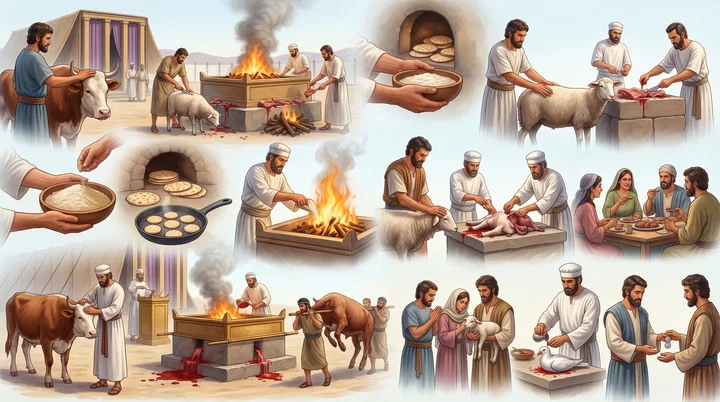
And if thy oblation be a meat offering baken in a pan, it shall be of fine flour unleavened, mingled with oil.
Translations
And if your oblation be a meat offering baked in a pan, it shall be of fine flour unleavened, mingled with oil.
King James Version, KJV Cambridge Paragraph Bible
And if thy oblation be a meat offering baken in a pan, it shall be of fine flour unleavened, mingled with oil.
And if thy oblation shall be a meat-offering baked in a pan, it shall be of fine flour unleavened, mingled with oil.
And if thy oblation be a meal offering of the baking pan, it shall be of fine flour unleavened, mingled with oil.
And if thy oblation be a meal-offering of the baking-pan, it shall be of fine flour unleavened, mingled with oil.
'And if thine offering [is] a present [made] on the girdel, it is of flour, mixed with oil, unleavened;
And if thine offering be an oblation [baken] on the pan, it shall be fine flour unleavened, mingled with oil.
But, if, a meal-offering, on a girdle, be thine oblation, of fine meal, overflowed with oil unleavened, shall it be;
Berean Standard Bible, Majority Standard Bible
If your offering is a grain offering prepared on a griddle, it must be unleavened bread made of fine flour mixed with oil.
If your offering is a meal offering made on a griddle, it shall be of unleavened fine flour, mixed with oil.
And if you give a meal offering cooked on a flat plate, let it be of the best meal, unleavened and mixed with oil.
But if thy meate offring be an oblation of the frying pan, it shall be of fine flowre vnleauened, mingled with oyle.
Douay-Rheims (Challoner revision)
If thy oblation be from the fryingpan, of flour tempered with oil, and without leaven,
Pictures
Cross-references
- Numbers 28:5
And a tenth part of an ephah of flour for a meat offering, mingled with the fourth part of an hin of beaten oil.
Daily offerings also included flour and oil.
- Leviticus 2:11
No meat offering, which ye shall bring unto the LORD, shall be made with leaven: for ye shall burn no leaven, nor any honey, in any offering of the LORD made by fire.
Prohibits leaven in the meal offering.
- 1 Corinthians 5:6-8
Your glorying is not good. Know ye not that a little leaven leaveneth the whole lump?
Leaven figures corruption, which must be removed.
- Exodus 12:18-20
In the first month, on the fourteenth day of the month at even, ye shall eat unleavened bread, until the one and twentieth day of the month at even.
Also requires leaven to be excluded.
- Hebrews 10:1
For the law having a shadow of good things to come, and not the very image of the things, can never with those sacrifices which they offered year by year continually make the comers thereunto perfect.
The law’s offerings are described as a shadow of what was to come.
Commentary
Each commentary is drawn from primary sources: the writings of Ellen G. White and Adventist pioneers and periodicals. Each commentary is separate. Its own words are not a quotation; follow the references to read the source passages.
Ellen G. White
1 source
The offering baked in the pan was formed from finely ground flour left without leaven and blended together with oil.CTBH 169.5 Its makeup proves that a meat offering under the Jewish system did not require the flesh of an animal but could be entirely of vegetable food.CTBH 169.5 The word meat in such a use therefore denotes nourishment or provisions in general rather than flesh meat alone.CTBH 169.5 Leviticus 2 establishes this broader sense by applying the term to flour and oil prepared as an oblation.CTBH 169.5
Sources
Pioneers and periodicals
11 sources
The verse describes a meat offering baked in a pan, made of fine flour without leaven and mingled with oil.RH Jul 22, 1902RH Aug 1, 1871RH Mar 4, 1875 In this setting “meat” means food in general rather than animal flesh, for these meat offerings were food offerings commonly made of fine flour and oil, and sometimes of green ears of grain.RH Jul 22, 1902ST Apr 8, 1875RH Aug 1, 1871RH Mar 4, 1875 The verse belongs to the instructions for particular offerings brought by individuals during the year, giving one of the different kinds of sacrifices described in the first eight chapters of Leviticus, which formed part of the priests’ daily service in the earthly sanctuary.RH Mar 8, 1870ST Feb 3, 1909STST Feb 13, 1912ST Apr 2, 1912
The grain offering of Leviticus 2 is connected with the salt of the covenant, which made the covenant effective and signified its preserving, uncorrupting nature.ST Aug 10, 1904 The meat offering belongs to individual atonement for the forgiveness of sins, whether made for a single person or for the whole congregation when collectively guilty of sin, and confession of sin with restitution where due must come before the atonement is made.RH Sep 16, 1852 When made in faith, the offering figured the transfer of the penitent’s sins to the sanctuary through the sacrifice’s blood or the priest’s ministry.ST
These individual offerings were brought by people burdened with sin and expressed faith in the Redeemer who was to come.STST Apr 2, 1912 The offerings and their types are shadows of their fulfillment in Jesus Christ, with every one of these sacrifices holding something in type concerning the work of Jesus Christ.ST Feb 3, 1909ST Feb 13, 1912 The offerings show that sin demands its penalty.ST Feb 3, 1909
Sources