Leviticus 2:7
And if thy oblation be a meat offering baken in the fryingpan, it shall be made of fine flour with oil.
Translations
And if your oblation be a meat offering baked in the frying pan, it shall be made of fine flour with oil.
King James Version, KJV Cambridge Paragraph Bible
And if thy oblation be a meat offering baken in the fryingpan, it shall be made of fine flour with oil.
And if thy oblation shall be a meat-offering baked in the frying-pan, it shall be made of fine flour with oil.
And if thy oblation be a meal offering of the frying pan, it shall be made of fine flour with oil.
And if thy oblation be a meal-offering of the frying-pan, it shall be made of fine flour with oil.
'And if thine offering [is] a present [made] on the frying-pan, of flour with oil it is made,
And if thine offering be an oblation [ prepared] in the cauldron, it shall be made of fine flour with oil.
But, if a meal-offering of the boiler, be thine oblation, of fine meal with oil, shall it be made.
Berean Standard Bible, Majority Standard Bible
If your offering is a grain offering cooked in a pan, it must consist of fine flour with oil.
If your offering is a meal offering of the pan, it shall be made of fine flour with oil.
And if your offering is of meal cooked in fat over the fire, let it be made of the best meal mixed with oil.
And if thy meate offring be an oblation made in the caldron, it shalbe made of fine floure with oyle.
Douay-Rheims (Challoner revision)
And if the sacrifice be from the gridiron, in like manner the flour shall be tempered with oil:
Pictures
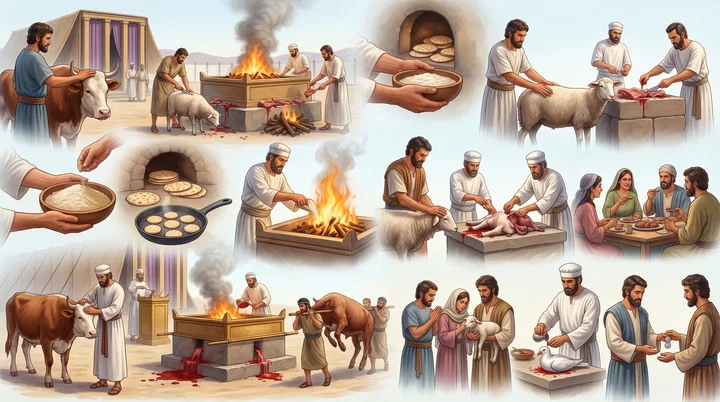
Cross-references
- Leviticus 2:13-16
And every oblation of thy meat offering shalt thou season with salt; neither shalt thou suffer the salt of the covenant of thy God to be lacking from thy meat offering: with all thine offerings thou shalt offer salt.
These verses describe other forms of the meat offering.
- Numbers 28:5
And a tenth part of an ephah of flour for a meat offering, mingled with the fourth part of an hin of beaten oil.
The daily offering includes a flour offering mingled with oil.
- Hebrews 10:1
For the law having a shadow of good things to come, and not the very image of the things, can never with those sacrifices which they offered year by year continually make the comers thereunto perfect.
The offerings are described as shadows pointing to Christ.
Commentary
Each commentary is drawn from primary sources: the writings of Ellen G. White and Adventist pioneers and periodicals. Each commentary is separate. Its own words are not a quotation; follow the references to read the source passages.
Ellen G. White
1 source
The oblation is a food offering prepared from fine flour combined with oil.CTBH 169.5 The term meat in this connection does not signify animal flesh.CTBH 169.5 It signifies food in the older sense of the word.CTBH 169.5
Sources
Pioneers and periodicals
13 sources
An oblation baked in the fryingpan was to be made of fine flour with oil, prepared by frying as well as baking.RH Jul 22, 1902ST May 29, 1901ST May 29, 1901 Here “meat” means food such as grain, flour, and oil, not only animal flesh.RH Jul 22, 1902ST Apr 8, 1875RH Aug 1, 1871 It belongs to the instructions for the meat offering in Leviticus 2, part of the various offerings in Leviticus 1-7 that formed the earthly sanctuary’s object lesson about God’s way.ST Jun 19, 1907ST Feb 3, 1909 Like every one of those sacrifices, it holds something in type concerning the work of Jesus Christ, pointing to Him and His priestly work in the heavenly sanctuary.ST Jun 19, 1907ST Feb 3, 1909ST Feb 13, 1912 Brought by individuals as expressions of faith in the coming Redeemer, such offerings when offered in faith represented the transfer of the penitent’s sins to the sanctuary, belonging to individual atonement for the forgiveness of sins.STST Apr 2, 1912RH Sep 16, 1852
Words and Sanctuary Setting
An oblation baked in the fryingpan was to be made of fine flour with oil, prepared by frying as well as baking.RH Jul 22, 1902ST May 29, 1901ST May 29, 1901 Meat offerings usually consisted of fine flour mixed with oil and sometimes green ears of corn.RH Jul 22, 1902 They could also be presented as cakes made from the same material, salted and anointed with oil.ST May 29, 1901 In this verse “meat” means food such as grain, flour, and oil, not only animal flesh.RH Jul 22, 1902ST Apr 8, 1875RH Aug 1, 1871RH Mar 4, 1875
It is one of the particular offerings that individuals presented during the year as part of the daily ministration.RH Mar 8, 1870ST Apr 2, 1912 Its meal and oil continually brought the people’s offerings together in worship.ST Apr 2, 1912 It belongs to the instructions for the meat offering in Leviticus 2.ST Jun 19, 1907ST Feb 3, 1909 That chapter is part of the various offerings in Leviticus 1-7 that formed the earthly sanctuary’s object lesson about God’s way.ST Jun 19, 1907ST Feb 3, 1909
Atonement and Christ Typified
The frying-pan oblation belongs to the instructions for the meat offering in Leviticus 2, within the various offerings of Leviticus 1-7 that formed the earthly sanctuary's object lesson about God's way.ST Jun 19, 1907ST Feb 3, 1909 Like every one of those different kinds of sacrifices it holds something in type concerning the work of Jesus Christ, pointing to Him and His priestly work in the heavenly sanctuary.ST Jun 19, 1907ST Feb 3, 1909ST Feb 13, 1912 These types showed that God hates sin and that sin demanded a penalty.ST Feb 3, 1909
They were offerings brought by individuals as expressions of faith in the coming Redeemer.ST Apr 2, 1912 When offered in faith they represented the transfer of the penitent's sins to the sanctuary through the sacrifice's blood or the priest's person, while the meal and oil offered with the sacrifices were part of the daily service that continually brought the people's offerings together in worship.STST Apr 2, 1912 The meat offering belongs in this way to individual atonement for the forgiveness of sins, made for a single person, or for the whole congregation when collectively guilty of some sin.RH Sep 16, 1852
Sources