Leviticus 3:4
And the two kidneys, and the fat that is on them, which is by the flanks, and the caul above the liver, with the kidneys, it shall he take away.
Translations
And the two kidneys, and the fat that is on them, which is by the flanks, and the lobe above the liver, with the kidneys, it shall he take away.
King James Version, Webster Bible
And the two kidneys, and the fat that is on them, which is by the flanks, and the caul above the liver, with the kidneys, it shall he take away.
and the two kidneys, and the fat that is on them, which is by the flanks, and the caul above the liver, with the kidneys, it shall he take away.
Revised Version, American Standard Version
and the two kidneys, and the fat that is on them, which is by the loins, and the caul upon the liver, with the kidneys, shall he take away.
and the two kidneys, and the fat which [is] on them, which [is] on the flanks, and the redundance above the liver, (beside the kidneys he doth turn it aside),
and the two kidneys, and the fat that is on them, which is by the flanks, and the net above the liver which he shall take away as far as the kidneys;
and the two kidneys, and the fat which is upon them, which is upon the loins,—and the caul upon the liver, upon the kidneys, shall he remove it.
Berean Standard Bible, Majority Standard Bible
both kidneys with the fat on them near the loins, and the lobe of the liver, which he is to remove with the kidneys.
and the two kidneys, and the fat that is on them, which is by the loins, and the cover on the liver, with the kidneys, he shall take away.
And the two kidneys, and the fat on them, which is by the top part of the legs, and the fat joining the liver and the kidneys, he is to take away;
He shall also take away the two kidneis, and the fat that is on them, and vpon the flankes, and the kall on the liuer with the kidneis.
Douay-Rheims (Challoner revision)
The two kidneys with the fat wherewith the flanks are covered, and the caul of the liver with the two little kidneys.
Pictures
Cross-references
- Leviticus 7:31-34
And the priest shall burn the fat upon the altar: but the breast shall be Aaron’s and his sons’.
Specifies the portions of peace offerings given to the priests.
- Exodus 29:13
And thou shalt take all the fat that covereth the inwards, and the caul that is above the liver, and the two kidneys, and the fat that is upon them, and burn them upon the altar.
Both describe the sacrificial fat and organs taken for burning on the altar.
- Hebrews 10:1
For the law having a shadow of good things to come, and not the very image of the things, can never with those sacrifices which they offered year by year continually make the comers thereunto perfect.
The offerings are shadows of good things to come, whose substance is Christ.
- Hebrews 10:3-4
But in those sacrifices there is a remembrance again made of sins every year.
Repeated animal sacrifices recalled sins but could not remove them.
Commentary
Each commentary is drawn from primary sources: the writings of Ellen G. White and Adventist pioneers and periodicals. Each commentary is separate. Its own words are not a quotation; follow the references to read the source passages.
Ellen G. White
3 sources
Leviticus 3:4 belongs to God's exact and minute directions for the peace offering within the sacrificial ceremonial system.ST Jul 15, 1880ST Jul 20, 1882ST Oct 14, 1913 Peace offerings were thanksgiving offerings brought in great numbers when the people assembled at the annual feasts.ST Oct 14, 1913 The fat with the two kidneys and the caul above the liver was to be taken away and burned on the altar as an offering to God Himself, and was never to be eaten.ST Oct 14, 1913 The breast and the right shoulder with some minor parts were given to the priest as his rightful share, and the remainder was eaten by those who brought the offering in a sacred feast.ST Jul 20, 1882ST Oct 14, 1913
The offering was presented with prayer for God's acceptance and blessing, and when properly conducted it fostered true devotion, piety, kindness, and sympathy rather than mere ceremony or self-gratification.ST Jul 20, 1882 The prescribed parts and the act of offering were not meaningless forms but pointed to the Saviour who would bear the world's sins and die for its redemption as the great Sacrifice that would take away sin.ST Jul 15, 1880ST Oct 14, 1913 Hophni and Phinehas violated this law by not being content with their rightful share, sending servants to demand flesh before the fat had been separated, and taking it by force with the fat when the offerer asked that the fat first be burned, thereby robbing the people of their rightful share and letting appetite, selfishness, and avarice triumph at a time when hearts should have been directed in penitence and faith to the great Sacrifice.ST Oct 14, 1913
Sources
Pioneers and periodicals
17 sources
The verse requires the kidneys with the fat on them by the flanks and the covering over the liver to be removed and burned on the altar as a fire offering of sweet savor to the Lord.ST Jun 5, 1901ST Jun 5, 1901ST Sep 19, 1900 That specified fat belongs to God and is never to be eaten, while the fat of ordinary meat eaten as food is not included in the prohibition.ST Oct 14, 1913ST Jun 20, 1911 It belongs to the daily service for the individual sinner, who brought a blameless victim, laid the hand upon it to transfer guilt, and saw it slain in his place while its blood carried that guilt into the sanctuary.RH Feb 3, 1853 Those prescribed acts were no empty forms, but shadows demanding the penalty for sin and fulfilled in Jesus Christ, who bore the sins of the world and died for its redemption.ST Jul 15, 1880ST Feb 3, 1909ST Nov 28, 1895 The peace offering followed acceptance and pardon, so that peace was found in renewed consecration to God's service, and the separating of the fat pictures the living word dividing between the person and sin.ST Sep 19, 1900RH Aug 20, 1901
Peace Offering Procedure
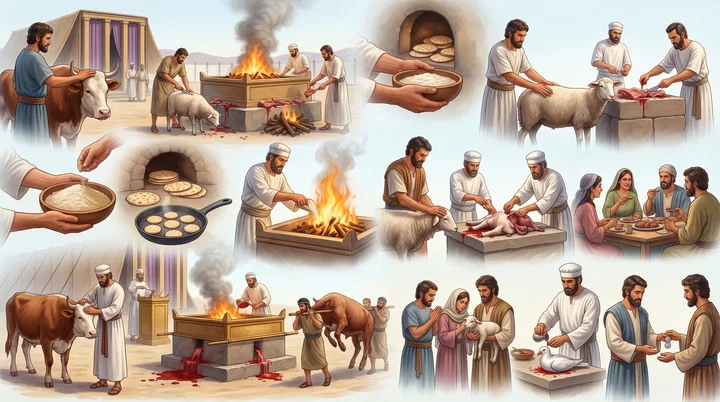
The two kidneys and the fat upon them by the flanks, with the caul above the liver taken away with the kidneys, were to be removed with the other fat and burned on the altar as an offering made by fire to the Lord, a sweet savor.ST Jun 5, 1901ST Jun 5, 1901ST Sep 19, 1900 In this the peace-offering was presented in nearly the same manner as other burnt-offerings.ST Jun 5, 1901 The animal represented the offerer and its life represented his life.ST Sep 19, 1900 It had to be without blemish, it was slain by the offerer himself, and its blood was sprinkled by the priest round about the altar.ST Sep 19, 1900
The offering was presented with prayer for God's acceptance and blessing.ST Jul 20, 1882 The portion reserved for the people was followed by a sacred feast.ST Jul 20, 1882 When properly conducted that service fostered true devotion and piety, with kindness and sympathy, rather than mere ceremony or self-gratification.ST Jul 20, 1882 Peace-offerings were exact and minute thanksgiving offerings, brought in great numbers when the people assembled at the annual feasts.ST Oct 14, 1913 The breast and the right shoulder with some minor parts were given to the priest as his rightful share, and the remainder was to be eaten by those who brought the offering.ST Oct 14, 1913
Hophni and Phinehas violated this law by not being content with their rightful share.ST Oct 14, 1913 They sent servants to demand flesh before the fat had been separated from it.ST Oct 14, 1913 When the offerer asked that the fat first be burned, they took it by force with the fat.ST Oct 14, 1913 By this they robbed the people of their rightful share.ST Oct 14, 1913 They let appetite, selfishness, and avarice triumph at the time when hearts should have been directed in penitence and faith to the great Sacrifice that would take away sin.ST Oct 14, 1913
The fat named here belongs to God Himself and was to be burned on the altar as an offering to Him, never to be eaten, as a type of the great Sacrifice.ST Oct 14, 1913ST Jun 20, 1911 The prohibition covers only that specified sacrificial fat from certain parts, not the regular fat of meat eaten as food, so favorable mentions of fatness elsewhere remain true.ST Jun 20, 1911 Even where fat is permitted, too much is injurious.ST Jun 20, 1911 Flesh meat is the poorest food for fatness, and sufficient fatness is available in milk, butter, grains, and fruits.ST Jun 20, 1911
Sin Transferred, Christ Foreshadowed
Leviticus 3:4 belongs to the instructions for individual offerings brought during the year as part of the daily ministration in the earthly sanctuary.RH Feb 3, 1853 A person who had sinned brought a victim and laid a hand on it to signify the transfer of sin to it.RH Feb 3, 1853RH Mar 28, 1854 The victim was then slain in the sinner's place because of the transgression.RH Mar 28, 1854 When offered in faith, its blood, borne by the priest into the sanctuary, represented the transfer of the penitent's guilt first to the victim and then to the sanctuary.RH Feb 3, 1853RH Mar 28, 1854ST
These directions belong to ceremonial laws instituted in consequence of sin.RH Jan 10, 1916 Their prescribed parts and acts were not meaningless forms.ST Jul 15, 1880 They were given to represent Christ's ministry and death.ST Jul 15, 1880
The offerings teach that sin demands its penalty, and they are shadows fulfilled in Jesus Christ.ST Feb 3, 1909 Every one of those sacrifices holds something in type concerning the work of Jesus Christ.ST Feb 13, 1912 They pointed to the Saviour who would bear the world's sins and die for its redemption.ST Jul 15, 1880 The yearly round of the Levitical sanctuary service typified Christ's ministry, which was offered once for all.ST Nov 28, 1895 They were brought by worshipers burdened with sin expressing faith in the Redeemer to come.ST Apr 2, 1912
The verse stands in Leviticus 1-4, which deal wholly with offerings whose types point largely to worship.ST Jan 31, 1911 They stand in God's order beginning with the burnt-offering and ending with the sin-offering.ST Jan 31, 1911 This is the reverse of the order in which sinners come to Him, beginning with the sin-offering and ending with the burnt-offering.ST Jan 31, 1911 Details such as fine flour, oil, frankincense, and a clean beast without blemish carry meaning to be noted.ST Jan 31, 1911
In the peace-offering the animal represented the offerer and its life represented his life.ST Sep 19, 1900 It had to be without blemish, was slain by the offerer, and its blood was sprinkled by the priest around the altar.ST Sep 19, 1900 Its fat and specified inward parts were removed and burned on the altar upon the burnt-offering.ST Sep 19, 1900 That burnt-offering followed the sinner's acceptance, pardon, and reconciliation through a sin-offering or trespass-offering.ST Sep 19, 1900 Thus the peace-offering came after renewed consecration of life to God's service, and peace was found in that consecrated service.ST Sep 19, 1900
The separation of the fat from the parts pictures full belief in the living and powerful word entering into the joints and marrow and into the thoughts and intents of the heart.RH Aug 20, 1901 In that picture the fat represents sin.RH Aug 20, 1901 The word so entering separates sin from the person, as the fat was separated from the animal.RH Aug 20, 1901
Sources