Leviticus 7:31
And the priest shall burn the fat upon the altar: but the breast shall be Aaron’s and his sons’.
Translations
And the priest shall burn the fat on the altar: but the breast shall be Aaron’s and his sons’.
King James Version, KJV Cambridge Paragraph Bible, Revised Version
And the priest shall burn the fat upon the altar: but the breast shall be Aaron’s and his sons’.
And the priest shall burn the fat upon the altar: but the breast shall be Aaron's and his sons'.
And the priest shall burn the fat upon the altar; but the breast shall be Aaron’s and his sons’.
'And the priest hath made perfume with the fat on the altar, and the breast hath been Aaron's and his sons;
And the priest shall burn the fat on the altar; and the breast shall be Aaron's and his sons'.
Then shall the priest make a perfume with the fat at the altar,—and the breast shall be for Aaron and for his sons.
Berean Standard Bible, Majority Standard Bible
The priest is to burn the fat on the altar, but the breast belongs to Aaron and his sons.
The priest shall burn the fat on the altar, but the breast shall be Aaron’s and his sons’.
And the fat is to be burned by the priest on the altar, but the breast is for Aaron and his sons.
Then the Priest shall burne the fatte vpon the Altar, and the breast shall be Aarons and his sonnes.
Douay-Rheims (Challoner revision)
Who shall burn the fat upon the altar, but the breast shall be Aaron’s and his sons’.
Pictures
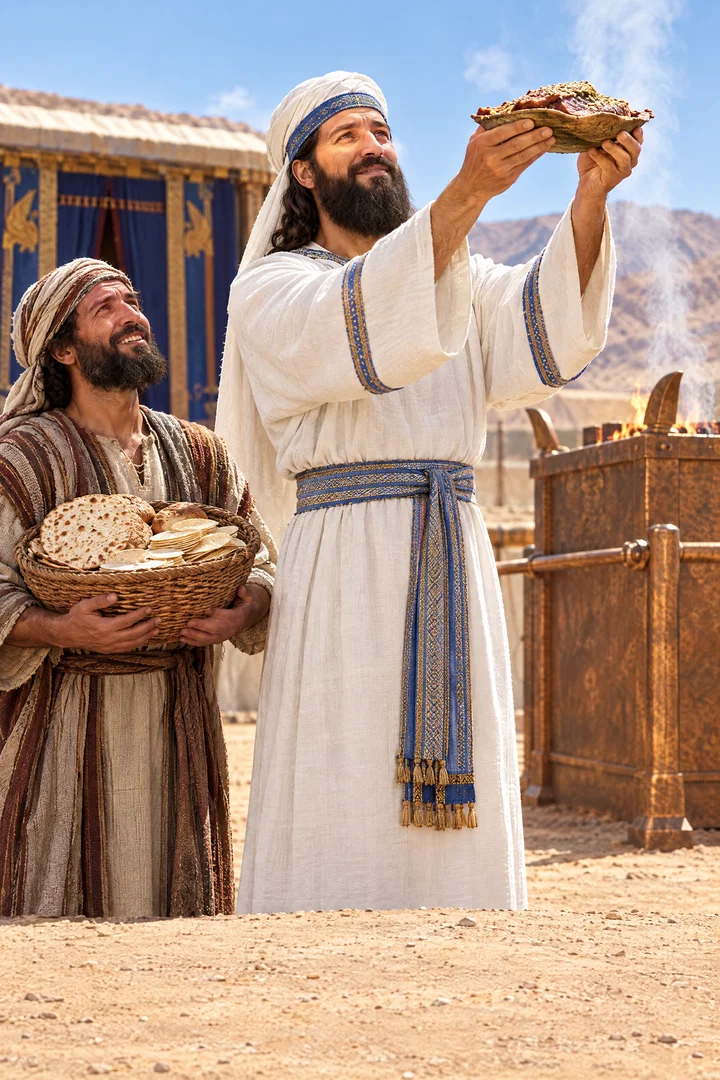
Cross-references
- Hebrews 8:3-5
For every high priest is ordained to offer gifts and sacrifices: wherefore it is of necessity that this man have somewhat also to offer.
Earthly priestly offerings serve as a pattern of Christ’s heavenly ministry.
- 1 Samuel 2:15-17
Also before they burnt the fat, the priest’s servant came, and said to the man that sacrificed, Give flesh to roast for the priest; for he will not have sodden flesh of thee, but raw.
Eli’s sons take sacrificial meat before the fat is burned, dishonoring the offering.
- Leviticus 10:14-15
And the wave breast and heave shoulder shall ye eat in a clean place; thou, and thy sons, and thy daughters with thee: for they be thy due, and thy sons’ due, which are given out of the sacrifices of peace offerings of the children of Israel.
Both assign the breast and other portions of offerings to the priests.
- Leviticus 3:16
And the priest shall burn them upon the altar: it is the food of the offering made by fire for a sweet savour: all the fat is the LORD’s.
The fat of the offering belongs to the Lord.
- Leviticus 7:23-25
Speak unto the children of Israel, saying, Ye shall eat no manner of fat, of ox, or of sheep, or of goat.
These verses prohibit eating animal fat.
- Deuteronomy 18:3-5
And this shall be the priest’s due from the people, from them that offer a sacrifice, whether it be ox or sheep; and they shall give unto the priest the shoulder, and the two cheeks, and the maw.
These verses describe portions due to the priests.
- Leviticus 3:17
It shall be a perpetual statute for your generations throughout all your dwellings, that ye eat neither fat nor blood.
The people are forbidden to eat fat.
- Leviticus 7:15-21
And the flesh of the sacrifice of his peace offerings for thanksgiving shall be eaten the same day that it is offered; he shall not leave any of it until the morning.
Both describe offerings from which portions could be eaten.
- 1 Samuel 9:23-24
And Samuel said unto the cook, Bring the portion which I gave thee, of which I said unto thee, Set it by thee.
Samuel gives Saul the shoulder portion of a peace offering.
- John 1:29
The next day John seeth Jesus coming unto him, and saith, Behold the Lamb of God, which taketh away the sin of the world.
The peace offering’s altar sacrifice points to the Lamb who takes away the world’s sin.
- Hebrews 9:11-12
But Christ being come an high priest of good things to come, by a greater and more perfect tabernacle, not made with hands, that is to say, not of this building;
Christ’s priestly ministry surpasses the earthly sacrificial ritual.
Commentary
Each commentary is drawn from primary sources: the writings of Ellen G. White and Adventist pioneers and periodicals. Each commentary is separate. Its own words are not a quotation; follow the references to read the source passages.
Ellen G. White
2 sources
The order laid down for the peace offering, which was especially an expression of thanksgiving to God, was that the fat alone was to be burned upon the altar to God, a specified portion including the breast belonged to Aaron and his sons, and the greater part was returned to the offerer to be eaten by him and his friends in a sacrificial feast.ST Oct 14, 1913PP 576.1–2 The fat had to be burned as an offering to God before the priests took their portion.ST Oct 14, 1913PP 576.1–2 The burning of the fat and the sacrifices were a type of the great Sacrifice, pointing forward to the death of Christ to take away the sin of the world, designed to preserve faith in the coming Redeemer and to direct all hearts to Him in gratitude and faith.ST Oct 14, 1913PP 576.1–2
Because of that solemn symbolic meaning, strict heed to the Lord's directions about the offering was of the greatest importance.PP 576.1–2 The sons of Eli did not realize the solemnity of the symbolic service but used it for self-indulgence.PP 576.1–2 Not content with the part allotted to them, they demanded an additional portion and whatever portion pleased them and refused to wait even until the fat had been burned as an offering to God.ST Oct 14, 1913PP 576.1–2 They threatened to take it by violence if denied and took it by force beforehand, using the great number of sacrifices at the annual feasts to enrich themselves at the expense of the people, which violated God's directions and robbed the offerers of their rightful share.ST Oct 14, 1913PP 576.1–2
Sources
Pioneers and periodicals
17 sources
The verse lays out the order for an individual peace-offering in which the offerer removed all the fat and gave it to the priest to burn on the altar over the burnt-offering, while the breast went to Aaron and his sons and the remainder belonged to those who brought it.ST Oct 14, 1913RH Feb 25, 1904ST Sep 19, 1900 The fat had to be burned before the priests received their share, and the peace-offering came after the offerings by which the repentant person was pardoned and reconciled, with the burnt-offering beneath its fat signifying a renewed life consecrated to God's service.ST Oct 14, 1913STST Sep 19, 1900 It belongs to the ceremonial law instituted because of sin, and its offerings were types pointing to Jesus, showing that sin required a penalty and expressing faith in the Redeemer to come.ST Feb 7, 1911RH Jan 10, 1916ST Feb 3, 1909ST Apr 2, 1912 The fat belonged to the Lord as a sweet savor in which sin was destroyed apart from the sinner, typifying Christ's sacrifice at Calvary, while the priests' eating of their appointed portions represented Christ bearing sin for humanity in His priestly ministry in the heavenly sanctuary accomplished once for all.ST Apr 6, 1888ST Dec 1, 1881ST Oct 14, 1913RH Feb 25, 1904RH Jun 13, 1912 Seizing the portion meant for the altar or demanding it before it was offered violates God's direction, empties the offering of its sacred meaning as a type of Christ's sacrifice and robs the offerers of their share, whereas the breast given to the priests points to the Lord carrying His people close to Him in comfort and, with the right shoulder, to the strength, guidance and never-ending peace given to all who entrust their affairs to Christ.ST Apr 6, 1888ST Dec 1, 1881ST Oct 14, 1913RH Jun 13, 1912RH Jun 6, 1912
Peace Offering Procedure
The procedure belongs to the individual offerings set out in the first seven chapters of Leviticus, which formed part of the priests' daily ministration in the earthly sanctuary.RH Feb 3, 1853ST In that order the fat of the sacrifice was to be burned upon the altar and the breast was to be Aaron's and his sons'.RH Feb 3, 1853ST
The sinner removed all the fat and handed it to the priest, who burned it on the altar over the burnt-offering.RH Feb 25, 1904ST Sep 19, 1900 The breast was assigned to Aaron and his sons, while the rest of the offering belonged to those who brought it.ST Oct 14, 1913RH Feb 25, 1904 The burning of the fat was a sweet savor to the Lord.RH Feb 25, 1904
The fat had to be burned before the priests took their portion.ST Oct 14, 1913 The peace-offering followed the offerings by which the repentant person was pardoned and reconciled to God.ST Sep 19, 1900 The burnt-offering upon which its fat was burned signified a renewed life consecrated to God's service.ST Sep 19, 1900
Israel's offerings cost the offerer something, with the cost varying according to wealth or position.ST Aug 16, 1883 They could include grain or wine.RH Mar 31, 1868 When they included meat, the meat was lean and came from young, healthy animals.RH Mar 31, 1868
Type of Christ's Ministry
Leviticus 7:31 belongs to the ceremonial law, not the moral law, having been instituted in consequence of sin.RH Jan 10, 1916 It stands among the laws concerning sacrifices and offerings and the instructions for Israel's offerings brought in the sanctuary, and every detail has meaning.ST Feb 7, 1911ST Feb 3, 1909ST Apr 2, 1912 Their fuller meaning is found in the sacrifice, life, and work of Jesus Christ, for the offerings were types pointing to Jesus, showing that sin required a penalty and expressing faith in the Redeemer who was to come.ST Feb 7, 1911ST Feb 3, 1909ST Apr 2, 1912
The sinner removed all the fat of the sacrifice and handed it to the priest to be burned on the altar, while the breast was assigned to Aaron and his sons.RH Feb 25, 1904RH Jun 13, 1912 That burning was a sweet savor to the Lord and represented sin being destroyed without the sinner, sin that is to be burned away.RH Feb 25, 1904RH Jun 13, 1912 The fat thus burned belonged to the Lord and was a type of the great Sacrifice, representing Christ's sacrifice at Calvary, while the priests' eating of their allotted portions represented Christ bearing sin for humanity in the heavenly sanctuary.ST Apr 6, 1888ST Dec 1, 1881ST Oct 14, 1913 To take that altar portion by force before it was offered deprived the offering of its sacred meaning and obscured its meaning as a type of Christ's sacrifice.ST Apr 6, 1888ST Dec 1, 1881
This division of fat to the altar and breast to Aaron and his sons, with the rest belonging to those who brought it, was one of the features of the earthly sanctuary service and of its yearly service.ST Oct 14, 1913ST Jun 19, 1907ST Nov 28, 1895 Those offerings and priestly duties typified Christ's priestly ministry in the heavenly sanctuary, a ministry accomplished once for all.ST Jun 19, 1907ST Nov 28, 1895 When the individual offerings described in the first seven chapters of Leviticus were offered in faith, with the fat burned upon the altar and the breast given to Aaron and his sons, the offering transferred in figure through the blood of the sacrifice or the person of the priest the sins of the penitent to the sanctuary.ST When the blood was sprinkled upon the altar before the ark, the forgiven sins were left there in figure, where they accumulated through the daily work of the year until cleansed on the tenth day of the seventh month.ST
Warnings and Present Comfort
The fat of the offering was to be burned on the altar for the Lord, while the breast was assigned to Aaron and his sons, and the priests' permitted share was strictly limited by that division.RH Mar 31, 1868 The provision allowed offerings of grain or wine, and when meat was offered it was lean meat from young, healthy animals, so it gave no authorization for eating fat or diseased meat.RH Mar 31, 1868
The fat belonged to the Lord and was to be burned on the altar before the priests took their portion, with the breast belonging to Aaron and his sons as their allotted share and the rest belonging to those who brought the offering.ST Dec 1, 1881ST Oct 14, 1913 The altar portion was a type of the great Sacrifice at Calvary, while the priests' eating of their allotted portions represented Christ bearing sin for humanity in the heavenly sanctuary.ST Apr 6, 1888 To take by force the portion meant for the altar, or to demand and take it before it was offered, violated God's explicit directions, deprived the offering of its sacred meaning and obscured its meaning as a type of Christ's sacrifice, and robbed the offerers of their rightful share.ST Apr 6, 1888ST Dec 1, 1881ST Oct 14, 1913
The burning of the fat represented sin that is to be burned away, while the giving of the breast to Aaron and his sons points to the Lord carrying His people close to Him, as a shepherd carries lambs in his bosom.RH Jun 13, 1912 The antitype of the breast is the comfort received by every trusting child of God from Christ.RH Jun 6, 1912 The related portion of the right shoulder points to strength and blessing, so that those who entrust the control of their affairs to Christ receive His guidance and never-ending peace.RH Jun 6, 1912
Sources