Leviticus 3:5
And Aaron’s sons shall burn it on the altar upon the burnt sacrifice, which is upon the wood that is on the fire: it is an offering made by fire, of a sweet savour unto the LORD.
Translations
And Aaron’s sons shall burn it on the altar on the burnt sacrifice, which is on the wood that is on the fire: it is an offering made by fire, of a sweet smell to the LORD.
And Aaron’s sons shall burn it on the altar upon the burnt sacrifice, which is upon the wood that is on the fire: it is an offering made by fire, of a sweet savour unto the LORD.
And Aaron’s sons shall burn it on the altar upon the burnt sacrifice, which is upon the wood that is on the fire: it is an offering made by fire, of a sweet savour unto the Lord.
And Aaron's sons shall burn it on the altar, upon the burnt-sacrifice which is upon the wood that is on the fire: it is an offering made by fire, of a sweet savor to the LORD.
And Aaron’s sons shall burn it on the altar upon the burnt offering, which is upon the wood that is on the fire: it is an offering made by fire, of a sweet savour unto the LORD.
And Aaron’s sons shall burn it on the altar upon the burnt-offering, which is upon the wood that is on the fire: it is an offering made by fire, of a sweet savor unto Jehovah.
and sons of Aaron have made it a perfume on the altar, on the burnt-offering which [is] on the wood, which [is] on the fire — a fire-offering of sweet fragrance to Jehovah.
and Aaron's sons shall burn it on the altar upon the burnt-offering which [lieth] on the wood that is upon the fire: [ it is] an offering by fire to Jehovah of a sweet odour.
Then shall the sons of Aaron make thereof a perfume at the altar, upon the ascending-sacrifice which is on the wood, which is on the fire,—an altar-flame of a satisfying odour unto Yahweh.
Then Aaron’s sons are to burn it on the altar atop the burnt offering that is on the burning wood, as an offering made by fire, a pleasing aroma to the LORD.
Then Aaron’s sons are to burn it on the altar atop the burnt offering that is on the burning wood, as a food offering, a pleasing aroma to the LORD.
Aaron’s sons shall burn it on the altar on the burnt offering, which is on the wood that is on the fire: it is an offering made by fire, of a pleasant aroma to the LORD.
That it may be burned by Aaron's sons on the altar, on the burned offering which is on the wood on the fire: it is an offering made by fire of a sweet smell to the Lord.
And Aarons sonnes shall burne it on the altar, with the burnt offering, which is vpon the wood, that is on the fire: this is a sacrifice made by fire for a sweete sauour vnto the Lord.
Douay-Rheims (Challoner revision)
And they shall burn them upon the altar, for a holocaust, putting fire under the wood: for an oblation of most sweet savour to the Lord.
Pictures
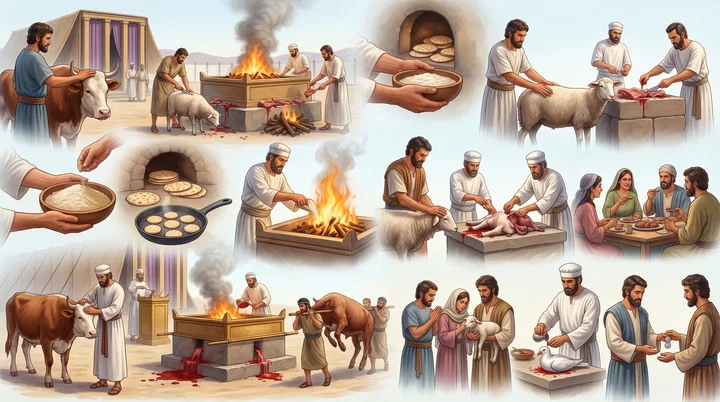
Cross-references
- Leviticus 1:3
If his offering be a burnt sacrifice of the herd, let him offer a male without blemish: he shall offer it of his own voluntary will at the door of the tabernacle of the congregation before the LORD.
Both describe an individual bringing an animal offering for sacrifice.
- Numbers 28:3-8
And thou shalt say unto them, This is the offering made by fire which ye shall offer unto the LORD; two lambs of the first year without spot day by day, for a continual burnt offering.
Details the continual burnt offerings in the daily service.
- Hebrews 8:3-5
For every high priest is ordained to offer gifts and sacrifices: wherefore it is of necessity that this man have somewhat also to offer.
Earthly sacrifices and sanctuary service are patterns of Christ’s heavenly ministry.
- Leviticus 23:27-29
Also on the tenth day of this seventh month there shall be a day of atonement: it shall be an holy convocation unto you; and ye shall afflict your souls, and offer an offering made by fire unto the LORD.
The offering made by fire belongs to the appointed Day of Atonement and its cleansing service.
- Leviticus 2:9
And the priest shall take from the meat offering a memorial thereof, and shall burn it upon the altar: it is an offering made by fire, of a sweet savour unto the LORD.
Cited alongside it for the rules of burning an offering on the altar.
- Leviticus 1:9
But his inwards and his legs shall he wash in water: and the priest shall burn all on the altar, to be a burnt sacrifice, an offering made by fire, of a sweet savour unto the LORD.
The burnt offering lies beneath the peace offering on the altar.
- Leviticus 3:16
And the priest shall burn them upon the altar: it is the food of the offering made by fire for a sweet savour: all the fat is the LORD’s.
Cited alongside it in the law of burning on the altar.
- Exodus 29:13
And thou shalt take all the fat that covereth the inwards, and the caul that is above the liver, and the two kidneys, and the fat that is upon them, and burn them upon the altar.
Both describe sacrificial fat burned on the altar as belonging to God.
- Leviticus 2:16
And the priest shall burn the memorial of it, part of the beaten corn thereof, and part of the oil thereof, with all the frankincense thereof: it is an offering made by fire unto the LORD.
Cited alongside it for the rules of burning an offering on the altar.
- Leviticus 4:10
As it was taken off from the bullock of the sacrifice of peace offerings: and the priest shall burn them upon the altar of the burnt offering.
Both describe priests burning sacrificial portions on the altar.
- Leviticus 1:5
And he shall kill the bullock before the LORD: and the priests, Aaron’s sons, shall bring the blood, and sprinkle the blood round about upon the altar that is by the door of the tabernacle of the congregation.
Both describe the law governing altar sacrifices.
- Hebrews 10:3-4
But in those sacrifices there is a remembrance again made of sins every year.
Animal sacrifices recalled sin but could not remove it.
- Hebrews 9:23-28
It was therefore necessary that the patterns of things in the heavens should be purified with these; but the heavenly things themselves with better sacrifices than these.
The altar’s sacrificial pattern points to Christ’s sacrifice and heavenly work.
- Leviticus 3:13
And he shall lay his hand upon the head of it, and kill it before the tabernacle of the congregation: and the sons of Aaron shall sprinkle the blood thereof upon the altar round about.
The sons of Aaron sprinkle the offering’s blood on the altar, where its parts are burned.
- Hebrews 9:11-12
But Christ being come an high priest of good things to come, by a greater and more perfect tabernacle, not made with hands, that is to say, not of this building;
Christ’s once-for-all priestly ministry surpasses the repeated earthly offerings.
- Leviticus 1:4
And he shall put his hand upon the head of the burnt offering; and it shall be accepted for him to make atonement for him.
Describes laying a hand on the offering’s head.
Commentary
Each commentary is drawn from primary sources: the writings of Ellen G. White and Adventist pioneers and periodicals. Each commentary is separate. Its own words are not a quotation; follow the references to read the source passages.
Ellen G. White
3 sources
Leviticus 3:5 belongs to the instructions for the peace offering within the sacrificial system given to Israel.ST Jul 15, 1880ST Jul 20, 1882 Peace offerings were an expression of thanksgiving to God and were presented in great numbers when the people assembled at the annual feasts.ST Oct 14, 1913 The offering was presented to the Lord with prayer for acceptance and blessing, with a portion set aside for a sacred shared meal.ST Oct 14, 1913ST Jul 20, 1882 In that meal the priest received the breast and the right shoulder with some minor parts, and those who brought the offering ate the remainder.ST Oct 14, 1913
The fat was to be separated first and burned on the altar as an offering to God Himself and never eaten, before the priest took what he desired.ST Oct 14, 1913 The directions were made most exact because appetite and covetous desire for gain could lead a priest to appropriate what was solemnly devoted to the Lord.ST Oct 14, 1913 This is what Hophni and Phinehas did by taking flesh by force before the fat had been separated.ST Oct 14, 1913
The outward ritual was not a meaningless form but was designed to point beyond itself to Christ's ministry and death as the great Sacrifice that would take away the sins of the world.ST Jul 15, 1880ST Oct 14, 1913 Properly observed, this worship encouraged genuine devotion, kindness, and sympathy rather than mere ceremony or self-gratification.ST Jul 20, 1882
Sources
Pioneers and periodicals
21 sources
The priests were to burn the fat and appointed portions of the peace offering on the altar on top of the burnt offering already lying on the wood in the fire, as a fire offering pleasing to the Lord.ST Jun 5, 1901ST Jun 5, 1901RH Mar 28, 1854 That fat belonged to God Himself and was to be wholly burned to Him and never eaten.ST Oct 14, 1913ST Jun 20, 1911 The rite belonged to the ceremonial law given because of sin, whose outward forms were designed to point beyond themselves to Christ's death and ministry.ST Jul 15, 1880RH Jan 10, 1916 The offerings taught that sin demands a penalty, and brought in faith in the coming Redeemer they were types of Christ and His priesthood in the heavenly sanctuary, with the worshiper laying a hand on the victim to transfer sin whose guilt its blood then carried into the sanctuary.RH Feb 3, 1853ST Feb 3, 1909ST Nov 28, 1895 Burning the peace offering upon the burnt offering pictures peace following pardon and reconciliation, when the forgiven sinner consecrates a renewed life to God's service and finds rest in freely giving that life in loving service to others.ST Sep 19, 1900ST Sep 19, 1900
Ritual Procedure and Setting
Aaron's sons, the priests, burned the prescribed portions and fat of the peace offering on the altar upon the burnt sacrifice already laid on the wood that is on the fire, as an offering made by fire of a sweet savor pleasing to the Lord.ST Jun 5, 1901ST Jun 5, 1901ST Feb 3, 1909ST May 6, 1886ST Sep 19, 1900 The peace offering was presented at the altar in nearly the same manner as a burnt offering, its portions laid over the regular burnt offering and the wood fire to be burned there.ST Jun 5, 1901RH Mar 28, 1854ST Feb 3, 1909 This was part of the law governing sacrifices offered through the Levitical priests at the lawful altar.ST May 6, 1886
The verse stands in the first four chapters of Leviticus, which deal wholly with offerings whose types point largely to worship.ST Jan 31, 1911 The book is named Vayyikra, meaning And He called, and is called Leviticus because much of its instruction pertained to the priestly tribe Levi.ST Jan 31, 1911 It belongs to the instructions prescribing the individual offerings brought by the people during the year as part of the earthly sanctuary's priestly service, including the burnt offering of chapter 1, the meat offering of chapter 2, the peace offering of chapter 3, the sin offering of chapter 4, and the trespass offering of chapter 5.RH Mar 8, 1870RH Sep 16, 1852 In these the victim was slain because of transgression, and its blood was carried by the priest into the sanctuary, transferring the worshiper's sin to the sanctuary.RH Mar 28, 1854 God sets forth the burnt offering first and the sin offering last, while sinners coming to Him begin with the sin offering and end with the burnt offering.ST Jan 31, 1911 The details of the offerings, the fine flour, the oil, the frankincense, and the clean beast without blemish, all carry meaning to be noted.ST Jan 31, 1911
The fat of the peace offering belonged to God Himself and was to be burned to Him and never eaten.ST Oct 14, 1913 The prohibition applies to certain fat of certain parts of beasts offered in sacrifice, and does not forbid the regular fat of meat used for food.ST Jun 20, 1911 The peace offerings were expressions of thanksgiving presented in great numbers when the people assembled at the annual feasts.ST Oct 14, 1913 They were presented with prayer for acceptance and blessing, while a portion was set aside for the people to share in a sacred meal.ST Oct 14, 1913ST Jul 20, 1882 A specified portion, the breast and the right shoulder with some minor parts, was given to the priest as his share, and the remainder was to be eaten by those who brought the offering, with the fat first separated and presently burned before the priest took what he desired.ST Oct 14, 1913 Properly observed with its shared meal, this worship encouraged genuine devotion, kindness, and sympathy rather than mere ceremony or self-gratification.ST Jul 20, 1882 The most exact directions were given because appetite and covetous desire for gain might lead the priest to appropriate sacrifices solemnly devoted to the Lord, as Hophni and Phinehas did by taking flesh by force before the fat had been separated.ST Oct 14, 1913
Atonement and Christian Meaning
This belongs to the ceremonial law instituted in consequence of sin, which Christ gave to Israel.ST Jul 15, 1880RH Jan 10, 1916 Its outward ritual was designed to point beyond itself to Christ's ministry and death, not to be a meaningless form.ST Jul 15, 1880RH Jan 10, 1916
It belongs to the individual atonement made for a single person, or for the whole congregation when collectively guilty of some sin, for the forgiveness of sins.RH Feb 3, 1853RH Sep 16, 1852 The worshiper laid a hand on the victim to signify the transfer of sin, the victim was slain because of the transgression, and its blood, used in the priest's ministry for the penitent, carried the sin and guilt into the sanctuary.RH Feb 3, 1853RH Mar 28, 1854RH Sep 16, 1852 An offering made in faith, together with the daily offering, represented the transfer of the penitent's sin to the sanctuary through the sacrifice's blood or the priest's ministry, where the sins were left in figure as forgiven sins until the yearly cleansing.ST The continual service through the year put some of the blood of the sin offering upon the horns of the altar of sweet incense before the Lord in the tabernacle of the congregation, representing the sinful life and sins of the sinner.RH Feb 19, 1901RH Mar 28, 1854 The morning and evening incense covered the altar of incense and the blood upon its horns, so that the sins were covered by the incense continually ascending before the Lord, whose fragrance extended far around the tabernacle.RH Feb 19, 1901
The offerings teach that sin demands a penalty and are shadows of their fulfillment in Jesus Christ.ST Feb 3, 1909ST Apr 2, 1912 Brought in faith in the Redeemer to come, they served as types of Christ and His priesthood in the heavenly sanctuary, and like every sacrifice in Leviticus 1-8 this contains something in type concerning the work of Jesus Christ, whose yearly services represented His once-for-all ministry.ST Feb 3, 1909ST Nov 28, 1895ST Apr 2, 1912ST Feb 13, 1912 The fat of the peace offering burned on the altar was a type of the great Sacrifice that would take away the sins of the world.ST Oct 14, 1913
The order of burning the peace offering upon the burnt offering pictures peace following pardon and reconciliation: after the sinner brought a sin offering or trespass offering and was accepted, the burnt offering represented a renewed life consecrated to God's service, and the peace offering was burned upon it.ST Sep 19, 1900 The peace offering burned on the burnt offering pictures peace found through freely giving one's life in loving service rather than seeking wealth, honor, or reward.ST Sep 19, 1900 The life is offered to God as a burnt offering, consumed in service to others by love, and this self-giving brings rest and peace without quarrels over its price or recompense.ST Sep 19, 1900 Properly observed with its shared meal, presented with prayer for acceptance and blessing, this worship encouraged genuine devotion, kindness, and sympathy rather than mere ceremony or self-gratification.ST Jul 20, 1882
Sources