Leviticus 7:14
And of it he shall offer one out of the whole oblation for an heave offering unto the LORD, and it shall be the priest’s that sprinkleth the blood of the peace offerings.
Translations
And of it he shall offer one out of the whole oblation for an heave offering to the LORD, and it shall be the priest’s that sprinkles the blood of the peace offerings.
And of it he shall offer one out of the whole oblation for an heave offering unto the LORD, and it shall be the priest’s that sprinkleth the blood of the peace offerings.
And of it he shall offer one out of the whole oblation for a heave offering unto the Lord, and it shall be the priest’s that sprinkleth the blood of the peace offerings.
And of it he shall offer one out of the whole oblation for a heave-offering to the LORD, and it shall be the priest's that sprinkleth the blood of the peace-offerings.
And of it he shall offer one out of each oblation for an heave offering unto the LORD; it shall be the priest’s that sprinkleth the blood of the peace offerings.
And of it he shall offer one out of each oblation for a heave-offering unto Jehovah; it shall be the priest’s that sprinkleth the blood of the peace-offerings.
and he hath brought near out of it one of the whole offering — a heave-offering to Jehovah; to the priest who is sprinkling the blood of the peace-offerings — it is his;
And of it he shall present one out of the whole offering as a heave-offering to Jehovah; to the priest that sprinkleth the blood of the peace-offering, to him it shall belong.
Then shall he bring near therefrom one of each oblation, a heave-offering unto Yahweh,—to the priest who dasheth [against the altar] the blood of the peace-offering—to him, shall it belong.
Berean Standard Bible, Majority Standard Bible
From the cakes he must present one portion of each offering as a contribution to the LORD. It belongs to the priest who sprinkles the blood of the peace offering.
Of it he shall offer one out of each offering for a heave offering to the LORD. It shall be the priest’s who sprinkles the blood of the peace offerings.
And let him give one out of every offering to be lifted up before the Lord; that it may be for the priest who puts the blood of the peace-offering on the altar.
And of all the sacrifice he shall offer one cake for an heaue offering vnto the Lord, and it shalbe the Priestes that sprinckleth the blood of the peace offrings.
Douay-Rheims (Challoner revision)
Of which one shall be offered to the Lord for firstfruits, and shall be the priest’s that shall pour out the blood of the victim.
Pictures
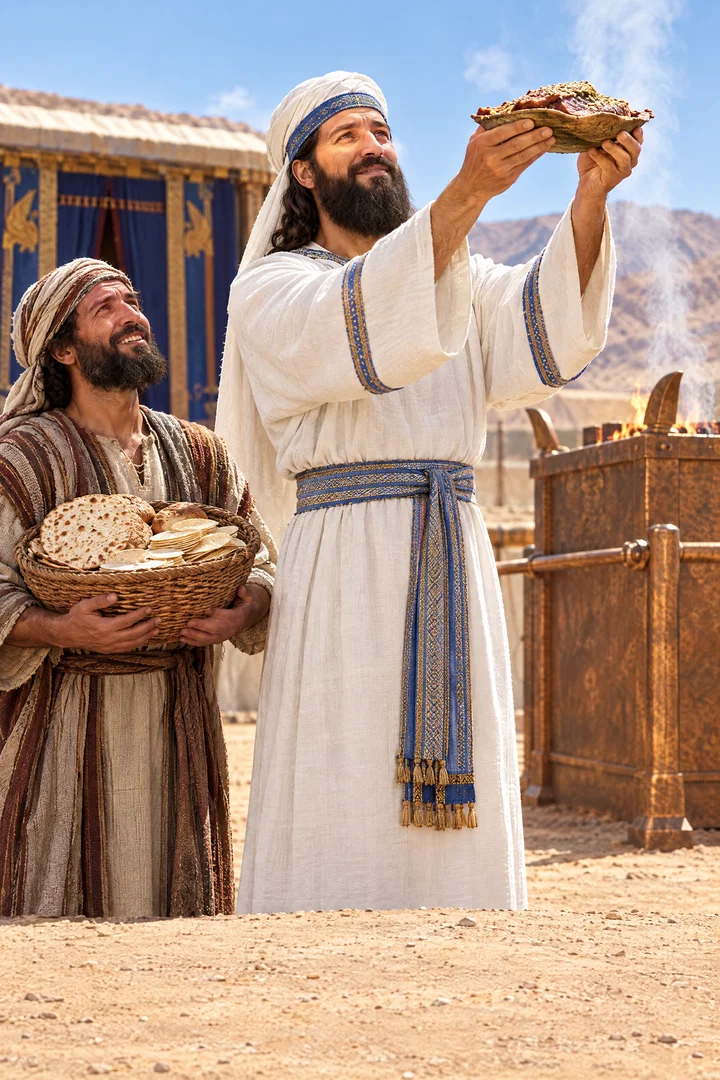
Cross-references
- Exodus 24:6
And Moses took half of the blood, and put it in basons; and half of the blood he sprinkled on the altar.
Both describe the priestly handling and sprinkling of sacrificial blood.
- Leviticus 3
And if his oblation be a sacrifice of peace offering, if he offer it of the herd; whether it be a male or female, he shall offer it without blemish before the LORD.
Both texts give instructions for peace offerings.
- Leviticus 1:5
And he shall kill the bullock before the LORD: and the priests, Aaron’s sons, shall bring the blood, and sprinkle the blood round about upon the altar that is by the door of the tabernacle of the congregation.
Both describe priests sprinkling sacrificial blood on the altar.
- 1 Samuel 2:13-16
And the priests’ custom with the people was, that, when any man offered sacrifice, the priest’s servant came, while the flesh was in seething, with a fleshhook of three teeth in his hand;
Eli’s sons took the priests’ portion unlawfully, contrary to the portion law.
- Hebrews 9:8-9
The Holy Ghost this signifying, that the way into the holiest of all was not yet made manifest, while as the first tabernacle was yet standing:
The earthly sanctuary service is presented as a type.
- Hebrews 9:12
Neither by the blood of goats and calves, but by his own blood he entered in once into the holy place, having obtained eternal redemption for us.
Christ’s once-for-all ministry contrasts with the repeated sanctuary service.
Commentary
Each commentary is drawn from primary sources: the writings of Ellen G. White and Adventist pioneers and periodicals. Each commentary is separate. Its own words are not a quotation; follow the references to read the source passages.
Ellen G. White
5 sources
Leviticus 7:14 belongs to the law of the peace offerings, which were especially an expression of thanksgiving and gratitude to God for His blessings.PP 576.1–25T 150.1 They were presented with prayer for His acceptance and blessing.ST Jul 20, 1882 They belonged to the Levitical system of required sacrificial offerings for religious service, through which Israel returned gifts to God and was reminded that property came from Him.4T 467.1–25T 150.1
In these offerings the fat alone was to be burned upon the altar, a certain specified portion was reserved for the priests, and the greater part was returned to the offerer.PP 576.1–2ST Oct 27, 1881 Part of the peace offering was thus set apart for the priest who sprinkled the blood, while the remaining portion was shared by the offerer.PP 576.1–2ST Oct 27, 1881 That portion reserved for the people was blessed before sharing, then eaten by the offerer with family and friends in a solemn, joyful, sacred, sacrificial feast.ST Jul 20, 1882PP 576.1–2ST Oct 27, 1881
The sacrifices pointed forward to the death of Christ and were designed to preserve in the hearts of the people faith in the Redeemer to come, directing all hearts in gratitude and faith to the great Sacrifice that was to take away the sin of the world.PP 576.1–2 For that reason the Lord's directions concerning them were to be strictly heeded in the most solemn manner.PP 576.1–2 When rightly conducted, such worship fostered true devotion, kindness, and sympathy rather than mere ceremony or self-gratification.ST Jul 20, 1882 The sons of Eli violated this law because they were not content with the part allotted them but demanded an additional portion and persisted in claiming whatever portion pleased them.PP 576.1–2 They refused to wait even until the fat had been burned as an offering to God, threatened to take meat by violence if denied, and used the great number of sacrifices at the annual feasts to enrich themselves at the expense of the people.PP 576.1–2
Sources
Pioneers and periodicals
21 sources
The verse requires that one cake out of the whole peace-offering oblation be lifted up as a heave offering to the Lord and given to the priest who sprinkles the blood, with sprinkling meaning to scatter the blood upon the altar, while what remains is eaten by the offerer with his family in a solemn joyful feast.RH Feb 3, 1916ST Feb 7, 1911ST Aug 14, 1901ST May 6, 1880 The peace offering so divided was an unblemished animal from herd or flock, slain by the bringer and offered with prayer and blessing, made as a thank offering, vow, covenant, voluntary or rejoicing offering that cost the worshiper according to his means.ST Jul 20, 1882ST Aug 16, 1883ST Sep 19, 1900RH Jun 6, 1912RH Feb 2, 1911 It belongs to the ceremonial law of sacrifices instituted because of sin, and with all the offerings it finds its fuller meaning as a shadow pointing to the sacrifice, life and priestly work of Jesus Christ.ST Feb 7, 1911RH Jan 10, 1916ST Feb 3, 1909ST Nov 28, 1895ST Feb 13, 1912 When offered in faith its blood figuratively transferred sin to the earthly sanctuary, where the priests in eating their portion bore the sins of the people before God, representing Christ's bearing of sin in the heavenly sanctuary and His sacrifice on Calvary.ST Apr 6, 1888ST Jun 19, 1907ST Nov 28, 1895ST The offering stands for the offerer and its life for his life, so abiding peace comes only after the sin or trespass offering by which the soul is pardoned and the burnt offering by which life is consecrated, and is then confessed before others in grateful testimony and holy living.ST Sep 22, 1914RH Jun 6, 1912ST Sep 19, 1900
Ritual Words and Procedure
The Hebrew word for the priest's act means to scatter, and here it denotes sprinkling, not dipping or immersing.ST May 6, 1880 One cake out of the whole oblation is to be offered as a heave offering to the Lord, and it becomes the property of the priest who sprinkles the blood of the peace offerings.RH Feb 3, 1916ST Feb 7, 1911RH Nov 23, 1911 What is left after the priest's portion has been made belongs to the offerer, who eats it with his family in a solemn and joyful meal.ST Oct 27, 1881ST Aug 14, 1901
The peace offering is brought as an unblemished animal from the herd or the flock.ST Sep 19, 1900RH Jun 6, 1912 It is slain by the one who brings it while the priest sprinkles its blood round about the altar of burnt offering, with stated portions of the meat eaten by the priests and all the fat burned on the altar upon the burnt offering.ST Sep 19, 1900 It is presented with prayer for God's acceptance and blessing, and the portion reserved for the people is blessed before they partake together of the sacred feast.ST Jul 20, 1882
Peace offerings are brought as thank offerings, as offerings confirming a vow or covenant, as voluntary and free-will offerings, and as offerings on occasions of special rejoicing.RH Jun 6, 1912RH Feb 2, 1911 Firstfruits, firstlings, and tithes were offered in peace offerings.RH Feb 2, 1911 They were used when the covenant with Israel was confirmed and when the ark was brought to Jerusalem.RH Jun 6, 1912 They cost the worshiper something according to wealth or position, for worship was not to cost nothing.ST Aug 16, 1883
The instruction belongs to the ceremonial law and not to the moral law, standing among the directions that distinguish the kinds and procedures of offerings.RH Feb 3, 1916RH Jan 10, 1916 The sacrificial system to which it belongs was instituted in consequence of sin and shows that sin demands a penalty.RH Jan 10, 1916ST Feb 3, 1909 It comprises individual offerings together with the daily offering in a daily, weekly, monthly, and yearly round of Levitical worship.ST Nov 28, 1895STRH Feb 2, 1911
Typology of Christ's Work
The laws of sacrifices and offerings find their fuller meaning in the sacrifice, life, and work of Jesus Christ.ST Feb 7, 1911ST Feb 3, 1909ST Feb 13, 1912 They are shadows pointing to Him, set in place because sin demands a penalty.ST Feb 7, 1911ST Feb 3, 1909 Each different kind of sacrifice teaches in type something distinct about His work.ST Feb 7, 1911ST Feb 13, 1912
The verse belongs to the service of the earthly sanctuary, which teaches God's way and serves as a pattern of Christ's priestly work in the heavenly sanctuary.ST Jun 19, 1907ST Nov 28, 1895 That service moved in a yearly round of Levitical worship which typified His ministry.ST Jun 19, 1907ST Nov 28, 1895 The yearly round culminated in the cleansing of the sanctuary, a work of judgment.ST Nov 28, 1895
When offered in faith, the blood of the individual offerings described in Leviticus 1-7, together with the daily offering, or the priest's ministry with it, figuratively transferred the penitent's sins to the sanctuary.ST Apr 6, 1888ST There the sins remained until the yearly cleansing.ST The priests' partaking of the sacrifice and bearing the people's sins before God represented Christ's work of bearing sins in the heavenly sanctuary and pointed to His sacrifice on Calvary.ST Apr 6, 1888 To take for themselves the portion meant for the altar dishonored that sacred sign and obscured its meaning.ST Apr 6, 1888
The offering stands for the offerer and its life for his life.ST Sep 19, 1900 Peace therefore comes only when a person willingly takes his own life and gives it freely to be sprinkled by the High Priest and used as He directs in the service of humanity.ST Sep 19, 1900 The peace offering must follow the sin offering or trespass offering by which the repentant soul is accepted, pardoned, and reconciled to God.ST Sep 19, 1900 It must also follow the burnt offering by which the renewed life is consecrated to God to be poured out and consumed in His service, with all the fat of the peace offering burned on the altar upon that consecrated offering.ST Sep 19, 1900 Even the continual morning and evening burnt offering gives no share of peace to the conscious trespasser until he brings his personal trespass offering, is reconciled, consecrates himself anew, and so finds peace, for there is no peace to the wicked while great peace belongs to those who love the law.ST Sep 19, 1900
As part of the instructions for the peace offering, the verse teaches how to obtain abiding peace from God.RH Jun 6, 1912
Thanksgiving and Holy Living
As part of the thanksgiving offering, the verse teaches that thanking God for freedom from sin is to be followed by confessing that blessing before others.ST Sep 22, 1914 That open confession stands as a model testimony to God's goodness and to the joy belonging to His child.ST Sep 22, 1914
Gratitude for abundance, such as a good harvest, is to be shown by freely giving God a thank offering from what He has provided rather than selfishly keeping it all.RH Nov 5, 1872 Peace offerings were made as free-will offerings, thank offerings, and offerings for vows, with first-fruits, firstlings, and tithes offered in peace offerings.RH Feb 2, 1911 The tithe is always the Lord's, the tenth of income reserved to Himself to be applied for the support of His ministers, as then so now, and all the sacrifices were offered by the priests in daily, weekly, monthly, and yearly services.RH Feb 2, 1911 The peace offering was presented with prayer for God's acceptance and blessing, and the portion reserved for the people was blessed before they shared the sacred feast.ST Jul 20, 1882 Such worship, when rightly conducted, fosters true devotion, kindness, and sympathy rather than mere ceremony or self-gratification.ST Jul 20, 1882
The peace offering must follow the sin offering or trespass offering by which the repentant soul is accepted, pardoned, and reconciled to God, and the burnt offering by which the renewed life is consecrated to be poured out and consumed in His service, with its fat burned upon that consecrated offering.ST Sep 19, 1900 Even the continual morning and evening burnt offering gives no share of peace to the conscious trespasser until he brings his personal trespass offering, is reconciled, and consecrates himself anew to find peace.ST Sep 19, 1900 For there is no peace to the wicked, while great peace belongs to those who love the law.ST Sep 19, 1900
Sources