Leviticus 1:5
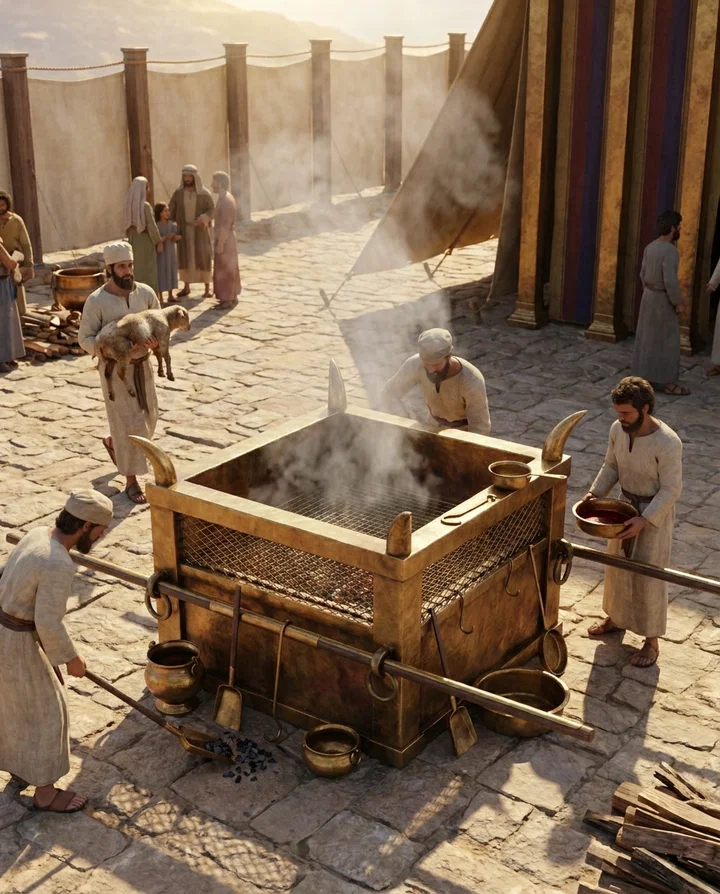
And he shall kill the bullock before the LORD: and the priests, Aaron’s sons, shall bring the blood, and sprinkle the blood round about upon the altar that is by the door of the tabernacle of the congregation.
Translations
And he shall kill the bullock before the LORD: and the priests, Aaron’s sons, shall bring the blood, and sprinkle the blood round about on the altar that is by the door of the tabernacle of the congregation.
And he shall kill the bullock before the LORD: and the priests, Aaron’s sons, shall bring the blood, and sprinkle the blood round about upon the altar that is by the door of the tabernacle of the congregation.
And he shall kill the bullock before the Lord: and the priests, Aaron’s sons, shall bring the blood, and sprinkle the blood round about upon the altar that is by the door of the tabernacle of the congregation.
And he shall kill the bullock before the LORD: and the priests, Aaron's sons, shall bring the blood, and sprinkle the blood around upon the altar that is by the door of the tabernacle of the congregation.
And he shall kill the bullock before the LORD: and Aaron’s sons, the priests, shall present the blood, and sprinkle the blood round about upon the altar that is at the door of the tent of meeting.
And he shall kill the bullock before Jehovah: and Aaron’s sons, the priests, shall present the blood, and sprinkle the blood round about upon the altar that is at the door of the tent of meeting.
and he hath slaughtered the son of the herd before Jehovah; and sons of Aaron, the priests, have brought the blood near, and sprinkled the blood on the altar round about, which [is] at the opening of the tent of meeting.
And he shall slaughter the bullock before Jehovah; and Aaron's sons, the priests, shall present the blood and sprinkle the blood round about on the altar that is at the entrance of the tent of meeting.
and he shall slay the young bullock before Yahweh,—and the sons of Aaron, the priests, shall bring near the blood, and shall dash the blood against the altar round about, [even the altar] that is at the entrance of the tent of meeting.
And he shall slaughter the young bull before the LORD, and Aaron’s sons the priests are to present the blood and sprinkle it on all sides of the altar at the entrance to the Tent of Meeting.
And he shall slaughter the young bull before the LORD, and Aaron’s sons the priests are to present the blood and splatter it on all sides of the altar at the entrance to the Tent of Meeting.
He shall kill the bull before the LORD. Aaron’s sons, the priests, shall present the blood and sprinkle the blood around on the altar that is at the door of the Tent of Meeting.
And the ox is to be put to death before the Lord: then Aaron's sons, the priests, are to take the blood and put some of it on and round the altar which is at the door of the Tent of meeting.
And he shall kill the bullocke before the Lord, and the Priestes Aarons sonnes shall offer the blood, and shall sprinckle it round about vpon the altar, that is by the doore of the Tabernacle of the Congregation.
Douay-Rheims (Challoner revision)
And he shall immolate the calf before the Lord, and the priests the sons of Aaron shall offer the blood thereof, pouring it round about the altar, which is before the door of the tabernacle.
Pictures
Cross-references 20 of 34
- Hebrews 8:5
Who serve unto the example and shadow of heavenly things, as Moses was admonished of God when he was about to make the tabernacle: for, See, saith he, that thou make all things according to the pattern shewed to thee in the mount.
Earthly priestly service is a shadow of heavenly things.
- Leviticus 3:2
And he shall lay his hand upon the head of his offering, and kill it at the door of the tabernacle of the congregation: and Aaron’s sons the priests shall sprinkle the blood upon the altar round about.
The offerer lays a hand on the victim before it is killed, and the blood is sprinkled on the altar.
- Leviticus 17:11
For the life of the flesh is in the blood: and I have given it to you upon the altar to make an atonement for your souls: for it is the blood that maketh an atonement for the soul.
Blood represents life and makes atonement in the offering.
- Hebrews 9:22
And almost all things are by the law purged with blood; and without shedding of blood is no remission.
Both texts show that remission requires shed blood.
- Hebrews 9:12
Neither by the blood of goats and calves, but by his own blood he entered in once into the holy place, having obtained eternal redemption for us.
Christ enters the holy places with his own blood.
- Hebrews 9:24
For Christ is not entered into the holy places made with hands, which are the figures of the true; but into heaven itself, now to appear in the presence of God for us:
Christ appears in God’s presence for us.
- Leviticus 17:14
For it is the life of all flesh; the blood of it is for the life thereof: therefore I said unto the children of Israel, Ye shall eat the blood of no manner of flesh: for the life of all flesh is the blood thereof: whosoever eateth it shall be cut off.
Identifies an animal’s blood with its life.
- Hebrews 13:11-12
For the bodies of those beasts, whose blood is brought into the sanctuary by the high priest for sin, are burned without the camp.
The earthly blood ritual is compared with Christ’s suffering outside the gate.
- Leviticus 4:6
And the priest shall dip his finger in the blood, and sprinkle of the blood seven times before the LORD, before the vail of the sanctuary.
The priest sprinkles sacrificial blood in the sanctuary.
- Hebrews 9:6-7
Now when these things were thus ordained, the priests went always into the first tabernacle, accomplishing the service of God.
Summarizes the priests’ continual service and blood offering in the sanctuary.
- Leviticus 1:10-13
And if his offering be of the flocks, namely, of the sheep, or of the goats, for a burnt sacrifice; he shall bring it a male without blemish.
Repeats the burnt-offering procedure for sheep or goats, requiring an unblemished male.
- Hebrews 8:1-2
Now of the things which we have spoken this is the sum: We have such an high priest, who is set on the right hand of the throne of the Majesty in the heavens;
Earthly priestly service patterns Christ’s ministry as High Priest in heaven.
- Leviticus 9:12
And he slew the burnt offering; and Aaron’s sons presented unto him the blood, which he sprinkled round about upon the altar.
Aaron’s sons present the burnt offering’s blood, which he sprinkles around the altar.
- Deuteronomy 12:27
And thou shalt offer thy burnt offerings, the flesh and the blood, upon the altar of the LORD thy God: and the blood of thy sacrifices shall be poured out upon the altar of the LORD thy God, and thou shalt eat the flesh.
blood poured on or around altar
- Exodus 24:6
And Moses took half of the blood, and put it in basons; and half of the blood he sprinkled on the altar.
Uses the same Hebrew word, rendered “sprinkled.”
- Hebrews 10:1-10
For the law having a shadow of good things to come, and not the very image of the things, can never with those sacrifices which they offered year by year continually make the comers thereunto perfect.
The sacrifices foreshadowed Christ’s offering.
- Exodus 24:8
And Moses took the blood, and sprinkled it on the people, and said, Behold the blood of the covenant, which the LORD hath made with you concerning all these words.
Uses the same Hebrew word, rendered “sprinkle.”
- Leviticus 1:11
And he shall kill it on the side of the altar northward before the LORD: and the priests, Aaron’s sons, shall sprinkle his blood round about upon the altar.
Uses the same Hebrew word for sprinkling blood.
- Deuteronomy 12:23-24
Only be sure that thou eat not the blood: for the blood is the life; and thou mayest not eat the life with the flesh.
It says blood is life and must not be eaten.
- Leviticus 4:4
And he shall bring the bullock unto the door of the tabernacle of the congregation before the LORD; and shall lay his hand upon the bullock’s head, and kill the bullock before the LORD.
Both describe the bullock being killed before the LORD for a sin offering.
Commentary
Each commentary is drawn from primary sources: the writings of Ellen G. White and Adventist pioneers and periodicals. Each commentary is separate. Its own words are not a quotation; follow the references to read the source passages.
Ellen G. White
1 source
The killing of the bullock before the Lord, with its blood brought and sprinkled round about upon the altar by the door of the tabernacle, belongs to the directions for the sacrificial service that Christ Himself instituted through Moses.ST Jul 15, 1880 The bullock thus offered was a type of Christ, representing both His ministry and His death.ST Jul 15, 1880 Its ceremonies were not empty outward acts but signified a deeper spiritual reality.ST Jul 15, 1880
Sources
Pioneers and periodicals
46 sources
The bullock was slain in the court before the LORD at the door of the tabernacle, and Aaron's sons as priests took its blood and scattered it round about upon the altar of burnt offering, after which the whole victim was flayed, divided, washed, and burned as wholly accepted.RH Feb 3, 1916ST May 29, 1901ST Jan 31, 1911RH Sep 19, 1912 With confession and hand laid upon its head the sinner was identified with the unblemished substitute, whose death bore the punishment due to transgression, life for life, and whose blood as its life was given to make atonement.ST Feb 8, 1883ST May 29, 1901ST Oct 18, 1883RH Oct 31, 1854 The whole service was ordained to point to Christ, the innocent victim whose real death bears imputed sin and whose blood alone takes it away to restore pardon and peace with God.ST Jul 15, 1880ST Feb 3, 1909ST Feb 13, 1912ST Apr 8, 1897 The offerer himself slew the victim, while the priests carried its blood into the sanctuary ministry, thereby bearing confessed guilt into the sanctuary where it remained until the yearly cleansing.RH Nov 24, 1863RH May 26, 1874ST Jan 17, 1884 So offered in faith the burnt offering also signifies full consecration, the renewed person voluntarily giving his whole life to be received by Christ the High Priest and consumed on God's altar.ST Jan 20, 1914ST Sep 12, 1900ST Sep 12, 1900ST Sep 12, 1900
Ritual Procedure and Setting
The bullock was killed before the LORD, and Aaron's sons as priests brought its blood and sprinkled it round about upon the altar by the door of the tabernacle of the congregation.RH Feb 3, 1916ST Jan 31, 1911 After the worshiper laid his hand on its head, he killed it before the LORD and the priests presented the blood upon that altar, then the burnt offering was flayed and cut into its pieces, fire was put upon the altar with wood laid in order, the pieces with the head and the fat were laid in order upon the wood on the fire, its inwards and legs were washed with water, and the priest burned the whole on the altar as a burnt offering made by fire of a sweet savor unto the LORD, showing the whole was accepted.ST May 29, 1901 The Hebrew word translated sprinkle means to scatter, hence to sprinkle, and does not mean to dip or immerse.ST May 6, 1880
The slaughter took place in the court before the LORD at the tabernacle entrance, also called the door of the first apartment.RH Sep 19, 1912 The congregation could assemble in the court and come to that entrance, though only priests could enter the tabernacle itself.RH Sep 19, 1912 Work in the court represented work done on earth, while work in the apartments represented work done in heaven.RH Sep 19, 1912 A bleeding burnt offering in which the victim is slaughtered and burned could only be offered upon the lawful altar at the tabernacle or before the ark through Levitical priests, unless occasioned by some extraordinary manifestation of God.ST May 6, 1886 A killing and burning on a secret altar without priestly assistance and mediation was not a burnt offering to the LORD at all, and no priest or priesthood could have consented to offer a daughter as in Jephthah's case because the law denounces it as the greatest abomination of the heathen.ST May 6, 1886
The burnt offering required a bullock, so sacrificing cows breaks the law, as was done in the days of Samuel and excused because of the circumstances.RH Apr 3, 1900 The first four chapters of Leviticus deal wholly with offerings concerning worship, in contrast to the types in Exodus which point largely to redemption.ST Jan 31, 1911ST Jan 31, 1911 The burnt offering is the offering with which the worshiper's approach to God culminates.ST Jan 31, 1911 The blood was poured on or around the altar and carried away by drains, in a system planned not for public gatherings but as a slaughtering place for oxen, sheep and goats.RH Mar 24, 1910 Approach to God was by gifts of sacrifice proportionate to the sins of the one making the offering and expressing his desire to dedicate his life to holiness, yet with no prayer, praise or oral testimony by the beneficiary, in a mechanical butcher-like priestly act that was entirely fleshly or carnal.RH Mar 24, 1910
The burnt offering was to be wholly burned upon the altar of burnt offering for a sweet savor unto the LORD.ST Sep 12, 1900 If the animal was not too large to burn whole upon the altar it must not be divided but must remain a whole burnt offering, and if too large it might be cut up for convenience but it must all be burned.ST Sep 12, 1900 The sacrifice must be ignited only with sacred consecrated fire first kindled by God Himself upon that altar and ever since carefully and constantly kept burning, except on special occasions when God kindled the sacrifice directly by a flash from on high as with Elijah upon Mount Carmel.ST Sep 12, 1900 No other fire must be used, as shown when Nadab and Abihu were themselves consumed by the LORD's displeasure for offering strange fire.ST Sep 12, 1900
Substitution and Atonement Meaning
The sinner became identified with his substitute by laying a hand on its head with confession of sin and figurative transfer of guilt to the clean, unblemished animal brought to the tabernacle entrance, and the accepted animal was then killed before the Lord by the one it represented as an acknowledgment that he deserved death.ST Feb 8, 1883ST May 29, 1901RH Oct 31, 1854ST Feb 17, 1890 Its death represented the punishment due for breaking God's law and the transgressor's deserved death, life for life, with God saving the sinner from the death penalty by sacrifice through substitution.ST Feb 8, 1883ST Oct 18, 1883RH Oct 31, 1854 Because human sins were thus imputed to the victim, its death had to be real and not merely apparent, pointing to the real death of Jesus on the cross as the sacrificial victim, whose saving benefit is received by those who share in His death through this substitution.ST Feb 8, 1883
The life of the flesh is in the blood, so the blood or life of the offering was given for the sinner's life to make atonement for him, and he was accepted by virtue of it.ST Oct 18, 1883 Atonement is made with blood alone, not by affliction of soul with fasting and prayer to remove past guilt, and the efficacy of the priest's work in bringing and sprinkling the blood round about upon the altar depends solely on the sprinkled blood, by which both the people and the priest as their representative are accepted.ST Oct 18, 1883 The killing and blood rite thus set forth the sinner's life given through a substitute as an atonement, after which the priests arranged the parts of the offering on the altar for burning.ST May 29, 1901 The victim's life, represented by its blood, paid the penalty in the sinner's place, and the blood carried by the priest into the sanctuary carried the sin there.ST May 29, 1901
The bloody sacrifice of the bullock killed and its blood sprinkled pictures a condemned sinner restored to God's favor and pardon.ST Oct 25, 1905ST Feb 8, 1883 With Moses and the Exodus and the church-nation, types, rites and ceremonies were greatly multiplied to continue expressing faith and hope and reconciliation, and the altar of burnt-offering with its victim's blood was the only approach to the Presence dwelling in the holy of holies, the second apartment of the sanctuary.ST Oct 25, 1905 Its purpose was cure for sin, healing of conscience, and peace with God, teaching the one great lesson learned in Egypt's darkest night that safety is in the blood of the Passover Lamb alone.ST Oct 25, 1905 The instructions for offerings show God's hatred of sin and that sin is hateful in His sight and demands a penalty, and they are types pointing to their fulfillment in Jesus Christ.ST Feb 3, 1909 The killing and blood service is an object-lesson showing that hatefulness and revealing how sin may be put away, but the blood itself cannot take away sin and only points to the Lamb of God and His work in its various phases by which souls are justified while God remains just, with all the lessons it was designed to teach perhaps not yet understood.
Christ Foreshadowed and Fulfilled
The sacrificial service given through Moses was a type of Christ, representing His ministry and death and signifying more than outward acts.ST Jul 15, 1880ST Feb 13, 1912 The sacrifices and rites of worship in this chapter teach in type about the work of Jesus Christ.ST Jul 15, 1880ST Feb 13, 1912 They were institutions of God recognized as realities by the New Testament, which depends upon them in presenting the work of redemption.ST May 8, 1879
Christ Himself gave Israel the instructions for the sacrificial offerings, whose earliest forms of worship pointed directly to Calvary.ST Apr 8, 1897 The blood poured forth as the offering writhed and struggled in the agonies of death acknowledged that the sinner was worthy of death and expressed faith in the coming Saviour.ST Apr 8, 1897 The innocent lamb struggling in death was a type of Christ's own bloody struggle in Gethsemane and on Calvary, which Jesus beheld as near while the blood flowed.ST Apr 8, 1897
The bull actually killed before the Lord after becoming the sinner's substitute represented the punishment due for breaking God's law.ST Feb 8, 1883 In the same way, because human sins were imputed to Him, Jesus had to die as the sacrificial victim, and His death was real and not merely apparent.ST Feb 8, 1883 Those who share in His death through this substitution receive its saving benefit.ST Feb 8, 1883
The type requires that the repentant sinner himself take the life of the offering before the Lord, and the antitype must correspond to the type.ST May 5, 1909 God never accepts a sacrifice knowingly or ignorantly made by ungodly men for themselves or for another, and the wicked have no part in carrying out the plan of redemption except to accept and live.ST May 5, 1909 Therefore at Calvary Christ was not slain by murderous unrepentant hands but gave His own life as a willing vicarious sacrifice from the foundation of the world, slain by the iniquity laid upon Him which broke His heart and crushed out His life-blood for remission.ST May 5, 1909
The burnt-offering instructions include the kinds of animals Abraham offered, with the significant arrangement that the land animals were divided while the birds were not, as specified in Leviticus 1:17.ST Feb 9, 1915 These sacrifices represent Christ, the great Sacrifice who brings freedom from the bondage of sin.ST Feb 9, 1915ST Feb 15, 1905 The sacrificial system was introduced after the fall and later enlarged and centered in the sanctuary service as types pointing forward to Christ the antitypical offering, and therefore the sacrificial rites ceased at Christ's death.ST Feb 15, 1905
Priesthood and Sanctuary Transfer
The slaying of the bullock and the making of atonement were two distinct acts, for the offerer and not the priest killed the victim before the LORD, while the necessary priestly work was to bring the blood and enter the sanctuary to make atonement.RH Nov 24, 1863RH May 26, 1874ST Jan 17, 1884 The death of the animal prepared the way for atonement but did not itself accomplish it.RH Nov 24, 1863RH May 26, 1874ST Jan 17, 1884 In fulfillment the blood of Jesus was shed by sinners outside, where atonement is not made, and then Jesus as High Priest entered with His own blood into the holy places not made with hands to appear in the presence of God for us.RH Nov 24, 1863RH May 26, 1874ST Jan 17, 1884
With hand laid upon its head the sinner confessed his sin and figuratively transferred his guilt to the clean, unblemished substitute brought to the tabernacle entrance.RH Feb 25, 1858ST Feb 17, 1890RH Feb 3, 1853 The victim was then killed because of the transgression, as an acknowledgment that death was deserved and with its life given in the sinner's place, life for life.RH Feb 25, 1858ST Feb 17, 1890RH Feb 3, 1853 The priests took its blood, which represents its life, and sprinkled and presented it in the sanctuary ministry on the sinner's behalf, thereby carrying the sin and guilt into the sanctuary.RH Feb 25, 1858ST Feb 17, 1890RH Feb 3, 1853 Confession, sacrifice, and priestly ministry together made the service effective.
When offered in faith the blood through the priest's ministry symbolically transferred the penitent's sins to the sanctuary.STST May 17, 1877 Those sins were represented as remaining and accumulating there through the year until the special service that freed the sanctuary from them.STST May 17, 1877 That freeing was its cleansing, performed once a year on the Day of Atonement.ST This individual ministry of sin-burdened persons bringing offerings, in which the killing of the victim expresses faith in the Redeemer to come, is the first of three general sanctuary ministries, standing with the daily national ministration and the yearly cleansing as one entire yearly round in which remembrance of sin was constantly made, all looking forward to a future antitype.ST Apr 2, 1912
Sanctuary System and Law
Leviticus 1-7 describes the main features of the service of the sanctuary, where by divine appointment the worship of the true God has centered since the days of Moses as His dwelling-place where His presence was manifested.ST Jun 19, 1907 It reveals God's way in the sanctuary and His power and glory, and is profitable for doctrine, for reproof, for correction, for instruction in righteousness to make the man of God perfect, written for learning to give patience and comfort and hope.ST Jun 19, 1907 The earthly sanctuary and its service was a pattern and shadow and type, an impressive object-lesson of the temple of God in heaven and Christ's priestly service therein as High Priest and Minister of the heavenly sanctuary, so its study enables understanding of the heavenly and gives clearer views of the Saviour and His work in behalf of men.ST Jun 19, 1907
The verse belongs to the especial work for individuals as they presented their particular offerings during the year.RH Mar 8, 1870 That work belongs to the first grand division of the ministration of the earthly sanctuary, the daily service in the holy place, alongside the regular morning and evening burnt offering, the burning of sweet incense, and the special work upon Sabbaths, annual sabbaths, new moons, and feasts.RH Mar 8, 1870 That whole earthly ministration in its yearly round of service was the example and shadow of Christ's more excellent ministry in the true tabernacle, typifying His once-for-all priestly ministry in the heavenly sanctuary.RH Mar 8, 1870ST Nov 28, 1895
The verse belongs to the Levitical law given to the children of Israel, the law of types communicated through Moses, distinguished from the law of God and the moral law that the Lord Himself directly spoke to the people from Sinai.RH Aug 20, 1872 Commands to shed a bull's blood and offer it on the altar are not among the Ten Commandments, and this Levitical law is regarded as abolished by Christ.RH Aug 20, 1872ST Jul 31, 1884 The law of the burnt offering in which the offerer kills the sacrifice before the Lord and Aaron's sons bring and sprinkle the blood round about the altar by the door of the tabernacle was not new with Israel but had been given to the family of Adam immediately after the fall.ST Jul 16, 1894 Abel's offering tallied in all respects with it, while Cain's offering of the fruit of the ground broke it, so God accepted Abel and rejected Cain because God accepts nothing but obedience and rejects only disobedience, and Cain's failure to do well was transgression of the law with sin lying at the door.ST Jul 16, 1894
The handling of the burnt offering, in which the bull is killed before the Lord and Aaron's sons bring its blood and sprinkle it around the altar at the entrance to the tabernacle, was already in use before the Babylonian captivity, as shown by Jews at Elephantine offering sacrifices according to Leviticus.RH Jul 4, 1912 Leviticus 1 gives directions for the burnt offering and places the offering at the tabernacle, forming the setting for bringing and killing an individual's sin or trespass offering, which was part of the atonement for forgiveness.RH Sep 16, 1852
Consecration and Christian Life
Following confession the burnt offering represented the surrender of all one's powers to God and was accepted to make atonement.ST Jan 20, 1914 In it the bull was killed before the Lord by the offerer himself while Aaron's sons brought its blood and sprinkled it round about upon the altar by the door of the tabernacle.ST Jan 20, 1914ST Jan 20, 1914 The offerer's own hand in taking the victim's life confessed that his sins caused the death of the Lamb of God, whom the victim represented as taking the sinner's place and bearing his sins.ST Jan 20, 1914ST Jan 20, 1914
The burnt offering is the sacrifice of consecration, offered after the sinner has been accepted in Christ's merit with the flesh crucified and the life renewed by divine power.ST Sep 12, 1900 In it the renewed person voluntarily presents his whole renewed being to God to be used as God alone directs and to be consumed as a sacrifice upon His altar by the sacred love-fire that God alone kindles in the soul.ST Sep 12, 1900 Its truest illustration is the life of Jesus, whose whole life was given to be consumed in daily service under divine love constantly burning on the altar of His heart, poured out day by day to be ignored and despised or received ungratefully, as when only one of ten healed returned thanks, and poured out in the end to be hated and mocked and spit upon and crucified.ST Sep 12, 1900 The offering must be whole, requiring an undivided heart.ST Sep 12, 1900
The offerer himself kills the offering because the animal stands for him, signifying that of his own free will he sheds his own blood, that is, gives and consecrates his life to God.ST Sep 12, 1900 The bringing and sprinkling of the blood round about upon the altar by Aaron's sons shows that while voluntary consecration is man's part, it is the work of Christ as High Priest to receive that consecrated life and direct how and where it shall be poured out and expended.ST Sep 12, 1900 All sacrificial animals representing Christ or the Christian had to be killed, the only exception being the scapegoat which represented Satan and not Christ or the Christian.ST Sep 12, 1900 The killing and shedding of blood means the giving of the life, without which there is no remission, and since the offering stood for the one who offered it its death means complete consecration.ST Sep 12, 1900 An animal bruised and beaten but let go would speak only of partial consecration, of going with Christ to Gethsemane and to Pilate's judgment hall, but only flowing blood with consecrated flesh consumed on the altar for a sweet savor speaks of full consecration willing in His strength to go with Him even to Calvary.ST Sep 12, 1900
Sources