Leviticus 8:7
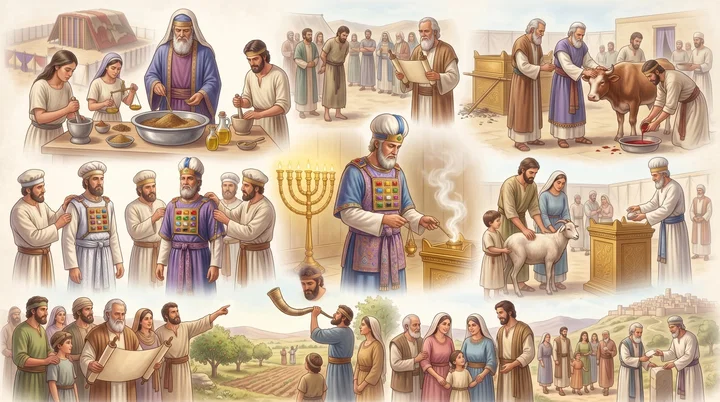
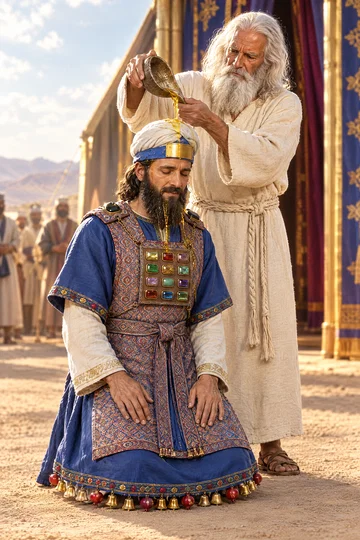
And he put upon him the coat, and girded him with the girdle, and clothed him with the robe, and put the ephod upon him, and he girded him with the curious girdle of the ephod, and bound it unto him therewith.
Translations
And he put on him the coat, and girded him with the girdle, and clothed him with the robe, and put the ephod on him, and he girded him with the curious girdle of the ephod, and bound it to him therewith.
King James Version, KJV Cambridge Paragraph Bible
And he put upon him the coat, and girded him with the girdle, and clothed him with the robe, and put the ephod upon him, and he girded him with the curious girdle of the ephod, and bound it unto him therewith.
And he put upon him the coat, and girded him with the girdle, and clothed him with the robe, and put the ephod upon him, and he girded him with the curious girdle of the ephod, and bound it to him with it.
And he put upon him the coat, and girded him with the girdle, and clothed him with the robe, and put the ephod upon him, and he girded him with the cunningly woven band of the ephod, and bound it unto him therewith.
And he put upon him the coat, and girded him with the girdle, and clothed him with the robe, and put the ephod upon him, and he girded him with the skilfully woven band of the ephod, and bound it unto him therewith.
and doth put on him the coat, and doth gird him with the girdle, and doth clothe him with the upper robe, and doth put on him the ephod, and doth gird him with the girdle of the ephod, and doth bind [it] to him with it,
And he put upon him the vest and girded him with the girdle, and clothed him with the cloak, and put the ephod on him, and he girded him with the girdle of the ephod, and fastened the ephod on him.
and put upon him the tunic and girded him with the band, and clothed him with the robe, and put upon him the ephod, and girded him with the curiously-woven band of the ephod, and bound it to him therewith;
Berean Standard Bible, Majority Standard Bible
He put the tunic on Aaron, tied the sash around him, clothed him with the robe, and put the ephod on him. He tied the woven band of the ephod around him and fastened it to him.
He put the tunic on him, tied the sash on him, clothed him with the robe, put the ephod on him, and he tied the skillfully woven band of the ephod on him and fastened it to him with it.
He put the coat on him, making it tight with its band, and then the robe, and over it the ephod, with its band of needlework to keep it in place.
And put vpon him the coate, and girded him with a girdle, and clothed him with the robe, and put the Ephod on him, which he girded with the broydred garde of the Ephod, and bounde it vnto him therewith.
Douay-Rheims (Challoner revision)
He vested the high priest with the strait linen garment, girding him with the girdle, and putting on him the violet tunick, and over it he put the ephod,
Pictures

Cross-references
- Leviticus 9
And it came to pass on the eighth day, that Moses called Aaron and his sons, and the elders of Israel;
Aaron begins priestly ministry after consecration, and the Lord’s glory appears.
- Exodus 28:1-4
And take thou unto thee Aaron thy brother, and his sons with him, from among the children of Israel, that he may minister unto me in the priest’s office, even Aaron, Nadab and Abihu, Eleazar and Ithamar, Aaron’s sons.
Aaron and his sons are appointed to priestly service and given sacred garments.
- Exodus 29
And this is the thing that thou shalt do unto them to hallow them, to minister unto me in the priest’s office: Take one young bullock, and two rams without blemish,
Both describe the consecration of Aaron and his sons for priestly ministry.
- Hebrews 8:1-5
Now of the things which we have spoken this is the sum: We have such an high priest, who is set on the right hand of the throne of the Majesty in the heavens;
Earthly priestly garments point to Christ’s heavenly ministry as High Priest.
- Hebrews 9:7
But into the second went the high priest alone once every year, not without blood, which he offered for himself, and for the errors of the people:
Aaron’s high-priestly service included entering the most holy place with blood.
- Exodus 28:41
And thou shalt put them upon Aaron thy brother, and his sons with him; and shalt anoint them, and consecrate them, and sanctify them, that they may minister unto me in the priest’s office.
Commands the anointing and consecration of the priests.
- Numbers 20:26
And strip Aaron of his garments, and put them upon Eleazar his son: and Aaron shall be gathered unto his people, and shall die there.
Aaron’s priestly garments are transferred to Eleazar.
- Hebrews 9:24
For Christ is not entered into the holy places made with hands, which are the figures of the true; but into heaven itself, now to appear in the presence of God for us:
Aaron’s priestly office represents Christ’s work as high priest.
- Leviticus 9:22-24
And Aaron lifted up his hand toward the people, and blessed them, and came down from offering of the sin offering, and the burnt offering, and peace offerings.
Fire consumes Aaron’s offering, publicly accepting the priests’ ministry.
- Hebrews 5:1-3
For every high priest taken from among men is ordained for men in things pertaining to God, that he may offer both gifts and sacrifices for sins:
Describes the priest’s work and need for consecration.
Commentary
Each commentary is drawn from primary sources: the writings of Ellen G. White and Adventist pioneers and periodicals. Each commentary is separate. Its own words are not a quotation; follow the references to read the source passages.
Ellen G. White
1 source
Leviticus 8:7 describes Aaron being clothed in the sacred garments of the high priest.PP 425.4 At Aaron's death those same vestments were removed from him by Moses and put upon Eleazar, marking Eleazar's divinely appointed succession to the office.PP 425.4 Because of Aaron's sin at Kadesh he would not continue to serve as high priest in Canaan.PP 425.4
Sources
Pioneers and periodicals
7 sources
Leviticus 8:7 belongs to one of the book's few historical narratives, the account of the consecration of Aaron and the priests, and it describes Moses clothing Aaron in the holy garments of the high priest for sanctuary service.ST Jun 27, 1911ST Jul 8, 1930RH Feb 3, 1916ST Jan 17, 1878 Aaron's consecration lasted seven days, by which he was chosen and consecrated to serve as high priest to minister between God and the people, and the clothing in verse 7 was part of that consecration before he began ministering for others.ST Jun 27, 1911ST Jul 8, 1930 The priestly garments were for glory and beauty, and the hallowing of Aaron and his garments and the consecration of Aaron and the sanctuary meant that the priest himself, what he wore, and the sanctuary were set apart for service to God.ST Jun 27, 1911ST Jan 17, 1878
This priestly service stands within the yearly sanctuary ritual whose culmination was the Day of Atonement, when the people's sins were represented and removed. The verse shows Moses setting apart the Levitical order of priesthood to minister before the ark containing the two tables of the law in the Most Holy Place of the typical sanctuary while that sanctuary should continue.RH Dec 12, 1854 That priesthood carried forward the ministration Moses began when he brought the holy law down to a sinful people, a ministration of condemnation and death that could only show guilt and exposure to the law's just penalty with no promise of pardon in itself.RH Dec 12, 1854
The sacrifices offered by that priesthood could take away no sin but could only point penitent sinners forward to the great Sacrifice to be offered for the sins of men.RH Dec 12, 1854 The sanctuary's priestly appointments were typical of Christ and his priesthood in the heavenly sanctuary.ST Nov 28, 1895 The sacrifices described in the first eight chapters of the book, and the sanctuary sacrifices and services generally, each have a symbolic connection to the work of Christ and pointed forward to Jesus Christ as the Lamb of God who takes away sin.ST Feb 13, 1912 The chapter containing the verse is included among the omitted readings recommended for study.ST Feb 13, 1912
Sources